Worksheets
Chemistry Revision V.1
Total questions: 20
Worksheet time: 10mins
Pure water boils at 100 °C.
What happens to the water particles when water boils?
They gain energy and move further apart.
They gain energy and stay close together.
They lose energy and move further apart.
They lose energy and stay close together.
Which method should be used to separate a mixture of two liquids?
crystallisation
electrolysis
filtration
fractional distillation
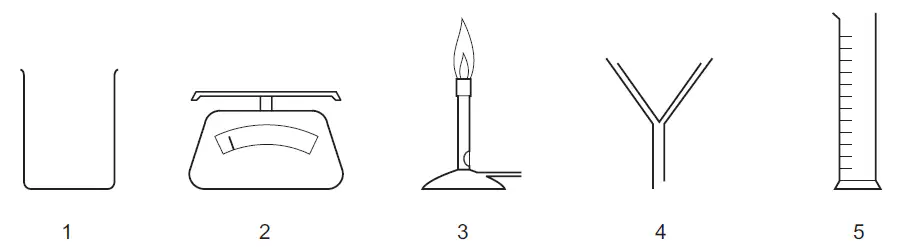
Lead(II) iodide is insoluble in water.
Lead(II) iodide is made by adding aqueous lead(II) nitrate to aqueous potassium iodide.
Which pieces of apparatus are needed to obtain solid lead(II) iodide from 20 cm^3 of aqueous
lead(II) nitrate?
1, 2, and 4
1, 3, and 5
1, 4, and 5
2, 4, and 5
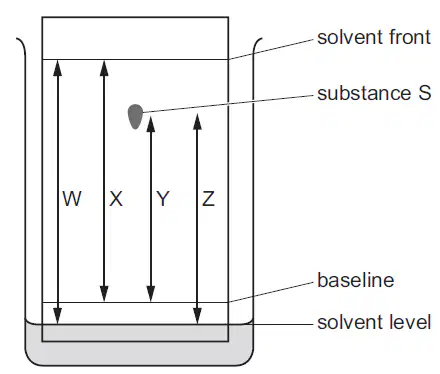
The chromatogram of substance S is shown.
Some distances, W, X, Y and Z, are labelled on the diagram. How is the Rf value of substance S calculated?
X/Y
W/Z
Y/X
Y/W
Which row describes isotopes of the same element?
number of protons: different | number of neutrons: different
number of protons: different | number of neutrons: same
number of protons: same | number of neutrons: different
number of protons: same | number of neutrons: same
Which row describes the structure of the positive ion in sodium chloride?
protons: 11 | electrons: 11 | neutrons: 12
protons: 11 | electrons: 10 | neutrons: 12
protons: 17 | electrons: 17 | neutrons: 18
protons: 17 | electrons: 18 | neutrons: 18
Which statement about copper, diamond and silicon(IV) oxide is correct?
Copper and silicon(IV) oxide have similar electrical conductivity.
In diamond the carbon atoms are covalently bonded as flat sheets.
In silicon(IV) oxide the silicon and oxygen atoms are covalently bonded as flat sheets.
The structure of copper includes a lattice of positive ions.
An oxide of nitrogen has the following composition by mass: N, 30.4%; O, 69.6%.
It has a relative molecular mass of 92.
What is the molecular formula of the oxide of nitrogen?
NO
NO2
NO4
N2O4
Calcium carbonate reacts with dilute hydrochloric acid according to the equation shown.
CaCO3 + 2HCl → CaCl2 + CO2 + H2O
10 g of calcium carbonate is reacted with 100 cm^3 of 1 mol / dm3 hydrochloric acid.
The following statements are made.
1 1.2 dm3 of carbon dioxide is formed.
2 5.6 g of calcium chloride is formed.
3 4.8 g of carbon dioxide is formed.
4 No calcium carbonate is left when the reaction is completed.
Which statements about the reaction are correct?
1 and 2
1 and 4
2 and 3
3 and 4
10 g of ammonium nitrate is added to water at 25 °C and the mixture stirred.
The ammonium nitrate dissolves and, after one minute, the temperature of the solution is 10 °C.
Which word describes this change?
endothermic
exothermic
neutralisation
reduction
Hydrogen reacts with chlorine according to the following equation.
H2(g) + Cl 2(g) → 2HCl (g)
The reaction is exothermic.
Which statement about this reaction is correct?
Energy absorbed for bond breaking is greater than the energy released in bond making.
Energy absorbed for bond breaking is less than the energy released in bond making.
Energy released in bond breaking is greater than the energy absorbed in bond making.
Energy released in bond breaking is less than the energy absorbed in bond making.

Hydrogen-oxygen fuel cells can be used to power cars. Platinum is used as a catalyst.
The amount of energy produced per gram is shown for three fuels. Which statement is correct and is an advantage of a hydrogen-oxygen fuel cell?
Hydrogen is difficult to store.
Hydrogen produces less energy per gram than methane or petrol.
Platinum is rare and expensive.
The only product is water.
A student adds dilute hydrochloric acid at two different temperatures to two different lumps of
limestone. The lumps of limestone have the same mass.
The carbon dioxide gas produced is collected in a gas syringe.
The volume of carbon dioxide collected in 1 minute at each temperature is shown. Which describes and explains the results obtained at 50 °C compared with 25 °C?
reaction rate: higher | energy of collision: lower
reaction rate: higher | energy of collision: higher
reaction rate: lower | energy of collision: lower
reaction rate: lower | energy of collision: higher
The formula of methane is CH4 and the formula of ethane is C2H6.
Which row describes diffusion and the relative rates of diffusion of methane and ethane?
description of diffusion: particles move from
a high concentration
to a low concentration | relative rate of diffusion: ethane diffuses more
quickly than methane
description of diffusion: particles move from
a high concentration
to a low concentration | relative rate of diffusion: methane diffuses more
quickly than ethane
description of diffusion: particles move from
a low concentration
to a high concentration | relative rate of diffusion: ethane diffuses more
quickly than methane
description of diffusion: particles move from
a low concentration
to a high concentration | relative rate of diffusion: methane diffuses more
quickly than ethane
Which test is used to show that a sample of water is pure?
Evaporate the water to see if any solids remain.
Heat the water to check its boiling point.
Test with anhydrous cobalt(II) chloride.
Use universal indicator paper to check its pH.

Which row about a change of state is correct?
A
B
C
D

Gases are separated from liquid air by fractional distillation.
The boiling points of four gases are shown.
Which gas is both monoatomic and a liquid at –200 C?
A
B
C
D
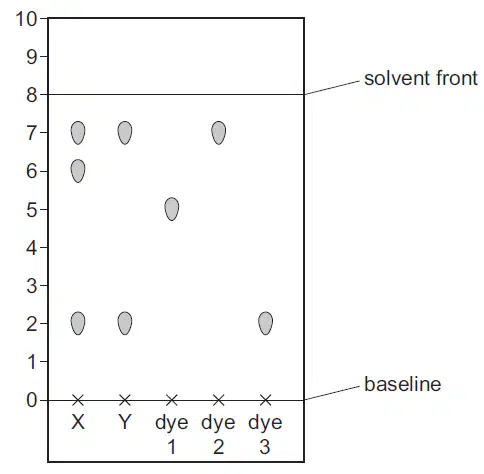
Two different food colourings, X and Y, are tested using chromatography.
Three pure dyes, 1, 2 and 3, are also tested.
The chromatogram is shown. Which statements are correct?
1 X and Y both contain two or more dyes.
2 Dyes 2 and 3 are present in both X and Y.
3 The Rf of dye 1 is 0.625.
1 and 2 only
1 and 3 only
1, 2, and 3
2 and 3 only
Which statement about the atoms of all the isotopes of carbon is correct?
They are all radioactive.
They have the same mass.
They have the same number of neutrons.
They have the same number of electrons in the outer shell.
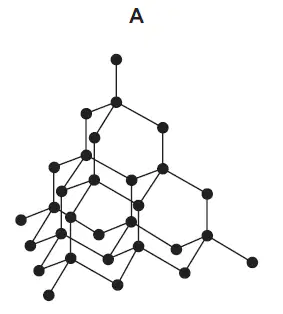
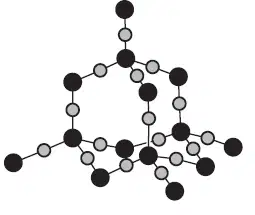
Which diagram represents the structure of silicon(IV) oxide?