
NEW
Font size
 Worksheets
Final Review
Total questions: 60
Worksheet time: 3600secs

Which phases of mitosis is picture A?
Prophase
Metaphase
Anaphase
Telophase
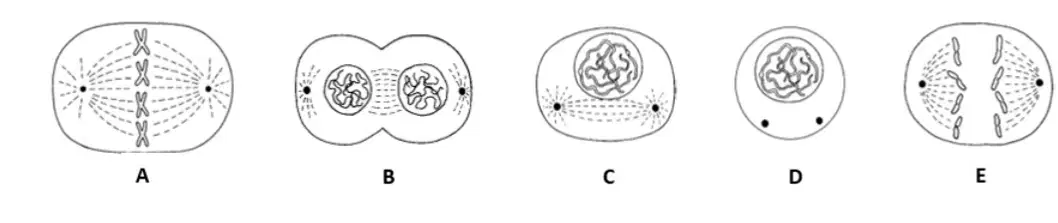
What phase of mitosis would be seen just after picture A?
Picture B
Picture C
Picture D
Picture E

Which picture would be seen just before cytokinesis?
Picture A
Picture B
Picture D
Picture E
During which phase of the cell cycle is deoxyribonucleic acid (DNA) replicated?
Gap 1 (G1)
Synthesis (S)
Gap 2 (G2)
Mitosis
When a bacterium undergoes the process of binary fission, what kind of reproduction is it?
Asexual
Sexual
Meiosis
Mitosis
Why do daughter cells have properties like the parent cell after cell division?
Chromosomes have changed structure
Proteins are denatured when a cell divides
Enzymes control cell division
DNA is replicated before cell division
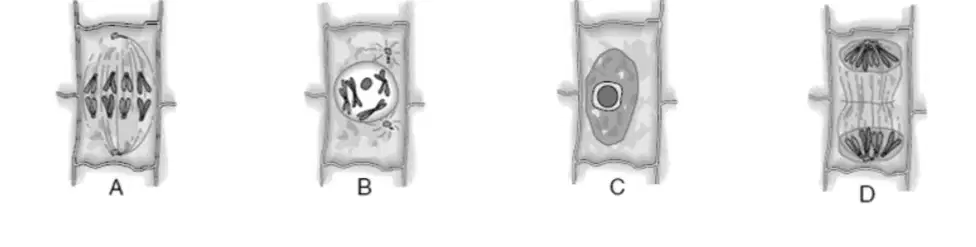
Use the following pictures to answer this question: What is the correct sequence for plant cell mitosis?
A. A-B-D-C
B. C-B-A-D
C. B-A-D-C
D. D-C-B-A
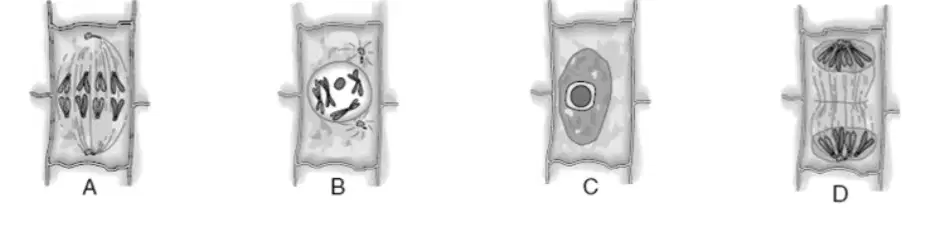
Use the following pictures to answer this question: What is happening in picture D?
A. A cleavage furrow is forming from a contracting ring of microfilaments, interacting with myosin.
B. A cell plate is forming on the equator and growing outward to the edges of the cell creating a new plasma membrane and cell wall for the daughter cells.
C. A cleavage furrow is forming on the equator and growing outward to the edges of the cell creating a new plasma membrane and cell wall for the daughter cells.
D. A cell plate is forming from a contracting ring of microfilaments, interacting with myosin.
How many chromosomes are in a human’s somatic cells?
A. 46
B. 92
C. 23
D. 1
Mrs. Henrietta Lack’s cells were the first immortal cell line, called HeLa, that came from the ______ cells of her cervix in 1951. Today, using Mrs. Lack’s cells in research without her consent would be a violation of ______.
cancer: bioingormatics
stem; bioinformatics
cancer;bioethics
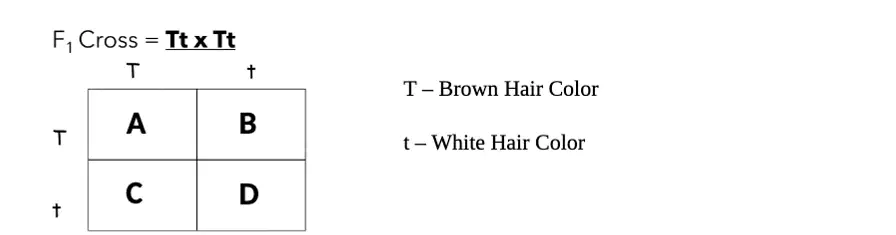
Use the following diagram for questions 14-16. The diagram represents a Punnett square for F1 Cross = Tt x Tt, where T represents Brown Hair Color and t represents White Hair Color. Which generation is represented inside the Punnett square?
A. P1 generation
B. P2 generation
C. F1 generation
D. F2 generation
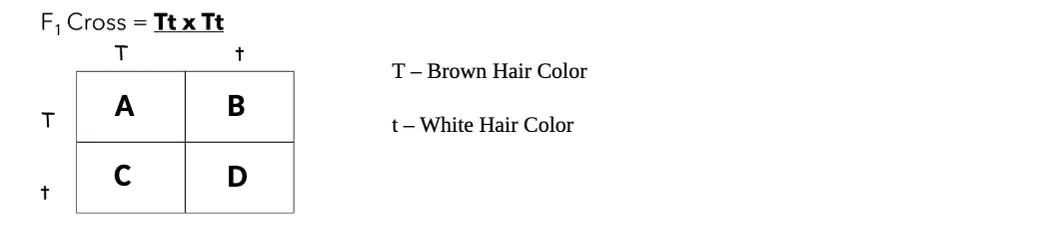
Use the following diagram. The diagram represents a Punnett square for F1 Cross = Tt x Tt, where T represents Brown Hair Color and t represents White Hair Color. What is the genotype for square B?
A. Purebred
B. Hybrid
C. Homozygous Dominant
D. Homozygous Recessive

Use the following diagram for questions 14-16. The diagram represents a Punnett square for F1 Cross = Tt x Tt, where T represents Brown Hair Color and t represents White Hair Color. What alleles should be found in box D?
A. TT
B. Tt
C. tT
D. tt
When is a dihybrid cross used in a study?
A. To review the alleles of one trait
B. To compare two traits
C. Dihybrid crosses are not used in studies
D. To compare the alleles of three traits
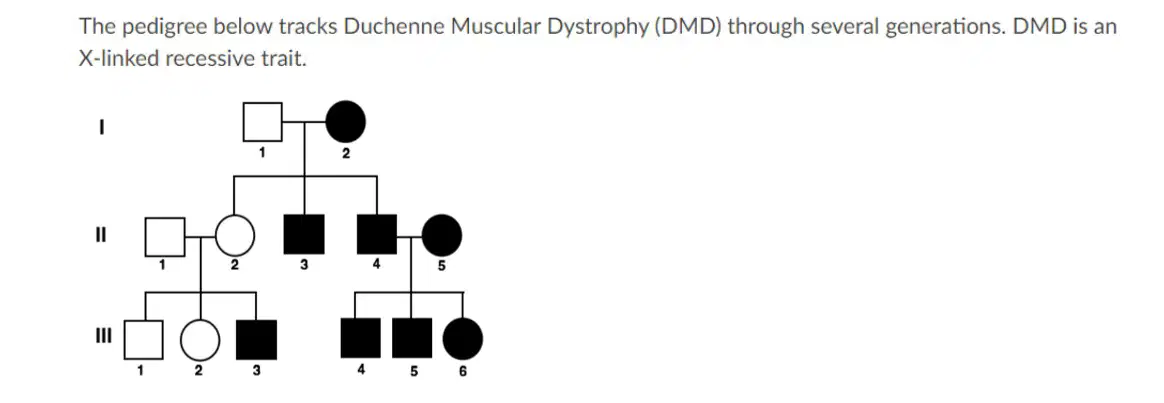
Use the following diagram for question 18. The pedigree below tracks Duchenne Muscular Dystrophy (DMD) through several generations. DMD is an X-linked recessive trait. Based on the pedigree which of the following is true?
A. Individual II-4 is an unaffected female
B. Individual II-3 is an affected female
C. Individual III-1 is an unaffected male
D. Individual III-2 is an affected male
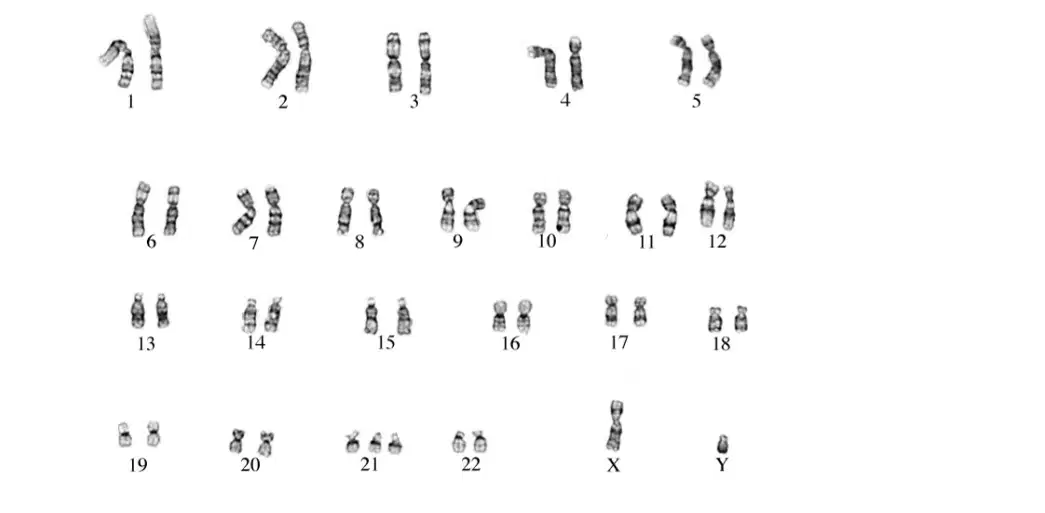
Based on the karyotype shown, which of the following is true?
The karyotype shows a male with trisomy 21.
The karyotype shows a female with monosomy X.
The karyotype shows the chromosomes of a normal male.
The karyotype shows the chromosomes of a normal female.
Mitosis is to somatic cells and meiosis is to _______.
animal cells
plant cells
stem cells
In 1928, Dr. Frederick Griffith studied streptococcus pneumoniae bacteria and he observed that R-strained bacteria had been changed by the heat-killed S-strained bacteria by _______.
mitosis
bacteria
amino acids
Oswald Avery used enzymes to prove that _______.
Proteins are the transformative agent
lipids are the transformative agent
DNA is the transformative agent
RNA is the transformative agent
How did Rosalind Franklin contribute to the understanding of DNA?
She produced images of DNA molecules using x-rays crystallography.
She built a model that showed DNA strands form a double helix.
She conducted experiments that showed nucleotides are complimentary.
She found that DNA was a nucleic acid made up of a long chain of nucleotides.
According to Chargaff’s rule, the amount of thymine in a DNA molecule is __________.
about equal to the amount of guanine
about equal to the amout of adenine
far greater than the amount of cytosine
far greater than the amount of guanine
Watson and Crick discovered that the two strands in DNA
run in perpendicular directions.
run in the same direction.
run in opposite directions.
run in random directions.

Which structure is the enzyme DNA polymerase?
Structure A
Structure C
Structure D
Structures A & C

What is the purpose of Structure D?
To stabilize the single DNA strands
To unzip the DNA strands
To synthesize the com[limentary strand
To connect Okazaki fragments
What makes this process of DNA replication semiconservative?
The two parent strands will reconnect together, and the two new strands will connect.
Half of the original DNA is maintained in each new daughter DNA strand.
Half of the ATP energy used for this process is conserved and reused to connect the complementary strands.
DNA replication is not a semiconservative process.
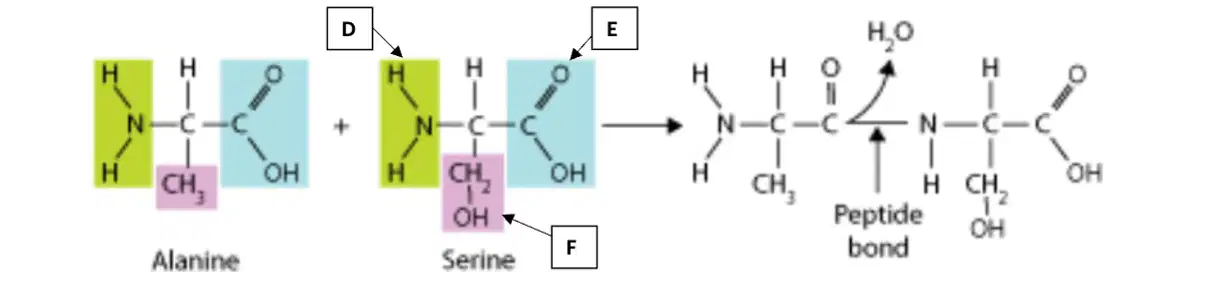
Which of the structures identified above is the amino group?
Structure D
Structure E
Structure F
Molecule has no amino group.
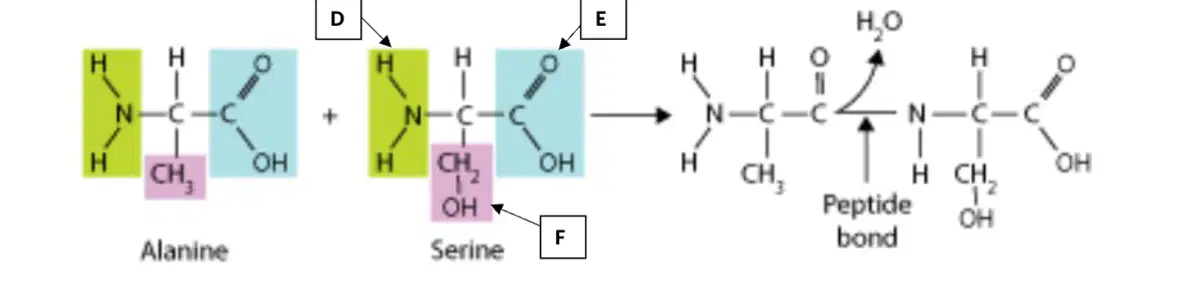
How was the peptide bond between the amino acids, Alanine and Serine, formed?
Dehydration synthesis
Hydrolysis
ATP Synthase
Peptidolysis
What is the order of protein synthesis?
Transcription -> Translation -> Protein
Translation -> Transcription -> Protein
Protein -> Transcription -> Translation
Translation -> Protein -> Transcription

What is the correct amino acid sequence for the mRNA code UACGGUCACUGA?
Tyrosine – Glycine – Histidine – (Stop)
Tyrosine – Glycine – Arginine - Histidine
Methionine – Proline – Alanine – Valine
Methionine – Proline – Valine – (Stop)

What is the "dangerous point of overuse" referred to in the passage above?
Antibiotics are not available in America.
Antibiotic resistance because of antibiotic overuse.
Vaccines are not available in America.
Viral resistance because of vaccine overuse.
When should antibiotics be prescribed by a doctor?
For a viral infection.
For a migraine headache.
For a bacterial infection.
For a common cold.
Cri du chat is a disorder that is the result of chromosome 5's p-arm missing a portion of its DNA due to _______.
translocation
deletion
insertion
inversion
The lac operon consists of all the following EXCEPT for the _______.
operator
promoter
regulatory gene
genes: lac Z, lac Y, lac A
In the trp operon model, the genes within the operon will be expressed if _______.
lactose is absent.
tryptophan is present.
lactose is present.
tryptophan is absent.
The main purpose of the Human Genome Project was to _______.
identify the unique parts of each person’s DNA
determine the genes responsible for human disease.
identify genes responsible for human behavior.
determine the entire sequence of human DNA.
A new variety of rice called golden rice has been genetically modified to contain vitamin A. People in starving countries can eat this rice and receive the vitamin A so they would not go blind from low vitamin A. Which word below best describes this rice?
restriction enzyme
DNA fingerprinting
genetically modified organism
clone
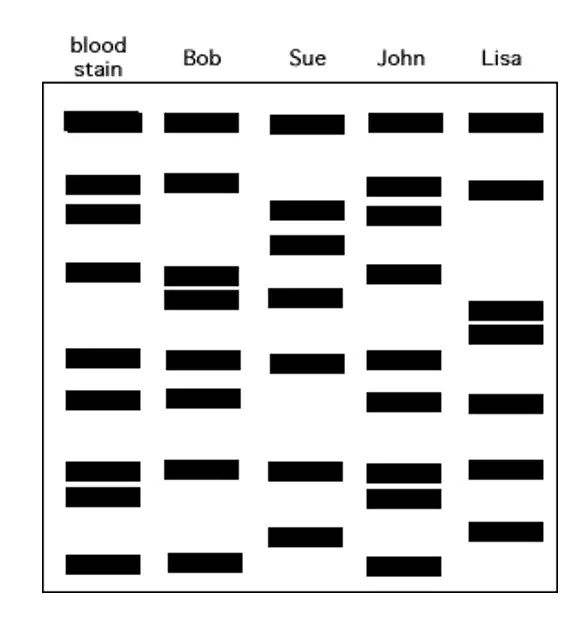
Four suspects were accused of being present at the scene of a crime. A sample of blood was taken from under the nails of the victim. According to gel electrophoresis results, which suspect was present at the scene of the crime?
Bob
Sue
John
Lisa
Cladograms are constructed by grouping together organisms based on their ______ characteristics.
shared
different
contrasting
opposite
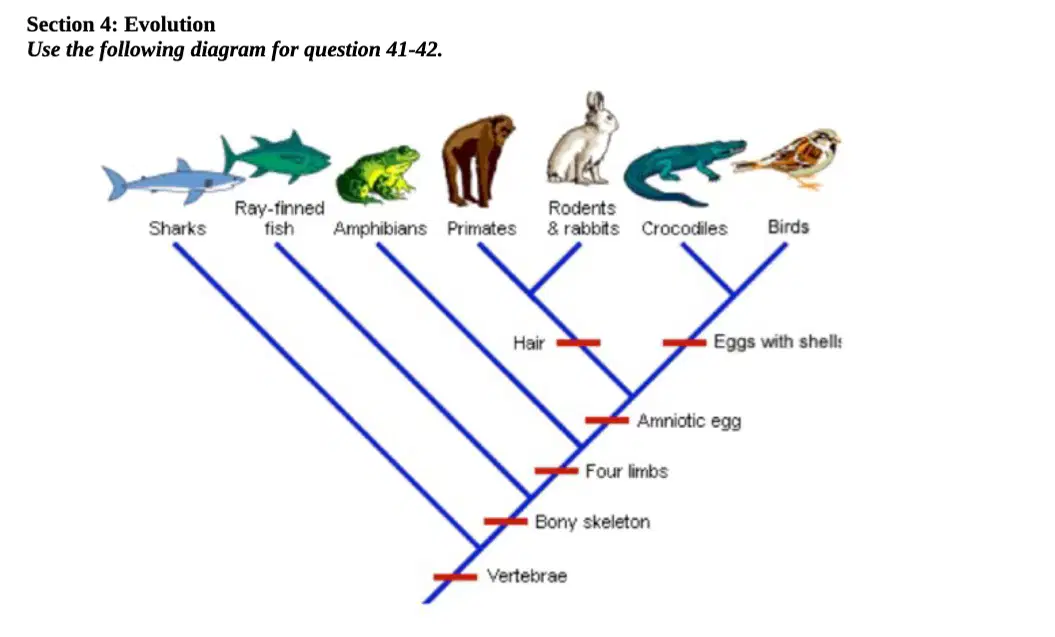
On the cladogram above, which animals have hair?
Primates, rodents, and rabbits.
Crocodiles
Birds
Amphibians
The process of the evolution of a new species happens mainly because of natural selection. This is when a mutation in the gene causes a change in the physical characteristics that allows better survival; therefore, that physical characteristic is carried on to the next generations. New species can emerge only if there is a change in the ______.
surrounding environment
reduction of variation in a population
gene pool
migration of the population
The process of the evolution of a new species happens mainly because of natural selection. This is when a mutation in the gene causes a change in the physical characteristics that allows better survival; therefore, that physical characteristic is carried on to the next generations. A change in a population can occur when organisms with favorable physical changes for a particular environment survive and pass these traits on to the next generation. This is called ______.
Natural Selection
Punctuated Selection
Variation and Adaptation
Acquired Characteristics
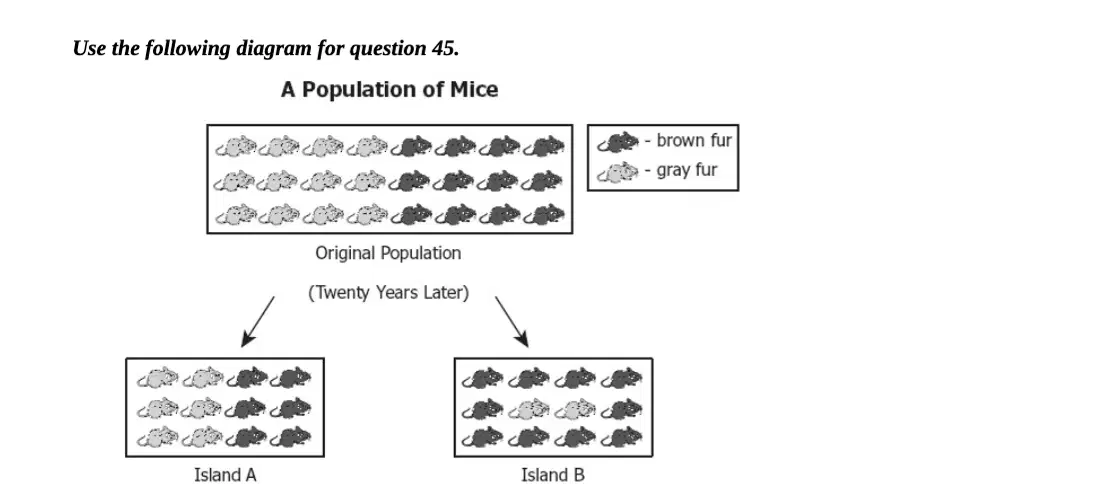
Use the following diagram for this question: A population of mice is evenly divided into two groups, and each group is placed on an isolated island with no existing mouse population. Which statement best explains the difference in the mouse populations on Island A and Island B at the end of the 20 years?
On Island A, the allele for gray fur was dominant.
Brown fur mice survive better on Island B.
Brown fur mice survive better on Island A.
The recapturing of mice on Island A and Island B was done differently.
When a group of foxes move to a new environment, which change is LEAST likely to be a selective pressure on the foxes?
Temperature
Food Sources
Decomposers
Predator populations
The science of classifying and naming living organisms is ___.
biotechnology
anatomy
evolution
What is the advantage of using a binomial system to name species?
Each name has one part rather than two.
It lets scientists accurately identify individual species.
It uses Latin words.
It uses common names of animals.
Which of the following options lists the taxonomic categories in the correct order from most inclusive to least inclusive?
genus, family,class,order, phylum
family, genus, class, order, phylum
class, order, family, genus, species
genus, family, order, class, phylum
Based on the introduction of predators into the habitat of certain ground-dwelling brown anoles, which of the following is the best prediction for what will happen over time to the populations of ground-dwelling brown anoles in areas where predators were introduced?
Over many generations, the ground-dwelling anoles will likely develop shorter legs as they adapt to living higher in trees.
Brown anoles that remain on the ground will likely produce more offspring in each generation than anoles that move higher in trees.
Within two or three generations, the anoles will likely become extinct due to predation.
The anole populations will likely develop longer legs over many generations as they adapt to jumping higher up in trees.
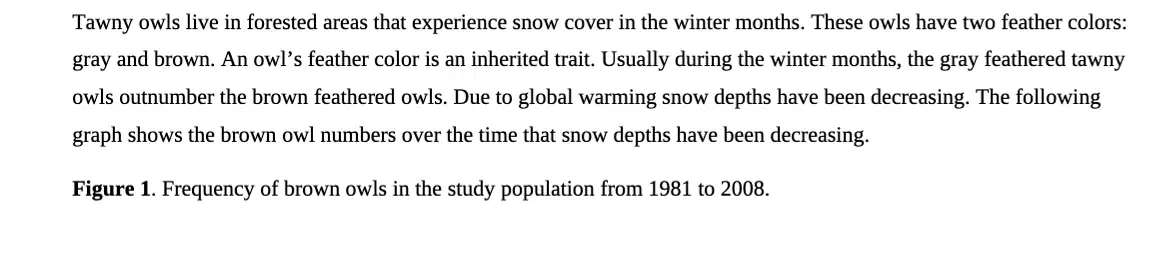
Considering the decrease in snow depth over time, which of the following statements about tawny owl evolution is true?
Gray owls were better able to survive and reproduce.
Gray owls had the color adaptation allowing them to blend in.
Brown owls were better able to blend in, survive, and reproduce.
Brown owl predators could see them better.
One biome is different from another by its types and amounts of __________.
soil, water, buildings, and humans
carbon dioxide, oxygen, water, and soil
animals, oxygen, plant life, and pollution
sunlight, rainfall, temperature, and species types
What term is given by scientists to an organism that eats mice, frogs, turtles, and deer?
Herbivore
Omnivore
Carnivore
Detrivore
Average temperature and rainfall are examples of __________.
Biotic Factors
Abiotic Factors
Community
Population
A population is __________.
all individuals of a species along with abiotic factors
a group of individuals of the same species that live in the same area
a group of individuals of a species plus all other species with which they interact
a group of individuals of different species living in the same place at the same time
If 10,000 kcal (kilocalories) is available from foods at the producer level of an energy pyramid, how much is available for the quaternary consumer?
10,000 kcal
100 kcal
1 kcal
1000 kcal
Use the following passage for question. In urban areas, water can contain high levels of phosphorus due to use of agents such as fertilizers. What is a possible negative effect of excess phosphorus in the water?
A decrease in algae blooms.
High rates of transcription.
Higher rates of dead fish.
An increase in aquatic life.
The phosphorus cycle supplies a limited resource that is mainly stored in __________.
macromolecules
rock
fertilizer
water
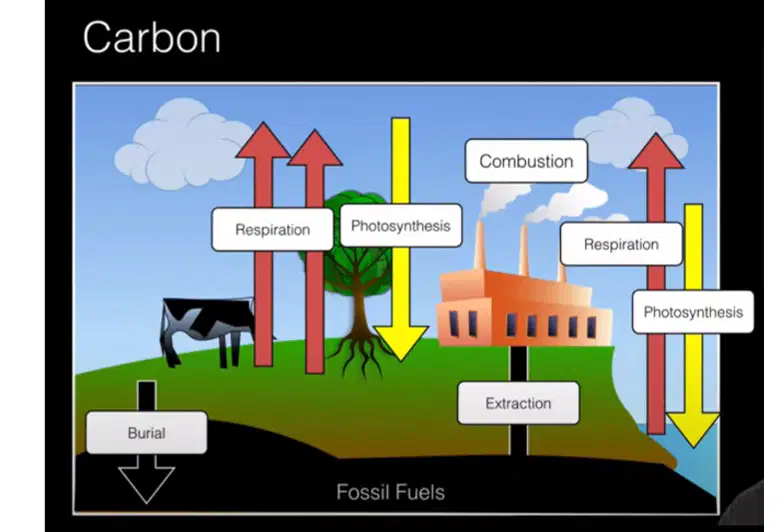
Use the following passage for this question. Carbon mainly cycles between the biotic and abiotic factors through the processes of __________.
cellular respiration and photosynthesis
evaporation and photosynthesis
transpiration and photosynthesis
cellular respiration and transpiration
The carbon reservoir most affected, as a direct result of human activity, is the __________.
deep ocean
plant vegetation
photosynthetic process
earth’s atmosphere
Who is the father of genetics?
Charles Darwin
Jean Baptist Lamarck
Gregor Mendel
Reginald Crundall Punnett
What is the passing of traits from parents to offspring?
Heredity
Taxonomy
Genetics
Biochemistry
Which of the following laws states that alleles can seperate during the formation of reproductive cells?
Law if Independent Assortment
Law of Dominance
Law of Segregation
Law of Recession

