wayground logo

Free Printable Worksheets

NEW

Font size

S
M
L
XL
Worksheets

DNA and Protein Synthesis

Total questions: 55

Worksheet time: 45mins

Name
Class
Date
1.

Which of the following is not a component of DNA?

a)

Deoxyribose Sugar

b)

Phosphate Group

c)

Carbon Base

d)

Nitrogen Base

2.
Which of the following is not a nitrogen base found in DNA?
a)
Thymine
b)
Uracil 
c)
Guanine
d)
Adenine
3.

According to the Base Pair rule, Cytosine always pairs with

a)

Adenine

b)

Uracil

c)

Thymine

d)

Guanine

4.
What is the significance of the sequence (order) of the Nitrogen Bases in DNA?
a)
The order of the Nitrogen Bases determines the number of chromosomes present in an organism.
b)
The order of the Nitrogen Bases determines the traits that an organism will possess (have).
c)
The order of the Nitrogen Bases determines the gender of an organism.
d)
The order of the Nitrogen Bases determines whether an organism is abiotic biotic.
5.

The twisted ladder shape of DNA is known as a

a)

Double Helix

b)

Triple Helix

c)

Single Helix

d)

Double felix

6.
Assume that you have straight hair and your sibling has curly hair. What accounts for this difference?
a)
You have DNA and your sibling does not.
b)
The your sequence of nitrogen bases is different than your sibling.
c)
Your sibling has a weave. 
d)
Your sibling has a genetic mutation. 
7.
The genetic material in cells is called......
a)
RNA
b)
Gene
c)
DNA
d)
Neuclotide
8.
What will the matching sequence be on a strand that reads AAGCTAT?
a)
AACGATA
b)
TTCGTTA
c)
CCTGATA
d)
TTCGATA
9.
Adenine bonds with ______________.
a)
Guanine
b)
Thymine
c)
Cytosine
d)
Adenine
10.
What are the 4 nitrogen bases?
a)
adenine, thymine, cytoplasm, and guanine
b)
adenine, thymine cytosine, and guanine
c)
adenine, thymine, cytosine, and gylcerol
d)
adenine, thymine, cytosine, and glucose
11.
Name this structure
a)
double helix
b)
nucelotide
c)
amino acid
d)
protein
12.
Which 2 molecules forms the sides (backbone) of the DNA ladder?
a)
ribose (sugar) and nitrogen bases
b)
ribose (sugar) and phosphate
c)
deoxyribose (sugar) and nitrogen bases
d)
deoxyribose (sugar) and phosphate
13.
Which organelle is DNA usually found in?
a)
mitochondrian
b)
cell membrane
c)
chloroplast
d)
nucleus
14.
Which shows the correct complementary base pairing for DNA?
a)
C-A, T-G
b)
A-G, C-T
c)
C-G, U-A
d)
T-A, G-C
15.
DNA codes for...
a)
bases
b)
proteins
c)
amino acids
d)
phosphates
16.
What does DNA stand for?
a)
deoxyribonucleic acid
b)
ribonucleic acid
17.
Which of the following units are repeatedly joined together to form a strand of DNA?
a)
amino acids
b)
nucleotides
c)
fatty acids
d)
polysaccharides
18.
The enzyme that unzips the DNA to prepare for replication
a)
helicase
b)
replicase
c)
polymerase
d)
synthase
19.
DNA replication results in two DNA molecules,
a)
each one with two original strands
b)
each one with two new strands
c)
each one with one new strand and one original strand
d)
one with two new strands and the other with two original strands
20.
A process in which DNA has the unique ability to make an exact copy of itself.
a)
Replication
b)
Translation
c)
Transcription
21.
In RNA, Uracil pairs with ______. 
a)
cytosine
b)
adenine
c)
guanine
d)
thymine
22.
The process to go from DNA to mRNA is _______
a)
translation
b)
transcription
c)
replication
23.
The process to go from mRNA to a protein is called ____
a)
transcription
b)
rRNA
c)
replication
d)
translation
24.
Choose the nucleotide sequence of the RNA strand that would be complementary to the following strand: 
GTAGTCA
a)
UATUAGA
b)
ACGACTG
c)
CAUCAGU
d)
CATCAGT
25.
The main function of tRNA is to...
a)
carry a message that, when translated, forms proteins
b)
form a portion of ribosomes
c)
string together complementary RNA and DNA strands
d)
bring amino acids from the cytoplasm to the ribosomes
26.
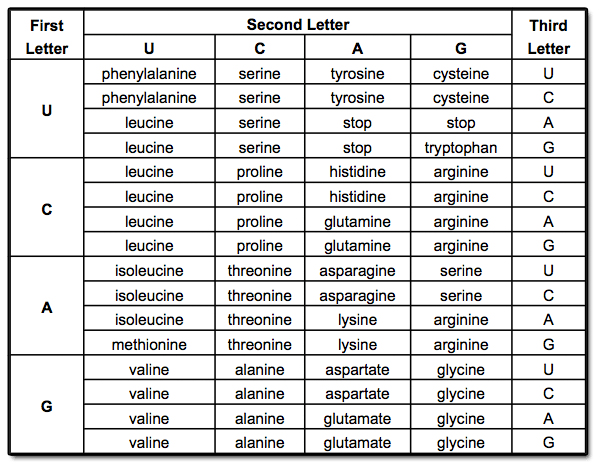
What amino acid is represented by the codon UUA?
a)
Phenylalanine
b)
Tyrosine
c)
Leucine
d)
Stop codon
27.
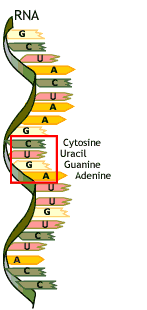
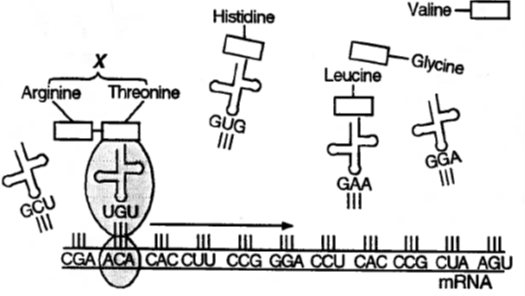
What process is going on in this photo? 
a)
Transcription 
b)
Translation 
c)
Replication 
d)
All the above 
28.
What is the location in the cell for translation?
a)
nucleus
b)
mitochondria
c)
ribosome
d)
chloroplast
29.
What is the three base sequence of mRNA that codes for a single amino acid?
a)
Anticodon
b)
Codon
c)
Protein
30.
What is the location in the cell for transcription?
a)
nucleus
b)
cytoplasm
c)
ribosome
d)
mitochondria
31.
Which is the mRNA molecule that would be transcribed from this DNA template:
TGGCAAGTACGT
a)
ACCGTTCATGCA
b)
UGGCAAGUACGU
c)
UCCGUUCUUGCU
d)
ACCGUUCAUGCA
32.
Does the order of amino acids in a protein matter?
a)
YES!
b)
NO!
33.
How many amino acids are coded for by this sequence of nucleotides:
ATG GGA ACT CCA
a)
4
b)
2
c)
6
d)
12
34.

What is the shape of RNA?

a)

Double helix

b)

Triple hexagon

c)

Single Helix

d)

Quad bases

35.

How are amino acids held together?

a)

By the centromere

b)

By the peptide bond

c)

By the metaphase plate

d)

By the nucleus

36.

What sugar does RNA contain?

a)

phosphate

b)

ribose

c)

fatty acid

d)

Sugra

37.

What does RNA stand for?

a)

Ribosenucleic Acid

b)

Ribonucleic Acid

c)

Ribonose Acid

d)

Riba Nuke Leic Acid

38.

Which of the following serves as a template for the production of RNA?

a)

DNA

b)

ATP

c)

protein

d)

carbohydrates

39.

How many nitrogen bases code for one amino acid?

a)

1

b)

2

c)

3

d)

4

40.

Which of the following is correctly matched with its function?

a)

rRNA-contains codes to make new ribosomes

b)

DNA-caries the animo acids to the ribosome

c)

tRNA-combines with pritein to make up ribosomes

d)

mRNA-carries genetic codes from the nucleus to the ribosomes
41.
In what way is the DNA of a nerve cell different from the DNA of a muscle cell?
a)
The DNA is the same but each cell contains different genes
b)
The DNA is the same but different genes are turned on in each cell
c)
Each cell has its own unique DNA
d)
The DNA is different, but each cell contains the same genes
42.
What is cell specialization or differentiation?
a)
The process where unspecialized cells become different in structure and function.
b)
When DNA controls the cell cycle.
c)
The ability of cells to make more cells.
d)
The ability of cells to maintain homeostasis.
43.
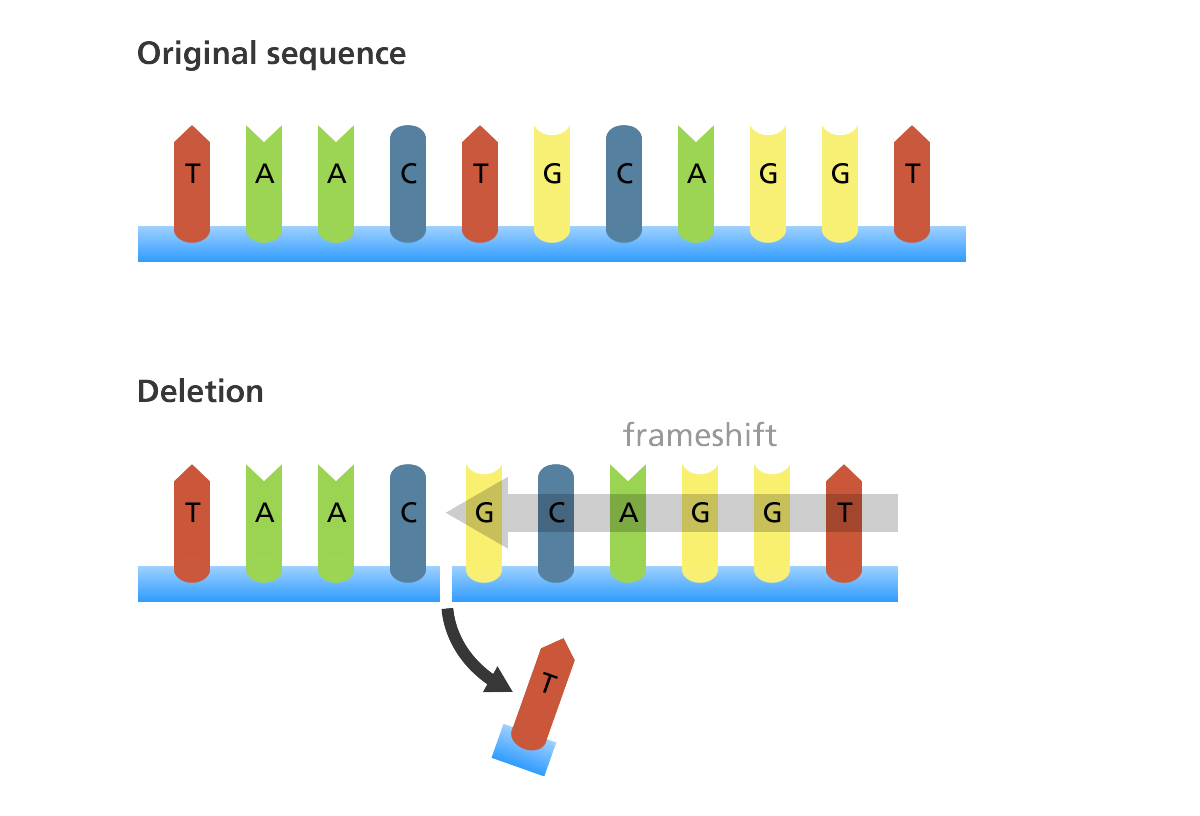
Why are insertion and deletion mutations so harmful?
a)
They change all of the codons from the mutation on down the line, which changes the amino acid sequence
b)
They insert things that an organism doesn't need.
c)
They often delete things that organisms need.
d)
Insertion and deletions are not any more harmful than substitution mutations.
44.
Identify the SUBSTITUTION mutation from the following DNA sequence: 
ATG CCA AAT
a)
ATG TCA AAT
b)
ATG CCT AAA T
c)
ATC CA  AT
d)
ATG CCA AAT
45.
How can a person's muscle cells have the same exact DNA sequences as their nerve cells even though the look and perform completely different?
a)
The two different cells become mutated
b)
The proteins expressed in each cell are different
c)
They actually have different DNA in the two types of cells.
d)
The genome of the different cells changes
46.
What is a Gene?
a)
A segment of RNA that encodes for a protein
b)
A chromosome
c)
A segment of DNA that encodes for a protein
d)
Your genome
47.
Any change in the sequence of DNA is...
a)
transgenic shift
b)
Single Genotype
c)
Monohybrid Trait
d)
Mutation
48.
What mutation has occurred here? 
T-G-A-C-C-A
T-G-A-G-C-A
a)

Point

b)

Deletion

c)

Insertion

d)

Frameshift 

49.
Which of the following would result in a frameshift mutation?
a)
Insertions only
b)
Substitution only
c)
Deletion only
d)
Insertions and Deletions
50.
Why is the order of amino acids so important?
a)
The order of amino acids dictates what shape the protein will fold into.
b)
It is not important. The protein folding chamber will force the protein to fold into the correct shape.
51.

Mutations are

a)

natural processes that provide genetic diversity

b)

natural processes that always affect the phenotype

c)

unnatural processes that always affect the phenotype

d)

unnatural processes that are harmful to genetic diversity

52.

A mutation can be passed on to an offspring in which of the following cells

a)

blood

b)

egg

c)

muscle

d)

nerve

53.

Which of the following is the primary link between a gene and the expression of that gene?

a)

sugars

b)

lipids

c)

vitamins

d)

proteins

54.

You can look at a ___________________ to determine the number of chromosomes a human has

a)

pedigree chart

b)

genotype

c)

karyotype

d)

punnet squares

55.

In some kinds of corn, the kernels turn red when exposed to sunlight. Based on this information, it can be concluded that the color of these corn kernels is due to

a)

different type of DNA produced when sunlight is present

b)

different species of corn is produced in sunlight

c)

effect of sunlight on the number of chromosomes inherited

d)

effect of environment on gene expression