
Font size
 Worksheets
Science Year End Review
Total questions: 110
Worksheet time: 1hrs 18mins
Both El Nino and La Nina have this in common
Influence birds that migrate over the ocean
Influence rainy / dry weather world wide
The weather at the polar regions
The directions that ships travel in the oceans
During an El Nino, it rains
in the central Pacific
in the FAR western Pacific
in the western Pacific
In all of the Pacific

The image is of a(n):
El Nino event
La Nina event
Non-El Nino (normal conditions)

The picture represents a(n) ___ event.
El Nino
La Nina
Non-El Nino (normal conditions)
Which best describes El Nino?
The water in the Pacific Ocean gets warmer than normal and causes fewer hurricanes to form
The water in the Pacific Ocean gets colder than normal and causes more hurricanes to form.
The water in the Pacific Ocean gets colder than normal, and the flow of the jet stream is disrupted
The water in the Pacific Ocean gets warmer than normal, and the flow of the jet stream is disrupted.
An increase in what type of weather during El Nino years can occur on the California coast?
drought
tornadoes
flooding
Clear, fair weather
How could La Niña affect weather during the summer in North Carolina?
It could decrease wind.
It could increase rainfall.
It could decrease rainfall.
Which lists some effects of El Niño?
warmer temperatures and more rain
warmer temperatures and less rain
cooler temperatures and less rain

The diagram above shows a weather map. Which city is MOST likely to experience the cold front first?
Athens
Dayton
Marietta
Steubenville

A narrow band of fast moving winds high in the atmosphere that move from west to east
Jet Stream
doldrums
equator
polar easterlies

Which best explains what type of weather the Gulf Stream usually brings
to North Carolina?
increased wind speed
increased air pressure
increased temperature
increased evaporation
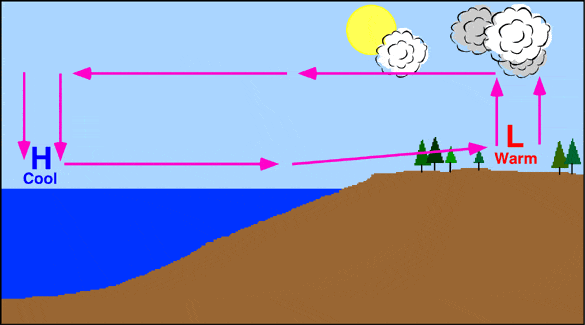

Air moves from _______ pressure to ________ pressure.
high to low
low to high
high to high
low to low

What will most likely result when the jet stream moves south of North
Carolina?
North Carolina will experience tropical weather conditions.
North Carolina will experience hot, dry weather.
North Carolina will experience mild weather.
North Carolina will experience cold weather.
Which direction do jet streams generally blow?
North to South
South to North
East to West
West to East
Where do jet stream form?
Close to the ground.
High in the atmosphere.
Only over the ocean?
Under the water.
The Gulf Stream current
cools the air where it travels
cools the land where it travels
is warmed by the air
warms the the air where it travels
What is the main cause of global convection currents?
The increase in the number of cities
Deforestation
The greenhouse effect
Uneven heating of the Earth by the Sun
Which of the following best explains how energy is transferred from the Sun to Earth?
Density currents
Red shifts
Molecular collisions
Electromagnetic waves
Which weather system is characterized by a whirling mass of warm, moist air that generally brings stormy weather?
Warm Pressure System
Warm Front System
Cold Front System
Low Pressure System
Which weather system is characterized by a whirling mass of warm, moist air that generally brings stormy weather?
Warm Pressure System
Warm Front System
Cold Front System
Low Pressure System

Use the Fronts and Pressure Systems Map and Chart to decide what kind of weather system is moving into the Pacific Northwest.
Warm Front
Occluded Front
Stationary Front
Cold Front

Identify the direction the low pressure system is moving across the state of Texas.
southeast to northwest
southwest to northeast
northeast to southwest
northwest to southeast
What is one condition that is necessary for a hurricane to form?
A strong warm front
A strong cold front
Cold ocean water
Warm ocean water


Warm water current off the east coast of the USA that circulates up from the equator to the North Atlantic
California current
spring tide
low tide
Gulf Stream Current
The Sun warms your skin on a cold day.
Conduction
Convection
Radiation
Macaroni rises and falls in a pot of heated water.
Conduction
Convection
Radiation
You burn your hand by touching a hot stove.
Conduction
Convection
Radiation
Warming your feet in front of a fire.
Conduction
Convection
Radiation
Hot air balloon rises.
Conduction
Convection
Radiation
The air near the ceiling in a room is warmer than the air near the floor.
Conduction
Convection
Radiation
The material in a lava lamp rises and falls.
Conduction
Convection
Radiation
The sidewalk increases in temperature on a sunny day.
Conduction
Convection
Radiation
The sidewalk burns your bare feet in the summertime.
Conduction
Convection
Radiation
A push or pull exerted on a object
Net force
Force
Inertia
two forces acting in opposite directions on an object, and equal in size
Friction
F=ma
Balanced Force
Friction
the action of one surface or object rubbing against another
Force
F=ma
Friction
an object will remain at rest or in uniform motion in a straight line unless acted upon by an external force
Newtons 1st law
Newtons 3rd law
Newtons 2nd law
A force is a push or a pull that acts upon an object as a results of its interaction with another object
Newtons 1st law
Newtons 3rd law
Newtons 2nd law
the action or process of moving or being moved
Motion
Force
Inertia
The faster the car I am in is moving, ______________
The slower I am moving
The faster I am moving
I would not be moving
I will stay at the same speed
Which one of Newtons laws does this equation belong to. F=m*a
1st law
2nd law
3rd law
4th law

Which one of Newton's laws is shown
3rd law
2nd law
1st law

What does this picture represent
Force,magnetism,acceleration
Force, money, Apples
Force, Mass, Acceleration
Funny, monkeys, Arrive

Which one of Newton's laws are displayed
2nd law
1st law
3rd law

Which of Newton's laws is shown
1st law
3rd law
2nd law

This is Newton's 3rd law
True
False
An object in motion will stay in motion and an object at rest will stay at rest unless acted upon by an outside force. Which law does this describe
2nd law
1st law
3rd law

If there is a big mass, it would need a stronger force to accelerate it. Which law does this describe?
3rd law
1st law
2nd law
What force slows objects down and keeps them from moving?
Acceleration
Gravity
Friction
Net Force

When there is a change in motion?
When forces are balanced
When the forces are unbalanced
Whe forces are equal
Never

During which interval is the object speeding up?
A to B
B to C
D to E
E to F

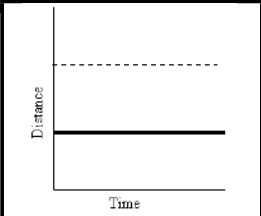
In which of the following graphs below are both runners moving at the same speed?


What was runner C's speed between 5 sec and 15 sec?
15 m/s
10 m/s
5m/s
0 m/s

Choose the description that best describes this motion graph.
The object is accelerating at an increasing rate.
The object is moving at a constant velocity/speed.
The object moved at a constant speed, then stopped. After stopping, it returned to the beginning and then moved back in the original direction at a very fast constant speed.

Choose the description that best describes this motion graph.
The object is accelerating at an increasing rate.
The object is moving at a constant velocity/speed.
The object moved at a constant speed, then stopped. After stopping, it returned to the beginning and then moved back in the original direction at a very fast constant speed.
What is the function of the respiratory system?
To digest your food
To remove waste from the body
To take in oxygen and remove carbon dioxide
To fight disease
Which two body systems work together to support the body and allow the body to move?
circulatory and respiratory
digestive and nervous
skeletal and muscular
circulatory and digestive
Which of the following is a component of the circulatory system?
heart
blood vessels
blood
all answers
What is the function of the digestive system?
It transports blood and oxygen to your cells
It breaks down food so the nutrients can be absorbed by your body
It helps you breathe by taking in oxygen and transporting carbon dioxide out of your body
It helps you move


Where does digestion start?
in the stomach
in the mouth/teeth
in the intestines
in the throat

What makes up an organ system?
a group of organs working together
similar cells that form a group of cells

Which system breaks down food into minerals that your body can use?
excretory
circulatory
respiratory
digestive


The heart pumps.....
minerals
blood
oxygen
water
Which systems of the human body function together to move and control body parts?
lymphatic
muscular
skeletal
digestive
excretory
When a person eats, the brain signals the stomach to start breaking down the food. Which two systems are involved in the process?
nervous
excretory
lymphatic
digestive
The function of the nervous system is to transmit signals and impulses from the brain to the rest of the body.
true
false

How many bones does a human body have?
300
306
206
16
A blood vessel that carries blood away from the heart.
Blood
Cardiovascular System
Heart
Artery
Connective tissue that serves as a transport system , made of plasma, platelets, white and red blood cells.
Blood
Cardiovascular System
Heart
Artery
Organ System that carries nutrients, gases, and hormones to body cells and waste products from body cells.
Blood
Cardiovascular System
Heart
Artery
Microscopic vessel through which exchanges take place between the blood and cells of the body.
Platelets
Capillaries
Plasma
Red Blood Cells
Liquid part of the cell
Platelets
Capillaries
Plasma
Red Blood Cells
Blood cells that carry oxygen from the lungs to the body cells.
Platelets
Capillaries
Plasma
Red Blood Cells
A blood vessel that carries blood back to the cell.
White Blood Cells
Vein
Pulmonary circulation
Systemic circulation
What is a food chain?
The flow of energy from one thing to another
The way animals eat each other
The way the sun makes everything
How the plants grow


*Remember Humans are on the top of all food chains because we do not get hunted.
An example of a predator:
shark
mouse
rabbit
An example of prey:
lion
mouse
shark

What is a decomposer?


Photosynthesis is the process where:
Plants turn green
Plants make their own food
Plants grow
Plants make flowers

