
NEW
Font size
 Worksheets
13-01: Radioactive Decay
Total questions: 15
Worksheet time: 8mins

Given the equation representing a reaction: which type of reaction is represented by this equation?
neutralization
polymerization
substitution
transmutation
In which reaction is an atom of one element converted into an atom of another element?
combustion
fermentation
oxidation-reduction
transmutation
Which equation represents a spontaneous transmutation?


Radioactive cobalt-60 is used in radiation therapy treatment. Cobalt-60 undergoes beta decay. This type of nuclear reaction is called:
natural transmutation
artificial transmutation
nuclear fusion
nuclear fission
Which emission causes the atomic number of a nuclide to decrease by 2 and its mass number to decrease by 4?
an alpha particle
a beta particle
gamma radiation
a positron
Which radioactive emission has the greatest penetrating power, but the least ionizing power?
alpha particle
beta particle
gamma ray
positron
Which nuclear emission has the least penetrating power and the greatest ionizing ability?
alpha particle
beta particle
gamma ray
positron
Which particle has the least mass?
alpha particle
beta particle
neutron
proton
The mass of a proton is approximately equal to the mass of
an electron
a neutron
an alpha particle
a beta particle
Which list of nuclear emissions is arranged in order from the least penetrating power to the greatest penetrating power?
alpha particle, beta particle, gamma ray
alpha particle, gamma ray, beta particle
gamma ray, beta particle, alpha particle
beta particle, alpha particle, gamma ray
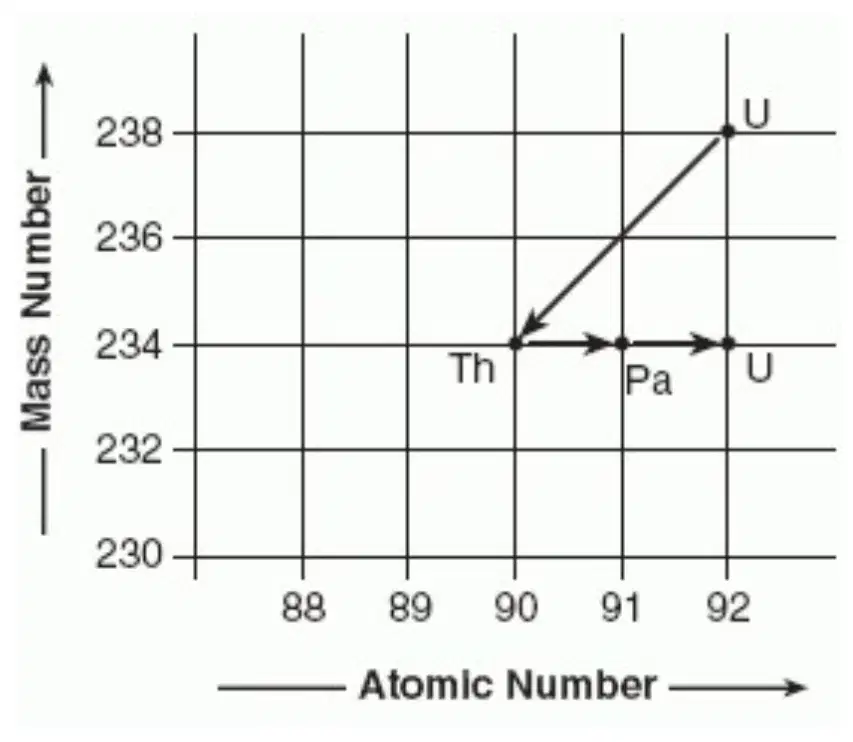
Using the chart, what is the correct order of nuclear decay modes for the change from U-238 to U-234?
β- decay, γ decay, β- decay
β- decay, β- decay, α decay
α decay, α decay, β- decay
α decay, β- decay, β- decay
Which nuclear emission has the greatest mass?
α
γ
β-
β+
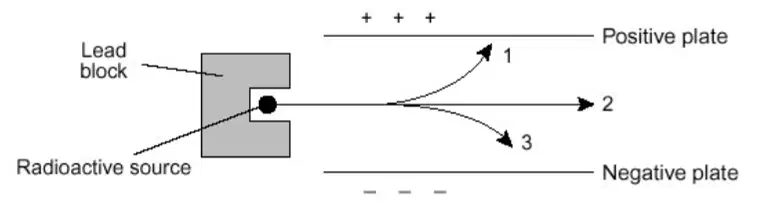
Which type of emanation is represented by the arrow labeled 1 in the diagram?
alpha particle
beta particle
positron
gamma ray

Given the reaction, which particle is represented by X?
alpha
beta
neutron
proton
Which particle cannot be accelerated in a magnetic field?
alpha particle
beta particle
neutron
proton

