
 Worksheets
Basic Diesel Engines Quiz
Total questions: 56
Worksheet time: 28mins
What is the primary function of diesel engines in DOE facilities?
To provide lighting to the facilities
To supply mechanical power for various operations
To enhance the interior design of the facilities
To monitor and control facility temperatures
Which of the following is NOT listed as a type of prime mover available at DOE facilities?
Gasoline engines
Nuclear reactors
Steam and gas turbines
Diesel engines
What is a key characteristic of diesel engines compared to other prime movers?
Less reliable
More expensive
Fuel efficient and extremely reliable
High energy consumption
What should be consulted for specific information on a particular diesel engine?
The DOE's general manual
The vendor's manual
Internet forums
General engineering textbooks
IDENTIFY the part labeled as 'f' in a diesel engine diagram.
Piston/rod
Cylinder
Blower
Exhaust ports or valve(s)
Who first applied the principles proposed by Sadi Carnot into a patented cycle or method of combustion known as the "diesel" cycle?
Adolphus Bush
Dr. Rudolf Diesel
Sadi Carnot
None of the above
What was the compression pressure used in Dr. Diesel's first engine that ran on coal dust?
550 psi
1500 psi
1000 psi
2000 psi
Which of the following is NOT a characteristic of diesel engines compared to gasoline engines?
Diesel engines operate with higher combustion pressures.
Diesel engines are typically lighter due to the materials used.
Both engines are internal combustion engines.
Diesel engines are driven by pistons moving laterally in two directions.
What significant modification did Dr. Diesel add to his engine design to lower the compression pressure?
Added a cooling water jacket around the cylinder
Increased the engine size
Used a different fuel type
Modified the piston design
Who built the first diesel engines for commercial use, installing them in his St. Louis brewery to drive various pumps?
Sadi Carnot
Dr. Rudolf Diesel
Adolphus Bush
None of the above
What is the primary reason diesel engines have greater combustion pressure compared to gasoline engines?
Diesel engines use a higher quality of fuel
Diesel engines have a higher compression ratio
Diesel engines operate at higher temperatures
Diesel engines have more cylinders
What is the typical compression ratio range used in diesel engines?
5:1 to 15:1
7:1 to 18:1
14:1 to 24:1
10:1 to 20:1
Why do gasoline engines have a self-speed-limiting feature?
Because they use a governor to control fuel injection
Because the air-fuel mixture controls the engine speed
Because they have a manual acceleration system
Because they use a carburetor to control air entry
How do diesel engines control the amount of fuel injected into the engine?
Through the air-fuel mixture
Using a carburetor
Using a governor
By manual control
What allows a diesel engine to operate without an ignition system?
The use of a carburetor
The high quality of diesel fuel
The heat created by the compression of air in the cylinder
The governor controlling fuel injection

Identify the part labeled in the diagram that helps in cooling the piston.
Water inlet manifold
Piston cooling oil pipe
Air box
Oil pan

What is the purpose of the crankcase in the diesel engine diagram?
To store engine oil
To house the crankshaft and its bearings
To support the fuel injector
To manage exhaust emissions
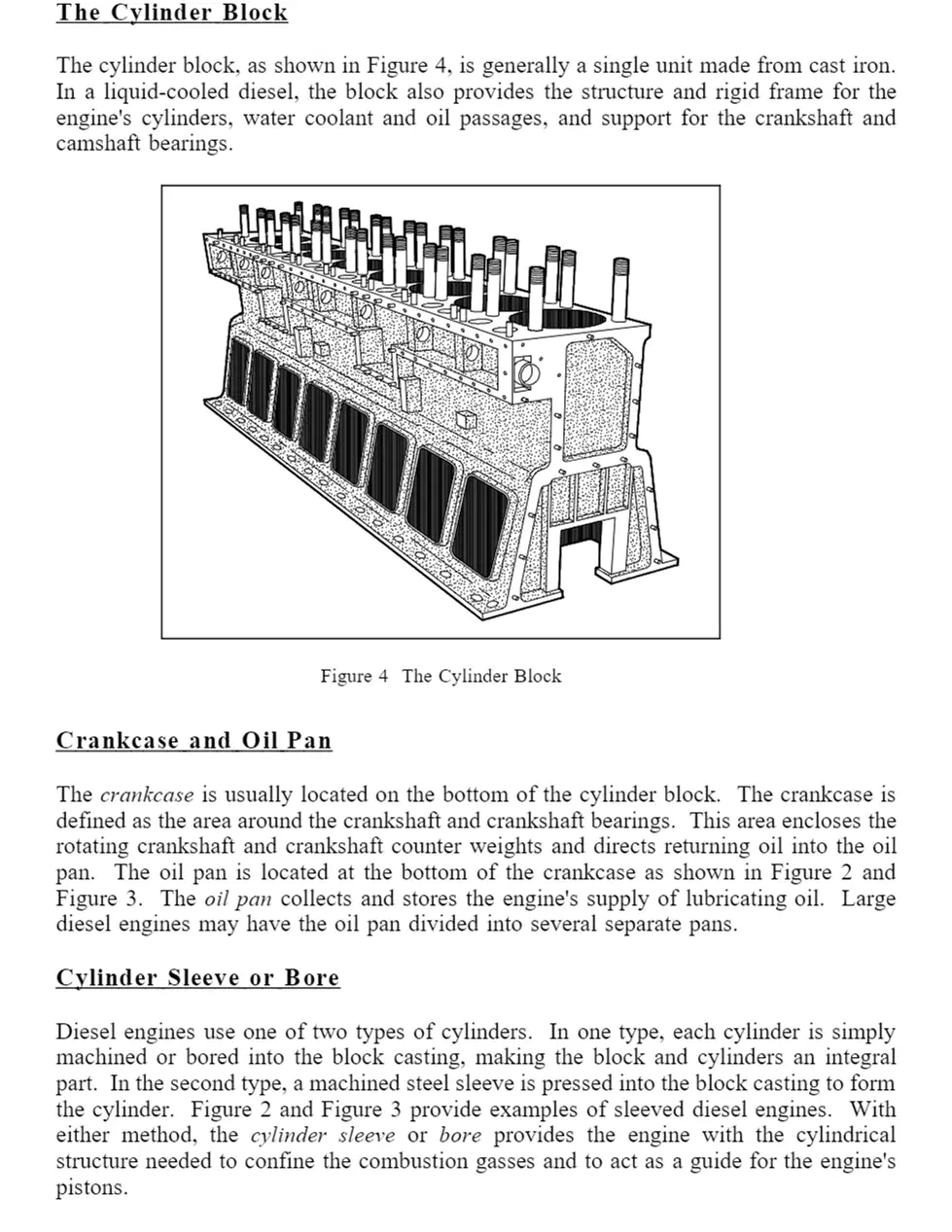
What is the primary material used to make the cylinder block in diesel engines, as shown in Figure 4?
Aluminum
Steel
Cast iron
Plastic

What does the cylinder block provide for the diesel engine besides its basic structure?
Electrical insulation
Fuel storage
Support for the crankshaft and camshaft bearings
Cooling for the exhaust system
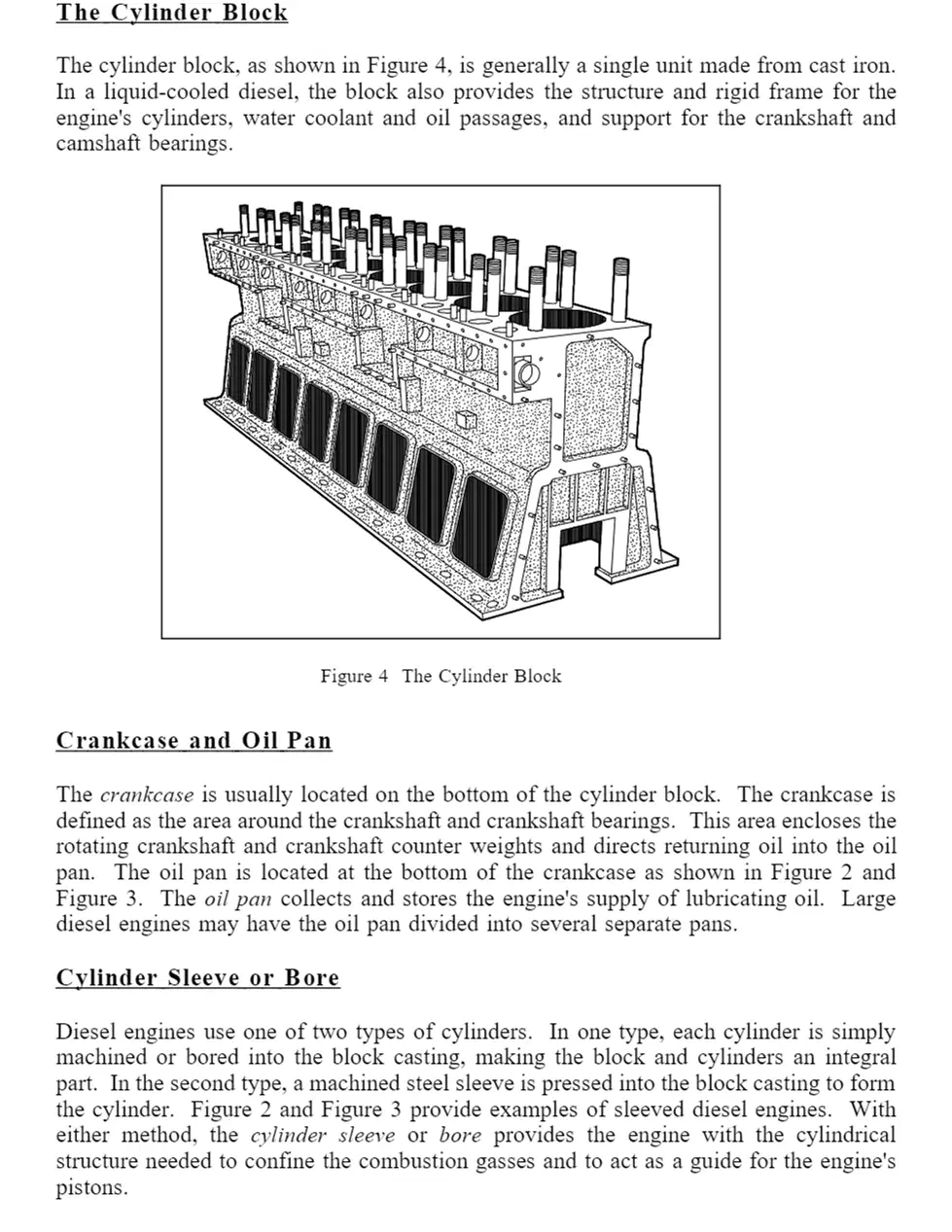
Where is the crankcase typically located in a diesel engine?
Above the cylinder block
On the side of the engine
On the bottom of the cylinder block
Inside the fuel injector

What is the function of the oil pan in a diesel engine?
To store coolant
To collect and store the engine's supply of lubricating oil
To filter the air intake
To distribute fuel to the engine

Which of the following best describes the cylinder sleeve or bore in diesel engines?
A component that filters engine oil
A part that enhances fuel efficiency
A structure that confines combustion gases and guides the engine's pistons
A device that controls exhaust emissions
What is the function of the piston in a diesel engine?
To inject fuel into the combustion chamber
To transform the energy of the expanding gases into mechanical energy
To cool the engine
To collect exhaust gases
What is the purpose of metal rings around the piston?
To increase fuel efficiency
To enhance the power output
To prevent combustion gases from bypassing the piston
To support the piston pin
What type of materials are commonly used to make pistons?
Steel and bronze
Aluminum or cast iron alloys
Plastic and ceramic
Wood and fiberglass
What is a wet sleeve in a diesel engine?
A type of cylinder that is lubricated by oil
A type of cylinder that is cooled by air
A type of cylinder surrounded by the engine's coolant
A type of cylinder that operates without coolant
How are the cylinders arranged in a "V" type engine?
In a single row
In two rows set at an angle to each other
In multiple rows without any specific angle
In a circular formation
What is the primary function of the top ring(s) in a diesel engine piston?
To ensure that the piston moves smoothly within the cylinder
To act primarily as the pressure seal
To supply lubricating oil evenly on the cylinder walls
To connect the piston to the crankshaft
What material is commonly used for manufacturing crankshafts?
Cast iron
Chrome
Forged steel
Molybdenum
How are diesel engine connecting rods typically modified to assist with lubrication?
They are coated with a special material
They are attached directly to the piston
They are drilled down the center to allow oil to travel up
They are made from drop-forged, heat-treated steel
What is the purpose of the counter weights found on a crankshaft?
To increase the efficiency of the engine
To reduce the wear on the crankshaft
To balance the weight of the connecting rods
To ensure an even force during the rotation of the moving parts
What is the primary function of the flywheel in a diesel engine?
To increase fuel efficiency
To reduce vibration by smoothing out the power stroke
To enhance the engine's electrical output
To decrease the engine's weight
How do diesel engine cylinder heads contribute to the engine's function?
They only seal the cylinder bore or sleeve
They provide the structure holding exhaust valves and fuel injectors
They reduce the noise of the engine
They control the temperature of the engine
Which method of admitting and exhausting gases from the cylinder is used in larger diesel engines?
Using both ports and valves
Using only ports
Using only valves
None of the above
Where are the intake ports typically located in a diesel engine's cylinder?
In the upper 1/3 of the bore
In the middle of the bore
In the lower 1/3 of the bore
Outside the cylinder
What is the function of the camshaft in a diesel engine?
To control the engine's cooling system
To regulate the timing of the valve openings and closings
To increase fuel efficiency by adjusting the air intake
To filter exhaust gases
What connects the camshaft to the engine's valves and fuel injectors?
Piston rings
Pushrods and rocker arms
Drive belts
Gaskets
What is the purpose of the valve seat in a diesel engine?
To support the camshaft lobes
To seal the combustion chamber
To house the fuel injectors
To attach the exhaust pipe
Which component is used to achieve precise intervals in relation to the motion of the piston?
Valve
Camshaft
Rocker arm
Drive gear
What is the primary function of the camshaft in a diesel engine?
To control the fuel injection timing
To transfer heat to the engine
To reduce the engine's noise
To control the opening and closing of the valves
What is the term used to describe the method that allows for expansion in valve pushrods and rocker arms due to temperature changes?
Valve float
Valve lash
Valve seal
Valve clearance
How is the camshaft driven in a diesel engine?
By a series of hydraulic pumps
By the engine's crankshaft through a series of gears
By electric motors
By direct mechanical linkage
What allows for the precise timing of valve opening, valve closing, and fuel injection in a diesel engine?
The piston's movement
The camshaft's rotation
The crankshaft's rotation
The idler gears' alignment
According to the document, where is the camshaft typically located in small or mid-sized V-type engines?
In the head of the engine
On the side of the cylinder bank
In the block at the engine's base
Outside the engine block
What is the primary function of the blower in a diesel engine's air intake system?
To filter the incoming air
To compress the incoming air for delivery to the cylinders for combustion
To cool the air before it enters the engine
To expel exhaust gases from the engine
Which of the following is NOT a supporting system required for a diesel engine to operate?
Cooling
Lubrication
Transmission
Fuel injection

What components are part of the major cooling system of a diesel engine?
Water pump, radiator, heat exchanger, water jacket, and thermostat
Oil pump, fuel injector, radiator, and coolant pump
Water pump, air filter, fuel injector, and thermostat
Radiator, oil cooler, air filter, and coolant pump
What is one of the primary purposes of oil in an internal combustion engine as described in the text?
To increase friction between moving parts
To lubricate the bearing surfaces
To decrease the engine's efficiency
To fuel the engine
According to the text, what does the oil help to prevent in an internal combustion engine?
Oil leakage
Metal-to-metal contact
Electrical faults
Overheating of the engine exterior
How is the flow of oil to the moving parts of the engine accomplished?
Through manual pumping
By natural gravitational force
By the engine's internal lubricating system
Through external cooling systems
What additional role does oil play in the engine besides lubrication?
Cooling the bearings by absorbing the generated heat
Increasing the heat generation
Solidifying the metal parts
Reducing the engine's power output
What is the primary function of oil in diesel engines as described in the document?
To increase fuel efficiency
To cool and lubricate the bearing surfaces
To enhance engine sound
To reduce exhaust emissions
According to the document, how is oil distributed into the engine block in medium to large diesel engines?
Through an external cooler only
By gravity-flow back into the oil pan
Through an internal or external oil cooler
By manual pumping
What is the role of injectors in the diesel engine fuel system?
To filter the fuel
To store the fuel
To deliver precisely metered fuel
To cool the fuel
How is the fuel filtered in diesel engines according to the text?
Through a single in-line filter
Through a series of in-line filters
By recycling the fuel back to the tank
Using a centrifugal filter only
What additional purpose does the fuel serve in a diesel engine besides running the engine?
Acts as a lubricant for the engine parts
Acts as a coolant
Enhances the power output
Reduces the noise of the engine

