
 Worksheets
AP Review - Everything
Total questions: 120
Worksheet time: 4hrs 23mins


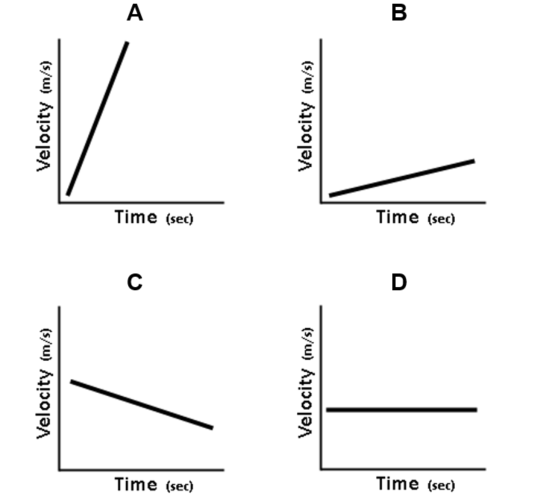


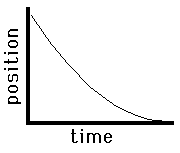
A particle accelerates from rest at a uniform rate of 55 m/s2 for a distance of 3 meters. How fast is the particle going at the 3 meter mark?
34.64 m/s
11.55 m/s
18.17 m/s
0.33 m/s
330 m/s
21.67 minutes
21.67 seconds
43 minutes
43 seconds
If the sum of all the forces acting on a moving object is zero, the object will
slow down and stop
change the direction of its motion
accelerate uniformity
continue moving with constant velocity
A 0.15 kg baseball moving at 20 m/s is stopped by a catcher in 0.010 seconds, The average force stopping the ball is:
−0.03 N
−300 N
30 N
3 N
A net force of 10 N accelerates an object at 5 s2m . What net force would be required to accelerate he same object at 1 s2m ?
1.0 N
2.0 N
5.0 N
50 N
Which body is in equilibrium?
a satellite orbiting earth in a circular orbit.
a ball falling freely toward the surface of the Earth.
a car moving with constant speed along a straight, level road
a projectile at the highest point in its trajectory
Earth's mass is approximately 81 times the mass of the Moon. If Earth exerts a gravitational force of magnitude F on the Moon, the magnitude of the gravitational force on Earth is
F
F/81
9F
81F

A projectile launched at an angle of 45⁰ above the horizontal travels through the air. Compared to the projectile's theoretical path with no air friction, the actual trajectory of the projectile with air friction is:
lower and shorter
lower and longer
higher and shorter
higher and longer
Which of the following statements is correct about static friction?
Static friction does not depend on the surface roughness.
Static friction always has the same magnitude for a given object on a given surface no matter what external forces are applied.
Static friction is always parallel to the object-surface interface.
The magnitude of the static friction force depends solely on which horizontal external forces are acting on the object.
FN=100N, Ff=20N
μ=5.0
μ=0.2
μ=1.2
μ=0.1

Given that the system has frictionless and massless pulleys, and a string of negligible mass; find the acceleration of the system if Block 1 has a mass of 1.8 kg, and Block 2 has a mass of 2.7 kg. Each answer has the units of m/s2.
2.38
9.8
4.3
1.96


What would the acceleration of m2 be if m1 was 4 kg and m2 is 5kg?
1.1 m/s/s, 270 degrees
1.1 m/s/s, 90 degrees
.92 m/s/s, 270 degrees
.92 m/s/s, 0 degrees

What is the acceleration of the cart on the table if the cart and mass has a combined mass of 8kg with a coefficient of friction of 0.15 and the hanging mass is 5.5kg?
15 m/s/s, 0 degrees
15 m/s/s 90 degrees
3.1 m/s/s 0 degrees
3.1 m/s/s 270 degrees
Draw a free body diagram on the blue box!
Remember, there in tension, weight, and normal force.


Which of the following is not true about the system?
T3 is equal to the scalar sum of the magnitudes of T2 and T1
T3 is equal in magnitude to Fg
The x- components of the T1 and T2 and equivalent but in opposite directions
The system is in equilibrium.

Rank the tensions experienced by the strings.
TA > TB > TC
TB > TA = TC
TB > TC > TA
Cannot be determined
A 5 kg ball is lifted 12 m above the ground. The ball:
gains elastic potential energy
gains gravitational potential energy
gains kinetic energy
gains mechanical energy
Which of the following objects has the most kinetic energy?
A 20 kg toddler running at 5 m/s
A 50 kg toddler running at 30 m/s
A 90 kg toddler running at 30 m/s
A 100 kg toddler running at 5 m/s
A student is asked to determine the work done on a block of wood when the block is pulled horizontally using an attached string. The student is supplied with a spring scale, a stopwatch, and a meterstick. Which of the following graphical analysis techniques will allow the student to determine the work done on the block by the string?
Graphing the force as a function of time and calculating the slope
Graphing the force as a function of time and calculating the area under the curve
Graphing the force as a function of distance and calculating the slope
Graphing the force as a function of distance and calculating the area under the curve
A rubber ball with mass 0.20 kg is dropped vertically from a height of 1.5 m above a floor. The ball bounces off of the floor, and during the bounce 0.60 J of energy is dissipated. What is the maximum height of the ball after the bounce?
0.30 m
0.90 m
1.19 m
1.56 m
Which of the following is true for a system consisting of a mass oscillating on the end of an ideal spring?
The kinetic and potential energies are equal to each other at all times.
The kinetic and potential energies are both constant.
The maximum kinetic energy and maximum potential energy are equal, but occur at different times.
The maximum potential energy is achieved when the mass passes through its equilibrium position.
A rock is lifted for a certain time by a force F that is greater in magnitude than the rock's weight W. The change in kinetic energy of the rock during this time is equal to the
work done by the net force (F - W)
work done by F alone
work done by W alone
difference in the momentum of the rock before and after this time
An object is projected vertically upward from ground level. It rises to a maximum height H. If air resistance is negligible, which of the following must be true for the object when it is at a height H/2?
Its speed is half of its initial speed.
Its kinetic energy is half of its initial kinetic energy.
Its potential energy is half of its initial potential energy.
Its total mechanical energy is half of its initial value.

What is the SI unit of Energy?
Watts
Entrons
Joules
Newtons
When the speed of an object triples, what happens to its kinetic energy?
3 times as much K
9 times as much K
1/3 as much K
1/9 as much K
What is the KE of a 4 kg ball moving at 3 m/s?
18 J
9 J
36 J
12 J
A force of 10 N is exerted on an object for 3 m. What is the objects change in KE energy
0.3 J
3.0 J
30.0 J
300 J
Eileen lifts her 1 kg physics book up 2 meters. How much work does she do?
2 N
20 N
20 J
2 J
The Work-Energy Theorem says:
p = mv
Ug = mgy
Change E = W
W = Fdcos angle

What is the definition of Mechanical Energy?
a change in speed or direction
the ability to do work
a force that works against motion as surfaces rub together
the energy an object has because of its motion
True or False
Negative work means that energy is being removed from the object.
True
False
A beat is dropped from the edge of a cliff. Which of the following graphs best represents the beat's kinetic energy KE as a function of time t?


The system shown consists of two objects of unequal masses, M1 and M2, and pulley with negligible mass and friction. Which of the following is true about the changes in the gravitational potential energy and kinetic energy of the system soon after the objects are released from rest?
ΔU = 0 and ΔK>0
ΔU>0 and ΔK>0
ΔU<0 and ΔK>0
ΔU=0 and ΔK=0
True or False
The total energy in an isolated system can be increased.
True or False
Gravity does negative work on you when you walk up some stairs.
True
False

A block of mass M on an inclined surface is attached to a spring of negligible mass, as shown. The other end of the spring is attached to a wall, and there is negligible friction between the block and the incline. The block is pulled to a position such that the spring is stretched from its equilibrium position. The block is then released from rest. Which of the following systems can be classified as a closed system?
A system consisting of the block only
A system consisting of the spring and Earth
A system consisting of the block and spring
A system consisting of the block, spring, and Earth
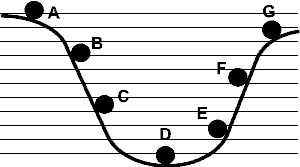
The Ug increases and K decreases
The K increases and Ug decreases.
The Ug is maximum at A.
The K is maximum at C and B.
Momentum is a ____________________ quantity
science
scalar
vector
energy
T/F: A big truck will always have more momentum than a small car.
True
False
A 9300 kg railroad car traveling at a velocity of 5 m/s strikes a second boxcar that weighs 5000 kg at rest. The railroad car is brought to a sudden stop while the boxcar moves away from the collision. At what speed will the second boxcar move?
18.6 m/s
9.3 m/s
7.5 m/s
1.86 m/s
What would happen to the momentum of a toy car if the mass is doubled and the velocity decreases by 1/2?
It decreases by 1/4
It decreases by 1/2
Stays the same
It is doubled
A 0.15 kg mass moving at +26 m/s is slowed to a stop by a force of -390 N. How long does it take the force to stop the mass?
0.01 s
0.001 s
0.02 s
0.23 s
A car is traveling 20 m/s. It takes 4 seconds with a 7,500 N force to come to a stop. What is the mass of the car?
150 kg
1,500 kg
37,500 kg
3,750 kg
How can a tennis ball and a bowling ball have the same momentum?
have the same speed
have different speeds
one is moving backwards
they can't
A track athlete throws a discus that has a momentum of 42kg*m/s into a field with a velocity of 21 m/s. What is the mass of the discus?
1 kg
2 kg
3 kg
4 kg

The Law of Conservation of Momentum states:
The total momentum before a collision is equal to the total momentum after a collision.
The total momentum before a collision is greater than the total momentum after a collision.
The total momentum before a collision is less than the total momentum after a collision.
The total momentum before a collision is not related to the total momentum after a collision.
A Russian cosmonaut(87 kg) and USA astronaut(94 kg) are outside the ISS and decide to run a momentum experiment. They are motionless facing each other palm to palm, then push apart from each other. What happens to their momentum?
their total momentum doubles
their total momentum decreases
the guy with the smaller mass has less momentum
their momenta are opposite but equal

A
B
C
D

A
B
C
D

A
B
C
D

A
B
C
D

A
B
C
D

A
B
C
D
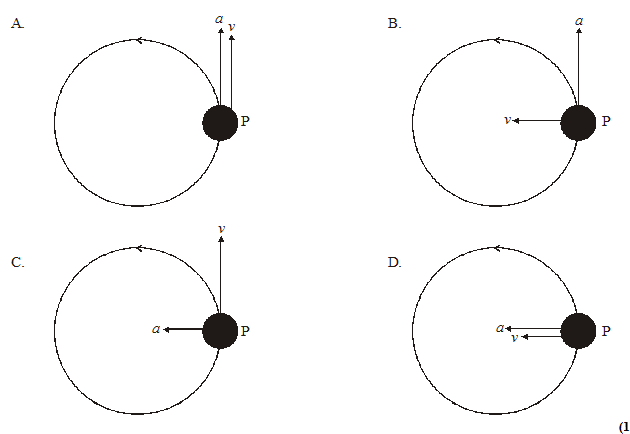
Particle P is moving in a circle with uniform speed. Which one of the following diagrams correctly shows the direction of the acceleration and velocity of the particle at one instant of time?

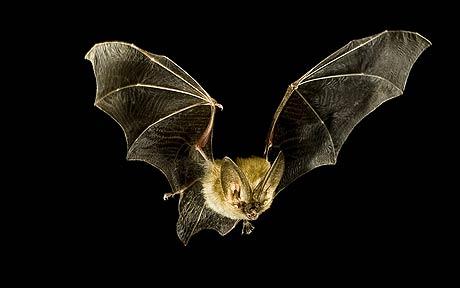
Bentley the bat has a mass of 0.58 kg and flies at a speed of 0.8 m/s in circle of radius 0.5 m. What is his centripetal acceleration?
0.25 m/s2
1.3 m/s2
1.6 m/s2
0.74 m/s2
A race car completes three laps of a circular track with a radius of 35 m in 9.0 seconds. Determine the speed of the car.
3.9 m/s
73.3 m/s
24.4 m/s
1.0 m/s
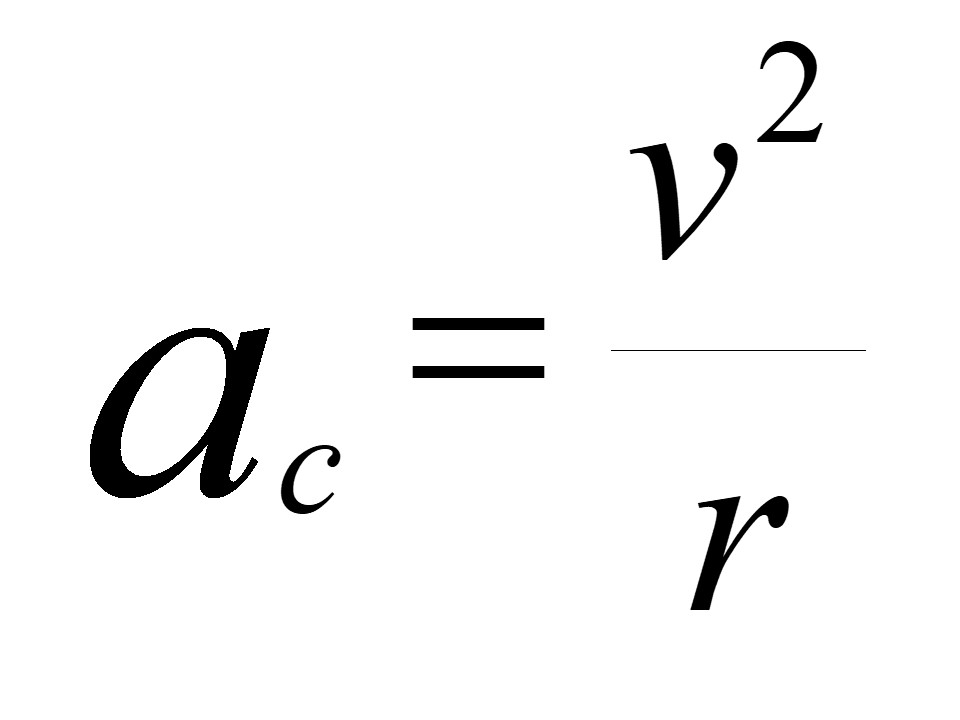
What's the centripetal acceleration of an object traveling 2.3 m/s around a circle of diameter 0.6 m?
5 m/s2
17.63 m/s2
10 m/s2
8.81 m/s2
A bicycle has a period of 0.3s . What is the
speed of its tires if their radius is 30 cm?
6 m/s
3 m/s
60 m/s
30 m/s
The drum of a washing machine rotates 1800 times in 3 minutes. What is the period?
0.1 s
0.2 s
0.3 s
0.5 s
what is the centripetal acceleration formula?


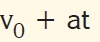
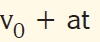
What is the velocity formula for uniform circular motion?



A tennis ball on a string is spun clockwise around a circle. After the string breaks, which path will the tennis ball follow?
Path I
Path II
Path III
Path IV
•What is the centripetal force acting on a 2000 kilogram airplane if it turns with a radius of 1000 meters while moving at 300 meters per second?
90000N
600N
1.8x10⁵N
1.77x10⁶N
•Is the centripetal force of friction enough for a 1000 kilogram car to make a turn with a radius of 50 meters while moving at 15 meters per second? The rubber tires on asphalt have a coefficient of friction of 0.7.
Yes, frictional force is greater than centripetal foce
No, frictional force is greater than centripetal force
Yes, frictional force is less than centripetal force
No, frictional force is less than centripetal force

The _______________________ supplies the centripetal force requirement for the car to move in a horizontal circle. Without it, the car would turn its wheels but would not move in a circle (as is the case on an icy surface).
friction force
centrifugal force
normal force
applied force

The diagram shows a stone tied to the end of a length of string and is whirled round in a horizontal circle . What provides the centripetal force on the stone?
The weight of the string.
The friction in the string.
The tension in the string.
The air resistance from the surroundings.
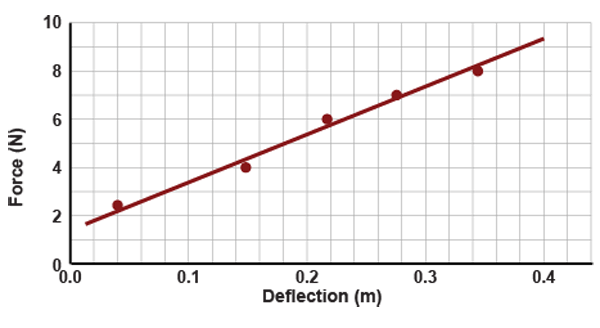
A spring extends 1.5 m under a load of 10 N. What is its spring constant?
0.15 N/m
8.5 N/m
6.7 N/m
15 N/m
Work 4 J
Displacement 30 m
spring constant 20 N/m
Velocity 2.6 m/s

Objects with different masses are hung on a spring. The diagram shows how much the spring stretches. What is mass M?
175 g
150 g
200 g
166 g
Which of these does not affect the period of a pendulum?
length
gravity
mass
The period of an ocean wave is 10 s. What is its frequency?
10 cycle/second
1 cycle/second
0.5 cycle/second
0.1 cycle/second
At what point in the swing of a pendulum is the bob moving fastest?
at the top of the arc
at the bottom of the arc
Pendulum "A" is on Jupiter Pendulum "B" is on the Moon. The Moon has less gravity than Jupiter. The pendulums have the same mass and length. Which Pendulum is moving faster?
A
B
Same
3.1 s
1.5 s
0.77 s
1.2 sec
A simple harmonic oscillator takes 4.8 s to undergo five complete vibrations. What is the frequency?
1 Hz
0.96 Hz
1 s
0.96 s
A block of mass 2.0 kg is attached to a spring. What is the spring constant if the block’s acceleration is 13 m/s2 when it is 0.75 m away from the equilibrium position?
35 N/m
0.12 N/m
4.8 N/m
9.8 N/m

What is the amplitude of this motion?
(a)

An object is attached to a spring and oscillates with amplitude A and period T, as represented on the graph above. The nature of the velocity v and acceleration a of the object at time T/4 is best represented by which of the following?
v > 0, a > 0
v > 0, a < 0
v > 0, a = 0
v = 0, a < 0
v = 0, a = 0
A 1.0 kg mass is attached to the end of a vertical ideal spring with a force constant of 400 N/m. The mass is set in simple harmonic motion with an amplitude of 10 cm. The speed of the 1.0 kg mass at the equilibrium position is
2 m/s
4 m/s
20 m/s
40 m/s
200 m/s

A mass is hung from an ideal spring. It is pulled down a distance y in the negative direction and released. Which shows the correct position vs. time and corresponding velocity vs. time graphs.
A
B
C
D

The figure above shows a uniform meterstick that is set on a fulcrum at its center. A force of magnitude F toward the bottom of the page is exerted on the meterstick at the position shown. At which of the labeled positions must an upward force of magnitude 2F be exerted on the meterstick to keep the meterstick in equilibrium?
A
B
C
D

The broomstick shown is in static equilibrium. The torque due to the mass to the right of the person's finger is ____________ compared to the torque due to the mass to the left of the person's finger.
more
less
equal
None of the above

If the fulcrum is on the hinge in the picture, which of the following forces are not creating torque.
Normal force from the wall
Weight from the rod
Tension from the string.
True or False: If the net torque is non-zero, the system is accelerating.
True
False
Reorder the following in ascending order of torque (low to high) due to the hanging weight at the hinge


Reorder the following in increasing order of difficulty to rotate about the axis shown by the long line



