wayground logo

Free Printable Worksheets

Font size

S
M
L
XL
Worksheets

Electricity/Magnetism Review

Total questions: 125

Worksheet time: 3hrs 23mins

Name
Class
Date
1.
Insulators are different than conductors in that insulators ____.
a)
do not contain electrons or protons 
b)
 do not contain any charge
c)
have a weaker affinity for electrons 
d)
do not allow charge to freely move 
2.
A glass rod becomes positively charged when it is rubbed with silk. This net positive charge accumulates because the glass rod
a)
gains electrons
b)
loses electrons
c)
gains protons
d)
loses protons
3.
A negatively charged plastic comb is brought close to, but does not touch, a small piece of paper. If the comb and the paper are attracted to each other, the charge on the paper
a)
must be positive
b)
must be negative
c)
may be neutral or negative
d)
may be neutral or positive 
4.
Two electrically charged identical-sized metal spheres, A (charge of -4) and B (charge of +8). If the spheres are brought into contact, which sphere will have a net gain of electrons?
a)
both A and B
b)
neither
c)
only A
d)
only B
5.
A positively charged rod is held near the knob of a neutral electroscope. What best describes what will happen to the leaves?
a)
the leaves will spread apart and be positive
b)
the leaves will spread apart and be negative
c)
the leaves will stay closed and be positive
d)
the leaves will stay closed and be negative
6.
Two electrically neutral metal spheres, A and B, on insulating stands are placed in contact with each other. A negatively charged rod is brought near, but does not touch the spheres, as shown in the diagram below. How are the spheres now charged?
a)
A is positive and B is positive.
b)
A is negative and B is positive.
c)
A is positive and B is negative.
d)
A is negative and B is negative.
7.
Which net charge could be found on an object?
a)
4.8 x 10⁻¹⁹ C
b)
1.8 x 10⁻¹⁹ C
c)
3.0 x 10⁻¹⁹ C
d)
2.8 x 10⁻¹⁹ C
8.
Metal sphere A has a charge of +12 elementary charges and identical sphere B has a charge of +16 elementary charges. After the two spheres are brought into contact and separated, the charge on sphere A is
a)
+14 elementary charges
b)
+28 elementary charges
c)
+2 elementary charges
d)
-2 elementary charges
9.
Three charged metal spheres, X, Y, and Z, are on insulating stands. All three spheres are simultaneously brought into contact with each other and then returned to their original positions.
Which statement best describes the charge of the spheres after this procedure is completed?
a)
All the spheres will end up with the same charge
b)
All the spheres are neutral
c)
Sphere Y has a greater charge than spheres X or Z
d)
Each sphere retains the same charge that it had originally
10.
An electrostatic force of magnitude F exists between two metal spheres having identical charge q. The distance between their centers is r. Which combination of changes would produce no change in the electrostatic force between the spheres?
a)
doubling q on both spheres while halving r
b)
doubling q on one sphere while halving r
c)
doubling q on one sphere while doubling r
d)
doubling q on both spheres while doubling r
11.
A metal sphere having an excess of +5 elementary charges has a net electric charge of
a)
8.0 x 10⁻¹⁹ C
b)
8.0 x 10¹⁹ C
c)
1.6 x 10⁻¹⁹ C
d)
5.0 x 10⁻¹⁹ C
12.

Three metal spheres, X, Y, and Z, are on insulating stands. Only Z is initially charged.

Y and Z are brought into contact then separated.

Z and X are then brought into contact then separated.

Which statement best describes the charge of the spheres after this procedure is completed?

a)

All the spheres will end up with the same charge

b)

All the spheres are neutral

c)

Sphere Y has a greater charge than spheres X or Z

d)

Each sphere retains the same charge that it had originally

13.
A negatively charged rod touches the knob of a neutral electroscope. Which  best represents the distribution of charge on the electroscope.
a)
both the knob and leaves become positive
b)
both the knob and leaves become negative
c)
the knob becomes negative and the leaves become positive
d)
the knob becomes positive and the leaves become negative
14.
Metal sphere A has a charge of -2 units and an identical metal sphere, B, has a charge of -4 units. If the spheres are brought into contact with each other and then separated, B will _____
a)
gain 1 electron
b)
lose 1 electron 
c)
gain 3 electrons
d)
lose 3 electrons
15.
During a physics lab, a plastic strip was rubbed with cotton and became positively charged. The correct explanation for why the plastic strip becomes positively charged is that ...
a)
the plastic strip acquired extra protons from the cotton.
b)
the plastic strip acquired extra protons from the charging process 
c)
protons were created as the result of the charging process
d)
the plastic strip lost electrons to the cotton during the charging process 
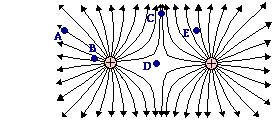
16.

Which of the following labeled points is in the region with the strongest force of electric charge

a)

A

b)

B

c)

C

d)

D

17.

When the distance between two charges is halved, the electrical force between the charges

a)

quadruples

b)

reduces to one fourth

c)

halves

d)

doubles

18.

which is the field for opposite charges

a)
b)
c)
d)
19.

2 charges are 20 cm apart and feel a force of 500 N. if the distance between them becomes 60 cm, what is the new force

a)

4500

b)

540

c)

1500

d)

55.6

20.
A negatively charged rod is brought near a neutral electroscope, causing the leaves to diverge.  This is an example of....
a)
Conduction
b)
Induction
c)
Insulation
d)
Friction
21.
When a rod is brought near a neutral electroscope, the leaves diverge.  Which statement best describes the charge on the rod?
a)
It must be positive.
b)
It must be negative.
c)
It may be positive or negative.
d)
It may be neutral.
22.
Balloon A simultaneously touches Balloons B and C.  Balloon A started with a charge of -4e, Balloon B started with a charge of +2e, and Balloon C started with a charge of +14e.  What will be the new charge on Balloon A after they were all allowed to touch?
a)
+12e
b)
+6e
c)
+8e
d)
+4e
23.

How can you determine how strong the electric force a point charge will experience at a certain point in an electric field?

a)

The total number of electric field lines

b)

How close together the electric field lines are

c)

What direction the electric field lines are pointing

d)

How large the charge at the center is drawn

24.

Which is NOT a similarity between gravitational force and electrical force?

a)

They both depend on the distance

b)

The both involve two objects (either charged or with mass)

c)

They are both repulsive and attractive

d)

They both significantly decrease with distance

25.

Electrical Field inside a Hollow Metallic Charges Sphere is:

a)

Zero


b)

Same field as the surface of sphere

c)

Decreasing towards centre of the sphere

d)

Increasing towards the centre of the sphere

26.

Which of the following statements is incorrect?

a)

Two objects with the same type of charge repel each other.

b)

Two objects with opposite types of charge attract each other.

c)

Two objects made of different materials rubbed against each other acquire the same type of charge.

d)

All of these statements are correct.

27.
What method of charging is depicted here?
a)
Induction
b)
Conduction
c)
Reduction
d)
Friction
28.
What direction are the electric field lines around an electron?
a)
towards the charge
b)
away from the charge
29.

How is the electric force between two charges affected when the distance between the charges is doubled?

a)

Four times as much.

b)

Two times as much.

c)

Half as much.

d)

One-fourth as much.

30.
When you draw the direction of the electric field you always use a ___________ test charge
a)
positive
b)
negative
c)
neutral
d)
radioactive
31.
Consider the electric field lines shown in the diagram below. From the diagram, it is apparent that object A is ____ and object B is ____.
a)
+,+
b)
+,-
c)
-,+
d)
-,-
32.
In the diagram below, P is a point near a negatively charged sphere. Which direction best represents the direction of the electric field at point P?
a)
Right
b)
Left
c)
Up 
d)
Down
33.
Qand Qare two charges creating an electric field. Based on the electric field lines, we can conclude
a)
Q> Q
b)
Q< Q
c)
QA = Q
34.
As a proton moves in the direction the electric field lines...
a)
it is moving from low potential to high potential and gaining electric potential energy.
b)
it is moving from low potential to high potential and losing electric potential energy.
c)
it is moving from high potential to low potential and gaining electric potential energy.
d)
it is moving from high potential to low potential and losing electric potential energy.
35.
What is voltage?
a)
The amount of electric potential energy per one coulomb of charge
b)
The amount of 1 coulomb of charge per unit of potential energy
c)
The number of volts per coulomb
d)
The amount of electric potential energy per volt
36.

The potential difference between the terminals of a connection wire is ……..

a)

Zero

b)

greater than zero

c)

Less than zero

d)

infinity

37.
A region of space contains a uniform electric field, directed toward the right, as shown in the figure. Which statement about this situation is correct?
a)
The potential at point A is the highest, the potential at point B is the second highest, and the potential at point C is the lowest.
b)
The potential at points A and B are equal, and the potential at point C is lower than the potential at point A.
c)
The potential at all three locations is the same.
d)
The potentials at points A and B are equal, and the potential at point C is higher than the potential at point A.
38.

The direction of electric field lines shows the

a)

direction of the force on a test positive charge.

b)

size of the field.

c)

strength of the field.

d)

all of the above

39.
Electric field lines between two oppositely charged parallel metal plates will be .. 
a)
straight lines, randomly spaced
b)
 straight lines, evenly spaced
c)
curved lines grouped together in small bunches. randomly spaced.
d)
 d. curved lines, evenly spaced. e. curved lines,
40.

Two parallel plates are oppositely charged. The right plate is negative and the left plate is positive. In which direction does the electric field point?

a)

to the left

b)

to the right

c)

up

d)

down

41.
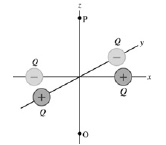
Four charged particles (two having a charge +Q and two having a charge -Q) are arranged in the xy-plane, as shown in the figure. These particles are all equidistant from the origin.  The electric potential (relative to infinity) at point P on the z-axis due to these particles, is
a)
Positive
b)
Negative
c)
zero
d)
impossible to determine based on the information
42.
The potential difference between two points is 100 V. If a particle with a charge of 2 C is transported from one of these points to the other, the magnitude of the work done is: 
a)
200 J
b)
100 J
c)
50 J
d)
2 J
43.
Consider a parallel plate system with the top plate being positive and the bottom negative. If I move a positive charge parallel to the top plate what happens to the energy of the charge?
a)
No effect
b)
Eincreases while Edecreases
c)
Ek decreases while Ep increases
d)
Impossible to tell
44.
Consider a parallel plate system with the top plate being positive and the bottom negative. If I move a positive charge toward the top plate what happens to the energy of the charge?
a)
No effect
b)
Ek increases while Ep decreases
c)
Ek decreases while Ep increases
d)
Impossible to tell
45.
Suppose the magnitude of a charge placed in a field were doubled. 
How much would the electric potential energy change?
a)
Double
b)
Decrease by 1/2
c)
No effect
46.
Suppose the magnitude of a charge placed in a field were doubled. 
How much would the electric potential  change?
a)
Double
b)
Decrease by 1/2
c)
No effect
47.
In what direction will a negatively charged particle accelerate in an electric field?
a)
In the same direction as field
b)
In opposite direction as field
c)
Perpendicular to field
d)
Impossible to tell
48.
The capacitance of a parallel-plate capacitor can be increased by: 
a)
increasing the charge 
b)
decreasing the charge 
c)
increasing the plate separation
d)
decreasing the plate separation 
49.

With respect to the capacitor, which relationship is true? •

a)

C = Q×V

b)

V = C×Q

c)

V = Q/C

d)

Q = C/V

50.

How is the capacitance (C) of a parallel-plate capacitor affected by the charge on the plates ?

a)

C depend on the charge on the plates

b)

C is vanished when there are plates

c)

C does not depend on the charge on the plates

d)

C is accumulated on one side only

51.

How is the capacitance of a parallel-plate capacitor affected by the potential difference across the capacitor ?

a)

C depend on the potential difference across the capacitor

b)

C does not depend on the potential difference across the capacitor

c)

C partially depend on the potential difference across the capacitor

d)

C sometime depend on the potential difference across the capacitor

52.

How is the capacitance of a parallel-plate capacitor affected by the area of each plate?

a)

C is directly proportional to the area A of each plate

b)

C is inversely proportional to the area A of each plate

c)

C is partially proportional to the area A of each plate

d)

C is fully proportional to the area A of each plate

53.

How is the capacitance of a parallel-plate capacitor affected by the distance between the plates ?

a)

C is directly proportional to the area A of each plate

b)

C is inversely proportional to the distance d between the plates

c)

C is partially proportional to the area A of each plate

d)

C is not affected by the area A of each plate

54.

How is the capacitance of a parallel-plate capacitor affected by filling the space between the plates with an insulator ?

a)

C stable when the space between the plates is filled with an insulator, εr >1

b)

C reduces when the space between the plates is filled with an insulator, εr >1

c)

C increases when the space between the plates is filled with an insulator, εr >1

d)

C fluctuate when the space between the plates is filled with an insulator, εr >1

55.

Which procedure below will increase the capacitance of a parallel-plate capacitor?

a)

Increase the distance of separation between the two plates

b)

Reduce the surface area of the plate

c)

Insert an insulator between the two plates

d)

Insert a conductor between the two plates

56.

A parallel-plate capacitor is charged and then disconnected from the supply. Which of the following will increase the capacitance of the capacitor?

a)

Reduce the area of the plates

b)

Move the plates closer to each other

c)

Insert a conductor between the plates of the capacitor

d)

Increase the potential difference across the capacitor

57.
If both the plate area and the plate separation of a parallel-plate capacitor are doubled, the capacitance is: 
a)
doubled
b)
halved
c)
unchanged 
d)
one-fourth the original 
58.

Four capacitors are connected in a circuit as shown below. If the voltage across the battery is 30V, then:

a) what is the total charge flowing through the circuit?

b) what is the charge flowing through the first capacitor on the left? (Think about the rules used in series and parallel circuits for charge)

a)

a) 200 Micro Coulombs

b) 200 Micro Coulombs

b)

a) 66.7 Micro Coulombs

b) 66.7 Micro Coulombs

c)

a) 200 Micro Coulombs

b) 66.7 Micro Coulombs

d)

a) 66.7 Micro Coulombs

b) 200 Micro Coulombs

59.
Which graph shows how the current through an ideal ohmic resistor changes with voltage?
a)
A
b)
B
c)
C
d)
none of the above
60.
A dielectric slab is slowly inserted between the plates of a parallel plate capacitor while the capacitor is connected to a battery.  As it is being inserted:
a)
the capacitance and the charge on the plate increase but the potential difference between the plates remains the same
b)
the capacitance and the charge on the positive plate decrease but the potential difference between the plates remains the same
c)
the potential difference between the plates increases, the charge on the positive plate decreases, and the capacitance remains the same
d)
the capacitance, the potential difference between the plates, the charge on the positive plate all decrease
61.
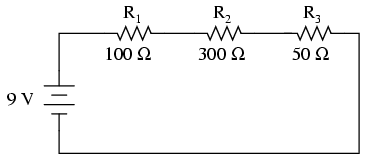
The picture shows an electrical circuit. This circuit is a series circuit because: 
a)
It has 3 light bulbs.
b)
The same current flows through all three light bulbs.
c)
It uses a single battery.
d)
The electrical current is divided between the three light bulbs.
62.
The total resistance in this circuit is 
a)
100 ohms
b)
450 ohms
c)
400 ohms
d)
30 ohms
63.
The voltage dropped across the 300 ohm resistor is 
a)
6 V
b)
9 V
c)
2 V
d)
30 V
64.
As resistors are added in series to a circuit, the total resistance will...
a)
increase
b)
decrease
c)
stay the same
65.
As the resistance of a circuit increases, the current will...
a)
increase
b)
decrease
c)
stay the same
66.
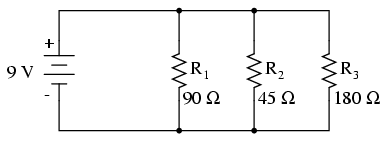
The current going through the 45 ohm resistor is 
a)
0.05 amps
b)
0.2 amps
c)
0.1 amps
d)
5 amps
67.
What will happen if one light bulb is removed from this circuit?
a)
The other bulbs will go out.
b)
The other bulbs will stay on
c)
The other bulbs will get dimmer.
d)
The battery will become stronger.
68.
An incomplete circuit is shown.
To complete the circuit, a wire should be placed from —
a)
Point D to Point C
b)
Point B to Point C
c)
Point A to Point D
d)
Point B to Point D
69.
Which bulbs will light?
a)
1 and 2
b)
2 and 3
c)
3 and 4
d)
4 and 2
70.
Which is NOT true of a series circuit
a)
One light bulb can be broken and other lights will still work.
b)
All loads are a single loop
c)
Adding more loads will lessen the current in the loop
71.
In Circuit A, what will happen if bulb B burns out?
a)
Both bulb A and bulb C will go out.
b)
Bulb A will stay lit, but bulb C will go out.
c)
Bulb A and bulb C will stay lit.                       
d)
Bulb A will go out, but bulb C will stay lit.     
72.
In Circuit B, what will happen if bulb F burns out?
a)
Both bulb D and bulb E will go out.
b)
Bulb D will stay lit, but bulb E will go out.
c)
Bulb D and bulb E will stay lit.                       
d)
Bulb E will go out, but bulb E will stay lit.     
73.
In Circuit C, what will happen if bulb G burns out?
a)
Both bulb H and bulb I will go out.
b)
Bulb H will stay lit, but bulb I will go out.
c)
Bulb H and bulb I will stay lit.                       
d)
Bulb H will go out, but bulb I will stay lit.     
74.
In Circuit A, the current at location 1 is _____ the current at location 2.
a)
greater than
b)
equal to
c)
less than
75.
Which bulb burning out would mean that no current could flow through the circuit?
a)
A
b)
B
c)
C
d)
D
76.
A class prepared some electrical circuits using battery, connecting wires, and three light bulbs.  Which of these circuits can make the three bulbs light?
a)
A
b)
B
c)
C
d)
D
77.

What is the current through 2ohm resistor?

a)

0.2 Ampere

b)

5.0 Ampere

c)

0.8 Ampere

d)

8 Ampere

78.

What will happen to the total current of a parallel circuit,if a resistor is removed from the connection?

a)

total current remains the same

b)

total current decreases

c)

total current increases

d)

none of the above

79.
A physics student is given three 12-ohm resistors with instructions to create the circuit that would have the lowest possible resistance. The correct circuit would be a 
a)
parallel circuit with an equivalent resistance of 4.0 ohms
b)
series circuit with an equivalent resistance of 4.0 ohms
c)
parallel circuit with an equivalent resistance of 36 ohms
d)
series circuit with an equivalent resistance of 36 ohms 
80.
Three resistors of 20. ohms, 30. ohms, and 60. ohms are connected in series with a battery. A current of 2 amperes will flow through this circuit when the potential difference of the battery is 
a)
10. V
b)
220 V
c)
110 V
d)
20. V 
81.
Two identical resistors connected in series have an equivalent resistance of 4 ohms. The same two resistors, when connected in parallel, have an equivalent resistance of 
a)
8 Ohms
b)
2 Ohms
c)
4 Ohms
d)
1 Ohms
82.
At which positition should an ammeter be placed to measure the current passing only through R1?
a)
1
b)
2
c)
3
d)
4
83.
In which current would ammeter A show the greatest current? 
a)
1
b)
2
c)
3
d)
4
84.
What is the potential difference across the source in the circuit shown?
a)
220 V
b)
440 V
c)
120 V
d)
60. V
85.

What is the total resistance in the circuit?

a)

10 ohms

b)

6 ohms

c)

4 ohms

d)

2.4 ohms

86.

What is the total current through the battery?

a)

0.75 A

b)

1.5 A

c)

3 A

d)

0.33 A

87.

What is the current through the 2 ohm resistor?

a)

0.75 A

b)

1.5 A

c)

3 A

d)

0.33 A

88.

What is the current through the 4 ohm resistor?

a)

1.5 A

b)

3 A

c)

2 A

d)

0.75 A

89.

What is the voltage drop over the 4 ohm resistor?

a)

6 V

b)

3 V

c)

2 V

d)

1 V

90.

Solve for total circuit resistance

a)

140 Ohms

b)

75 Ohms

c)

90 Ohms

d)

65 ohms

91.

The wattage being dissipated at R2 is _______________ W.

a)

27

b)

12

c)

15

d)

36

92.

The voltage drop across R1 is ______________________________ V.

a)

20

b)

30

c)

40

d)

50

93.
Two resistors have the same resistivity and cross-sectional area. One is twice as long as the other. What is the voltage on the longer resistor? 
a)
12 V
b)
8 V
c)
6 V
d)
4 V
94.
a)

i1 + i5 +i4 = i2 + i3

b)

i1 + i5 +i3 = i2 + i4

c)

i5 + i2 +i4 = i1 + i3

d)

i1 + i5 = i2 + i3 + i4

95.

Which equations are correct?

a)

ε1 - i1R1 - i2R2 = 0

b)

ε1 + ε2 + i3R3 - i2R2 = 0

c)

ε1 - i2R1 - i2R2 = 0

d)

ε1 - ε2 - i3R3 + i2R2 = 0

96.
a)
Circuit X is brighter than circuit Y
b)
Circuit Y is brighter than circuit X
c)
Both circuits have the same brightness
d)
Neither circuit will light the bulbs
97.
a)
A2 = A3
b)
A2 + A3 = A1
c)
A1 + A2 = A3
d)
A4 = A2 - A3
98.
a)
all bulbs are lit equally
b)
the two top bulbs are brighter
c)
the single lower bulb is brighter
d)
the single bulb does not light and the other two are dim
99.
when the switch is closed.....
a)
both bulbs TURN ON
b)
both bulbs STAY ON
c)
both bulbs TURN OFF
d)
both bulbs STAY OFF
100.
Assuming each resistor has the same resistance, which resistor will have the greatest current?
a)
R1
b)
R5
c)
R6
d)
R7
101.

Draw a circuit with a battery connected to four resistors, R1, R2, R3, and R4, as follows. Resistors R1 and R2 are connected in parallel with each other, resistors R3 and R4 are connected in parallel with each other, and both parallel sets of resistors are connected in series with each other across the battery.

a)
b)
c)
d)
102.
Each of the four capacitors shown is 500 mF.  The voltmeter reads 1000V.  The magnitude of the charge on each capacitor plate is:
a)
0.2 C
b)
0.5 C
c)
20 C
d)
50 C
103.
Capacitors C1 and C2 are connected in parallel and a potential difference is applied to the combination. If the capacitor that is equivalent to the combination has the same potential difference, then the charge on the equivalent capacitor is the same as: 
a)
the charge on C1
b)
the sum of the charges on C1 and C2
c)
the difference of the charges on C1 and C2
d)
the product of the charges on C1 and C2
104.
A charged particle travelling horizontally enters a uniform electric field. Which of the following is true?
a)
The charge must be positive
b)
The charge must be negative
c)
Both plates are positively charged
d)
The bottom plate only is positively charged
105.
As electrons move, they make
a)
A. electromagnetism.
b)
B. auroras.
c)
C. ferromagnetism.
d)
D. magnetic fields.
106.
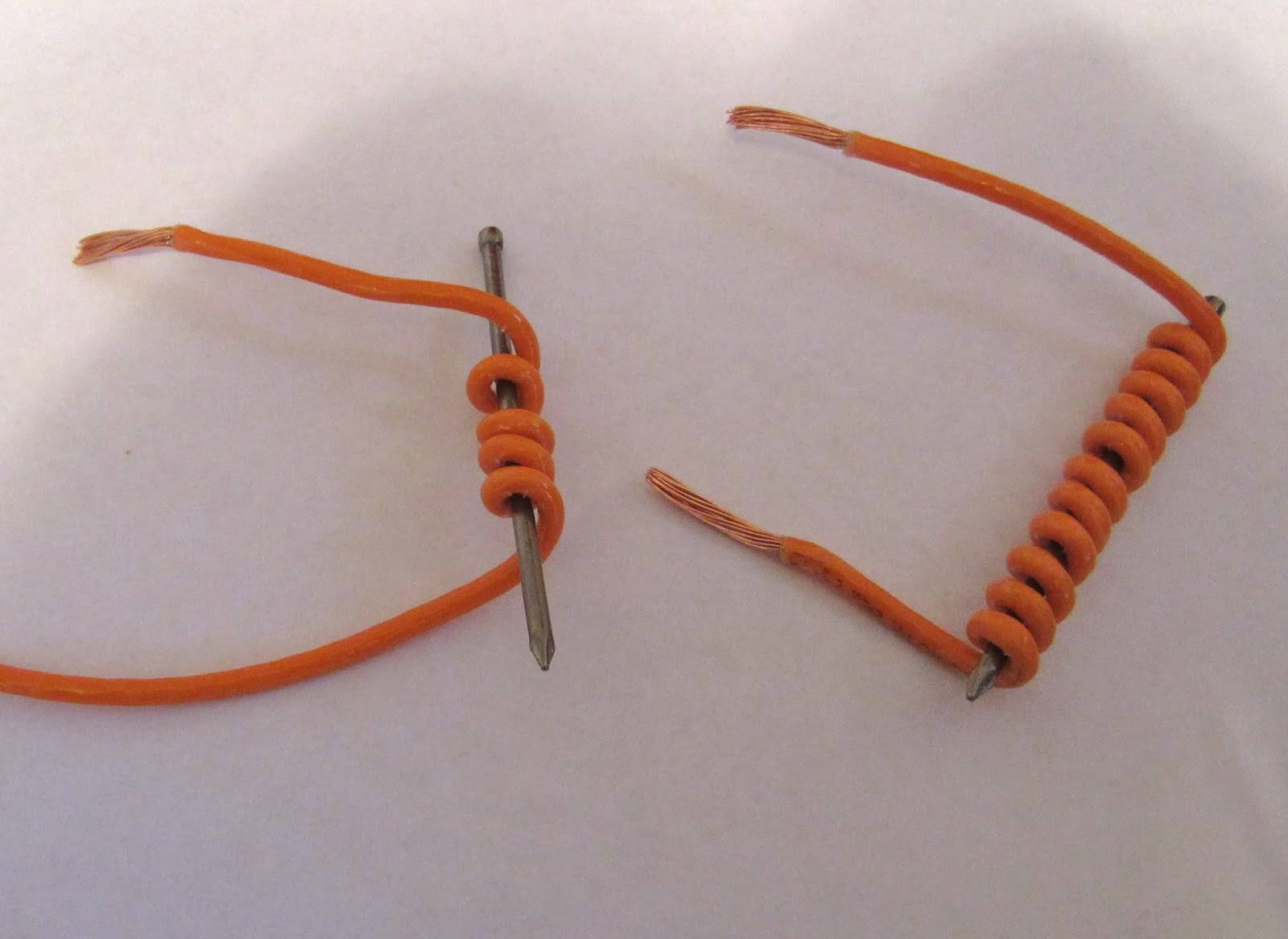
What happens to the strength of an electromagnet as you add more coils around it?
a)
Increases
b)
Decreases
c)
Stays the same
d)
Stops completely
107.

A magnetic field is produced by the current in a long straight wire. The strength of the magnetic

field increases if

a)

The magnitude of the current increases

b)

The distance from the wire increases

c)

The length of the wire increases

108.

Which electromagnet is the strongest?

a)
b)
c)
d)
109.
What does the following represent?
⊗⊗⊗⊗⊗⊗⊗⊗⊗⊗⊗⊗⊗⊗⊗⊗
⊗⊗⊗⊗⊗⊗⊗⊗⊗⊗⊗⊗⊗⊗⊗⊗
⊗⊗⊗⊗⊗⊗⊗⊗⊗⊗⊗⊗⊗⊗⊗⊗
a)
Multiplied by a billion
b)
A piece of modern art
c)
Uniform magnetic field directed into the screen away from you
d)
Uniform magnetic field directed out of your screen at you
110.
What does the following represent?
⊙⊙⊙⊙⊙⊙⊙⊙⊙⊙⊙⊙⊙⊙⊙
⊙⊙⊙⊙⊙⊙⊙⊙⊙⊙⊙⊙⊙⊙⊙
⊙⊙⊙⊙⊙⊙⊙⊙⊙⊙⊙⊙⊙⊙⊙
a)
A crowd with binoculars
b)
A bunch of coaxial cables 
c)
Uniform magnetic field directed into the screen away from you
d)
Uniform magnetic field directed out of your screen at you
111.
Are the magnetic field lines in the picture correct?
a)
Yes, because they point from north to south.
b)
No, because they point from north to south (they're supposed to go the other way).
c)
Yes, because the North pole is on the left in all pictures.
d)
No, because the North pole is on the left in all pictures (it's supposed to be on the right).
112.

A coil of wire with a current is called a _______. The two ends of this act like the poles of a magnet. It is a weaker electromagnet.

a)

compass

b)

bar magnet

c)

solenoid

d)

circuit

113.
How is energy being transferred in the scenario shown below?
a)
Potential --> Kinetic
b)
Kinetic --> Potential
c)
Kinetic --> Kinetic
d)
Neither
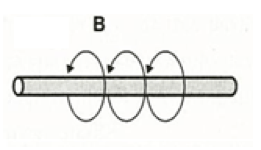
114.

1) A wire carries a current, creating a magnetic field around itself as shown. The current in the wire is:

a)

A. Directed to the right

b)

A. Directed to the left

c)

A. Equal to the magnetic field

d)

In the same direction as the magnetic field
115.

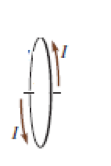
1) The magnetic field inside the coil shown below is directed:

a)

Into the page

b)

Out the Page

c)

To the left

d)

Towards the bottom of the page

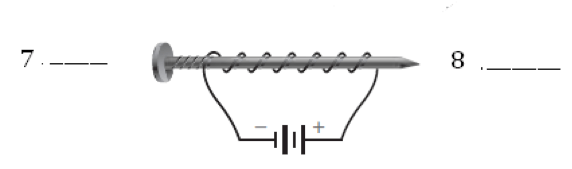
116.

1) In the figure, using the right hand rule around a solenoid, which of the below statements is correct:

a)

North Pole is 7 and South pole is 8

b)

North Pole is 8 and South Pole is 7

c)

There is no magnet, so no north or south

d)

The current is flowing in the direction from 7 to 8

117.

1) A straight wire carries a current inside the paper. What is the direction of the magnetic field at point P?

a)

Points to the right

b)

Points to the left

c)

Points to the top of the page

d)

Points to the bottom of the page

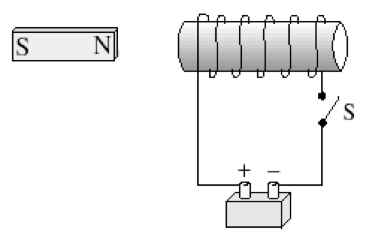
118.

1) A bar magnet is at rest, next to a fixed electromagnet. In which direction will the bar magnet move when switch S is closed?

a)

to the left

b)

to the right

c)

up the page

d)

down the page

119.

Two parallel wires of length 2 m are separated by 40 cm. If the magnetic force between the two wires is 2 ×10^-6 N and the current in the second wire is twice the current in the first one.

1) Which of the following is true concerning the force between the two wires:

a)

The magnetic force is a repulsion between wires

b)

The magnetic force is an attraction between the wires

120.

1) Two long, parallel wires each carry the same current I in the same direction. Is the total magnetic field at the point midway between the wires:

a)

Zero

b)

Directed into the page

c)

Directed out of the page

d)

Directed to the left

121.

1) Solenoid A has length L and N turns, solenoid B has length 2L and N turns, and solenoid C has length L/2 and 2N turns. If each solenoid carries the same current, rank by the strength of the magnetic field in the center of each solenoid from largest to smallest.

a)

A, B, C

b)

A, C, B

c)

B, C, A

d)

C, A, B

122.

1) Which of the following actions would double the magnitude of the magnetic force per unit length between two parallel current-carrying wires? Choose all correct answers.

a)

Double one of the currents.

b)

Double the distance between them.

c)

Double both currents.

d)

None of the above

123.

1) A wire carries current I directed to the right as shown in the figure below. What is the direction of the magnetic field generated by the wire at point A?

a)

To the right

b)

To the left

c)

Toward the wire

d)

Into the page

124.

A wire has a current travelling through towards the left. If it is in a magnetic field directed downward, what direction will the wire experience a force?

a)

Up

b)

down

c)

out of page

d)

into page

125.

Which method of charging does not change the overall charge on any object involved?

a)

Induction

b)

Conduction

c)

Reduction

d)

Triboelectric