
 Worksheets
4.0 Heat
Total questions: 120
Worksheet time: 4hrs 39mins

Which is NOT a way that heat can be produced?
electricity
rubbing your hands together
fire
rain
What is the earth's main source of heat?
the moon
the sun
the ocean
forests
What is a conductor?
a material that heat moves through easily
a material that heat does not move through easily
a material that turns cold when heated
a tool for measuring temperature
What is an insulator?
a material that heat moves through easily
a material that heat does not move through easily
a material that turns cold when heated
a tool for measuring temperature
Which of these is a better insulator?


Which of these is a measure of how hot or cold something is?
temperature
radiation
insulation
friction
The law of conservation of energy describes how the amount of total energy can change in a closed system. Which of these statements correctly describes this law?
The amount of kinetic energy in a system is a constant value.
Energy can be converted from one form into another, but it cannot be created or destroyed.
An object can have potential energy or kinetic energy, but not both at the same time.
The amount of energy created when an object moves is equal to the energy destroyed when it stops moving.

The graph below represents the relationship between the temperature of 2.0 kilograms of a pure substance and the heat energy added to the substance.
AB, only
BC, only
BC and DE
AB and CD

A substance of mass 2.0 kilograms is originally in the solid state. The graph below represents the temperature of the substance as heat is added to it. During which interval is the average kinetic energy of the molecules of the substance unchanged?
BC
CD
AB
AC
How is temperature related to heat?
Temperature is a measure of the heat of an object.
Heat causes a change in the temperature of an object.
Raising the temperature causes the heat of an object to increase.
Temperature and heat are two different ways to measure the same thing.
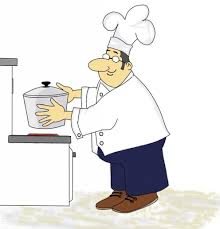
Zara is warming a pot of soup on the stove. How is the motion of the particles in the soup different after the temperature of the soup increases?
They move faster on average.
They have less average energy.
They move less freely.
They vibrate and are close together
The temperature of 50.0 grams of water was raised to 50.0°C by the addition of 4200 joules of heat energy. What was the initial temperature of the water?
10.0°C
20.0°C
30.0°C
60.0°C


If heat is lost by an object, the temperature of the object will
rise
fall
remains unchanged
When a piece of copper is heated, which of the following physical quantities remains constant?
surface are
volume
density
mass
When a piece of copper is heated, which of the following physical quantities remains constant?
surface are
volume
density
mass

The figure shows two objects P and Q which are in thermal contact with each other. Which of the following statements is true?
Heat flows from object P to object Q only.
Heat flows from object Q to object P only.
Heat flows in both directions.
The net flow of heat is zero.
Which of the following statements about heat is true?
Heat is not a physical quantity.
Heat is measured in 0C.
Heat is a form of energy.
Heat is the degree of hotness of an object.

The diagram shows two bodies X and Y which are in thermal equilibrium with each other. Which of the following statements is true?
The temperature of X and Y is the same
The weight of X and Y is the same.
The volume of X and Y is the same.
Both X and Y must be solids.

The diagram shows part of the scale of a thermometer. What is the reading as shown?
23.2 0C
23.4 0C
23.8 0C
24.4 0C
“The specific heat capacity of metal R is 450 J kg-1 0C-1.” The statement means that
450 J of heat is required to increase the temperature of metal R by 10C.
450 J of heat is required to increase the temperature of 1 kg of metal R by 10C.
450 J of heat is required to melt 1 kg of metal R.
450 J of heat is required to increase 1 g of metal R form 00C to 1000C.
Lead has a higher specific heat capacity than copper. If a piece of lead of mass 200 g and a piece of copper of the same mass is heated at the same rate, which of the following statements is true?
The rise in temperature of copper is greater than the rise in temperature of lead
The rise in temperature of lead is greater than the rise in temperature of copper.
Both metals experienced the same increase in temperature.
What is the name given to the amount of heat required to change 1 kg of ice at 00C completely to water?
Heat capacity
Specific heat capacity
Specific latent heat of fusion
Specific latent heat of vapourisation.
The unit of measurement of heat is
Newton
Newton -metre
Kelvin
Pascal
In which of the following gas laws is the pressure kept constant?
Boyle's Law
Charles' Law
Pressure Law
For a fixed mass of gas at constant temperature in an air-tight container, which of the graphs correctly represents the relationship between pressure and volume of the gas


Which law states that for a given mass of gas at constant volume, the pressure of the gas is directly proportional to its thermodynamic temperature?
Boyle's Law
Charles' Law
Pressure Law
Hooke's Law
What is the physical quantity that is kept constant in Boyle’s Law, Charles’ Law and Pressure Law?
Mass
Volume
Absolute Temperature
Pressure
How much heat energy is required to raise the temperature of a 4kg iron bar from 320C to 520C? (Specific heat capacity of iron = 452 Jkg-1 0C-1).
(a)
Calculate the amount of heat required to raise the temperature of 0.8 kg of copper from 350C to 600C. (Specific heat capacity of copper = 400 J kg-1 C-1).
(a)

It is possible to cook food much faster with a pressure cooker as shown above. Why is it easier to cook food using a pressure cooker?
More heat energy can be supplied to the pressure cooker
Heat loss from the pressure cooker can be reduced
Boiling point of water in the pressure cooker is raised
Food absorbs more heat energy from the high pressure steam
A gas of volume 20m3 at 370C is heated until its temperature becomes 870C at constant pressure. What is the increase in volume?
3.23 0C
5.20 0C
23.2 0C
32.2 0C
In the process to transfer heat from one object to another object, which of the following processes does not involve a transfer to material?
Convection
Radiation
Evaporation
Vaporisation

The graph in figure below shows how the temperature of some wax changes as it cools from liquid to solid. Which section of the graph would the wax be a mixture of solid and liquid?
PQ
QR
RS
ST

The specific heat of platinum is 0.133 J/g°C. How much heat(Q) is released when a 10 g piece of platinum cools from 100°C to 50°C?
66.5 J
665 J
0.0266 J
0.665 J
20 g of water. specific heat of water is 4.18 J/g°C. temperature changes from 25° C to 20° C, how much heat energy (Q) moves from the water to the surroundings?
418 J
209 J
83 J
4.18 J
The SI units J/g°C measures
Specific heat
mass
temperature
heat energy

Determine the heat energy needed to heat the water in the pot to boiling.
Latent heat is
the heat absorbed or released at a boiling process during a change of phase
the heat absorbed or released at a constant temperature during a change of phase
the heat absorbed or released at a constant temperature during a change of phase of 1 kg object
the heat absorbed or released by an object to increase or decrease its temperature by 1 degree Celcius
The heat absorbed by melting a solid is known as
latent heat of fusion
latent heat of solid
latent heat of liquid
latent heat of vaporisation
The amount of heat required to change the phase of a substance depends on two factors which are
surrounding temperature
temperature change
material
the mass
specific latent heat of vaporisation is
the amount of heat required to change 1 kg of the substance from the solid to liquid phase without change in temperature
the amount of heat required to change 1 kg of the substance from the liquid to gaseous phase without change in temperature
the amount of heat required to change the temperature 1 kg of the substance by 1 degree Celcius
the symbol for specific latent heat is
c
L
Q
m
What is the formula to calculate specific latent heat of vaporisation?
L = Q/m
c = Q/(mΔƟ)
Q = mcΔƟ
Q = mL

The graph shows the cooling curve of a substance. At which stages the specific latent heat released?
AB and CD
BC and DE
AB and EF
BC and CD
When a body absorbs heat, its temperature will
increase.
decrease.
remains constant.
Which statement defines the thermal capacity (heat capacity) of a solid body?
the energy needed to melt the body without a change in temperature
the energy needed to raise the temperature of the body by one degree Celsius
the increase in the volume of the body when its temperature is raised by one degree Celsius
the total amount of internal energy in the body


One goes up, one goes down.
Boyle's Law
Charles Law
BOTH go up OR down
Boyle's Law
Charles' Law
IF we are using Charles' law and our Volume goes UP, what must our temp do?
Go UP
Go DOWN
Stay the same
Wrong law.
IF we are using Boyles' law and our Pressure goes UP, what must our volume do?
Go UP
Go DOWN
Stay the same
Wrong law.
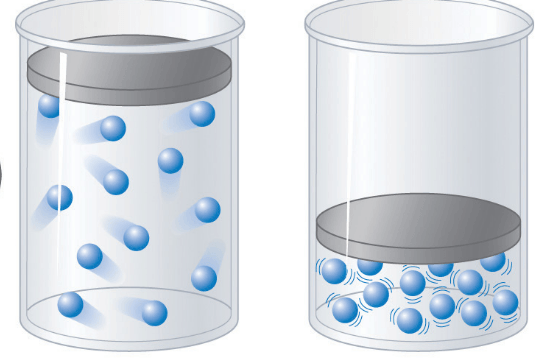

Hint: Boyle's Law
It is the average kinetic energy of gas molecules.
Amount of gas
Pressure
Temperature
Volume
It states that the volume of a gas changes inversely with the pressure of the gas as long as the temperature and the amount of gas remain constant.
Avogadro’s Law
Boyle’s Law
Charles’ Law
Newton’s Law
If you heat gas in a closed container that cannot expand, the gas will increase in
volume
pressure
mass
weight
What type of relationship exists between the temperature and volume of a gas?
inverse relationship
direct relationship
reverse relationship
none of the above

The graph for the Charles' law is
True
False
Heating a gas gives its particles
more energy.
greater speed.
a higher temperature.
all of the above.
A hot air balloon inflates because it is pumped full of helium.
True
False
When the pressure of a gas is held constant, increasing its temperature ______________ its volume.
Increases
Decreases
Pressure is always a...
Push
Pull
Taco
Mouse
Pressure always moves from...
High pressure to Low pressure
Low pressure to High pressure
Low pressure to Low pressure
High pressure to High Pressure

Which container will have lower pressure?
Right
Left
Boyle's Law is the relationship between...
Volume and Pressure
Volume and Temperature
Pressure and Temperature
Mass and Volume

A sample of a gas in a cylinder is shown. If the temperature is kept constant and the piston moves down to decrease volume, the pressure increases because the gas particles...
Expand
Become smaller
Lose velocity within the container
Collide more often within the container
Charles' Law is the relationship between...
Pressure and Volume
Pressure and Temperature
Volume and Temperature
Mass and Volume

The following graph shows ______ law.
Charles' Law
Boyle's Law
Newton's Law
Gases have...
A definite shape and volume
A definite shape but no definite volume
No definite shape but a definite volume
No definite shape or volume
In gases, pressure is
directly proportional to volume
inversely proportional to volume
directly proportional to friction
inversely proportional to heat
Gas pressure is caused by
Gas molecules heating up
Gas molecules reacting with other gas molecules
Gas molecules hitting the walls of a container
Gas molecules hitting other gas molecules
Gauge Pressure is the difference between air and gas pressure
False
True

The formulae of Pressure law is given by
P1T1 =P1T2
P1T2=P2T1
P1/T1 = P2/T2
P1/T2 = P2/T1
If the pressure in a car tire is 1.88 atm at 25°C, what will be the pressure if the temperature warms to 37°C?
2.78atm
1.96atm
1.96kPa
2.76atm

