
 Worksheets
Ultimate 3rd Quarter Exam Review
Total questions: 124
Worksheet time: 2hrs 27mins
What are the different types of waves?
Mechanical, electromagnetic, matter
Transverse, longitudinal, surface
Sound, light, water
What are the parts of a wave?
Crest, trough, wavelength, amplitude
Frequency, period, speed
Compression, rarefaction
What is potential energy?
Energy due to position or configuration
Energy due to motion
Energy due to rest
What is power in physics?
Rate at which work is done
Rate at which energy is transferred
Rate at which force is applied
What are the properties of waves?
Reflection, refraction, diffraction, interference
Speed, frequency, wavelength
Pitch, loudness, quality
What is the formula for momentum?
p=mv
F=ma
E=mc^2
What is the law of conservation of momentum?
Total momentum of an isolated system remains constant
Momentum is always conserved
Momentum can be created or destroyed
What is the law of conservation of energy?
Energy cannot be created or destroyed, only transformed
Energy can be created or destroyed
Energy remains constant in a closed system
What is kinetic energy?
Energy of motion
Energy of position
Energy of rest
What is the work-energy theorem?
The work done on an object is equal to the change in its kinetic energy
The work done on an object is equal to the change in its potential energy
The work done on an object is equal to the change in its total energy
What is the definition of wave speed?
The speed at which a wave travels through a medium
The speed of light
The speed of sound
What are the different types of collisions?
Elastic, inelastic, perfectly inelastic
Head-on, rear-end, side-impact
High-speed, low-speed, medium-speed
What is work in physics?
Transfer of energy
Transfer of mass
Transfer of force
What is the equation for impulse?
Δp = Ft
F=ma
E=mc^2
What are the properties of sound waves?
Reflection, refraction, diffraction, interference
Speed, frequency, wavelength
Pitch, loudness, quality
What is the definition of wave interference?
When two or more waves meet and combine to form a new wave
The bending of waves around obstacles and the spreading of waves after passing through an opening
The change in direction of a wave when it hits a surface at an angle
What is the principle of superposition of waves?
When two or more waves overlap, the resulting wave is the sum of the individual waves
Waves can be reflected, refracted, or diffracted
Waves can travel through different mediums at different speeds
What is the definition of wave interference?
When two or more waves meet and combine to form a new wave
The bending of waves around obstacles and the spreading of waves after passing through an opening
The change in direction of a wave when it hits a surface at an angle
What is the definition of wave speed?
The speed at which a wave travels through a medium
The speed of light
The speed of sound
What is the definition of wave reflection?
When a wave bounces off a surface
The bending of waves around obstacles and the spreading of waves after passing through an opening
The change in direction of a wave when it hits a surface at an angle
What is the principle of diffraction of waves?
Waves can be reflected, refracted, or diffracted
When two or more waves overlap, the resulting wave is the sum of the individual waves
Waves can travel through different mediums at different speeds
What is the definition of wave diffraction?
Waves can be reflected, refracted, or diffracted
When two or more waves overlap, the resulting wave is the sum of the individual waves
Waves can travel through different mediums at different speeds
What is the equation for calculating the speed of a wave?
v = fλ
v = E/h
v = p/m
What is the principle of superposition of waves?
When two or more waves overlap, the resulting wave is the sum of the individual waves
Waves can be reflected, refracted, or diffracted
Waves can travel through different mediums at different speeds
What is the definition of wave frequency?
The number of complete waves that pass a point in a certain amount of time
The distance between two consecutive crests or troughs of a wave
The maximum displacement of a wave from its equilibrium position
What is the principle of wave reflection?
When a wave bounces off a surface
The bending of waves around obstacles and the spreading of waves after passing through an opening
The change in direction of a wave when it hits a surface at an angle
What is the equation for calculating the wavelength of a wave?
λ = v/f
λ = T/f
λ = vT
The momentum of an object depends upon the object's ___________&_____________.
size and shape
mass and speed
mass and veloctiy
mass and energy


Which of the following situations shows that work is done?
teacher sitting on a chair
book resting on a table
key chain hanging from a bag
a ball being rolled on the floor
In which of the following situations is work NOT done?
pushing a cart in a store
shooting a basketball
holding a 20 pound box above the floor
running a mile
In which of this cases is work being done?
a student sleeping
a student pushing a locked door
a student carrying his chair into another room
a student sitting on the carpet
If you push a cart with a force of 60 N for 2 m. How much work have you done?
120 J
30 J
120 N
30 N

It took 500 Newtons of force to push a car 4 meters. How much work was done?
2000 J
125 J
0.008 J
500 J
If 68 Joules were necessary to move a 4 Newton crate, how far was the crate moved?
272 m
17 m
4.05 m
272 cm
Two people push on a wall with 100 N. The wall doesn’t move. How much work is done?
100 J
100 N
0 J
0 N
Andrew who weighs 80 kg, uses 180 N of force to get him up the slope. The vertical distance is 2 m and the diagonal is 10 m. Calculate the work he does.
160 J
1,600 J
1,800 J
3,600 J
It is done when a force that is applied to an object moves that object.
Work
Energy
displacement
force
__________ is the ability to do work
Displacement
Power
Energy
Force
Two factors that determine work are ____________
force and speed
speed and energy
force and displacement
displacement and speed
You do work only when you exert a force on an object and move it. (TRUE OR FALSE)
True
False
Maybe
None of the above
Which of the following is an example of work being done?
Teacher sitting in a chair
Keys hanging from a key chain
A man pushing a wall
A ball being rolled on the floor
________ is a method of transferring energy
distance
force
energy
work

Is this an example of work?
YES
NO
MAYBE

Is this an example of work?
YES
NO
MAYBE

Is this an example of work?
YES
NO
MAYBE
What are the two major forms of energy?q
Light and Sound Energy
Heat and Mechanical Energy
Kinetic and Potential Energy
Electrical and Magnetic Energy
It is defined as the ability to do work.
inertia
energy
interaction
none of the above
Which among the following is defined as the energy in motion?
potential energy
kinetic energy
thermal energy
chemical energy

Which among the two has more potential energy?
yellow skier
blue skier
none of the two
Which statement shows kinetic energy?
a picture frame hanging on the wall
a boy sitting on the bench
a stretched rubber band
a leaf falling from a tree
You threw a ball with a mass of 1 kg. It leaves your hand with a velocity of 3 m/s2 . How much kinetic energy does the ball have?
4.5 J
3 J
9 J
6 J
Which among the following has a greater potential energy?
a 2kg ball on the floor
a 5g feather on the top of a 3m roof
a 1kg drone hovering 200m above the ground
a 2000kg truck parking at the roadside
Which of the following factors has a more significant effect on determining kinetic energy?
mass
velocity
What is the correct formula for kinetic energy?
KE = 1/2 mv
KE = 1/2 mv2
KE = mgh
KE = mv2
What is the unit of measurement for energy?
kilograms
m/s2
Newton
Joule
There is a bell at the top of a tower that is 50 m high. The bell weighs 100N. How much potential energy does the bell has?
500 J
5000 J
50000 J
50 J
It is the ability of an object to perform work.
Energy
Force
Power
Which of the following situations shows that WORK is done on an object?


True or False. Work is done when the applied force is parallel to the object's displacement.
True
False
What is the SI unit of work?
Joule
Newton
Pascal
Watt
Energy in motion is also called (a) Energy.

Which of the following energy is/are present in the animation? Check all that applies.
Thermal
Electrical
Light
Which of the following is a Non-Renewable source of energy?


How much work is done on an object if the amount of force applied is 50 N and the object was displaced by 2 meters from its original position?
100 J
25 J
100 W
25 W
Mathematically, work is the (a) of force and displacement.
Which of the following is/are form/s of kinetic energy? Check all that applies.
Chemical Energy
Electrical Energy
Thermal Energy
Nuclear Energy

What does your Pie Chart look like at Point A?


What does your Pie Chart look like at Point C?
What does your Pie Chart look like at Point E?
What does your Pie Chart look like at Point F?


Which 2 letters have the most potential energy?
W & Y
X & Z

MOST potential energy
A
B
C
D

MOST potential Energy
A
B
C
D
At which point is kinetic energy greatest?
W
X
Y
Z
MOST kinetic Energy
A
B
C
D
MOST kinetic energy
A
B
C
D
LEAST kinetic Energy
A
B
C
D
Which 2 letters have the LEAST kinetic energy?
W & Y
X & Z
Which point has the most potential energy?
G
F
B
A
Which point has maximum kinetic energy ?
Location G
Location B
Location E
Location D
Which two factors influence the amount of kinetic energy an object has?
Height and Mass
Height and Speed
Speed and Mass
Location and Force
Which two factors influence the amount of potential energy that an object has?
Height and Mass
Speed and Mass
Height and Speed
Force and Speed
What is potential energy?
The energy an object has due to its atomic structure
The energy an object has due to its chemical composition
The energy an object has due to its motion
The energy an object has due to its position or condition
What is kinetic energy?
The energy an object has due to its position or condition
The energy an object has due to its motion
The energy an object has due to its chemical composition
The energy an object has due to its atomic structure
Why do objects at high elevations have more potential energy than objects at low elevations?
Because the thinner air at higher elevations means objects have a greater potential to move very fast
Because objects at high elevations are closer to the sun, which is the source of all energy on earth
Because objects at high elevations tend to move slower than objects at low elevations
Because gravity gives objects at high elevations the potential to fall much further

Why does the nickel have double the kinetic energy compared to the penny?
The mass of the nickel is double the amount of the penny.
The speed of the nickel is double the amount of the penny.
The nickel does not have double the kinetic energy of the penny as they are equal.
The nickel is more shiny than the penny so its kinetic energy is higher.
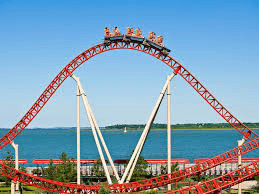
When a roller coaster is at the top of a hill it has
high potential energy.
high kinetic energy.
low potential energy.
equal amounts of kinetic and potential energy.
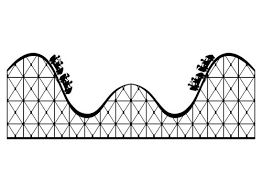
When a roller coaster is at the bottom of a hill it has
high potential energy.
high kinetic energy.
low kinetic energy.
equal amounts of kinetic and potential energy.

Which passenger has the most potential energy?
A
B
C
D
Conservation of energy means that
energy can be created but not destroyed.
energy can be destroyed but not created.
energy can both be created and destroyed.
energy can neither be created nor destroyed.
Which is the best example that something has kinetic energy?
a car parked on a steep hill
a tennis ball rolling across the court
a picture hanging on the wall
a piece of coal before it's burned

A skateboarder heads down a smooth, steep course. What graph illustrates the change in kinetic and potential energy during this process?
A
B
C
D

Consider the diagram of a pendulum's motion shown above. A pendulum can be used to model the change from potential energy to kinetic energy and back to potential energy. According to the diagram, where are energy conversions taking place?
A
B
C
A and C
Car A has a mass of 1,000 kg and is traveling 60 km/hr. Car B has a mass of 2,000 kg and is traveling 30 km/hr. Which statement best compares the kinetic energy of Car A with that of Car B? (Hint: Use KE formula)
The kinetic energy is equal between the two cars.
The kinetic energy of Car A is half as much as Car B.
The kinetic energy of Car A is twice as much as Car B.
The kinetic energy of Car A is four times as much as Car B.

Which point on the pendulum's swing represents the minimum potential energy?
A
B
C
A and C



