
 Worksheets
Grade Recovery # 1 - Nature of Science and Physical Science
Total questions: 40
Worksheet time: 21mins
Gregor Mendel conducted research about genetics by breeding pea plants. Although he could not actually see into cells, he deduced from his results that each of an organism’s traits is determined by two factors (alleles). Long after Mendel’s work, microscopes were improved, and scientists observed that chromosomes in the nucleus occurred in matching pairs. It is now accepted that the two alleles for each trait are located on homologous chromosomes. What does this demonstrate about science?
Advances in science may result from new interpretations of previous work
Improvements in equipment and data gathering can disprove previous conclusions
Earlier scientists did not have the proper equipment and materials to make their conclusions
Much of early scientific research was faulty because the earlier scientists did not practice the same data-gathering practices as modern scientists
During the nineteenth century, biologists knew that South America and Africa contained similar fossils. These fossils let them believe that a temporary land bridge between South America and Africa allowed ancient species to move between both continents. In the twentieth century, evidence showed that South America and Africa were once part of the same larger continent and that there were no land bridges between them. How should biologists respond to the new geological findings?
Biologists should reject the geological finding, because it is new
Biologists should ask physicists what to do, because physics is a more exact science
Biologists should reject the belief in ancient species, because there were no land bridges
Biologists should update the history of life, because it should include the new geological finding
Elements on the periodic table are arranged into vertical columns called groups. Which of the following is true of the elements in a group?
Only elements within a group can bond together to form compounds
Elements in a group have the same number of neutrons
Elements in a group have the same number of protons
Elements in a group have similar properties
When formulating a new recipe, food scientists take detailed notes of their procedures and record carefully measured amounts of the ingredients. Different scientists will then follow the steps in the recipe and compare the final products. Why is it important for other food scientists to review new recipes before they are sold to the public?
To determine if the researcher is creating the most nutritious recipes
To make sure that they get the most profit from the new product
To ensure that the recipe can be replicated easily by others
To ensure that the recipe can be repeated by themselves
A group of scientists has been asked to conduct a study on how an oil spill will affect the surrounding sea life. The scientists decide that the best way to complete the study is to create a model. Which of the following is the most likely reason that the scientists will use a model instead of creating an actual oil spill study?
They think using a model will provide them with more accurate results
They can study the effects of an oil spill without harming surrounding sea life
They can use different species that the plants and animals found in the real ecosystem
They expect the oil spill in their model to have a much greater effect than an oil spill in the natural environment
Atomic theory, which describes the atoms that make up matter, has been explored for centuries. Scientists in ancient Greece first proposed that matter was made of units called atoms. For many years, scientists thought atoms were solid and could not be divided. Then, in the nineteenth century, scientists began to discover the particles that make up atoms. Modern techniques have allowed scientists to split atoms into increasingly smaller particles. Which of the following statements about theories is supported by the history of the atomic theory?
If new evidence contradicts earlier theories, it is a result of an experimental error
Experiments with modern equipment cannot be used to support earlier theories
A theory is discarded when new evidence contradicts a part of the theory.
Theories can change in response to new evidence.
Allison and Heather are going to conduct an experiment to see whether salt affects the growth of plants. They assemble five groups of identical plants and give the plants in each group water with a different salt concentration. What is the outcome variable (dependent variable) for their experiment?
Salt concentration in plant tissue
Salt concentration in plant water
Amount of water absorbed by plants
Average mass of plants in each group
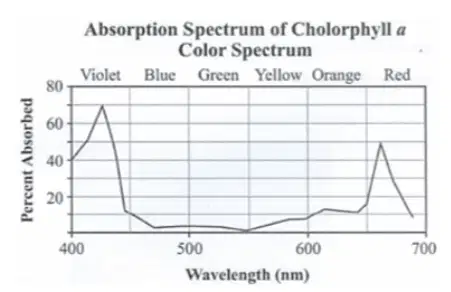
The graph below shows which wavelengths, in nanometers (nm), and corresponding colors of light are absorbed by the plant molecule chlorophyll a. Chlorophyll a is one of the molecules that plants use for photosynthesis.
Which of the following would be an accurate analysis of the information shown?
The least effective color of light for photosynthesis appears to be green
The least effective colors of light for photosynthesis appear to be orange and red
The most effective wavelengths of light for photosynthesis are between 450 and 550 nm.
The lease effective wavelengths of light for photosynthesis are between 600 and 700 nm.
In 1969, Neil Armstrong became the first person to walk on the Moon. Video coverage showing the astronaut walking on the surface of the Moon gives the impression that he was bouncing while he walked. What is the reason for this?
The astronaut's mass on the Moon decreases
The density of astronauts on the Moon is higher than on Earth
The atmosphere of the Moon affects the way the astronaut is able to move
The astronaut's weight on the Moon depends on the Moon's gravitational force
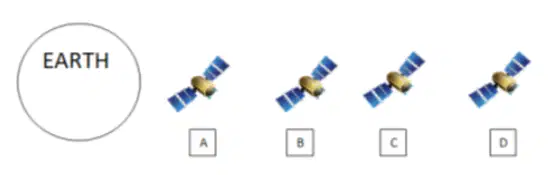
According to the Law of Universal Gravitation, which satellite would experience the least amount of gravitational attraction to the Earth?
Satellite A
Satellite B
Satellite C
Satellite D
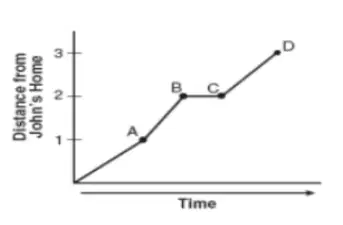
John left his home and walked 3 blocks to his school, as shown in the accompanying graph.
What is one possible interpretation of the section in the graph from point B to point C?
John arrived at school and stayed throughout the day.
John waited before crossing a busy street.
John returned home to get his math homework.
John reached the top of a hill and began walking on level ground.
Dominique and her sister are practicing their basketball skills at the park. If both Dominique and her sister both throw their basketballs at the same time and they hit each other, what would happen to their basketballs?
Only the basketball’s speed would be changed
Only the basketball’s directions would be changed
Both the basketball’s speed and direction would change
Neither the basketball’s speed nor direction would change
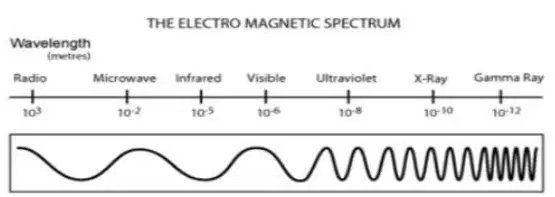
Refer to the electromagnetic (EM) spectrum diagram.
According to the electromagnetic (EM) spectrum diagram, what type of radiation has a larger wavelength than those found in the visible light spectrum?
Ultraviolet Light
Infrared Light
Gamma Ray
X-Ray
When solar radiation crosses space and moves toward Earth, it consists of many types of radiation. Together, these radiation types are known as the electromagnetic spectrum. Which of the following properties differentiates among the different types of radiation found in the electromagnetic spectrum?
amplitudes
wavelengths
temperatures
chemical makeup
As Charlotte watches her popcorn pop in the microwave, she wonders why she can’t see the energy that is heating up the kernels. Why can’t she see the microwaves that are creating the heat?
The energy level of microwaves is too high for us to detect with our eyes
Microwaves are moving too slow for our eyes to detect
The wavelength is too long for us to see with our eyes
Microwaves are moving too fast for our eyes to detect
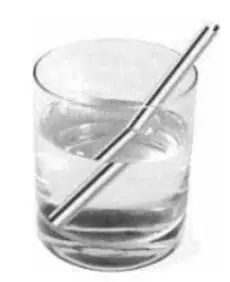
Brady notices that when he places a straw in a glass of water, the image of the straw in water and the image of the straw outside of the water do not match up. What is the reason for the difference in how the straw looks above and below the water?
Light travels faster through water, refracting the image
The surface of the water reflects the image of the straw
Light travels faster through air, refracting the image of the straw
The light is reflected several times in the glass, creating a false image
In science class, you listen to the sound of a tuning fork after it is hit against a cork. When you place the tuning fork to one end of a piece of wood and your ear to the other, you notice that the sound becomes high pitched. What happened to the sound waves as they went through the wood?
They slowed, due to a high pitch echo
They slowed, due to more matter in the wood
They sped up, creating a higher frequency
They sped up, creating a higher wavelength
Sound waves need a medium to move through in order to keep moving. Through which of the following would sound travel the slowest?
Air
Metal
Water
Wood
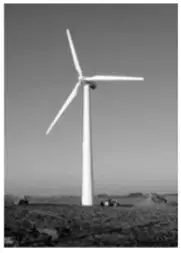
The government is exploring many new green technologies in order to produce energy. One example is the wind turbine. As the wind passes by, the blades move which turns a generator and produces energy. What energy transformation is taking place in the wind turbine?
Kinetic energy transformed to potential energy
Chemical energy is transformed to kinetic energy
Kinetic energy is transformed to mechanical energy
Mechanical energy is transformed to kinetic energy
Harry uses a pulley to put up a bucket of water from a well. Which of the following energy transformations also occurs as the bucket rises from the bottom of the well?
Energy is gained as potential energy is transformed to kinetic energy
Energy is gained as kinetic energy is transformed to potential energy
Energy is conserved as potential energy is transformed to kinetic energy
Energy is conserved as kinetic energy is transformed to potential energy
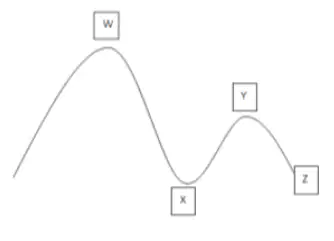
Refer to the diagram of a roller coaster to help you answer this question.
Ryan and his family are visiting a theme park and he wants to ride a roller coaster. At which point in the diagram would he expect to have the greatest amount of potential energy?
Point W
Point X
Point Y
Point Z
Jesse is walking on the sand at the beach one summer day. If heat is not flowing between her feet and the sand, which of the following must be true?
The sand is wet
The sand is too cold for heat to flow
The sand is the same temperature as her feet
There is no friction between her feet and the sand
On a hot summer day in Florida, Sarah was having a picnic with her family. She took a glass, which had been sitting in the Sun, and filled it with ice cubes from a cooler. Then she added lemonade from a thermos jug. Which of the following describes one direction in which heat will flow?
From the ice cube to the glass
From the lemonade to the glass
From the lemonade to the ice cube
From the ice cube to the lemonade
Jeffery brings a book from an air-conditioned apartment to a balcony on a hot summer day. How will the cool book interact with the outside air?
Heat from the book will move to the air.
Heat from the air will move to the book.
Coolness from the book will move to the air.
Coolness from the air will move to the book.
Katie's teacher has given her a sample that contains a mixture of salt, sand, and iron filings. She is instructed to separate the mixture into the three individual components. What would be the best physical property to focus on for the first step in separating the mixture?
Density
Electrical conductivity
Magnetism
Melting point
Jamal is combining salt with water in order to determine its solubility. He notices that after adding ten spoonsful of salt, no more will dissolve into the water. Which statement best explains his observation?
There is not enough solute added to the solution.
The solution has reached its saturation point.
The density of the salt is being change.
The state of the water is being changed.
Mario uses a hot plate to heat a beaker of 50mL of water. He used a thermometer to measure the temperature of the water. The water in the beaker began to boil when it reached the temperature of 100°C. If Mario completes the same experiment with 25mL of water, what would happen to the boiling point?
The water will not reach a boil.
The boiling point of water will increase.
The boiling point of water will decrease.
The boiling point of water will stay the same.
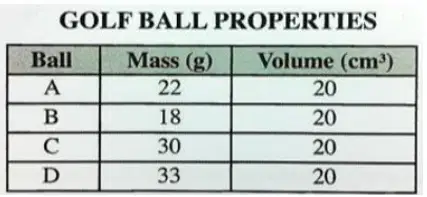
Gabriel is testing the properties of four brands of golf balls. He places them in graduated cylinders containing 100 milliliters (mL) of water and determines that each ball has a volume of 20 cubic centimeters (cm3). He places the balls on a balance and finds that each has a different mass measured in grams (g). The properties of the golf balls are shown in the chart below.
Gabriel uses the numbers in the chart to find the density of the golf balls. Water has a density of 1.0 g/cm3. Which ball will float? (D= m/V.)
Ball A
Ball B
Ball C
Ball D
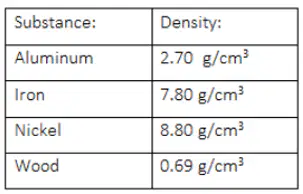
Latrice is given an unknown substance and is asked to identify it based on its properties. She measures its mass as 237.6 g. The cube's length, width, and height are 3 cm each. What is the unknown substance? (D= m/V.)
Aluminum
Iron
Nickel
Wood
Terry sees an old rusty swing set at the park. He knows that rust is formed when iron (Fe) combines with oxygen (O) in the atmosphere to form iron oxide (FeO). How would you classify iron oxide?
compound
element
mixture
solution
Before today's science class, Jose thought that salt was something that he uses to season his French fries. What is the scientific definition of "a salt"?
when fat molecules are suspended in a solution
the result when an acid and base are combined
the particles that settle at the bottom of a solution
when the pH of a solution is lower than 7 but higher than 3
Which of the following correctly describes a property of an atom?
It has more protons than neutrons.
It has a negative or positive charge.
It has an equal number of neutrons and electrons.
It has an equal number of protons and electrons.
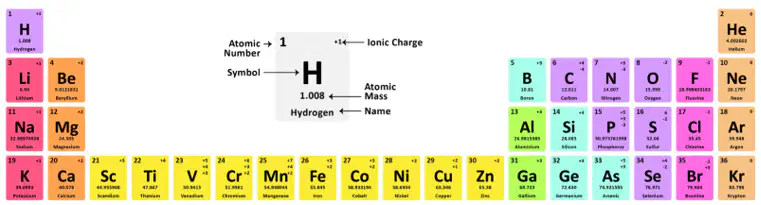
Reference your periodic table to help you answer the following question. Which of the following elements would you expect to have chemical properties similar to Fluorine (F)?
Argon (Ar), because they are both noble gasses.
Beryllium (Be) because they are in the same period.
Neon (Ne), because they have almost the same number of protons.
Chlorine (Cl), because they are found in the same group.
Four siblings did chores during the weekend. Ling cooked eggs. Gabe raked leaves. Chris sewed buttons. Briana dried laundry. Which of these involved a chemical change?
Cooking eggs
Raking leaves
Sewing buttons
Drying laundry
Anthony’s homework assignment is to demonstrate that an orange has already undergone a chemical change. Which of the following should he bring to class to best demonstrate a chemical change?
Diced orange
Rotten orange
Peeled orange
Mashed orange
Carlos stomps a soda can flat and throws it away. Which of the following statements BEST describes the change made in the soda can?
The soda can kept the same mass as it changed in shape only
The soda can lost mass as it was changed into a smaller size
The soda can gained more mass because its shape changed
The soda can lost mass as it was crumpled and changed form
Which best describes why we can find aquatic fossils in rock high up in mountain ranges?
There used to be more water
The Earth's crust is on plates that move
The Earth used to have less water
Animals such as sea birds brought them there

What kind of plate boundary is found where Indian plate and Eurasian plate occur?
Caribbean boundary
Convergent boundary
Divergent boundary
transform boundary
Tt is what type of alleles?
Which of the following is an example of Homozygous recessive alleles?
Bb
TT
hh
BT

