
 Worksheets
G12 review T3
Total questions: 67
Worksheet time: 6hrs 35mins
As two oppositely charged particles approach each other, what happens to the electrical force between them?
The attractive force increases
The magnitude of the electric force decreases
The repulsive force increases
The magnitude of their charges increases
Which is the value of the constant in Coulomb's equation?
k = 9·10-9
k = 9.8
k = 6.67·10-11
k = 9 ·109
What happens to the force between two charged objects when you halve the distance between them?
2X
1/2X
4X
1/4X
If one of the charges doubles, what happens to the force?
it doubles
it gets cut in half
it quadruples
it is cut by 1/4
A point charge (q1) has a magnitude of 3x10⁻⁶ C. A second charge (q2) has a magnitude of -1.5x10⁻⁶ C and is located 0.12 m from the first charge. Determine the electrostatic force each charge exerts on the other.
-4.52 x 10⁻³ N
-83 N
-2.81 N
-9 x 10³ N
A 5 C and 8 C charge give off a force of 2.5 x 10⁹ N. What is the distance between them?
11 m
12 m
121 m
144 m
Two charges of equal magnitude give off a force of -441000 N when they are 1000 m away from each other. What are the charges magnitude?
5
7
9
11

If the electroscope was charged negatively, how does this remove the charge from the electroscope?
Electrons move from the hand to the electroscope
Protons move from the hand to the electroscope
Electrons move from the electroscope to the hand
Protons move from the electroscope to the hand

Insulators are different than conductors in that insulators ____.
do not contain electrons or protons
do not contain any charge
have a weaker affinity for electrons
do not allow charge to freely move

A typical lightning bolt has about 10.0 C of charge. How many excess electrons are in a typical lightning bolt?
6 x 10¹⁹
6 x 10-19
6 x 1031
6 x 10-31

In which direction will the electric force from the two equal positive charges move the negative charge shown below?
To the North
To the South
To the South-West
To the West
To the North-West

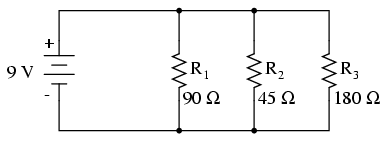
An IPod uses a standard 1.5 V battery. How much resistance is in the circuit if it uses a current of 0.01A?
0.015 Ω
150 Ω
1.5 Ω
None of the above

Electric Current is...
The flow of charge
The flow of volts in a given time
The flow of charge in a given time
The rate of flow
Calculate current if a charge of 10 Coulombs flows past a point in 5 seconds
2 Amps
50 Amps
0.5 Amps
Calculate the charge that passes a point in 20 seconds if 500mA flows for this time.
10 000 Coulombs
25 Coulombs
10 Coulombs
0.025 Coulombs
The correct symbol equation is:
Q = I / t
I = Q x t
t = I / Q
Q = I x t
To measure current we use
an ampmeter
a voltmeter
a geiger counter
an ammeter
What is an electrical circuit?
a whole bunch of wires
a broken path that electric charges can flow
a circuit board
a complete, unbroken path through which electric charges flow
When a switch is open...
the circuit is working and gives energy
the circuit is broken and charges cannot flow
the circuit is turning lights on
I don't know...ask Ms. Cednick
Describe a series circuit.
a circuit that has multiple branches
a circuit that has one path
a circuit that dead ends after a light bulb

What type of circuit is this an image of?
series circuit
parallel circuit

Will the light bulbs light up in this image?
Yes, both of them will
Yes, but only the one on the right
No, neither of them will
Yes, but only the one on the left


A student connected a copper wire coil to a battery and dipped the wire coil in iron filings as shown in the diagram below. The iron filings were attracted to the coil. What would happen to the iron filings when the wire is disconnected from the battery?
The iron filings will continue sticking to the wire coil.
The iron filings will no longer be attracted to the wire coil.
The iron filings will become magnetic on their own.
The iron filings will become electrically charged.

The circuit diagram below shows a series circuit with two d-cell batteries connected to four light bulbs and four different materials labeled 1, 2, 3, and 4. Which of the four materials is acting as an insulator rather than a conductor?
1
2
3
4

An electrical circuit is shown below. Which object at X will complete the circuit?
A metal paper clip.
A plastic bottle.
A rubber band.
A wooden stick.

Both light bulbs are lit in the circuit pictured above. In order to turn off both lights, a switch must be installed in the circuit at the place marked-
1
2
3
4

Choose the correct sentence.
This circuit will work because it is an
open circuit
This circuit will work because it is a
closed circuit
This circuit will not work because it is an
open circuit
This circuit will not work because it is a
closed circuit


What components are in this schematic diagram?
battery, switch, bulb, wire
switch, switch, bulb
battery, switch, bulb, motor

Which schematic circuit matches this circuit picture?



What happens to the galvanometer if the copper rod is moved upwards?
No change
Deflect to the right
Deflect to the left
Deflect to the right and left


Thumb and first finger represent .......
magnetic field, force
force, current
force, magnetic field
current, force

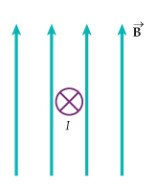
The diagram show the direction of magnetic field,B and current, I.
By using Fleming left hand rules, determine the direction of Magnetic force, F.
left
downward
into the page
out from the page
The diagram show the direction of magnetic field,B and current, I.
By using Fleming left hand rules, determine the direction of Magnetic force, F.
no force produced
right
into the page
out from the page
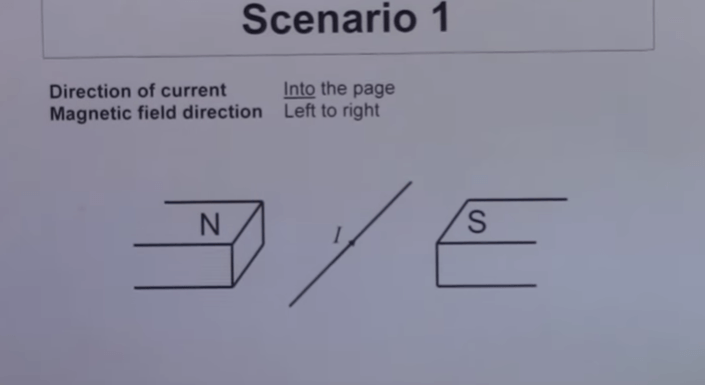
What direction does the wire move?
Up
Down
Left
Right
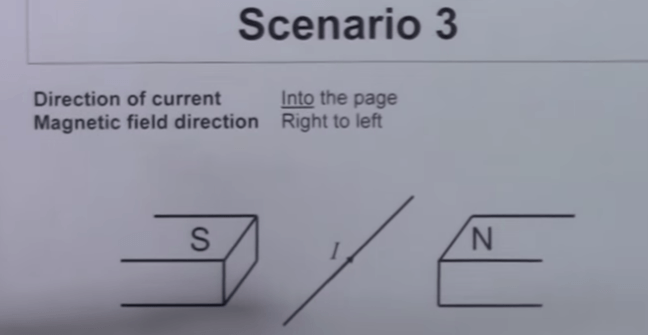
What direction would the wire move?
Up
Down
Left
Right

Assume primary has 240 turns and secondary has 60 turns. Primary is connected with 120V AC power supply. What is the voltage on the secondary?
30 V
0.333 V
2 V
120V
choose all step down transformers
TV adapter
Mobile charger
Transformer outside the homes
Transformers outside power generating stations

A 12Ω resistor is connected across the secondary winding of an ideal transformer whose secondary voltage is 120V. Determine the primary voltage if the supply current is 4A.

