
 Worksheets
Unit 8 Exam Study Prep (5/16)
Total questions: 45
Worksheet time: 1hrs 7mins
Some organisms that share a common ancestor, have features that no longer serve a function but are remnants that served a purpose in their past. These are known as ____.
Homologous Structure
Analogous Structure
Vestigial Structure
Embryological Structure
Some organisms that share a common ancestor, have features that have different functions, but are similar structures. These are known as ____.
Homologous Structure
Analogous Structure
Vestigial Structure
Embryological Structure
Some organisms that share a common ancestor having similar developmental stages and structures controlling their development in various stages of development. These are known as ____.
Homologous Structure
Analogous Structure
Vestigial Structure
Embryological Structure
Some organisms that share a common ancestor have adaptations to a common function but are anatomically different. An example is the wings of fly, bird, and bat. These are known as ____. Choose the correct term.
Homologous Structure
Analogous Structure
Vestigial Structure
Embryological Structure
Humans, birds, whales, and lizards all have similar arm bones. What is the reason for this? Choose the correct explanation.
The function of these bones is the same in all animals
They live in similar environments
They have a common ancestor
There is no connection and scientists are wrong
Bird wings and butterfly wings are an example of ____. Choose the correct term.
Homologous Structure
Analogous Structure
Mimicry
Camouflage
An organism’s ability to survive and reproduce in its environment refers to its ____. Choose the correct term.
Mutation
Variation
Fitness
Genetic Drift
Which of the following pieces of evolution evidence deals with age and identification of fossils? Choose the correct answer.
Fossil Record
Comparative Anatomy
Embryology
Biochemistry
Which of the following pieces of evolution evidence deals with comparing similar structures of various species; using morphology to identify relationships? Choose the correct answer.
Fossil Record
Comparative Anatomy
Embryology
Biochemistry

What is the type of natural selection where individuals for the extreme type are more likely to survive and reproduce; produces a shift in normal distribution?
Genetic Drift
Disruptive Selection
Directional Selection
Stabilizing Selection
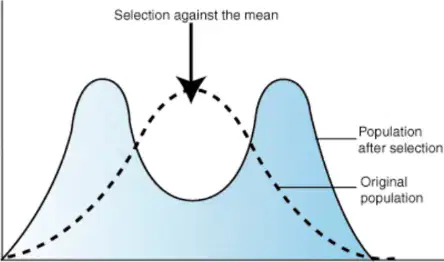
What is the type of natural selection where individuals of the intermediate traits are lost and both extreme forms are more likely to survive and reproduce?
Genetic Drift
Disruptive Selection
Directional Selection
Stabilizing Selection
The name of the process where a species move to a different area and creates a new entirely different population.
Natural Selection
Genetic Drift
Mutation
Gene Flow

What is the type of natural selection where the intermediate trait is more likely to survive and reproduce; decrease in the extreme forms?
Genetic Drift
Disruptive Selection
Directional Selection
Stabilizing Selection
A type of genetic drift in which small groups of organisms separate from larger populations to form new colonies.
Bottleneck Effect
Founder’s Effect
Artificial Selection
Natural Selection
Charles Darwin had no intention of publishing his works because he knew it would be a logistical nightmare for his family.
True
False
The smaller the gene pool, the higher the diversity of mates and less likely for the bottleneck effect to occur when a natural disaster strikes.
True
False
An example of the Bottleneck Effect is when a natural disaster hits, drastically reducing the large population and new gene pool contains only survivors.
True
False
Microevolution is large changes over a very large time scale.
True
False
The mechanisms for evolution are mutations, gene flow and natural selection.
True
False

This image is an example of
vestigial sttructures
similar embryology
geographic distribution
fossil record
Match the type of evidence to its corresponding component of evolutionary support.
Reveals similarities in body structures and functions between organisms
Homologous Anatomical Structures
Determines time in which a species was living and reveals extinct species
Fossil Evidence
Reveals genetic sequence similarities and differences between organisms.
Molecular Evidence

Analogous Structure
Same function different structure
Homologous Structure
Same structure different function
Comparative Embryology
Comparing embryological development of different species
Biochemical Evidence
Comparing DNA and amino acid sequences of different species
Vestigial Structures
Structures in the body of an organism that no longer work.
The fossils found closer to the surface of the ground are generally -
(a)
The preserved remains of an organism, or the trace evidence of an organism’s existence in the past. (a)
Evidence for a (a) can be found in the fossil record

The diagram shows data on the evolution of horses. The data in the diagram is evidence that —
a new species of horse suddenly appeared
horses slowly developed over time
horses have similar stages of rapid embryological development
horses have a common ancestry with other hooved animals

Whales pelvis is
Homologous
analogous
common structure
vestigial structure
Which can be used as evidence for evolution (change over time)? Check all that apply.
Fossils
Homologous Structures
Embryo Similarities
Biochemical Analysis
Match the following scientist with their ideology
Co-Father of Evolution
Russel Alfred Wallace
Father of Evolution
Charles Darwin
Wrote about Speciation using Poems
Eramus Darwin
Father of Geology
Charles Lyell
Religious Scientist who was against idea of evolution
George Cuvier
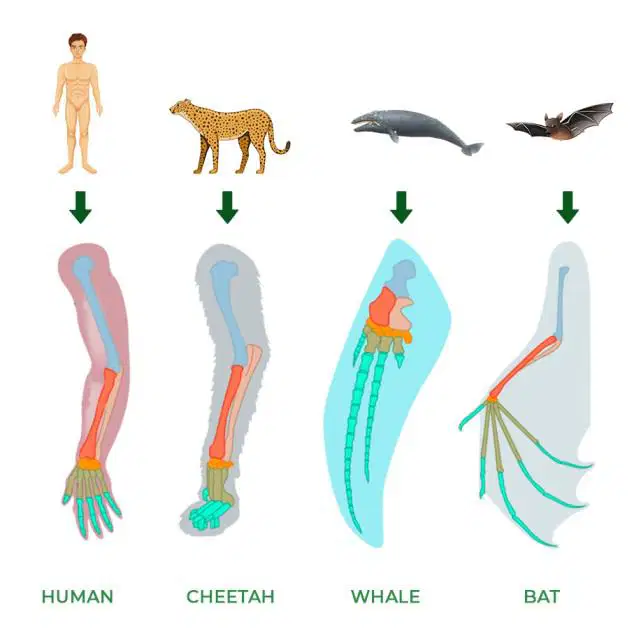
What type of evidence for evolution is depicted in the image?
(Hint: Same Structure But Different Function)
Homologous Structure
Vestigial Structure
Analogous Structure
Embryological Structures
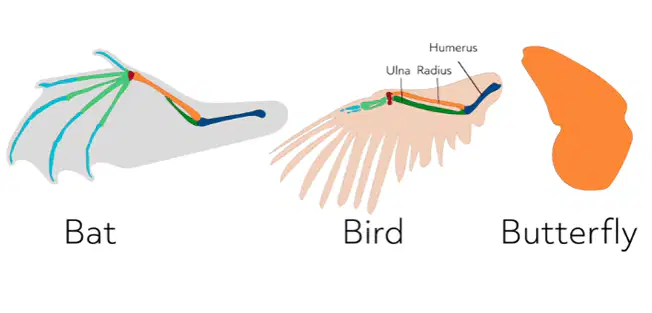
What type of evidence for evolution is depicted in the image?
(Hint: Same Function But Different Structure)
Homologous Structure
Vestigial Structure
Analogous Structure
Embryological Structures
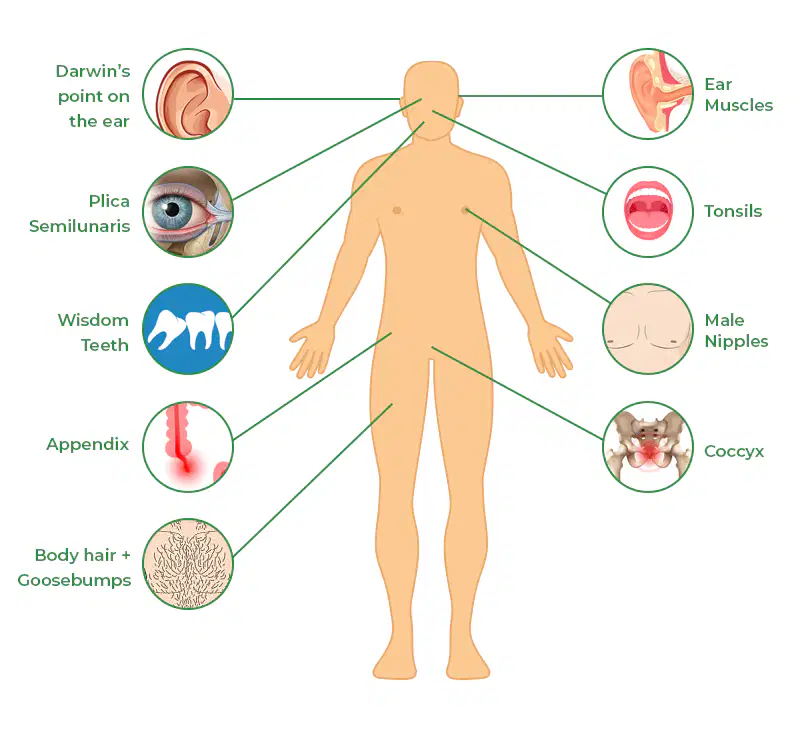
What type of evidence for evolution is depicted in the image?
(Hint: Remnants of past structure and function)
Homologous Structure
Vestigial Structure
Analogous Structure
Embryological Structures
How does comparative anatomy provide evidence for evolution?
By disproving the theory of evolution
By proving that all organisms have identical anatomy
By focusing solely on molecular biology
By showing structural similarities and differences among species
Why are homologous structures important in studying evolution?
They are unrelated to evolutionary theory
They indicate a common ancestry
They suggest that all species have the same DNA
They show that species do not evolve

The similarities of bone structure in the diagram provide evidence of what?
The organisms probably use there forelimbs for the same thing.
The organisms evolved from a common ancestor.
The organisms have the same DNA.
All vertebrate species have identical forelimbs.
Structures that are similar in function but are not similar in origin (a)
Evolution is the result of a process called ____________
Natural Selection
Artificial Selection
Survival of the Weakest
Supernatural Selection
Some changes in genes can help organisms _____
Survive
Mutate
Rest
True or False? All changes in genes are harmless.
True
False
Which word describes the word "variation"?
Adaptations
Differences
Traits
Genetics

Genetic diversity is decreased through this process.
Gene Flow
Genetic Drift
Adaptations are features you are born with that either help you or hurt you in your environment.
True
False

