
 Worksheets
World History Final Assessment
Total questions: 77
Worksheet time: 2hrs 39mins
Gladiators were men who fought against one another or against large animals as a form of entertainment for others. Generally, the gladiators were...
Slaves, prisoners of war, and/or criminals
slaves
prisoners of war
those who had broken the law
Which statement best describes how the ideas in the book "The Republic", written by Plato, relate to the ideas of Taoism (Daoism)?
The book "The Republic" was highly influenced by Taoist ideas about leadership and respect.
The book "The Republic" emphasizes that king's job is to rule over the state, while Taoist ideals suggest that a good ruler has minimal interference in the lives of his subjects.
The book "The Republic" takes the ideas of Taoism and changes them slightly to fit into Greek culture.
The book "The Republic" mixes the Taoist ideals of noninterference with the Confucian ideal of filial piety.
From most powerful to less powerful, choose the correct answer for Ancient Rome.
Plebians
Patricians
Enslaved People
Women
Enslaved People
Plebians
Patricians
Plebians
Enslaved People
Plebians
Patricians
Women
1. Which of the following best describes isolationism?
A policy of avoiding contact with other countries.
A philosophy based on the teachings of Confucius.
A movement within a country that supports revolution.
A policy of expanding boundaries through military conquest.
The Olympic Games originally honored ____, and were first held in _______.
The main god Zeus; Athens
The main god Zeus; Olympia
All of the gods; Greece
The main god Zeus; Marathon
Socrates taught _____; who then taught _________.
Plato; Aristotle
Plato; Alexander the Great
Aristotle; Plato
Aristotle; Alexander the Great
It is an oath of ethics historically taken by physicians. It is one of the most widely known of Greek medical texts. In its original form, it requires a new physician to swear to uphold specific ethical standards.
Socrates' Oath
Hippocratic Oath
Code of Conduct
Doctor's Oath
The Mayan civilization of the Early Americas is best known for which achievement?
Elaborated jewelry and masks
Accurate stonewalls for building structures
Building early roads to link cities
Observatories for studying the skies
Which statement best compares the political development of Athens and Sparta?
Both Athens and Sparta transformed from oligarchies into democracies at about the same time
Athens replaced its tyranny with democracy while Sparta maintained a militaristic, semi-democratic oligarchy
Both Athens and Sparta established popular democracies by overthrowing their hereditary monarchs
Athens slowly transformed its oligarchy into a democracy while Sparta overthrew its tyranny to establish a democracy
Greek plays used which of the following genres that still exist today?
comedy
fantasy
horror
thriller
What was the result of the power struggle between Athens and Sparta, who each competed for and interfered with the city-states allied of the other?
Persian Wars
Punic Wars
Peloponnesian Wars

The diagram is a set of characteristics. The diagram illustrates the characteristics of which central concept?
Transportation
Civilization
Economics
Language
Choose the option which best describes how history transmits culture and heritage and provides models for human character.
The Ten Commandments are followed on how to behave as a good human beings
Military groups are better trained to make sure soldiers keep a solid mental health
Innovations in science are kept secret for the well-being of human beings
The Olympic Games provide a platform for nations to compete with each other
West Africans traded gold with the people of modern-day Mali (across the Sahara dessert), for what precious resource they couldn't find in West Africa?
Salt
Spices
iron
grains
Which statement explains the main difference between Taoism (Daoism) and Legalism?
Taoism focuses on nature, while Legalism focuses on science.
Taoism promotes hierarchy, while Legalism promotes equality.
Taoism emphasizes harmony, while Legalism emphasizes obedience.
Taoism is based on virtue and integrity, while Legalism is based on rules and punishments.
The Roman political system was heavily influenced by Greek political philosophy. However, democracy in the Roman Republic was different from democracy in the ancient Greek city-states. The Greek city-states had a direct democracy, where all citizens has a say in the laws, whereas the Roman Republic had a representative democracy, where elected officials made the laws.
Which statement best explains why the Roman Republic used a different type of democracy that the Greek city-states?
Roman citizenship was highly limited because of class divisions on Roman society
The Roman Republic was too large and diverse for direct democracy to be workable
Roman society was not as influenced by social status as Greek society was
Most Romans had to serve in the military because the Republic was more vulnerable to foreign invasion
Confucius believed that rulers have the responsibility to...
respect the rights of all citizens
prevent their subjects from suffering
demonstrate to others how to behave correctly
increase the power and security of their kingdom
Which factor restricted trade between China and civilizations to its west and southwest?
shortages of natural resources
significant geographic obstacles
constant fighting among local rules
conflict over a limited number of customers
What were the causes of the growth and longevity of the Roman Empire?
Strong military presence; offered citizenship to those conquered; adopted and adapted some of their religions and cultures
Strong military presence in every conquered territory
Adopted religions and cultures from conquered land
He was sentenced to death by the Athenians because the authorities considered him dangerous to society for encouraging everyone to think and ask questions
Aristotle
Plato
Hippocrates
Socrates
Which statement best demonstrates how the structure of the government in ancient China was similar to the structure of the traditional Chinese family?
Women and men both contributed to the state but served in separate types of jobs.
Moving up the ranks of government service was directly tied to age and family status.
The emperor was given the same respect by citizens as fathers were by their children.
Government officials were expected to live in dormitories with others in their ministry.
Imagine a hunter-gatherer and a farmer of the Neolithic Era arguing with each other concerning their respective quality of life. Each thinks his quality of life is superior to the other's.
Which argument would most likely be made by the farmer?
"I have much greater mobility."
"I have more personal freedom."
"I will live a longer, healthier life."
"I have access to a wider variety of foods."
A pharaoh named Akhenaton forced his subjects to worship only the sun god Aton. Which statement best explains why Akhenaton's religious policy caused conflict throughout Egypt?
Most ancient Egyptians preferred worshiping the god Seth
Many ancient Egyptians viewed the sun god as a lesser god
Most ancient Egyptians were polytheistic and believed in worshiping many gods.
Many ancient Egyptians did not believe in worshiping gods associated with forces of nature
Which problem contributed the most to the construction of the Great Wall during the Qin dynasty?
civil war
foreign invasion
trade competition
high unemployment
Which statement describes a belief that was common in ancient Chinese society?
Women should not enter the workforce.
Only the father of a family should earn an income.
Service to the nation is more important than family.
Boys should leave home at an early age to join the army.
Which Chinese innovation would most benefit a merchant traveling by sea?
iron metalwork
seismograph
refined paper
magnetic compass
Which statement best explains why commerce on the Silk Road led to changes in Chinese cultural traditions?
The traders who used the Silk Road came from many different backgrounds.
The Silk Road made it easier for armies to move from one bettlefield to another.
The towns that sprang up along the Silk Road were not controlled by any government.
The leaders of Silk Road caravans had to be very innovative to avoid thieves and bandits.
Laws displayed in the Roman Forum to notify citizens about the rules and punishments. This was to be fair and to protect the rights of Roman citizens. Those laws were known as...
The Rule of Law
The Twelve Tables
The Separation of Powers
Which statement best explains the Mongols' advantage over other warrior cultures?
Their armies were able to move much faster than others.
Their warriors were brave in combat and did not fear death.
Their commanders were chosen by merit rather than by birth.
Their weapons and tactics were designed to attack fortified cities.
"Geography doesn’t simply begin and end with maps showing the locations of all the countries of the world. In fact, those maps don’t necessarily tell us much. No – geography poses fascinating questions about who we are and how we got to be that way, and then provides clues to the answers.” – Kenneth Davis
What is the speaker of the passage above stating?
Maps are not helpful to historians
Historians want to know where people settled
Human geography is more important than physical geography
Physical features and locations tell historians about the way people lived
Roman architecture includes arches. Roman architectural designs, and other architectural structures around the world, were inspired by ...
Greece
Mesopotamia
India
Persia

Examine the diagram. Which issue best replaces the question mark in the diagram?
high taxes
unfriendly rulers
harsh travel conditions
a shortage of customers
Which is the best summary of Maya Society?
The upper and lower classes provided food and goods for each other.
The upper class included farming families and priests, and the lower classes included warriors.
The lower classes provided food and labor, and the upper class led religious ceremonies
The lower classes provided religious ceremonies and the upper class controlled the economies.
The discovery of Tutankhamen's tomb provided archaeologists with many artifacts that were very useful in helping them better understand ancient Egyptian life. Which statement best explains why Tutankhamen's tomb was special?
Tutankhamen rules Egypt longer than any other pharaoh
Little had been known about this period in Egyptian history
This tomb still contained everything that had originally been placed inside
Egyptian historians had not mentioned the location of this tomb
Based on his teachings, Confucius would most likely have approved of which action?
a younger brother correcting the behavior of an older sibling
a mother earning money to improve the lives of her family
a father facing shielding his children from unpleasant truths
a merchant refusing to sell an item for a price that was too high
What is the difference between a primary source and an artifact?
Primary sources are studied by historians; artifacts are not.
Primary sources are written sources; artifacts are objects.
Primary sources are made by people; artifacts are made by machines.
Primary sources are studied by archaeologists; artifacts are studied by historians.
Hindus and Buddhists believe that _____ will define your next life when you get____________.
karma, converted
karma, reincarnated
dharma, karma
dharma, reincarnated
The US adopted from Greece...
having one single leader with absolute authority.
splitting power between city-states.
limiting government power.
citizens voicing their opinions and voting.
Buddhism and Hinduism spread out through other countries, this is part of what we know as
conversion
knowledge
marketing
diffusion
Which statement describes the ancient Egyptian achievement called the Book of the Dead?
It was a guide to mummifying bodies.
It was a record of soldiers killed in battle.
It was a record of the reasons why people died.
It was a guide to help people reach the afterlife.
By the early 1400s BC, Egypt was the leading military power. Based on this fact, what conclusion can you make about Egypt’s resources?
It was a rich country.
It was a poor country.
Its resources were being heavily taxed.
Its resources were being sent to help other countries.
What does the concept "rule of law" mean?
The idea that all citizens are held responsible to the same laws
The protocols the government must follow
The ethical standards of government officials
The laws made by the ruler
The Inca Empire built highways and byways to connect the cities separated by mountains. What impact did this have to the Inca civilization? Select all that apply
It helped unify the empire by enabling travel and trade.
The communication between all regions of the empire was easier.
It allowed the army to move quicker from region to region.
It helped keep the Inca Empire united.
The first person to write Greek history?
Plato
Herodotus
Alexander the Great
Socrates
The concept of the "Mandate of Heaven" was used to justify...
the existence of slavery
the takeover of foreign people
the right of the father to rule the family
the emperor's control over the government
Hatshepsut...
was favored by the God Ra.
increased trade and wealth.
placed harsh punishments.
conquered Kush.
How did the Punic Wars contribute to the end of the Roman Empire?
They divided the loyalties of Roman leaders, who fought to control the new territories
They created deep political rivalries that divided the Senate and paralyzed the government
They overextended the Roman military, which weakened defenses along the northern border
They resulted in territorial expansion that made the Republic wealthier but more economically unequal
Architects in ancient Egypt determined a standard length for a cubit, which was traditionally the measure of a man's arm from his elbow to his fingertips, by using rods or ropes with a standardized length. Why did Egyptians developed a standard system of weights and measurements?
To ensure that trade could be practiced fairly across Egypt.
Because some of them were not good with math.
To find out how long their limbs were.
To measure people's heights.
Which statement best explains how Taoism (Daoism) differs from Confucianism?
Taoists reject human desire, whereas Confucians attempt to shape people's desires
Taoists use strict punishments, whereas Confucians provide rewards for good behavior
Taoists believe in freedom for citizens, whereas Confucians believe in respect for authority
Taoists emphasize integrity and fairness, wheras Confucians emphasize harmony and unity
Which of the following beliefs was central to the Egyptian religion?
The afterlife
The Pharaos
The Heavens
The Pyramids
What would've happened if farmers hadn't learned how to irrigate the fields?
No invaders would have shown up.
settlements would have not grown along rivers.
There would be no advancement.
Why did ideals of Confucianism appeal to Han rulers?
They wanted to eliminate superstition in order to modernize Chinese society.
They hoped to advance scientific progress in order to promote rapid economic growth.
They wanted to promote artistic and intellectual achievement among the Chinese people.
They hoped to create a well-run system of rule over a large territory and diverse population.
The influence of Greek culture in Asia was largely a result of...
The spread of democracy
The popularity of Homer's writings
The power of the scientific method
The conquest of Alexander the Great
The two consuls of the Roman Republic led Rome in foreign policy and military matters. The Senate made laws and controlled spending.
Which democratic principle did this information demonstrate?
Rule of law
separation of powers
Constitutionalism
popular sovereignty
What effect did farming have for the people in the Stone Age?
It allowed them to travel
It allowed them to paint caves
It allowed them to hunt for animals
It allowed them to build permanent settlements
Which statement best explains the reasons for the Punic Wars between Rome and Carthage?
Both sought to control Western Mediterranean
Both sought to control the Eastern Adriatic
Both sought to control northern Africa
Both sought to control southern Italy
Which of the following describes a representative democracy?
All citizens help make the laws
Citizens act as judges and law makers
All men, women and children can vote
Citizens elect officials to make the laws
The Roman Senate is an important aspect in the United States government because it
creates laws
evaluates laws
passes judgment over criminal actions
provides a direct democracy with the people
His logical process of analysis and inference influenced the scientific method, a process scientists use to devise experiments that test hypotheses and draw logical conclusions from them.
Aristotle
Plato
Socrates
Hippocrates
What was the cause of the Persian Wars between Persia and Greece?
Persia wanted to expand its empire and conquer more land
Greece was hostile to Persia
Greece was in debt with Persia
Greece wanted to expand its territory
When talking about Ancient Rome, the statement: "nobody is above the law, not the king, the senate, the people, etc.", refers to:
checks and balances
democracy
separation of powers
Rule of law
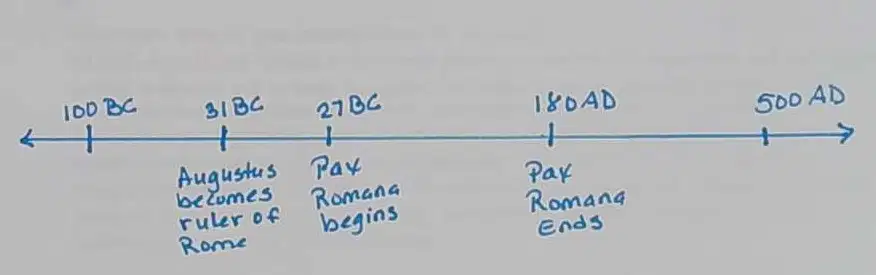
Look at the timeline and answer the question below. Which description best fits the period from 27 BC to 180 AD?
A period of constant expansion of the Roman Empire
A period of foreign invasions in the Roman Empire
A period of stability in the Roman Empire
A period of failure in the Roman Empire
Which event would most likely have caused early agricultural civilizations to interact with each other?
the expansion of a civilization's territory
the conquest of one people by another
the migration of one people to another location
the outbreak of disease
The conquest of Alexander the Great spread Greek ideas and culture throughout the lands he conquered in Asia. His conquests caused Greek and Asian cultures to mix, thereby producing the ______ _____ after his death?
Hellenistic Age
The Greatest Conquest
Olympic Games
Spread of Democracy
Which statement best explains why early civilizations were located in large river valleys?
Rivers contributed the resources needed for widespread agriculture to develop.
River valleys provided the natural obstacles needed to protect against conquest.
River valleys had the kind of temperate that humans are adapted to the best.
Rivers made it easier to travel long distances needed to trade with others.
The Phoenicians interacted with nearby Greek, Egyptian, and Mesopotamian peoples, adopting many aspects of these varied cultures. Over time, the people who lived around the Mediterranean Sea became more and more alike. The Phoenicians are an example of a Mediterranean culture that was greatly affected by what?
Oppressive type of governments
Cultural Diffusion
Money and Power
Isolationism
Which statement best describes a difference between the Greek city-states of Athens and Spparta?
In Sparta, women could become citizens; in Athens, they could not.
In Sparta, women could serve as generals in the military; in Athens, they could only serve as basic officers
In Sparta, women could actively participate in raising their children; in Athens, they used nannies to do most of their care-taking
In Sparta, women could participate in the voting process; in Athens, they were not permitted to vote.
The passage below is about the Ming Dynasty.
In 1433, the Ming Dynasty halted all sailing expeditions. Historians believe one reason was the great expense of large-scale voyages when money was needed for defenses against the Mongols in the northern regions. Officials favoring traditions also might have convinced the rulers that the idea of growth and foreign trade was against Chinese ideals.
Which outcome resulted from the decision described in the passage?
The end of construction of The Great Wall.
The overthrow of the Ming Dynasty
A decline in the Chinese economy
A war against the Mongols

Which phrase fills the empty spot?
ethnic diversity
social hierarchy
advanced industry
polytheistic religion
Hammurabi was a Mesopotamian king who recorded a system of laws called Hammurabi's Code. What was the impact of this code of laws?
It changed the way people thought about justice
It made the rulers become more oppressively
Civilizations refused to follow the laws
It was never enforced by rulers
Which statement best explains the importance of ancient Rome's large system of roads?
The Roman population was highly mobile.
Foreign trade was the main basis of the Roman economy.
The Roman government prevented unemployment by funding public-works projects.
Efficient transportation was an economic and military necessity in the Roman Empire
Which statement best summarizes Kublai Khan's policy in China?
He reorganized the government and removed all foreign officials.
He tried to invent an alphabet that could be used far all languages.
He greatly valued education, learning and the study of ancient Chinese texts.
He encouraged the adoption of Mongol religions and customes.
What is the significance of the silk roads and maritime routes across the Indian Ocean to the movement of goods and ideas among Asia, East Africa, and the Mediterranean Basin?
It provided a way to sell silk which was in high demand
It opened a route for invaders to attack the Chinese people
It provided not only for the exchange of goods, but also the exchange of ideas, beliefs, culture, and knowledge
It made the Chinese government very wealthy
What was one thing that allowed people to build more permanent homes and and live in larger communities?
Inoculation - Vaccination against diseases for people to live longer
Metallurgy - The invention of tools such as spears and shovels to hunt and grow crops
Division of labor - for everyone to have a specific task to do
a central government - they needed leadership because they didn't know how to get organized
Which of the following statements best summarizes the relationship between farming and the growth of towns?
Farming held back developments in the arts
Farming competed with hunting and gathering practices
The development of farming led to more hunter-gatherer groups
The development of farming helped establish more permanent settlements
Which of civilization believed in multiple gods?
Egyptians, Mesopotamians, and Greeks
Egyptians, Chinese, Mesopotamians, and Jewish
Egyptians, Mesopotamians, Greeks, early Romans and Hindus
Buddhists, Mesopotamians, and Greeks
What effect did the replacement of the republican system with an imperial system have on life throughout the Roman Empire?
It produced widespread stability
It created decades of economic chaos
It led to military defeats in the provinces
It fundamentally transformed religion

