
 Worksheets
WH S2 Review #2
Total questions: 100
Worksheet time: 2hrs 2mins

The immediate consequence of the use of atomic bombs on Japan was:
A Cold War with Russia
International anger at the United States
A Japanese attack on Hawaii
The Japanese surrender and the end of World War II
Japan
Germany
Italy
United States
United Kingdom
Soviet Union
China

The United States entered World War 2 because of this event that occurred on On December 7, 1941.
German submarine attacks
Italian attacks on a neutral country
A surprise Japanese attack on Pearl Harbor
The Soviet Union asking for help

Was the United States' use of atomic bombs on Japan justified? Why or why not?

During the war, Nazi Germany carried out the Holocaust. Millions of ____ were placed in concentration camps and killed.
Muslims

One long-term cause of World War II was
The rise of dictatorships
The rise of democracies
Improved farming techniques
The increased power of the League of Nations

The Soviet army and Russian winter helped to turn the tide against the Germans in the Eastern Front. A key Soviet victory occurred at
D-Day
The Battle of Stalingrad
The Battle of Midway
Pearl Harbor

The Battle of Midway was a key American victory that turned the tide against
Italy
Japan
The Soviet Union
Germany

On D-Day, Allied forces finally returned to France and helped defeat ___________.
France
Germany
Japan
Italy

One long-term consequence of World War II was
The Soviet Union and USA became rival dominant powers
The spread of fascism
The end of democracy in Britain
Lasting world peace

In some ways, World War 2 was "won on the factory floor". What does this mean?
Russians defended Stalingrad in a building to building fight
The Allies (especially the USA) outproduced the Axis
The British economy was strong and did not need help
The German war machine was unstoppable

During World War 2 many ___________-Americans were placed in camps by the US government.
Chinese
Indian
Japanese
Italian

Which of the following (3) was were changes that took place in America during World War 2?
Rationing
More women worked in factories and supporting the troops
The government spent less money
Very low unemployment
Match the leader to their country

The United States

The United Kingdom

Japan

The Soviet Union

Germany
Place the events in order

Germany invades Poland

Germany defeats France

Germany attacks the Soviet Union

Japan attacks the United States

The United States drops atomic bombs
Which of the following were effects of World War 2? (pick 3)

The creation of the United Nations

The start of the Cold War & the division of Europe between western democracies and eastern communist countries

Japan begins a Greater East Asia Co-Prosperity Sphere

The creation of the country of Israel after the Holocaust

The Soviet Union becomes a democratic government
After World War 2, what former allies became enemies during the Cold War.
The United States and Soviet Union
Germany and Italy
The United Kingdom and France
Spain and Turkey

_______ was the secret American program that created the atomic bomb.
NKVD
The Manhattan Project
Bletchley Park
Operation Overlord

After Franklin D. Roosevelt died, ______________ became the next US president.
Theodore Roosevelt
Abraham Lincoln
Harry Truman
Richard Nixon
Identify the correct location for each country.
Australia
Egypt
India
Brazil
Germany
USA
Soviet Union
Japan

How could future Holocausts or genocides be prevented in the future?

How did the US prepare for World War 2 before joining the war in December 1941. (pick 2)
The US military protected Britain from German attacks
The Lend Lease Act sent supplies to the UK, Soviet Union & China
The US Selective Service Act of 1940 was a peace time draft to start training additional soldiers
The US bombed Germany, Japan and Italy to disrupt their war production

Which of the following was a significant factor in Japan's decision to engage in aggressive military expansion before World War 2?
The desire to spread Shintoism
The need for natural resources and raw materials
The goal of establishing a worldwide democratic government
The intention to join the League of Nations

Once (a) dictators in Germany, (b) and Japan took control of their countries, they started taking land that didn't belong to them. The (c) countries reacted by following a policy called (d) .

In the 1930s, the United States foreign policy was
Imperialism
Isolationism
Militarism
Decided by the League of Nations

What country did Germany defeat in June 1940
The Soviet Union
The UK
France
Italy
Near the end of WWII, what country did the United States military drop atomic bombs on?
China
Germany
Japan
The Soviet Union
Near the end of the Second World War, what cities did the United States drop atomic bombs?
Pearl Harbor and Hiroshima
Pearl Harbor and Nagasaki
Niroshima and Hagasaki
Hiroshima and Nagasaki

Holocaust Trials
WW2 Trials
True or false: The Soviet Union had 9,000,000 military deaths, which was way more than the U.S. had.
True
False
True or false: The U.S. spent $341 billion on WWII, more than anyone else did.
True
False
True or false: The U.S. has been the first AND only country that has dropped an atomic bomb on another country.
True
False
True or false: The U.S. became fearful when they thought about which countries would create atomic bombs next.
True
False

Which of the following was a key decision made at the Yalta Conference in Feb. 1945?
to begin a two front war with the D-Day invasion
the division of Germany into four zones of occupation (French, British, American, Soviet)
the decision to drop the atomic bomb on Japan
picking a new name for Germany
Japan surrendered in August 1945 because the United States
Captured the islands of Iwo Jima and Okinawa.
Dropped atomic bombs on Hiroshima and Nagasaki.
Threatened to use the atomic bomb.
Took Tokyo, the Japanese capital.

Who was the leader who led the Soviet Union to victory during WWII?
Vladimir Lenin
Josef Stalin
Leonid Brezhnev
Nikita Khrushchev
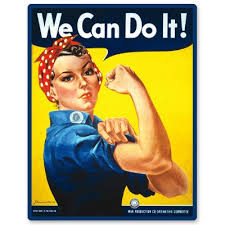
Who is this a image of and what did she a symbol of .....
June the Fighter symbol of women's suffrage
Susan the solider symbol of women working on airplanes
Rosie the Riveter symbol of women working in factories during the war.

Which two cities were attacked with atomic bombs by the United States?
Nagasaki & Hiroshima
Tokyo & Kyoto
Tokyo & Yokohama
Osaka & Kyoto
What industry manufactured about 1/3 of military equipment during WWII
steel industry
ship-industry
intercultural sector
automobile industry
Why was the Battle of the Bulge important to the end of WWII in Europe?
It was the U.S. last attempt to gain control of Stalin.
It was Hitler's last attempt to gain control.
It was the last battle Hitler won.
It was the start of WWII.
What is the Battle of the Bulge
An old guy worried about getting fat.
A German word meaning "lightening war"
The dropping of the Atomic Bomb
A month long battle in which the allies turned back the Germans.
One problem that the U.S army intelligence had during the war
The enemy was decoding our messages
The enemy was too smart for us
They didn't feel like working
The ____________________ spoke in secret codes and the enemies could not understand them.
Navajo Code Talkers
WASPs
British
president
What was the government act that sent Japanese Americans to the internment camps?
Executive Order 255
Executive Order 9066
Executive Order 99
Defcon 4
Japanese Americans were interned as a result of what major event?
Germany invading Poland
Pearl Harbor
The Appeasement Policy
the death of Franklin Roosevelt
Where was Iwo jima?
South of Japan
Japan
Usa
Italy
Why did the Americans want Iwo Jima
They wanted it for supplies
They wanted it for the US
It was the key stepping stone to invading japan
They wanted there food
Treaty of Versailles is signed
Attack on Pearl Harbor
DDay
Battle of the Bulge
Iwo Jima
Which group of Native Americans created a code that was never broken during WWII?
Navajo
Apache
Sioux
Iroquois
The US strategy used in the Pacific was called
(a)
The (a) showed American forces in the Pacific the (b) of their enemy, the (c) .

This famous image is from which battle of the Pacific Theater?
Battle of Guadalcanal
Battle of Okinawa
Battle of Midway
Battle of Iwo Jima
The Nuremberg Laws (a) the rights of (b) Germans, and legalized antisemitism.
Which battle halted the Japanese advance across the Pacific, and kept the Japanese from gaining an strategic location from which to launch an attack on Hawaii or the US west coast?
Battle of Okinawa
Battle of Midway
Bataan Death March
Battle of Guadalcanal
Battle of Iwo Jima
Allied victory here put mainland Japan within range of Allied bombers
Battle of Okinawa
Last major battle in the Pacific Theater
Battle of Midway
Major turning point in the Pacific Theater
United States
Franklin D Roosevelt
Britain
Winston Churchill
Soviet Union
Joseph Stalin
Italy
Benito Mussolini
Japan
Hideki Tojo
What was Japan's main defence system on Iwo Jima?
having a large naval battle on the island then fighting on land
defending the beach to the last man
underground cave systems
Using civilian forces
Despite heavy bombardment from American bombs and artillery, the Japanese suffered little damage and were ready to defend Iwo Jima against the American attack.
True
False
Associated Press photographer Joe Rosenthal took the iconic photo of six Marines raising the U.S. flag on top of which Iwo Jima mountain?
Battle Mountain
Mount Tapotchau
Mount Suribachi
Mount Rausu


Last major “offensive” for Germany & their defeat set up the Allied capture of Germany
Battle of the Bulge
Stalingrad
2nd Battle of El Alamein
Normandy Landings
Largest amphibious landing ever; Allowed Allies to open a 2nd front against the Axis powers
Battle of the Bulge
Stalingrad
Dunkirk
Normandy (Operation Overlord)
Major Soviet Union victory & turning point for the Eastern Front of WWII
El Alamein
Battle of the Bulge
Normandy Invasion
Stalingrad
1st major victory for British forces in Egypt; Led to invasion of Italy by Allies
El Alamein
Dunkirk
Battle of the Bulge
Stalingrad
Code name for the project to develop the 1st Atomic bomb:
Brooklyn Project
Manhattan Project
Los Alamos Project
Chicago Project
Lead scientist for the Manhattan Project:
Albert Einstein
Enrico Fermi
Leslie Groves
Robert Oppenheimer
The immediate consequence of the use of atomic bombs on Japan was:
A Cold War with Russia
International anger at the United States
A Japanese attack on Hawaii
The Japanese surrender and the end of World War II
Japan
Germany
Italy
United States
United Kingdom
Soviet Union
China

The immediate cause of World War 2 was
Germany attacking Poland
Germany taking the Sudetenland
Germany rebuilding its military
The Munich Agreement
The United States entered World War 2 because of this event that occurred on On December 7, 1941.
German submarine attacks
Italian attacks on a neutral country
A surprise Japanese attack on Pearl Harbor
The Soviet Union asking for help
Was the United States' use of atomic bombs on Japan justified? Why or why not?
During the war, Nazi Germany carried out the Holocaust. Millions of ____ were placed in concentration camps and killed.
Muslims
One long-term cause of World War II was
The rise of dictatorships
The rise of democracies
Improved farming techniques
The increased power of the League of Nations
The Soviet army and Russian winter helped to turn the tide against the Germans in the Eastern Front. A key Soviet victory occurred at
D-Day
The Battle of Stalingrad
The Battle of Midway
Pearl Harbor
The Battle of Midway was a key American victory that turned the tide against
Italy
Japan
The Soviet Union
Germany
On D-Day, Allied forces finally returned to France and helped defeat ___________.
France
Germany
Japan
Italy
One long-term consequence of World War II was
The Soviet Union and USA became rival dominant powers
The spread of fascism
The end of democracy in Britain
Lasting world peace
In some ways, World War 2 was "won on the factory floor". What does this mean?
Russians defended Stalingrad in a building to building fight
The Allies (especially the USA) outproduced the Axis
The British economy was strong and did not need help
The German war machine was unstoppable
During World War 2 many ___________-Americans were placed in camps by the US government.
Chinese
Indian
Japanese
Italian
Which of the following (3) was were changes that took place in America during World War 2?
Rationing
More women worked in factories and supporting the troops
The government spent less money
Very low unemployment
Match the leader to their country
The United States
The United Kingdom
Japan
The Soviet Union
Germany
Place the events in order
Germany invades Poland
Germany defeats France
Germany attacks the Soviet Union
Japan attacks the United States
The United States drops atomic bombs
Which of the following were effects of World War 2? (pick 3)
The creation of the United Nations
The start of the Cold War & the division of Europe between western democracies and eastern communist countries
Japan begins a Greater East Asia Co-Prosperity Sphere
The creation of the country of Israel after the Holocaust
The Soviet Union becomes a democratic government
After World War 2, what former allies became enemies during the Cold War.
The United States and Soviet Union
Germany and Italy
The United Kingdom and France
Spain and Turkey
_______ was the secret American program that created the atomic bomb.
NKVD
The Manhattan Project
Bletchley Park
Operation Overlord
After Franklin D. Roosevelt died, ______________ became the next US president.
Theodore Roosevelt
Abraham Lincoln
Harry Truman
Richard Nixon
How did the US prepare for World War 2 before joining the war in December 1941. (pick 2)
The US military protected Britain from German attacks
The Lend Lease Act sent supplies to the UK, Soviet Union & China
The US Selective Service Act of 1940 was a peace time draft to start training additional soldiers
The US bombed Germany, Japan and Italy to disrupt their war production
Which of the following was a significant factor in Japan's decision to engage in aggressive military expansion before World War 2?
The desire to spread Shintoism
The need for natural resources and raw materials
The goal of establishing a worldwide democratic government
The intention to join the League of Nations
Once (a) dictators in Germany, (b) and Japan took control of their countries, they started taking land that didn't belong to them. The (c) countries reacted by following a policy called (d) .
In the 1930s, the United States foreign policy was
Imperialism
Isolationism
Militarism
Decided by the League of Nations
What country did Germany defeat in June 1940
The Soviet Union
The UK
France
Italy
The League of Nations voted sanctions against which country for invading Ethiopia in 1935?
Italy
Germany
Greece
The Soviet Union
What did Stalin and Hitler agree to do when they signed the Nazi Soviet Pact?
Agreed to not go to war with Poland
Split Poland between them
Agreed to attack the United States
None of the above

