
 Worksheets
TRANSLATION-INTERPRETING STUDIES
Total questions: 20
Worksheet time: 14mins
What is the most basic definition of translation?
In addition to language proficiency, what is crucial for a translator?
What are some of the sub-disciplines within translation studies?
Pragmatics translation studies
Explain the difference between interpreting and translating in the context of translation studies.
Interpreting is visual, translating is auditory.
Interpreting is oral, translating is written.
Interpreting is written, translating is oral.
Interpreting is simultaneous, translating is consecutive.
What does NOT describe the characteristics of interpreting?
It requires quick decision-making.
There is no review or editing during interpreting.
The urgency affects the linguistic outcome.
It generally takes place in low-stakes situations.
What is the definition of translation according to the perspective of translation studies?
The process of transforming the original text without considering cultural and social contexts.
The process of adding new information to the target text, and ignoring cultural and linguistic norms in the source language.
The process of transferring meaning from the source text to the target text while considering cultural, social, and linguistic contexts.
The process of changing the source text completely by localizing all the cultural elements/norms available.
The strategic competence refers to the:
ability to transform a source text in translation
knowledge of the rules of translation
ability to identify translation problems
ability to make an overall plan of translation
What is the main difference between interpreters and translators?
Interpreters take time to translate, while translators provide immediate interpretations
Interpreters read and write, while translators listen and speak
Interpreters work with legal contracts, while translators work in meetings and conferences
Interpreters reconstruct the speaker's message, while translators provide precise translations
What is a disadvantage of being an interpreter compared to a translator?
Interpreters have to work under time pressure
Interpreters have more time to think of the perfect word
Interpreters have a nice document at the end of the day
Interpreters don't have to travel for work
What is a potential disadvantage of interpreting as a career?
Having to work under time pressure
Having to travel to interesting places
Having to reconstruct the speaker's message creatively
Not being able to take work home

What is the idiom meaning related with the picture?
not something that a person would do
it's something easy
it's just a cup of tea
tea time!

What meaning could be understood from the picture?
it is a piece of cake
it is something easy
it is delicious cake!
the cake must be delicious
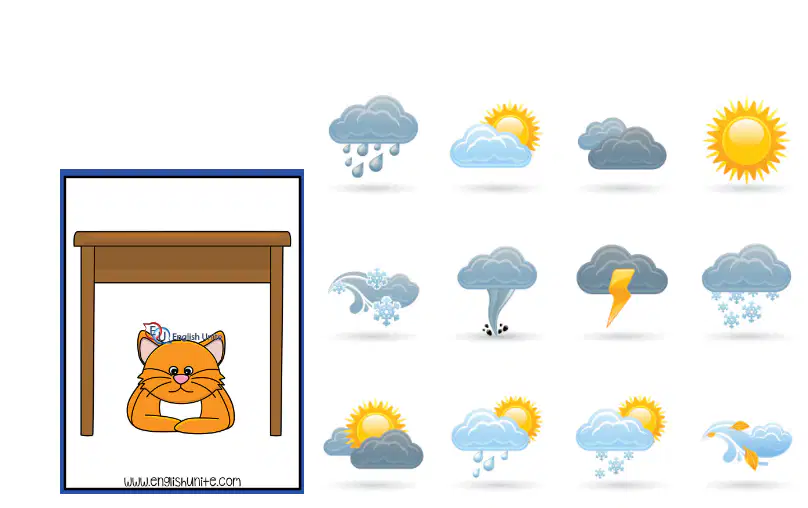
What kind of sentence does suit to the picture?
the cat is under table while the weather is not certain
I cannot come to the class since I am under the weather
I will not let my cat get sick by the weather
The weather is really hot lately that I need to keep my cat at home
Sociolinguistic competence of the translator refers to the:
knowledge of linguistic means appropriate to genres and styles of discourse
ability to select topics that are appropriate for a communicative event
knowledge of sociolinguistics
ability to use language that is appropriate to social contexts
Degrees of equivalence of the source and target texts may be.....
which answer is not part of "degree of equivalence"
full equivalenc
zero equivalence
partial equivalence
predominant equivalence
If the idiom or fixed expression in SL is not available in TL, ................ will be used.
paraphrasing
sentence
long sentence
different words
When to use free translation?
When losing some of the specific details of the original text
When translating literary works or poetry
When accuracy is the most important factor
All of above
What type of translation do these sentences belong to?
SL: How long have you been working with him?
TL: Sejak kapan kamu bekerja dengannya di sana?
word by word translation
literal translation
contextual translation
semantic translatiom

