wayground logo

Free Printable Worksheets

Font size

S
M
L
XL
Worksheets

EOYE quiz biology

Total questions: 57

Worksheet time: 29mins

Name
Class
Date
1.

A consumer that eats only plants is called...

a)

an omnivore

b)

a carnivore

c)

an autotroph

d)

an herbivore

2.

Herbivores are also called...

a)

secondary consumers

b)

primary consumers

c)

producers

d)

tertiary consumers

3.

Energy enters an ecosystem as...

a)

chemicals

b)

food

c)

minerals

d)

sunlight

4.

On a food web, the arrows show...

a)

what eats what.

b)

where the energy is going.

c)

what each organism hunts.

d)

who is friends with whom.

5.

What is a producer?

a)

Organisms that produce food for themselves and other organisms.

b)

Someone who makes a movie.

c)

Something that makes toys.

6.

Check all that apply. Examples of producers are:

a)

algae

b)

plants

c)

lion

d)

antelope

7.

An example of a predator is -

a)

a rose bush

b)

an antelope

c)

an eagle

8.
What are small stretches of DNA that code for traits
a)
Nucleus
b)
Chromosomes
c)
Gene
d)
Centromeres
9.
Where is all the genetic information in a cell?
a)
Nucleus
b)
Nucleotides
c)
Chromosomes
d)
Cytoplasm
10.

How many chromosomes are found in each cell of your body?

a)

46

b)

23

c)

40

d)

45

11.

Which of the following statements about chromosomes is correct?

a)

Chromosomes are long, thread-like structures

b)

Chromosomes are found in the nucleus of all cells in the human body

c)

Chromosomes contain DNA

d)

All of the above

12.
The twisted ladder shape of DNA is referred to as a ....
a)
Twizzler candy
b)
twisted ladder
c)
double helix
d)
yo mama
13.

From smallest to largest how would genetic information be organized?

a)

genes, cell, nucleus, chromosome, DNA

b)

chromosome, cell, gene, DNA, nucleus

c)

DNA/nucleotides, gene, chromosome, nucleus, cell

d)

nucleus, cell, gene, DNA, chromosome

14.
All rabbits living in a particular area would be an example of a(n)
a)
population
b)
species
c)
fossil
d)
individual organism
15.
The example of the peppered (brown) moths living near English industrial cities demonstrates that
a)
A change in an environment can result in the evolution of species living there
b)
Evolution occurs so slowly that is it not possible to determine that it has happened in less than a million years
c)
The environment near these cities has always favored dark colored moths
16.
Any variation that can help a species survive in a given environment is called...
a)
an adapatation
b)
a characteristic
c)
a homologous structure
d)
a vestigial structure
17.
When every organism of a species has died.
a)
Evolution
b)
Natural Selection
c)
Extinction
d)
Artificial Selection
18.
Which of the following is NOT a reason a species may become extinct?
a)
competition
b)
reproducing
c)
habitat loss
d)
overhunting
19.
Which one of the following shows discontinuous variation?
a)
Eye colour
b)
Height
c)
Strength
d)
Weight
20.
Which one of the following shows continuous variation?
a)
Blood group
b)
Height
c)
Male or female
d)
Tongue rolling
21.
What type of graph do we use for discontinuous variation?
a)
A bell-shape
b)
Bar chart
c)
Line graph
d)
Scatter Graph
22.
What shape graph do you see for many examples of continuous variation?
a)
A straight line downwards
b)
A straight line upwards
c)
A bell-shape
d)
A flat line
23.
Which of the following is an example of Inherited variation?
a)
Eye colour
b)
Blood type
c)
Skin colour
d)
All of the above
24.

What causes variation?

a)

inherited factors only

b)

environmental factors only

c)

inherited and environmental factors

25.

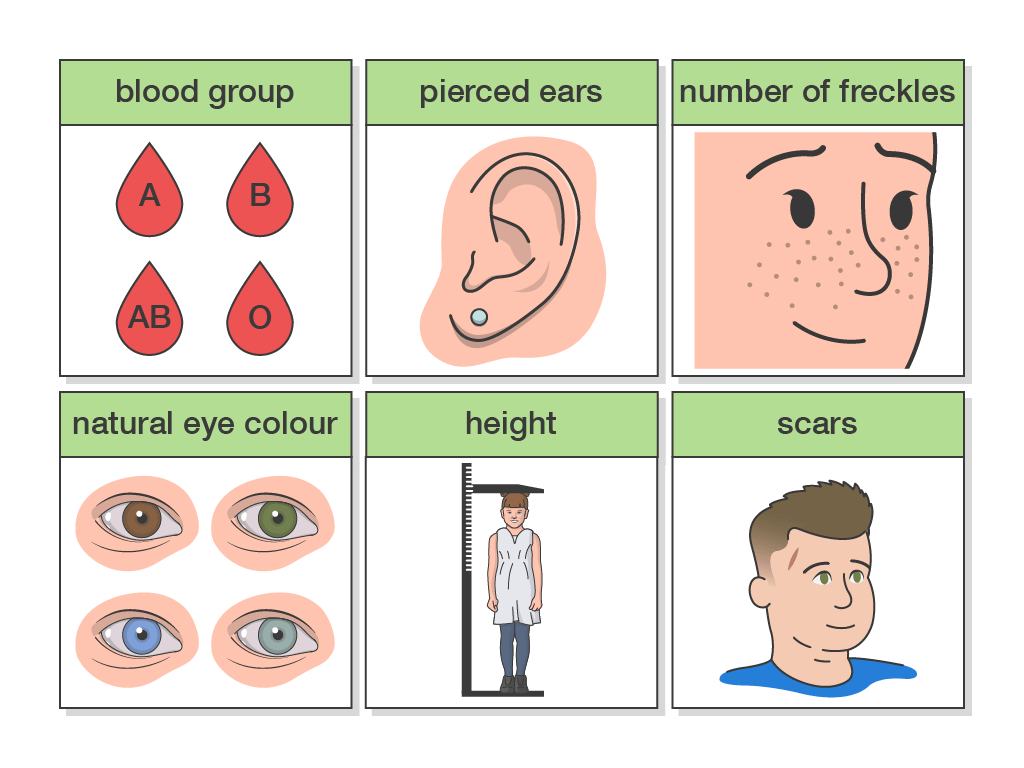
Which two characteristics show variation as a result of environmental factors only?

a)

blood group

b)

pierced ears

c)

Scar

d)

natural eye colour

e)

height

26.

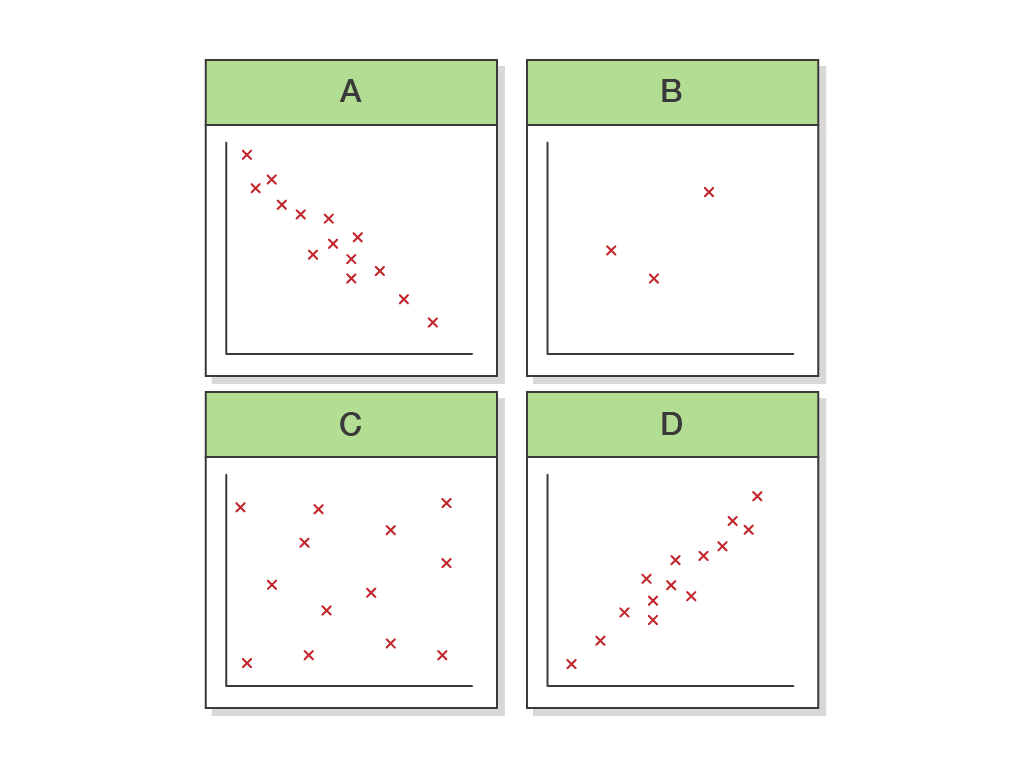
Which two scattergraphs show a correlation (relationship) between the two plotted variables?

a)

scattergraph A

b)

scattergraph B

c)

scattergraph C

d)

scattergraph D

27.

A group of only one type of organism is a

a)

Population

b)

Community

c)

Ecosystem

d)

Niche

28.

Several populations living and interacting with other populations in an ecosystem is a(n)          

a)

population.

b)

community.

c)

ecosystem.

d)

environment.

29.

What does this figure represent?

a)

community

b)

niche

c)

organism

d)

species

30.

What happens to a species if the death rate is higher than the birthrate?

a)

The population size increases.

b)

The population size decreases.

c)

The species becomes extinct.

d)

The species will start to migrate.

31.

The number of organisms of the same species that live in a particular geographic area at the same time.

a)

population

b)

community

c)

ecosystem

d)

ecology

32.
How do you think an increase in the fox population affected the hare population?
a)
The hares decreased beacause there were fewer food sources
b)
The hares increased because there were more food sources
c)
The hares decreased because there were more fox to prey on them
d)
The hares increased because they had more space 
33.

Is a Behavior and physical characteristics of species that allow them to live successfully in their environment.

a)

Natural Selection

b)

Adaptation

c)

Insight learning

d)

Cooperative behavior

34.
Why might some plants have thorns?
a)
to stay safe from animals that want to eat the plant
b)
to attract insects that spread pollen to other plants
c)
to take in nutrients from the air
d)
to provide shade for the plant
35.
What is one reason why some plants have scents?
a)
to shed extra water off the plant
b)
to take in nutrients from the soil
c)
to attract animals to spread its pollen
d)
to conserve water during dry periods
36.
Why might some plants that grow on the shady rain forest floor have large leaves?
a)
to stay safe from predators
b)
to attract different animals
c)
to survive harsh winters with heavy snowfall
d)
to take in as much sunlight as possible
37.
Some grasses grow in hot dry areas. Why might they grow deep roots?
a)
to protect the plant from sun damage
b)
to take in as much light as possible
c)
to spread seeds to new places
d)
to reach water down below
38.

Which would be an adaptation useful in an animal that lives in a cold climate?

a)

Being of a smaller size

b)

Being active during the cooler times of day

c)

Blubber/fat

d)

Having dark fur

39.

What would be the most useful adaptation for a rabbit in the snow...

a)

camoflauge

b)

having long ears

c)

having strong legs

d)

strong teeth

40.
Which is NOT a feature of an eagle?
a)
strong claws
b)
good eyesight
c)
sharp beak
d)
webbed feet
41.

Having webbed feet is an adaptation. How do webbed feet help animals survive?

a)

They stay cool in the summer.

b)

They can swim faster.

c)

They can blend in with their surroundings.

d)

They can attack their prey.

42.
What type of respiration requires oxygen?
a)
Aerobic
b)
Anaerobic
43.
What are the products of anaerobic respiration?
a)
Glucose and oxygen
b)
Carbon dioxide and water
c)
Lactic acid
d)
Carbon monoxide
44.
Which type of respiration is most efficient?
a)
Aerobic
b)
Anaerobic
45.
Which equation shows the reaction for anaerobic respiration
a)
carbon dioxide + water --> glucose and oxygen
b)
glucose + Oxygen --> lactic acid and energy
c)
glucose + oxygen --> carbon dioxide and water and energy
d)
glucose --> lactic acid and energy
46.
A weightlifter is using heavy weights in short bursts for a competition. Because his muscle cells are not able to take in enough oxygen to make very much ATP the weightlifter begins to get fatigue in his muscles. Which of the following processes is most likely going on in the muscles of the weightlifter as he competes in his event
a)
As the cells run out of oxygen they switch to anaerobic respiration, which allows the cell to make small amounts of ATP in the absence of oxygen. 
b)
As the cells run out of oxygen, they die off gradually and the weightlifter's muscles have fewer contracting muscle cells.
c)
The cells will never run out of oxygen if the weightlifter is breathing.
d)
As the cells run out of oxygen, they will continue to make the same amount of ATP, since oxygen is not required to make ATP. 
47.
What process is the opposite of aerobic respiration?
a)
anaerobic respiration
b)
cellular respiration
c)
photosynthesis
d)
lactic acid fermentation
48.

What is the chemical equation for cellular respiration?

a)

Glucose + Oxygen -> Carbon dioxide + Water + Energy

b)

Oxygen + Carbon dioxide + Energy -> Glucose + Water

c)

Carbon dioxide + Glucose -> Oxygen + Water + Energy

d)

Water + Carbon dioxide + Energy -> Oxygen + Glucose

49.
What pigment in the leaf captures energy from the sun?
a)
carbon
b)
chlorophyll
c)
air
d)
chloroplast
50.

Respiration takes place in

a)

the cells

b)

the lungs

c)

the heart

d)

the brain

51.

For respiration to take place glucose needs to react with substance A. Select substance A.

a)

Carbon dioxide

b)

Water

c)

Oxygen

d)

Ozone

52.

When respiration takes place, energy is produced along with another two substances B and C. Select substances B and C.

a)

Carbon dioxide

b)

Water

c)

Oxygen

d)

Ozone

53.

The glucose used during respiration is provided by our

a)

digestive system

b)

respiratory system

c)

circulatory system

54.
What are the products of aerobic respiration?
a)
Glucose and oxygen
b)
Carbon dioxide and water
c)
Lactic acid
d)
Carbon monoxide
55.
Where in the cell does aerobic respiration take place?
a)
Nucleus
b)
Cytoplasm
c)
Mitochondria
d)
Cell membrane
56.

Where in the cell does anaerobic respiration take place?

a)

Nucleus

b)

Cytoplasm

c)

Mitochondria

d)

Cell membrane

57.

Which type of respiration produces the most energy

a)

Anaerobic

b)

Aerobic

c)

Both produce the same amount