
 Worksheets
Physics for Engineers
Total questions: 90
Worksheet time: 1hrs 17mins
SI stands for ___.
Sports Illustrated
Scientific Notation
International System (of measurements)
Instructional System (of measurements)
What is the derived unit for volume?
square meter
cubic meter
kilograms per cubic meter
grams per mole
The shadow of a metre rule used to estimate the height of a tree is 75cm long and that of the tree is 840 cm long.
What is the estimated height of the tree in metres?
11.2 m
1120 m
1.120 m
112 m
When an object of mass 85 g is fully immersed in a measuring cylinder, it displaces a volume of 17 cm 3. What is the density of the object in SI units?
5 g/cm 3
5000 g/cm 3
5000 kg/cm 3
5000 kg/m 3
A body has a mass of 1600 g and its volume is 0.002 m3 . Determine its density.
800 gcm−3
800 kgcm−3
0.8 kgm−3
800 kgm−3
What are the units for frequency?
Herz
Hez
Hertz
Htz
The distance between the Earth and the Sun is around 150,000,000 km. Express this value in scientific notation.
15 x 10 7 km
1.5 x 10⁷ km
15 x 108 km
1.5 x 10⁸ km
Distance travelled by the body in 5 minutes if it travels with a speed of 20 ms-1.
6 m
600 m
6 km
45 km
Scalars are the one which has __________
Magnitude only
direction only
Magnitude and direction
A car moving on a straight line path covers a distance of 2 km due east in 100 s, the speed & velocity of the car is
20 ms-1 and 20 ms-1
20 ms-1 and 40 ms-1
20 ms-1 and 20 ms-1 due south
20 ms-1 and 20 ms-1 due east
The unit of linear acceleration is
sm
s2 m
s2 rad
The speed of the car is 72 kmph. What is the speed in m/s?
16 ms-1
18 ms-1
100 ms-1
20 ms-1
Which of the following is a vector quantity?
5 m/s
5m/s, east
5s
none of these
Which statement describes a vector?
It has magnitude but no direction
It has both direction and magnitude
It has direction but no magnitude
It has constant magnitude but no direction
As the projectile reaches its maximum height, what happened to its final velocity?
constant
zero
9.8 m/s
-9.8 m/s
During free fall, the acceleration due to gravity is approximately 9.8 m/s². If an object is dropped from rest, how long will it take to reach a speed of 19.6 m/s?
1 second
2 seconds
4 seconds
9.8 seconds
A car accelerates uniformly from rest to 25 m/s in 5 seconds. What is the total displacement of the car during this time?
62.5 m
125 m
25 m
250 m
What is the final velocity of an object that starts from rest, accelerates uniformly at 3 m/s², and travels a displacement of 45 meters?
15 m/s
18 m/s
21 m/s
12 m/s
On a velocity-time graph, what does the area under the curve represent?
Acceleration
Displacement
Velocity
Time
Which of the following equations is not one of the equations of motion for uniformly accelerated motion?
v = v0 + at
d = v0t + 1/2 at2
v² = v0² + 2ad
d = v0t - 1/2 at²
If a ball is thrown straight up with an initial velocity of 15 m/s, what will be its velocity at the peak of its motion?
0 m/s
7.5 m/s
15 m/s
-15 m/s
What is the displacement of an object that moves with a constant velocity of 10 m/s for 8 seconds?
18 m
80 m
40 m
100 m
A car moving with an initial velocity of 20 m/s comes to a stop in 5 seconds due to uniform deceleration. What is the magnitude of this deceleration?
2 m/s²
4 m/s²
-4 m/s²
-2 m/s²
An object starts from rest and accelerates uniformly at 5 m/s². What is the velocity of the object after 6 seconds?
10 m/s
30 m/s
60 m/s
15 m/s
The displacement of an object that has moved can be:
Positive (+)
Negative (-)
Zero
All of the above
When an object starts from rest, what is its original velocity?
Depends on the problem
0
Always positive
Always negative
A boy is pulling a cart tied with a rope at speed of 4m/s. The rope is making 30 degree with the horizontal. What is the horizontal component?
3.46 m/s
2 m/s
2.31m/s
none of these
One will use Pythagorean theorem to find the magnitude of
two horizontal vectors added
two vertical vectors added
one vertical and one horizontal vectors added
direction of the vectors
A tangent function is used to find the direction of the perpendicular vectors added. Tangent is
hypotenuseadjacent
adjacentopposite
oppositeadjacent
adjacenthypotenuse
A projectile is launched at an angle of 25° above horizontal. Ignoring air resistance, what are the projectiles horizontal and vertical accelerations when it reaches its maximum height?
Both horizontal and vertical accelerations are zero
The horizontal acceleration is zero and the vertical acceleration is 9.8s2m .
The horizontal acceleration is 9.8s2m and the vertical acceleration is zero
Both the horizontal and vertical acceleration are 9.8s2m
A football player kicks a ball with initial velocity of 25m/s at an angle 53° above the horizontal. What is the vertical component of the ball?
33 m/s
20 m/s
15 m/s
10 m/s
A cannonball has initial velocity of 5m/s and have a vertical component of 3m/s. What is the angle at which the cannon ball is launched?
37°
53°
31°
none of these
The magnitude of the first vector is 3 m to the east is connected to 4 m to the north. What is the magnitude of its resultant?
1 m
5 m
25 m
7 m
A projectile is launched at 5 m/s with an angle 30° from the horizontal. What is the maximum range obtained by the ball?
2.55 m
4.33 m
2.89 m
none of these
A coin tossed vertically upward and it reaches the highest point in 7.0s. at the highest point, the velocity is _______.
9.8 m/s
0
9.8 m/s2
98 m/s2
A 10 kg object experiences a net force of 20 Newtons. Calculate the object's acceleration.
2 s2m
0.5 s2m
200 s2m
3.33 s2m
Force =mass x acceleration
For every action there is a equal and opposite reaction
Speed = timedisplacement
A cart of mass 4.0 kg is being pulled with a force of 24 N. The cart accelerates at 3.0m s–2. An unknown friction force also acts on the cart. What is the net force on the cart?
6.0 N
8.0 N
12 N
24 N
A constant force of 12 N is applied for 3.0 s to a body initially at rest. The final velocity of the body is 6.0m s–1. What is the mass of the body?
1.5 kg
6.0 kg
24 kg
36 kg
A box is pulled by a tension force with an unknown magnitude to the right. The box experiences a constant friction force equal to 20 Newtons. The box has a mass of 10 kg and experiences an acceleration of 5 m/s^2 to the right. What must be the magnitude of the tension force applied to the right?
50 Newtons
70 Newtons
30 Newtons
150 Newtons
An object has a mass of 30 kg and an acceleration of 2 m/s^2. What must be the net force on the object?
60 N
45 N
15 N
0.067 N
A 20 kg bike accelerates at 10 m/s2. What was the force?
30 Newtons
2 Newtons
200 Newtons
10 Newtons
A book is lying at rest on a table. The book will remain there at rest because
there is a net force but the book has too much inertia
there are no forces acting on it at all
there is no net force on the book
there is a net force, but the book is too heavy to move
A hockey puck slides on ice at constant velocity. What is the net force acting on the puck?
equal to its weight
zero
less than its weight but more than zero
depends on the speed of the puck


Which way would a swimmer push to move forward in the water?
To the left
Forward
Backward
One litre of water occupies a volume of
100 cm3
250 cm3
500 cm3
1000 cm3
The force of attraction between object with mass
magnetism
gravity
weight
electrostatic
A boy pushes a book kept on a table by applying a force of 4.5 N. find the work done by the force, if book is displaced through 30 cm along the direction of push
1.10 J
1.25 J
1.35 J
None
How much work is being done with 200 N of force to the right on object that moves 426 meters to the right? (assume the force and displacement are in the same direction)
85,200 J
45,620 J
90,480 J
62,329 J
What is the formula for calculating the total amount of mechanical energy?
ME = KE + PE
KE = ME + PE
PE = mgh
ME = 1/2 mv2
A box is pushed by 20 N force to the right and displace for 0.1 m. What is the work done?
0.005 J
0.1 J
1 J
2 J
As speed increases, kinetic energy
Increases
Decreases
Stays the same
Increase then decrease
What would 54N be an example of?
work
power
distance
force

A work of the force is ____________ if the force and displacement are in the same direction.
positive
negative
it depends on the problem
Which of the following statements are true about work?
Work is a form of energy.
Work is a time-based quantity; it is dependent upon how fast a force displaces an object.
Newton is the standard metric unit of work.
None of these.
Which of the following statements are true about potential energy?
Potential energy is dependent on the speed of a body.
Moving objects cannot have potential energy.
Potential energy is the energy stored in an object due to its position.
None of these
Which of the following statements are true about kinetic energy?
Kinetic energy is the form of mechanical energy which depends upon the position of an object.
If an object is on the ground, then it does not have any kinetic energy.
If an object is at rest, then it does not have any kinetic energy.
None of these
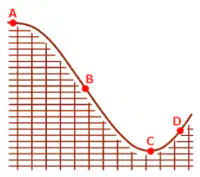
At which point on the roller coaster is the kinetic energy at its maximum?
A
B
C
D
A 10-kg box is lying on a horizontal floor. It is pulled 3 m horizontally with a force of 30 N. What is the work done in Joules?
0
30
90
294
How much work must be done to stop a 1250-kg car traveling at 105 km/hr?
480 kJ
540 kJ
630 kJ
720 kJ

An open cart rolls along a frictionless track while it is raining. As it rolls, what happens to the speed of the cart as the rain collects in it? (assume that the rain falls vertically into the box)
stops immediately
maintains constant speed
speeds up
slows down

A small car and a large truck collide head-on and stick together. Which one has the larger momentum change?
the car
the truck
they both have the same momentum change
Which of the following is NOT a unit of momentum?
kg*m/s
N*s
kg*mph
kg*m/s2

In an elastic collision, ______ is conserved.
Momentum only
Kinetic Energy only
Both momentum and energy

The type of collision represented by these two masses is

