
 Worksheets
Finals: STUDY GUIDE
Total questions: 85
Worksheet time: 6hrs 58mins
What is a function?
Has inputs and outputs
Every input has only ONE output
Inputs have different outputs every time
x-values and y-values
What are all the y values or outputs called?
Domain
Range
Relation
Function
What are all the x values or inputs called?
Domain
Range
Relation
Function
Which is NOT the same
Range
Input
Dependent Value
Y-Value

What is the domain of the graph?
1≤ x ≤ 4
1 < x < 4
1≤ y ≤ 4
1 < y < 4

What is the domain? An open circle means it DOES NOT equal that number - use < and >. Only use ≤ and ≥ with a closed circle.
-4 < x ≤ 5
-4 ≤ x < 5
-3 < y < 3
-3 ≤ y ≤ 3


Match the story that best describes the graph.
It snowed heavily at first then slowed down.
It snowed lightly at first, then heavily, and then it stopped.
It snowed lightly for a while, stopped for a while, snowed heavily, and then stopped.
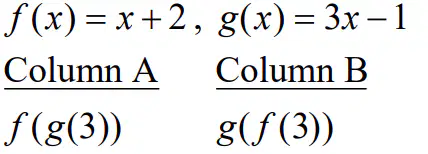
8. Compare the quantity in Column A with the quantity in Column B.
The quantity in Column A is greater.
The quantity in Column B is greater.
The two quantities are equal.
The relationship cannot be determined on the basis of the information supplied.
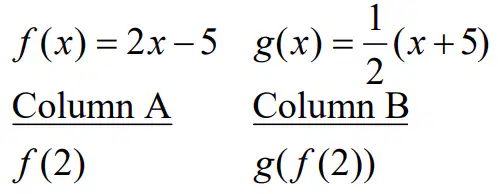
Compare the quantity in Column A with the quantity in Column B.
The quantity in Column A is greater.
The quantity in Column B is greater.
The two quantities are equal.
The relationship cannot be determined on the basis of the information supplied.
Apply function notation in problem-solving: If f(x) = 4x - 1 and g(x) = 2x + 3, find f(3) + g(2).
15
10
7
20


Determine f(3)
Undefined
1
2
3
and g(x) = x - 2
Find f(g(5))
g(x) = x - 2
Find (f∘g)(0)
Bob has $150 in his savings account and saves $40 per month. Which function models his savings?
y = 150 + 40
y = 40x + 150
y = 150x + 40
Which statement is TRUE?
Which of the following is the Point-Slope Form given the point (c, d) and the slope m?
y−d=m(x−c)
y=mx+b
y=mx−b
Ax+By=C
What has the GREATER rate of change.
y = 7x + 10
Someone who starts with $6 and gets $8 each day.
y = 5x + 20
Someone who starts with $8 and gets $6 each day.
Emma, Olivia, and Ava are trying to solve a system of equations. They found that the lines representing the equations are parallel. What does this mean for their solution?
They have one common solution
They have no common solution
They have an infinite number of solutions
They have two common solutions
Susan is solving the system of equations by using elimination.
5x−3y=−7
3x+15y=−1
Which of the following could NOT be equivalent to her system after she performs the first step?


Which of the following statements is/are true?
i. A system of linear equations cannot have more than one solution.
ii. In a system of two linear equations, if the coefficients are equal, the system has no solution.
iii. If the graphs of the system of two linear equations coincide, it means the system has infinitely many solutions.
iii only
i and ii
all of them
i and iii
Which of the ff. statements is/are FALSE?
i. In a system of linear equations, it's possible for the lines represented by the equations to not intersect at any point.
ii. In a system of linear equations, every system with more equations than unknowns is inconsistent.
iii. A solution to a system of two linear equations can be found at the point of intersection of their graphical representation.
ii only
i only
iii only
none of the them
The solution of a system of linear equations is the point where the lines cross each other.
true
false
An inconsistent system of linear equations is when all the equations in the system intersect at one point.
true
false
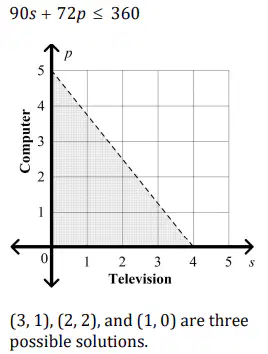
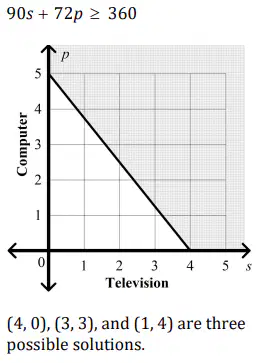
An electronics store makes a profit of $90 for every television sold and $72 for every computer sold. The manager’s target is to make at least $360 a day on sales from televisions and computers. Write a linear inequality and graph the solutions. What are three possible solutions to the problem?
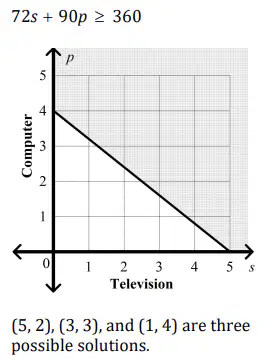
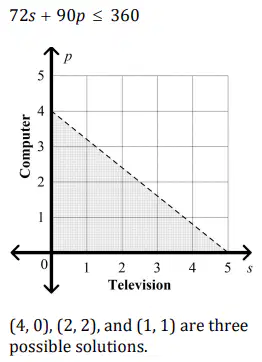
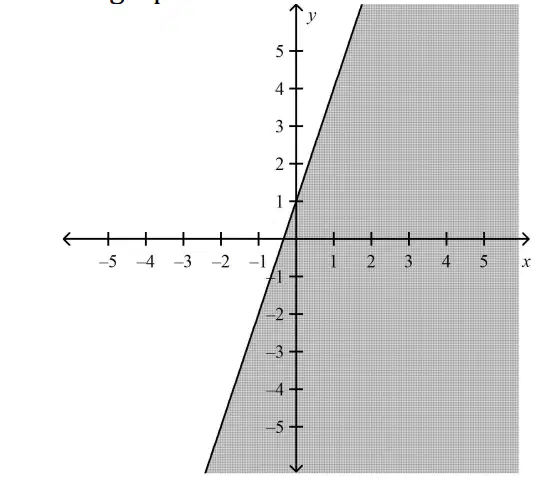
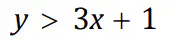
Which inequality represents the graph?
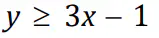

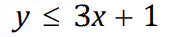

Fill in the formula
x2−6x−40=0
BLUE= (a) RED= (b)
GREEN= (c)
Which of the following statements is FALSE
The complex number system is an extension of the real number system, where an imaginary unit i is defined by i2=−1
The addition of two complex numbers results in another complex number.
A complex number is made up of two parts, a real part and an imaginary part which is multiplied by i (the square root of 1).
Why are quadratic equations set equal to zero?
Because zero is an easy number to work with.
Because we are trying to find the x-intercepts and that happens when y=0.
Because setting it equal to zero helps us find the y-intercepts.
None of the above
Match the type of number with its definition
Complex Number
a+bi, a=0, b=0
Imaginary number
a+bi, a=0, b=0
Real Number
a+bi, b=0
John is trying to solve a complex number problem and he needs to find the value of i52. What is the correct value?
i
-i
1
-1
The axis of symmetry for a vertical parabola always matches...
the y-intercept
the y-value of the vertex
the x-value of the vertex
the x-intercepts
Which of these is NOT another term for "solution" when we're talking about quadratics?
y-intercept
zero
root
x-intercept
Rewrite the quadratic functions in standard form. f(x)=−(x+2)2+17
f(x)=2x2+x−17
f(x)=x2+2x+17
f(x)=−x2−4x+13
f(x)=x2+4x−13

Determine how many solutions:
One Solution
Two Solutions
No Solutions
Infinitely Many Solutions

What is the minimum value?
(-1,0)
-4
(0,-3)
(3,0)
(1,-4)

What do you know about the discriminant?
It equals zero
It is greater than zero
It is less than zero
It has no discriminant
If the discriminant is positive, then the solution will be
one real solution
two real solutions
no real solutions
two imaginary solutions

Which is FALSE about the graph pictured?
The discriminant is negative.
The y-intercept is (0, -1).
The discriminant is 0.
The A value is negative.
Find the Axis of Symmetry of y = x2 - 12x + 46
x = 12
x = 6
x = -12
x = -6
Which polynomial has a degree of 5?
f(x)=(x2−4)(x2+9x+14)
f(x)=x(x2−1)(x3+27)
f(x)=(x5+x4+3x3)(x2−25)
f(x)=(x3+2x2−x)(x2−16)
How many zeros does the polynomial contain? p(x)=(x2−4)(x2+4x+3)
2
3
4
none
Determine the factored form of the polynomial.
p(x)=(x2−1)(x2−5x+6)
p(x)=(x+1)(x−1)(x−3)(x−2)
p(x)=(x−1)(x+3)(x+2)
p(x)=(x+1)(x−1)(x+1)(x+6)
p(x)=x(x−1)(x+6)
Determine a correct first step in factoring the given polynomial.
p(x)=6x3+24x2+18x
p(x)=6(x3+24x2+3x)
p(x)=(6x2+3x)(6x2+24x)
p(x)=6x(x2+4x+3)
p(x)=6x(4x+3)+3x(8x+3)
Rohan's savings = 2x2 + 3x + 5
Arjun's savings = 3x2 - 7x + 12
If Rohan's savings + Charlotte's savings = Arjun's savings,
what must Charlotte's savings equal?
x2 - 10x + 7
5x2 - 4x + 17
x2 - 4x + 7
5x2 - 10x + 17

Identify the degree of the polynomial and the sign of the leading coefficient
Degree - Even
Degree - Odd
Degree - Even
Degree - Odd
Determine end behavior of function with the given function:
f(x) =1 +x7−x5−2x8
x→−∞; f(x) → −∞ x→+∞; f(x)→+∞
x→−∞; f(x)→+∞ x→+∞; f(x)→−∞
x→−∞; f(x)→−∞ x→+∞; f(x)→ −∞
x→−∞; f(x)→+∞ x→+∞; f(x)→+∞
Determine end behavior of function with the given function:
f(x) =1 +x7−x5
x→−∞; f(x) → −∞ x→+∞; f(x)→+∞
x→−∞; f(x)→+∞ x→+∞; f(x)→−∞
x→−∞; f(x)→−∞ x→+∞; f(x)→ −∞
x→−∞; f(x)→+∞ x→+∞; f(x)→+∞

Kai, Henry, and Liam are trying to write a polynomial in standard form for their math homework. Which of the following polynomials have they written correctly in standard form?
-3x + 8x2 + 9x3 - 11
9x3 + 8x2 - 3x - 11
8x2 + 9x3 -11 - 3x
-11 - 3x + 8x2 + 9x3
What is the CONSTANT TERM of this polynomial?
2x3 - 8x2 + 3x - 7
(3x - 4x3 + 6x4 + 1) / (x + 3)

Cam divided (x4 + 3x2 - 4x - 2) by factor of (x-2) using synthetic division. His work is shown above. Which best describes his mistake?
Cam wrote the remainder incorrectly.
Cam did not use a zero place holder for the x3 term.
Cam added instead of subtracting the rows.
Cam should have used -2 as his division since the factor was x-2.

What is the proper way to write the answer for the following problem?
2x3 -x2 -25x +12
2x4 -x3 -25x2 -12x +0
2x3 -x2 -25x -12
2x4 -x3 -25x2 -12x -0
What is the formula for the difference of squares?
a² - b² = (a+b)(a+b)
a² - b² = (a+b)(a-b)
a² - b² = (a-b)(a+b)
a² - b² = (a-b)(a-b)
Which of the following are identities used in the expressions a³ + b³ and a³ - b³? (a) (b)
Factor:
27x3 - 8
(3x -2)(3x2 + 6x + 4)
(3x - 2)(9x2 + 6x - 4)
(3x -2)(9x2 + 6x + 4)
(27x - 8)(729x2 + 216x + 64)
Select all the factors for:
8x3 + y3
(8x + y)
Can't Factor
(8x2 - 2xy + y2)
(2x + y)
(4x2 - 2xy + y2)
x(x−3)(x−3)(x+4)
State the values of x that must be excluded to prevent division by zero.
0 and 3
0 and -3
3 and -4
0, 3, and -4
Simplify: 20a5c45a3c10
a24c6
41a2c6
4a21c6
4c61a2

3n−102(n−1)
3n−104(n−1)
3n−102(n−2)
3n−104(n−1)
Simplify the following rational function:
(x+4)(x+3)(x+1)(x+2)(x−2)(x+1)(x−2)(x+3)(x−4)
x+21
(x−2)(x−4)(x+3)
(x+4)(x−2)(x+1)(x+2)
(x+4)(x+2)x−4
How do you find the x-intercept?
replace all x-values with 0
replace the y-value with 0 or make the numerator equal 0
set denominator equal to 0
compare the degrees of the numerator and denominator
A discontinuity is found by setting the _________= to zero and solving for x
The end behavior of a rational function equals zero when:
the degree of the numerator and denominator are equal
the degree of the numerator is less than the degree of the denominator
the degree of the numerator is greater than the degree of the denominator
the numerator equals zero
What is an asymptote?
an imaginary line that your function never touches
a part of your function
a point on your graph
a type of fruit

What discontinuities are present?
A hole when x = 2
A vertical asymptote at x = 2
there is no hole or vertical asymptote
A vertical asymptote a x = 2 and hole at x = 1


Identify the point(s) of discontinuity.
f(x)=(x−3)(x+2)x+2
Only x = 2
Only x = -2
Only x = 3
x = 2 and x = 3
x = -2 and x = 3
Determine all removable points of discontinuity (holes), vertical asympotes, and horizontal asympotes for the following function.
f(x)=2x2+5x−32x−1
Holes: x = -3
Vertical: x = 1/2
Horizontal: y = 0
Holes: x = 1/2
Vertical: x = -3
Horizontal: y = 0
Holes: Do Not Exist
Vertical: x = 1/2 and x = -4
Horizontal: y = 1
Holes: x = 1/2
Vertical: x = -3
Horizontal: y = 1
Holes: x = -3
Vertical: x = 1/2
Horizontal: Does Not Exist

Find f(g(0)).
-2
3
4
1

Which of the following best describes the continuity at x = -4?
Continuous
Removable Discontinuity
Infinite Discontinuity
Jump Discontinuity

What is the domain?
(−∞, −3]
[3, −∞)
(−∞,3]
(−∞,∞)
None of the answer choices
What is the SUM of the roots of quadratic equation x2 + 13x + 42 = 0?
-42
-13
13
42
Determine the SUM of the roots of the given quadratic equation below:
−311
311
−34
Determine the PRODUCT of the roots of the given quadratic equation below:
−311
−34
34
Determine the SUM of the roots of the given quadratic equation below:
−23
23
−41
Determine the PRODUCT of the roots of the given quadratic equation below:
−145
145
143

