
 Worksheets
Banked
Total questions: 106
Worksheet time: 35mins
Name
Class
Date
1.
What is the charge of a single electron?
a)
+0.1602 ×× 10-18 coulombs
b)
-0.1602 ×× 10-18 coulombs
c)
-0.1620 ×× 10+18 coulombs
2.
What is a charged atom known as?
a)
An ion.
b)
An electron.
c)
A neutron.
3.
What charge is carried by an atom that has fewer electrons than protons?
a)
It carries a neutral charge.
b)
It carries a negative charge.
c)
It carries a positive charge.
4.
Which of the following are the parts of an atom?
a)
Ions and neutrons
b)
Molecules
c)
Protons, neutrons and electrons
5.
What charge is carried by an atom that has more electrons than protons?
a)
A neutral charge.
b)
A negative charge.
c)
A positive charge.
6.
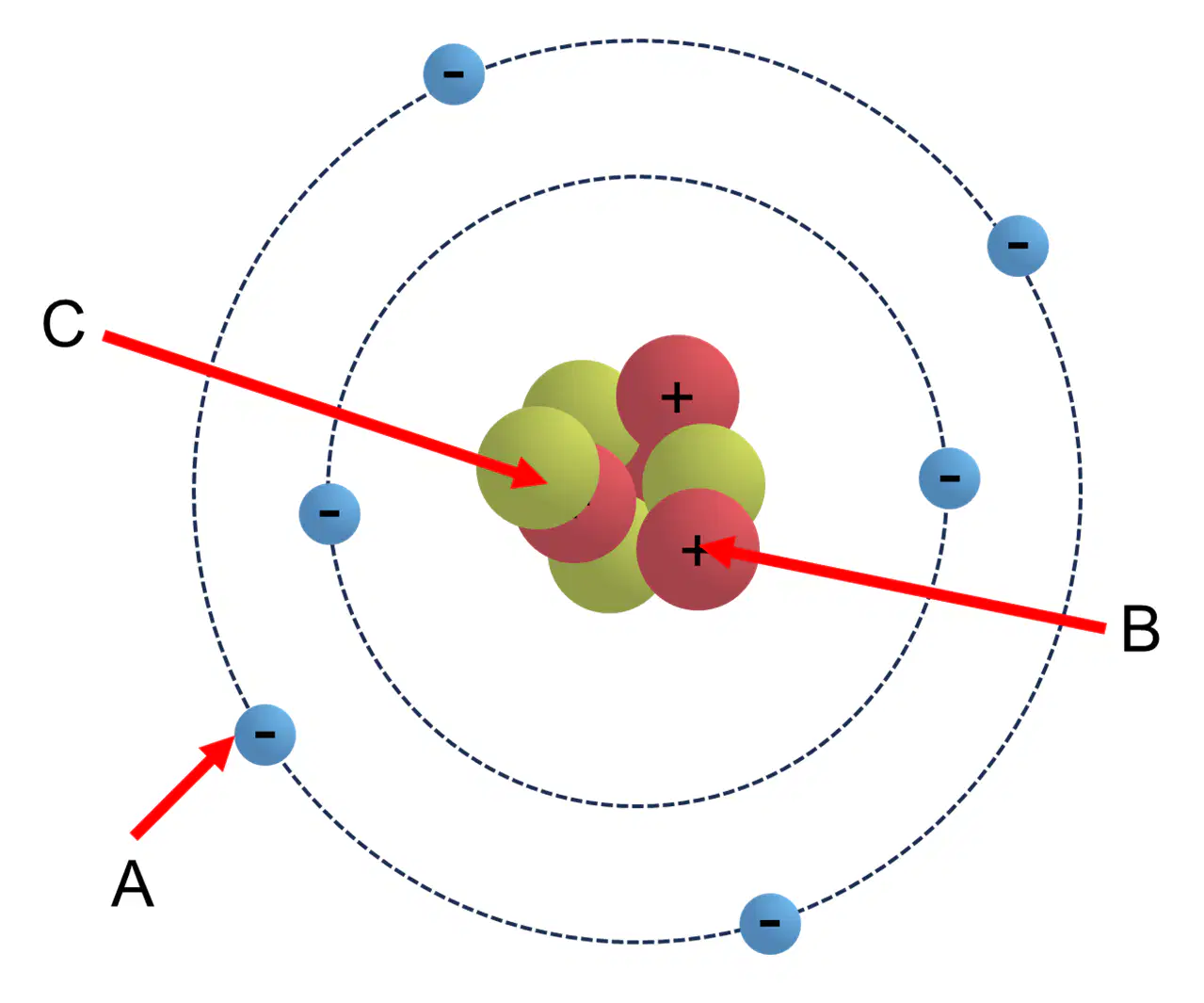
Identify the parts of an atom as indicated on the following figure.
a)
A = Neutron, B = Proton, C = Electron
b)
A = Ion, B = Proton, C = Neutron
c)
A = Electron, B = Proton, C = Neutron
7.
Which of the following elements is NOT a metallic conductor?
a)
Copper
b)
Aluminium
c)
Germanium
8.
Which statement about a metallic conductor is correct?
a)
In a metallic bond the atoms are loosely packed and have a crystal lattice.
b)
In a metallic bond the atoms are closely packed and have no crystal lattice.
c)
In a metallic bond the atoms are closely packed and have a crystal lattice.
9.
When is an atom electrically neutral?
a)
When there are more protons than electrons.
b)
When there is an equal number of protons and electrons.
c)
When there are more electrons than protons.
10.
What charge is carried by an atom if there is a surplus of electrons?
a)
Positive
b)
Negative
c)
Neutral
11.
What term is used to describe a positively or negatively charged atom?
a)
Neutron
b)
Ion
c)
Proton
12.
What are the different sub-atomic particles of an atom?
a)
Protons, ions and neutrons.
b)
Protons, neutrons and electrons.
c)
Protons, neutrons and shells.
13.
What charges are carried by (1) electrons, (2) protons and (3) neutrons?
a)
(1) positive, (2) negative and (3) neutral
b)
(1) negative, (2) positive and (3) neutral
c)
(1) neutral, (2) negative and (3) positive
14.
Which parts of the atom are usually considered to make up its mass?
a)
The electrons and neutrons
b)
The protons and neutrons
c)
The protons only
15.
Metal is a good conductor of electricity, this is due to what?
a)
The high mobility of its electrons.
b)
The high mobility of its protons.
c)
The low mobility of its electrons.
16.
How many electrons does a conductor generally have in its outer orbit (electron shell)?
a)
Exactly four
b)
More than four
c)
Less than four
17.
How many electrons does a semiconductor generally have in its outer orbit (electron shell)?
a)
More than four
b)
Less than four
c)
Exactly four
18.
How many electrons does an insulator generally have in its outer orbit (electron shell)?
a)
More than four
b)
Less than four
c)
Exactly four
19.
How can conductivity be produced in semiconductors?
a)
By subtraction of other foreign atoms.
b)
By the addition of other foreign atoms.
c)
By the addition of a second semiconductor material.
20.
Which two materials are examples of conductors?
a)
Silver and aluminium
b)
Carbon and mica
c)
Porcelain and silicon
21.
The charge for a single electron is measured in?
a)
Volts
b)
Amps
c)
Coulombs
22.
Which of the following materials is the best electrical conductor?
a)
Silicon
b)
Mica
c)
Copper
23.
Which of the following materials is the best insulator?
a)
Silicon
b)
Porcelain
c)
Copper
24.
The charge of a single proton is:
a)
+0.1602 x 10⁻¹⁹C
b)
-0.1602 x 10⁻¹⁹C
c)
+0.1602 x 10¹⁹C
25.
Which statement about electric charges is correct?
a)
Like charges attract each other.
b)
Unlike charges repel each other.
c)
Unlike charges attract each other.
26.
Which symbol is used for charge?
a)
R
b)
Q
c)
S
27.
What name is given to the decomposition of chemical compounds by passing DC through a liquid?
a)
Electro-plating
b)
Electromagnetism
c)
Electrolysis
28.
What happens when two materials are rubbed together?
a)
Neutrons are transferred from one material to the other.
b)
Protons are transferred from one material to the other.
c)
Electrons are transferred from one material to the other.
29.
What would be the effect of bringing a positively charged rod towards a metal bar without touching?
a)
The metal bars electrons would be attracted towards the charged rod.
b)
The charged rod will repel the metal bars electrons.
c)
There will be no effect.
30.
What happens to a glass rod rubbed with silk?
a)
The glass rod gives up electrons and becomes negatively charged.
b)
The glass rod gives up electrons and becomes positively charged.
c)
The glass rod gives up electrons and becomes neutrally charged.
31.
Which of the following is an application of electron current in a vacuum?
a)
A cathode ray tube
b)
An aircraft battery
c)
An inductive circuit
32.
The conduction of electricity by gases is known as what?
a)
Gas Emission.
b)
Gas Discharge.
c)
Gas Conduction.
33.
Which statement is correct regarding a conductor with a constant current flow?
a)
Fewer electrons flow in the conductor with smaller cross-sectional area.
b)
More electrons flow in the conductor with smaller cross-sectional area.
c)
Same number of electrons flow in the conductor regardless of cross-sectional area.
34.
What carries a charge when an electric current flows through an electrolyte?
a)
Ions.
b)
Electrons.
c)
Protons.
35.
What are Cations?
a)
Negatively charged Ions.
b)
Neutrally charged Ions.
c)
Positively charged Ions.
36.
What charge do Anions have?
a)
Positive.
b)
Negative.
c)
Neutral.
37.
What is the unit for the potential difference between two differently charged points?
a)
Ampere
b)
Volt
c)
Coulomb
38.
Which of the following is correct for electron flow in a closed circuit?
a)
Electron flow is in the opposite direction to conventional current flow.
b)
Electron flow is in the same direction as conventional current flow.
c)
Electrons do not move.
39.
What is the standard unit of electrical current?
a)
Ohm
b)
Ampere
c)
Volt
40.
How many volts is equal to 0.002kV?
a)
20 volts
b)
2 volts
c)
0.2 volts
41.
Which unit is corresponds to 0.001 ampere?
a)
Microampere
b)
Kiloampere
c)
Milliampere
42.
Which unit corresponds to 1000 ampere?
a)
Microampere
b)
Kiloampere
c)
Milliampere
43.
Which of the following statements is correct about Direct Current (DC) Voltage?
a)
A direct current voltage changes polarity over time.
b)
A direct current voltage maintains the same polarity over time.
c)
A direct current voltage is generated by a rotating magnet.
44.
What is the standard unit of electrical charge?
a)
Coulomb (C)
b)
Ampere (A)
c)
Volt (V)
45.
What is voltage sometimes also called?
a)
Magnetomotive force
b)
Electromotive stress
c)
Electromotive force
46.
What is one ampere equal to?
a)
One coulomb per second
b)
One coulomb per minute
c)
One coulomb per hour
47.
Which of the following statements is true regarding conductance?
a)
It is the reciprocal of voltage.
b)
It is the reciprocal of current.
c)
It is the reciprocal of resistance.
48.
How is DC voltage defined?
a)
A voltage that maintains the same polarity over a period of time.
b)
A voltage that changes polarity with a constant size over a period of time.
c)
A voltage that constantly changes polarity and amplitude over a certain period of time.
49.
How many directions do all electrical charges flow within a DC electrical circuit?
a)
Three
b)
One
c)
Two
50.
What is the standard unit of electrical resistance?
a)
Ohm
b)
Ampere
c)
Volt
51.
Which direction do electrons flow?
a)
Negative to positive
b)
Positive to negative
c)
Negative to negative
52.
Which symbol is indicating a low resistance value?
a)
mΩ
b)
MΩ
c)
kΩ
53.
If there is a voltage of 1 Volt across a resistor and a current of 1 Ampere through the resistor, what is the value of the resistor?
a)
10 Ω
b)
1 Ω
c)
0.5 Ω
54.
What is the relationship between Conductance and Resistance?
a)
High Resistance - Low Conductance.
b)
High Resistance - High Conductance.
c)
Low Resistance - Low Conductance.
55.
How large can the build up of an electrical static charge on the human body become from friction with plastic or synthetic materials?
a)
Several millivolts
b)
Several volts
c)
Several kilovolts
56.
Which device produces voltage by means of pressure?
a)
Piezoelectric crystal element
b)
Photo cell
c)
Thermocouple
57.
Which device produces voltage by means of a chemical reaction?
a)
Thermocouple
b)
Piezoelectric crystal element
c)
Battery
58.
What is an arrangement of different metals placed with an acid between them called?
a)
An inductor
b)
A battery
c)
A capacitor
59.
What is the generation of electricity by the use of magnetism called?
a)
Conductance
b)
Transformation
c)
Induction
60.
Which of the following creates static electricity?
a)
Lightning
b)
Friction
c)
Heat
61.
What reaction occurs during the break up of the crystal bonding in a semiconductor material?
a)
A proton and hole are released.
b)
An electron and hole are released.
c)
An electron and proton are released.
62.
When can voltages in the kV ranges be experienced due to friction?
a)
During the combining of charges.
b)
During the separation of charges.
c)
During the recombination of charges.
63.
Which term is used to describe the generation of voltage by the application of pressure?
a)
Piezoelectric effect
b)
Friction
c)
Induction
64.
When will a voltage be generated by two different types of metal?
a)
When immersed in a solid
b)
When immersed in a gas
c)
When immersed in a liquid
65.
What are the parts of a galvanic cell?
a)
Electrolyte, three different electrode types and a casing
b)
Electrolyte, two different electrode types and a casing
c)
Electrolyte, four different electrode types and no casing
66.
What is generated into a coil during its movement within a magnetic field?
a)
MMF
b)
EMF
c)
ADF
67.
Which factor directly affects the voltage induced across a coil?
a)
Shape of the coil
b)
Material of the coil
c)
Magnetic field strength
68.
What is the primary reason for static dischargers?
a)
They discharge the static build up created by friction caused by the aircraft tyres as it taxies.
b)
They discharge the static build up created by friction as the aircraft flies through the air.
c)
They charge up the aircraft battery by the static build up created by friction.
69.
Which device uses Induction to generate electricity?
a)
Generator.
b)
Photocell.
c)
Battery.
70.
Devices that use voltage generation by chemical reaction are referred to as?
a)
Thermocouples.
b)
Piezo crystals.
c)
Galvanic cells.
71.
Which of these devices is capable of producing a voltage by means of difference in temperature?
a)
Photo cell
b)
Thermocouple
c)
Silicon cell
72.
Which materials are usually used in modern aircraft thermocouples?
a)
Chromel and alumel
b)
Copper and aluminium
c)
Constantan and aluminium
73.
Which metal combination is most commonly used to generate a voltage for EGT (exhaust gas temperature) indication in modern aircraft engines?
a)
Copper and mica
b)
Bismuth and copper
c)
Chromel and alumel
74.
What does the thermoelectric output voltage of a thermocouple depend upon?
a)
Total temperatures of the junction and both free ends
b)
Difference in temperature between the junction and the two free ends, plus the material combination
c)
Total temperatures of both the free ends
75.
What is the voltage of a set of three batteries that are connected in parallel when each of the batteries provide 1.5 volts?
a)
1.5 volts
b)
3 volts
c)
4.5 volts
76.
What is the voltage of a set of four batteries that are connected in series when each of the batteries provide 1.5 volts?
a)
1.5 volts
b)
6 volts
c)
4 volts
77.
What is a primary cell?
a)
A rechargeable cell
b)
A non-rechargeable cell
c)
An aircraft battery
78.
What is a secondary cell?
a)
A rechargeable cell
b)
A non-rechargeable cell
c)
A dry cell
79.
What does the electrolyte in a lead acid cell consist of?
a)
Potassium hydroxide
b)
Sulphuric acid (30%) and water (70%)
c)
Sulphuric acid (70%) and water (30%)
80.
Why are some batteries connected in series?
a)
For higher resistance
b)
For lower current
c)
For higher voltage
81.
Why are some batteries connected in parallel?
a)
For higher resistance
b)
For higher current
c)
For higher voltage
82.
Which of the following material combinations is used for an aircraft battery?
a)
Zinc and carbon
b)
Nickel and cadmium
c)
Lead and sulphur
83.
What kind of cells are zinc carbon cells?
a)
Aircraft battery cells
b)
Primary cells
c)
Secondary cells
84.
What is an advantage of a nickel-cadmium battery over a lead acid battery?
a)
Better power to weight ratio.
b)
Tolerates higher discharge currents.
c)
No charging is required.
85.
What is a disadvantage of a nickel-cadmium battery compared to a lead acid battery?
a)
Higher costs
b)
Worse power to weight ratio
c)
Longer charging period
86.
Which of the following is true for batteries that are connected in series?
a)
All the currents must be added.
b)
All the voltages must be added.
c)
All the batteries must be different types.
87.
What are the characteristics of a secondary cell?
a)
It cannot be recharged.
b)
It can be recharged.
c)
It supplies less voltage when connected in series.
88.
What is the electrolyte of a lead acid secondary cell?
a)
Potassium acid
b)
Sulphuric acid
c)
Lead acid
89.
If two identical power sources are connected in parallel, what happens to the total current carrying capacity?
a)
Total current carrying capacity increases.
b)
Total current carrying capacity decreases.
c)
Total current carrying capacity remains the same.
90.
What does the voltage output of an photo-cell depend upon?
a)
Light intensity only
b)
Light intensity, kind of light and depletion layer type
c)
Light intensity and kind of light only
91.
Which device can produce a voltage due to being exposed to light?
a)
Thermocouple
b)
Piezoelectric crystal element
c)
Photocell
92.
Which statement is true for Galvanic cells?
a)
Primary cells need to be charged before use.
b)
Primary cells cannot be recharged.
c)
Primary cells can only be connected in series.
93.
Aircraft storage batteries are normally of what type?
a)
Lead Acid or Nickel Cadmium.
b)
Lead Acid or Zinc-Carbon.
c)
Nickel Cadmium or Zinc-Carbon.
94.
What happens to the electrolyte during charging in a Nickel Cadmium battery?
a)
The level will fall.
b)
The level will rise.
c)
The level will stay the same.
95.
Which statement is correct for Nickel Cadmium cells?
a)
They have a voltage of 2 V which will fall to 1.83 V when discharged.
b)
They have a voltage of 3.5 V which will fall to 3 V when discharged.
c)
They have a voltage of 1.2 V which will fall to 1 V when discharged.
96.
What is the average value of a common AC?
a)
Zero
b)
The minimum
c)
The maximum
97.
What is the number of sine waves cycles per second called in AC?
a)
Mircowave
b)
Frequency
c)
Voltage
98.
What is frequency?
a)
It is the length of a sine wave.
b)
It is the peak value of the AC voltage.
c)
It is the number of complete cycles per second.
99.
What is meant by the term RMS?
a)
RMS is the abbreviation for Real Metric System used to measure the voltage in an AC circuit.
b)
RMS is the abbreviation for Real Measurement System used to measure the voltage in an AC circuit.
c)
RMS is the abbreviation for Root Mean Squared.
100.
What is expressed by the term frequency?
a)
The length of a complete cycle of AC
b)
The amount of the AC voltage
c)
The number of complete cycles of AC in one second
101.
What is the wave form of the AC used in electrical networks?
a)
Square wave
b)
Sine wave
c)
Triangular wave
102.
Which of the values in the drawing is incorrectly shown?
a)
UPP (peak to peak)
b)
URMS
c)
T
103.
What is the angle between the three individual phases in a three phase system?
a)
90 degrees
b)
120 degrees
c)
180 degrees
104.
What are the two different voltages that can be supplied by a standard three phase system?
a)
115V and 200V
b)
200V and 240V
c)
115V and 28V DC
105.
What is the unit for the number of cycles per second of an AC supply?
a)
Volts (V)
b)
Watts (W)
c)
Hertz (Hz)
106.
In AC, what is the Peak Voltage?
a)
The peak voltage is the positive (or negative) maximum voltage.
b)
The peak voltage is the positive maximum voltage only.
c)
The peak voltage is the negative maximum voltage only.
100 %

