
 Worksheets
extra credit
Total questions: 191
Worksheet time: 5hrs 28mins
Which equation transforms f(x) = x to a horizontal stretch by a factor of 2, a reflection over the x axis, and a shift down 4?
f(-2x - 4)
f(-1/2x) - 4
-f(2x) - 4
-f(1/2x) - 4

Reflection across the x-axis
Vertical shift right 2 units
Horizontal shift down 7 units

What transformation will occur
f(x) = 2+−2(x−3)
flipped over x axis, vertical stretch 2, right 3, up 2
flipped over y axis, vertical stretch 2, right 3, up 2
flipped over y axis, horizontal compression 1/2, right 3, up 2
flipped over x axis, horizontal stretch 2, right 3, up 2
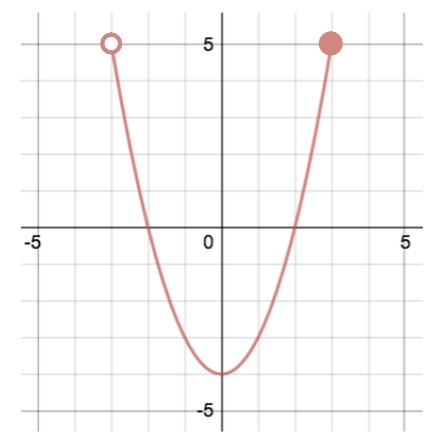


How many extrema are there in this graph?
1
2
3
4

How would you describe the point at (1,7)?
Relative Minimum
Absolute Minimum
Relative Maximum
Absolute Maximum

Check all the intervals where this graph is decreasing.
(-∞, -1)
(-1, 0)
(0, 1)
(1, ∞)
Check all the intervals where this graph is increasing.
(-∞, -1)
(-1, 0)
(0, 1)
(1, ∞)

Which of the following best describes the continuity at x = 1?
Continuous
Removable Point Discontinuity
Infinite Discontinuity
Jump Discontinuity

Which of the following best describes the continuity at x = -4?
Continuous
Removable Point Discontinuity
Infinite Discontinuity
Jump Discontinuity


Identify the type of symmetry based on the graph:
i. symmetric with respect to the x-axis
ii. symmetric with respect to the y-axis
iii. symmetric with respect to the origin
i only
ii only
iii only
i, ii, and iii

Identify the type of symmetry based on the graph:
i. symmetric with respect to the x-axis
ii. symmetric with respect to the y-axis
iii. symmetric with respect to the origin
i only
ii only
iii only
i, ii, and iii
Which classification is given to a function that exhibits symmetry over the y-axis?
odd
even
Which classification is given to a function that exhibits symmetry over the origin?
odd
even
Use the symmetry tests to determine tif the given function is odd, even, or neither: f(x)=x5+1
odd
even
neither

Select the graph that show the corresponding vertical & horizontal asymptotes to this function


Select the graph that show the corresponding vertical & horizontal asymptotes to this function


What's the horizontal asymptote of the function?
y = 0
No horizontal asymptote
y = 2
y = 4

What's the horizontal asymptote of the function?
y = 0
No horizontal asymptote
y = 1/2
y = 1

What's the vertical asymptote of the function?
x = -9
x = 9
x = 3 , x = -3
x = 3

What's the vertical asymptote of the function?
x = 5
x = 0
x =5 , x = -5
x = 25

What's the vertical asymptote of the function?
x = 4
x = 16
x = 4 , x = -4
No vertical asymptote

Select the graph that show the corresponding vertical & horizontal asymptotes to this function


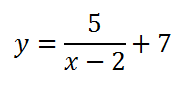


Welcome to your Unit 3 Assessment! Take your time, and do your best. Please show all work on a separate sheet of paper and submit in Buzz. For each question, be sure to check that your calculator is appropriately in degrees or radians :)
Got it! I will make sure my calculator is appropriately in degrees or radians for each question.
No thanks. There is no difference between degrees and radians.
A complex number is represented by a point in the complex plane. The complex number has the rectangular coordinates (-3, 3). Which of the following is one way to express the complex number using its polar coordinates (r, θ)?
(A) (3√2 cos(π/4) + i(3√2 sin(π/4)))
(B) (3cos(π/4) + i(3sin(π/4)))
(C) (3√2 cos(3π/4) + i(3√2 sin(3π/4))
(D) (3cos(3π/4) + i(3sin(3π/4))
A complex number is represented by a point in the complex plane. The complex number has the rectangular coordinates (1/2, -√3/2). Which of the following is one way to express the complex number using its polar coordinates (r, θ)?
(A) (cos(-π/6) + i(sin(-π/6))
(B) (cos(π/6) + i(sin(π/6))
(C) (cos(5π/3) + i(sin(5π/3))
(D) (2cos(5π/3) + i(2sin(5π/3))
A complex number is represented by a point in the complex plane. In polar coordinates, the complex number can be expressed as (3 cos(5π/4) + i(3 sin(5π/4)). Express the complex number using its rectangular coordinates (x, y).
(A) (-3√2/2, -3√2/2)
(B) (-3√2/2, 3√2/2)
(C) (-3√2, -3√2)
(D) (3√2, 3√2)
A complex number is represented by a point in the complex plane. In polar coordinates, the complex number can be expressed as (4 cos(-2π/3)) + i(4 sin(-2π/3)). Express the complex number using its rectangular coordinates (x, y).
(-2√3, -2)
(-2, -2√3)
(-2, 2√3)
(2, -2√3)

The figure shows the graph of the polar function r = f(θ), for 0 ≤ θ ≤ 2π, in the polar coordinate system. Which of the following could be an expression for f(θ)?
1.5 + 1.5 sin θ
1.5 - 1.5 sin θ
1.5 + 1.5 cos θ
1.5 - 1.5 cos θ

The figure shows the graph of the polar function r = g(θ), for 0 ≤ θ ≤ 2π, in the polar coordinate system. Which of the following could be an expression for g(θ)?
1 - 2 sin θ
1 + 2 sin θ
1 - 2 cos θ
1 + 2 cos θ

The figure shows the graph of the polar function r = f(θ), where f(θ) = 1 + 2 cos(2θ), in the polar coordinate system for 0 ≤ θ ≤ 2π. There are four points labeled A, B, C, and D. If the domain of f is restricted to 0 ≤ θ ≤ π/2, the portion of the given graph that remains consists of two pieces. One of those pieces is the portion of the graph in Quadrant I from A to B. Which of the following describes the other remaining piece?
The portion of the graph in Quadrant I from B to D
The portion of the graph in Quadrant II from D to B
The portion of the graph in Quadrant III from B to E
The portion of the graph in Quadrant IV from B to A

The figure shows the graph of the polar function r = g(θ), where g(θ) = 3sin(3θ), in the polar coordinate system for 0 ≤ θ ≤ 2π. There are four points labeled A, B, C, and D. If the domain of g is restricted to π/2 ≤ θ ≤ 2π/3, which of the following describes the portion of the given graph that remains?
(A) The top portion of the graph in Quadrant II from D to B
(B) The bottom portion of the graph in Quadrant II from B to D
(C) The portion of the graph in Quadrant III from D to C
(D) The portion of the graph in Quadrant IV from C to D
A portion of the graph of the polar function r = f(θ), where f(θ) = 1.5cos(3θ), is shown in the polar coordinate system for a ≤ θ ≤ b. If 0 ≤ a < b ≤ 2π, which of the following could be the values for a and b?
(A) a = 7π/6 and b = 4π/3
(B) a = 5π/6 and b = π
(C) a = 11π/6 and b = 2π
(D) a = 3π/2 and b = 2π

Which of the following is the graph of the polar function r = f(θ), where f(θ) = 1.5 + 1.5 cos(θ), in the polar coordinate system for 0 ≤ θ ≤ 2π?
A
B
C
D

Which of the following is the graph of the polar function r = g(theta), where g(theta) = 3sin(4theta), in the polar coordinate system for 0 ≤ theta ≤ 2pi?
Diagram A
Diagram B
Diagram C
Diagram D

Which of the following is the graph of the polar function r = h(theta), where h(theta) = 6 cos(2theta), in the polar coordinate system for 0 <= theta <= 2pi?
Graph A
Graph B
Graph C
Graph D

Which of the following is the graph of the polar function r = f(θ), where f(θ) = 6sin^2θ, in the polar coordinate system for 0 ≤ θ ≤ 2π?
Graph A
Graph B
Graph C
Graph D

Which of the following is the graph of the polar function r = f(θ), where f(θ) = 3 cos(3θ), in the polar coordinate system for 0 ≤ θ ≤ 2π?
Graph A
Graph B
Graph C
Graph D

Which of the following is the graph of the polar function r = f(θ), where f(θ) = 3 - 3sinθ, in the polar coordinate system for 0 ≤ θ ≤ 2π?
Diagram A: Polar coordinate system graph.
Diagram B: Polar coordinate system graph.
Diagram C: Polar coordinate system graph.
Diagram D: Polar coordinate system graph.

Which of the following is the graph of the polar function r = f(θ), where f(θ) = 1 - 2 sin θ, in the polar coordinate system for 0 ≤ θ ≤ 2π?
Graph A
Graph B
Graph C
Graph D

The figure shows the graph of the polar function r = f(θ), where f(θ) = 6 cos(2θ), in the polar coordinate system for 0 ≤ θ ≤ 2π. There are four points labeled A, B, C, and D. If the domain of f is restricted to 5π/4 ≤ θ ≤ 3π/2, which of the following describes the portion of the given graph that remains?
(A) The portion of the graph in Quadrant I from E to B
(B) The portion of the graph in Quadrant III from A to E
(C) The portion of the graph in Quadrant III from E to D
(D) The portion of the graph in Quadrant IV from D to E

The figure shows the graph of the polar function r = f(θ), where f(θ) = 6 sin(2θ), in the polar coordinate system for 0 ≤ θ ≤ 2π. There are four points labeled A, B, C, and D. If the domain of f is restricted to 7π/4 ≤ θ ≤ 2π, which of the following describes the portion of the given graph that remains?
The top portion of the graph in Quadrant II from E to A
The bottom portion of the graph in Quadrant II from A to E
The top portion of the graph in Quadrant IV from C to E
The bottom portion of the graph in Quadrant IV from E to A
Consider the graph of the polar function r = f(θ), where f(θ) = 2 + 3 cos(θ), in the polar coordinate system for 0 ≤ θ ≤ 2π. Which of the following statements is true about the distance between the point with polar coordinates (f(θ), θ) and the origin?
The distance is increasing for 5π/6 < θ < π, because f(θ) is negative and decreasing on the interval.
The distance is increasing for 4π/3 < θ < 3π/2, because f(θ) is positive and decreasing on the interval.
The distance is decreasing for 5π/6 < θ < π, because f(θ) is negative and increasing on the interval.
The distance is decreasing for 4π/3 < θ < 3π/2, because f(θ) is positive and increasing on the interval.
Consider the polar function r = f(θ), where f(θ) = 2 - 4 sin(θ), graphed in the polar coordinate system for 0 ≤ θ ≤ 2π. On which of the following intervals of θ is the distance between the point with polar coordinates (f(θ), θ) and the origin decreasing?
π/6 < θ < π/2
5π/6 < θ < π
5π/4 < θ < 3π/2
5π/3 < θ < 11π/6
Consider the polar function r = f(θ), where f(θ) = -1 - 2 cos(2θ), graphed in the polar coordinate system for 0 ≤ θ ≤ 2π. On which of the following intervals of θ is the distance between the point with polar coordinates (f(θ), θ) and the origin increasing?
[0, π/6]
[π/2, 5π/6]
[π, 7π/6]
[7π/6, 3π/2]

In the polar coordinate system, the graph of the polar function r = f(θ) is shown with a domain of all real values θ for 0 ≤ θ ≤ 2π. On this interval of θ, the graph has no holes, passes through each point exactly one time, and as θ increases, the graph passes through the labeled points A, B, C, and D, in that order. On which of the following intervals is the average rate of change of r with respect to θ least?
From A to B
From B to C
From B to D
From D to A

In the polar coordinate system, the graph of the polar function r = f(θ) is shown with a domain of all real values θ for 0 ≤ θ ≤ 2π. On this interval of θ, the graph has no holes, passes through each point exactly one time, and as θ increases, the graph passes through the labeled points A, B, C, and D, in that order. On which of the following intervals is the average rate of change of r with respect to θ greatest?
From A to B
From A to C
From B to C
From B to D
The polar function r = f(θ), where f(θ) = 4 cos(2θ), is graphed in the polar coordinate system. As θ varies from -π/4 to 3π/4, how is the distance between the origin and the point with polar coordinates (f(θ), θ) changing?
The distance is decreasing.
The distance is increasing.
The distance increases, then the distance decreases.
The distance decreases, then the distance increases.
Consider the graph of the polar function r = f(θ), where f(θ) = -1 - 2sin(θ), in the polar coordinate system. Which of the following statements about r = f(θ) is true over the interval 2π/3 ≤ θ ≤ 3π/4 when r = f(θ) is graphed in the xy-plane?
The average rate of change of r with respect to θ is positive, and the points on the graph are above the x-axis.
The average rate of change of r with respect to θ is negative, and the points on the graph are above the x-axis.
The average rate of change of r with respect to θ is positive, and the points on the graph are below the x-axis.
The average rate of change of r with respect to θ is negative, and the points on the graph are below the x-axis.
Consider the graph of the polar function r = f(θ), where f(θ) = 3(sin(θ) cos(θ)), in the polar coordinate system. As θ increases on the interval π/2 ≤ θ ≤ 3π/4, which of the following statements is true about the points on the graph of r = f(θ) in the xy-plane?
The points on the graph are below the x-axis and are getting farther from the origin.
The points on the graph are below the x-axis and are getting closer to the origin.
The points on the graph are above the x-axis and are getting farther from the origin.
The points on the graph are above the x-axis and are getting closer to the origin.
The function g is defined by g(x) = a*sin(b*(x+c))+d, for constants a, b, c, and d. In the xy-plane, the points (3, -1) and (7, 3) represent a minimum value and a maximum value, respectively, on the graph of g. What are the values of a and d?
a = 2 and d = -1
a = 2 and d = 1
a = 4 and d = -1
a = 4 and d = 1
The function h is defined by h(x) = a*sin(b*(x+c))+d, for constants a, b, c, and d. In the xy-plane, the points (2, 4) and (4, 10) represent a minimum value and a maximum value, respectively, on the graph of h. What is the value of b?
b = 2
b = 4
b = π/2
b = π
The function f is defined by f(x) = a*cos(b*(x+c))+d, for constants a, b, c, and d. In the xy-plane, the points (π, 6) and (2π, 2) represent a maximum value and a minimum value, respectively, on the graph of f. What are the values of b and d?
b = 2π and d = 2
b = 1 and d = 2
b = 2π and d = 4
b = 1 and d = 4
The function k is defined by k(x) = a*cos(b*(x+c))+d, for constants a, b, c, and d. In the xy-plane, the points (π/4, 10) and (3π/4, 40) represent a minimum value and a maximum value, respectively, on the graph of k. What are the period and amplitude of the function k?
The period is π/2 and the amplitude is 15.
The period is π/2 and the amplitude is 30.
The period is π and the amplitude is 15.
The period is π and the amplitude is 30.
The function f is given by f(x) = 1 + 2 tan x. Which of the following gives the vertical asymptotes of f?
pi/2 + pi k, where k is an integer
pi/2 + 2pi k, where k is an integer
pi/4 + pi/2 k, where k is an integer
pi + 2pi k, where k is an integer
The function k is given by k(x) = tan(1/2 x). Which of the following gives the vertical asymptotes of k?
pi/4 + pi/2 k, where k is an integer
pi/2 + pi k, where k is an integer
pi + 2pi k, where k is an integer
pi + 4pi k, where k is an integer
The function g is given by g(x) = tan(pi x). Which of the following gives the vertical asymptotes of g?
pi/2 + pi k, where k is an integer
pi + 2pi k, where k is an integer
1 + pi/2 k, where k is an integer
1 + 2pi k, where k is an integer
The function h is given by h(x) = tan(x - pi). Which of the following gives the vertical asymptotes of h?
pi/2 + pi k, where k is an integer
pi/2 + 2pi k, where k is an integer
pi k, where k is an integer
2pi k, where k is an integer

The graph of the function f is given in the xy-plane. If f(x) = a tan(bx), where a and b are constants, which of the following is true?
(A) a > 0 and b > 1
(B) a > 0 and b < 1
(C) a < 0 and b > 1
(D) a < 0 and b < 1

The graph of the function h is given in the xy-plane. If h(x) = tan(b(x + c)), where b and c are constants, what are the values of b and c?
(A) b = 1 and c = -π/2
(B) b = 1 and c = π
(C) b = 2 and c = -π/2
(D) b = 2 and c = π

The graph of the function k is given in the xy-plane. Which of the following could be the expression for k(x)?
-2 tan(4x)
-2 tan(1/4 x)
2 tan(4x)
2 tan(1/4 x)

The graph of the function k is given in the xy-plane. Which of the following could be the expression for k(x)?
-2 tan(1/8 x)
-2 tan(1/4 x)
2 tan(1/8 x)
2 tan(1/4 x)

The graph of the function h is given in the xy-plane. Which of the following could be the expression for h(x)?
tan((1/2)x - π/4)
tan(2x) - π/4
tan((1/2)(x - π/4))
tan(2(x - π/4))
The function f is given by f(x) = tan(3x) - 1. The graph of f is mapped to the graph of g in the same xy-plane by a vertical dilation of the graph of f by a factor of 4. Which of the following is an expression for g(x)?
4tan(3x) - 1
4tan(3x) - 4
(1/4)tan(3x) - 1
tan(3x) + 3
The function h is given by h(x) = 5tan(2x). The graph of h is mapped to the graph of k in the same xy-plane by a vertical translation of the graph of h by π units. Which of the following is an expression for k(x)?
5tan(2x) + π
5tan(2x) - π
5π tan(2x)
5tan(2πx)
The function f is given by f(x)=2tan(4x) . The graph of f is mapped onto the graph of g in the same xy-plane by a horizontal translation of the graph of f by 2π units right. Which of the following is a expression for g(x)?
2tan(4x−2π)
2tan(4(x−2π))
2tan(4(x+2π))
2tan(4x)+2π
The function h is given by h(x)=6tan(2x). The graph of h is mapped to the graph of k in the same xy-plane by a horizontal dilation of the graph of h by a factor of 5. Which of the following is an expression for k(x)?
30tan(2x)
56tan(2x)
6tan(10x)
6tan(52x)
78. The function f is given by f ( x) = arcsinx . What input value in the domain of f yields an output value of 2arccos(22)? ?
0
1/2
6π
22
The function g is given by g(x)=2arccos(3x).
What input value in the domain of g yields an output value of 2π ?
0
1/18
1/6
3/2
The function h is given by
h(x)=31tan−1(x3). What input value in the domain of
h yields an output value of 4π ?
−3
−31
31
3
The function k is given by k(x)=3sin−1(2πx) .
What input value in the domain of
k yields an output value of 2π ?
6π 1
4π 1
π 1
π 3
The function g is given by g(x)=3cos−1(4x).
What input value in the domain of g yields an output value of π ?
-1/12
1/8
83
2
Consider the functions f and g given by f(x)=21sin−1(3x) and g(x)=6π .
In the xy-plane, which x-coordinate is the point of intersection of the graphs of f and g?
1/2
3/2
-3/2
3
Consider the functions f and g given by f(x)=41tan−1(x3) and g(x)=6π.
In the xy-plane, what is the x-coordinate of the point of intersection of the graphs of f and g?
-3
-1/3
-1
4/3
What are all values of theta, for 0≤θ <2π , where cos2θ=−cosθ ?
(A) 0 only
(B) pi only
(C) 0 and pi
(D) (pi/2), pi, and (3pi/2)
What are all values of theta, for θ, for 0≤θ<2π, where 2sin2θ=23?
(A) (pi/6) and (5pi/6) only
(B) (pi/3) and (2pi/3) only
(C) (pi/6), (5pi/6), (7pi/6), and (11pi/6)
(D) (2pi/3), (4pi/3), and (5pi/3)
What are all values of theta, for θ, for 0≤θ<2π , where 2cosθ=3?
(pi/6) and (5pi/6) only
(pi/6) and (11pi/6)
(pi/3) and (5pi/3)
(5pi/6), (7pi/6), and (11pi/6)
What are all values of theta, for θ, for 0≤θ<2π, where −2sinθ=2 ?
(A) (pi/4) and (3pi/4)
(B) (7pi/4) and (5pi/4)
(C) (3pi/4) and (5pi/4)
(D) (5pi/4) and (7pi/4)
What are all values of theta, for θ, for 0≤θ<2π, where 4+2cosθ=3?
pi/3 and 2pi/3
pi/3 and 5pi/3
2pi/3 and 4pi/3
5pi/6 and 7pi/6
What are all values of theta, for θ, for 0≤θ<2π, where sin(2θ)=1?
pi/2
7pi/4 only
pi/4 and 5pi/6
pi/4 and 5pi/4
What are all values of theta, for θ, for 0≤θ<2π, where 2sin2θ=1?
pi/6 and 5pi/6 only
pi/4 and 3pi/4 only
pi/6, 5pi/6,7pi/6 and 11pi/6
pi/4, 3pi/4, 5pi/4 and 7pi/4
Let f(x) = 1 - 2 tan x and g(x) = 1 + 2 3 . In the xy-plane, what are the x-coordinates of the points of intersection of the graphs of f and g for 0≤x<2π? ?
pi/6 and 7pi/6
pi/3 and 4pi/3
5pi/6 and 11pi/6
2pi/3 and 5pi/3
Let f(x) = (sin x)(tan x) and g(x) = sin x. In the xy-plane, what are the x-coordinates of the points of intersection of the graphs of f and g for [0,2pi)?
pi/6 and 7pi/6
pi/3 and 4pi/3
5pi/6 and 11pi/6
2pi/3 and 5pi/3
The function f is given by f(x) = (1+2sin x)/cos x. What are the zeros of f on the interval [0,2pi)?
(A) pi/6 and 5pi/6
(B) pi/2 and 3pi/2
(C) 4pi/3 and 5pi/3
(D) 7pi/6 and 11pi/6
The functions f and g are given by f(x) = 2sin(x)cos(x) and g(x) = cos(x). If h(x) = f(x) - g(x), what are the zeros of h on the interval [0,2pi)?
(A) 0, pi/2, and pi
(B) pi/2, 5pi/6
(C) 0, 5pi/6, and pi
(D) 7pi/3, 2pi/3, and pi
The function f is given by f(x) = 9tan^2 x. The function g is given by g(x) = f(x) - 1. What are the zeros of g on the interval [0,2pi)?
(A) pi/6 and 5pi/6 only
(B) pi/2 and 3pi/2
(C) pi/6, 5pi/6, 7pi/6 and 11pi/6
(D) pi/3, 2pi/3, 4pi/3, and 5pi/3
The functions f and g are given by f(x) = cos^2 x and g(x) = cos x. If h(x) = f(x) + g(x), what are the zeros of h on the interval [0,2pi)?
(A) π only
(B) 0 and π only
(C) π/2, π, and 3π/2
(D) 0, π/2, π, and 3π/2
What are all intervals of θ, for [0,2pi), where 2sin θ + 1 < 0?
(5π/6, 7π/6)
(7π/6, 11π/6)
(4π/3, 5π/3)
(7π/6, 11π/6) ∪ (0, 2π)
The functions f and g are given by f(x) = 2cos x and g(x) = √2. What are all intervals of x, for [0,2pi), where f(x) > g(x)?
(π/4, 3π/4)
(π/4, 7π/4)
(0, π/4) ∪ (3π/4, 2π)
(0, π/4) ∪ (7π/4, 2π)
The functions f and g are given by f(x) = -2sin x and g(x) = sqrt{3}. What are all intervals of x, for [0,2pi), where f(x) > g(x)?
(7pi/6, 11pi/6)
(4pi/3, 5pi/3)
(0, 7pi/6) cup (11pi/6, 2pi)
(0, 4pi/3) cup (5pi/3, 2pi)
What are all values of theta, for 0≤θ<2π where 5 + 3sec theta = 11?
(pi/3) and (2pi/3)
(pi/3) and (5pi/3)
(pi/6) and (5pi/6)
(pi/6) and (11pi/6)
What are all values of theta, for 0≤θ<2π , where 2cot theta = 2sqrt{3}?
(pi/6) and (5pi/6)
(pi/6) and (7pi/6)
(pi/3) and (2pi/3)
(pi/3) and (4pi/3)
In the xy-plane, what are the x-coordinates of the points of intersection of the graphs of f(x) = 5 + sqrt(3) sec x and g(x) = 3 for 0≤θ<2π ?
5pi/6 and 7pi/6
7pi/6 and 11pi/6
2pi/3 and 4pi/3
4pi/3 and 5pi/3
In the xy-plane, what are the x-coordinates of the points of intersection of the graphs of f(x) = 1/2 csc^2 x and g(x) = 2 for 0 < x < 2pi?
pi/6 and 5pi/6 only
pi/6, 3pi/2, and 5pi/6
pi/6, 5pi/6, 7pi/6, and 11pi/6
pi/3, 2pi/3, 4pi/3, and 5pi/3
Which of the following is a vertical asymptote on the graph of f(x) = sec(1/3x)?
x = 0
x = pi/6
x = pi/3
x = 3pi/2
Which of the following is a vertical asymptote on the graph of g(x) = csc(4x)?
x = 1/4
x = pi/4
x = 4
x = 4pi
In the xy-plane, the graph of which of the following functions has a vertical asymptote at x = π?
f(x) = sec(x)
g(x) = csc(1/2x)
h(x) = sec(x - π)
k(x) = cot(x)
In the xy-plane, the graph of which of the following functions has a vertical asymptote at x = 1/2?
f(x) = csc(1/2x)
g(x) = csc(2x)
h(x) = sec(πx)
k(x) = sec(2πx)
Which of the following is a vertical asymptote on the graph of g where g(x) = cot(1/2x)?
x = π/4
x = π/2
x = π
x = 2π
In the xy-plane, what are the x-coordinates of the points of intersection of the graphs of f and g for 0 ≤ x < 2π where f(x) = 4 - √3cscx and g(x) = 2?
π/6 and 5π/6
π/6 and 11π/6
π/3 and 2π/3
4π/3 and 5π/3
Which of the following expressions is equivalent to (1/2) sin(2x)?
(1/2) (cos^2 x - sin^2 x)
(1/2) sin x * (1/2) cos x
sin x * cos x
1 - 2sin^2 x
Which of the following expressions is equivalent to cos(5π/11) cos(2π/11) - sin(5π/11) sin(2π/11)?
cos(3π/11)
cos(7π/11)
sin(3π/11)
sin(7π/11)
Which of the following expressions is equivalent to sin(2π/7) cos(π/7) - sin(π/7) cos(2π/7)?
cos(π/7)
cos(3π/7)
sin(π/7)
sin(3π/7)
What is the value of cos(5π/12) cos(π/12) + sin(5π/12) sin(π/12)?
0
(1/2)
(√3/2)
1
What is the value of sin(7π/12) cos(π/12) + sin(π/12) cos(7π/12)?
-(1/2)
0
(√3/2)
1

Use the following information to answer this question: The figures show two circles centered at the origin with angle measures of α and β, respectively, in standard position. The terminal ray of angle α intersects the circle at point P, and the terminal ray of angle β intersects the circle at point Q. The coordinates of P are (3, 4) and the coordinates of Q are (12, 5). What is the value of sin (2α)?
-7/25
12/25
24/25
8/5

Use the following information to answer this question: The figures show two circles centered at the origin with angle measures of α and β, respectively, in standard position. The terminal ray of angle α intersects the circle at point P, and the terminal ray of angle β intersects the circle at point Q. The coordinates of P are (3, 4) and the coordinates of Q are (12, 5). What is the value of cos (α + β)?
16/65
33/65
56/65
63/65

Use the following information to answer this question: The figures show two circles centered at the origin with angle measures of α and β, respectively, in standard position. The terminal ray of angle α intersects the circle at point P, and the terminal ray of angle β intersects the circle at point Q. The coordinates of P are (3, 4) and the coordinates of Q are (12, 5). What is the value of cos (2β)?
7/13
24/13
119/169
120/169

Use the following information to answer this question: The figures show two circles centered at the origin with angle measures of α and β, respectively, in standard position. The terminal ray of angle α intersects the circle at point P, and the terminal ray of angle β intersects the circle at point Q. The coordinates of P are (3, 4) and the coordinates of Q are (12, 5). What is the value of sin (α - π/2)?
-4/5
-3/5
3/5
4/5
Which of the following expressions is equivalent to (cos^2 θ - 1) (sec θ)?
- tan^2 θ
- tan(θ) sin(θ)
(cos θ - 1)
(sin^2 θ / cos θ)
Which of the following expressions is equivalent to (cos x - sin x)^2?
1
-2 sin(x) cos(x)
1 - sin(2x)
(cos(2x))
Where (1 - cos^2 x ≠ 0), which of the following is equivalent to (sin^2 x - 1) / (1 - cos^2 x)?
- cot^2 x
(cot^2 x)
- tan^2 x
(tan^2 x)
Where (csc^2 x ≠ 0), which of the following is equivalent to (csc^2 x - 1) / (csc^2 x)?
- cot^2 x
- cos^2 x
(cos^2 x)
(sec^2 x)
Which of the following expressions is equivalent to (csc x)(sin(2x))?
(sin x)
(sin(x) cos(x))
2 cos x
(csc x - 2 sin x)
Which of the following expressions is equivalent to 5 cos(2θ)?
10 cos θ
10 sin(θ) cos(θ)
10 cos^2 θ - 5
10 sin^2 θ - 5
The location of a point in the plane is given by polar coordinates ( 7, 5π/6 ). Which of the following gives another representation for this point in polar coordinates?
( -7, -5π/6 )
( -7, 7π/6 )
( 7, -7π/6 )
( 7, -π/6 )
The location of a point in the plane is given by polar coordinates ( 1, π/2 ). Which of the following gives another representation for this point in polar coordinates?
( -1, -π/2 )
( -1, -3π/2 )
( 1, -π/2 )
( 1, 3π/2 )
The location of a point in the plane is given by polar coordinates ( -2, -2π/3 ). Which of the following gives another representation for this point in polar coordinates?
( -2, -2π/3 )
( -2, 5π/3 )
( 2, -π/3 )
( 2, 4π/3 )
The location of point A in polar coordinates (r, θ) is (2, 7π/6). Which of the following describes the location of point A in rectangular coordinates (x, y)?
(-√3, -1)
(-√3, 1)
(-1, -√3)
(-1, √3)
The location of point B in polar coordinates (r, θ) is (-1, 5π/3). Which of the following describes the location of point B in rectangular coordinates (x, y)?
(-1/2, -√3/2)
(1/2, -√3/2)
(-√3/2, -1/2)
(√3/2, 1/2)
The location of point X in polar coordinates (r, θ) is (-4, -π/2). Which of the following describes the location of point X in rectangular coordinates (x, y)?
(-4, 0)
(4, 0)
(0, -4)
(0, 4)
The location of point X in rectangular coordinates (x, y) is (-2, 0). Which of the following describes the location of point X in polar coordinates (r, θ)?
(-2, -π)
(-2, π)
(-2, 2π)
(2, 0)

The figure shows two full periods of the periodic function f. Which of the following statements is true?
The period of f is 5, and f(31) = 1
The period of f is 10, and f(31) = 1
The period of f is 5, and f(31) = 3
The period of f is 10, and f(31) = 3

Using the graph of the periodic function g below, where two full periods of g are shown, what is the period of g?
4
7
9
14

Using the graph of the periodic function g, what is the value of g(32)?
0
2
3
4

Using the graph of the periodic function g, on which of the following intervals is g decreasing?
(70, 72)
(72, 74)
(74, 76)
(76, 78)

What is the value of ( f(3) )? Use the information provided in the table where the graph of f is periodic with a period of 8. Values of f are shown at selected values of x.
-11
-9
0
9

What is the value of ( f(-4) )? Refer to the table where the graph of f is periodic with a period of 8, and values of f are shown at selected values of x.
-10
-6
1
12

For which of the following values of x does f(x) = -4? Consider the table where the graph of f is periodic with a period of 8, and values of f are shown at selected values of x.
x = -12
x = -8
x = 4
x = 9

What is the value of ( h(2) )? Use the information provided in the table where the graph of h is periodic where h(x + 9) = h(x). Values of h are shown at selected values of x.
-5
0
6
16

What is the value of ( h(h(-3)) )? Refer to the table where the graph of h is periodic and h(x + 9) = h(x). Values of h are shown at selected values of x.
1
7
10
100

What is the value of ( h(9k - 1) ), where k is an integer? Consider the table where the graph of h is periodic and h(x + 9) = h(x). Values of h are shown at selected values of x.
-11
-8
-4
7

The figure shows a circle centered at the origin with an angle of measure θ radians in standard position. The terminal ray of the angle intersects the circle at point R, and point S also lies on the circle. The coordinates of R are (-x, y), and the coordinates of S are (x, y). Which of the following is true about the cosine of θ?
cos θ = -x/8, because it is the ratio of the horizontal displacement of R from the y-axis to the distance between the origin and R.
cos θ = x/8, because it is the ratio of the horizontal displacement of S from the y-axis to the distance between the origin and S.
cos θ = -y/8, because it is the ratio of the vertical displacement of R from the x-axis to the distance between the origin and R.
cos θ = y/8, because it is the ratio of the vertical displacement of S from the x-axis to the distance between the origin and S.
In the xy-plane, two different angles α and β are in standard position and share a terminal ray. Based on this information, which of the following gives possible values for α and β?
α = -π/2 and β = π/2
α = -π/2 and β = -3π/2
α = π/2 and β = -3π/2
α = π/2 and β = 3π/2

The figure shows a circle centered at the origin with an angle of measure θ radians in standard position. The terminal ray of the angle intersects the circle at point S, and point P also lies on the circle. The coordinates of P are (x, y), and the coordinates of S are (x, -y). Which of the following is true about the sine of θ?
sin θ = x/5, because it is the ratio of the horizontal displacement of P from the y-axis to the distance between the origin and P.
sin θ = -x/5, because it is the ratio of the horizontal displacement of S from the y-axis to the distance between the origin and S.
sin θ = -y/5, because it is the ratio of the vertical displacement of S from the x-axis to the distance between the origin and S.
sin θ = y/5, because it is the ratio of the vertical displacement of P from the x-axis to the distance between the origin and P.
In the xy-plane, two different angles α and β are in standard position and share a terminal ray. Based on this information, which of the following gives possible values for α and β ?
α=6π and β=67π
α=−3π and β=−35π
α=−2π and β=2π
α=4π and β=49π

The figure shows a circle centered at the origin with an angle of measure θ radians in standard position. The terminal ray of the angle intersects the circle at point P, and point R also lies on the circle. The coordinates of P are (x, y) and the coordinates of R are (x, -y). Which of the following is true about the tangent of θ?
tan θ = y/x, because it is the ratio of the vertical displacement of P to the horizontal displacement of P.
tan θ = x/y, because it is the ratio of the horizontal displacement of P to the vertical displacement of P.
tan θ = -y/x, because it is the ratio of the vertical displacement of R to the horizontal displacement of R.
tan θ = -x/y, because it is the ratio of the horizontal displacement of R to the vertical displacement of R.

The figure shows a circle centered at the origin with an angle of measure θ radians in standard position. The terminal ray of the angle intersects the circle at point R, and point P also lies on the circle. The coordinates of P are (4, 3) and the radius of the circle is 5. What is the value of tan θ?
-3/4
-4/3
3/4
4/3

The figure shows a circle centered at the origin with an angle of measure θ radians in standard position. The terminal ray of the angle intersects the circle at point S, and point P also lies on the circle. The coordinates of P are (6, 8) and the radius of the circle is 10. What is the value of sin θ?
-4/5
-3/5
3/5
4/5

The figure shows a circle centered at the origin with an angle of measure θ radians in standard position whose terminal ray intersects the circle at point P and coincides with the line y = -4/3x in quadrant II. Which of the following is true about θ?
cos θ = 3/5
cos θ = -4/5
tan θ = 3/4
tan θ = -4/3

The figure shows a circle centered at the origin with an angle of measure θ radians in standard position and a point P on the circle. The terminal ray of the angle intersects the circle at point Q. The length of arc PQ is 15 units. Which of the following gives the distance of point Q from the x-axis?
\( \cos \left( \frac{15}{13} \right) \)
\( \sin \left( \frac{15}{13} \right) \)
\( 13\cos \left( \frac{15}{13} \right) \)
\( 13\sin \left( \frac{15}{13} \right) \)

The figure shows a circle centered at the origin with an angle of measure θ radians in standard position and a point P on the circle. The terminal ray of the angle intersects the circle at point Q. The length of arc PQ is 3 units. Which of the following gives the distance of point Q from the y-axis?
3\cos \left( \frac{3}{4} \right)
3\cos \left( \frac{4}{3} \right)
4\cos \left( \frac{3}{4} \right)
4\cos \left( \frac{4}{3} \right)

The figure above shows a circle of radius 5 along with the equilateral triangle P̂QO. Which of the following gives the coordinates of point P?
[5 cos(5π/6), 5 sin(5π/6)]
[5 cos(7π/3), 5 sin(7π/3)]
[5 cos(2π/3), 5 sin(2π/3)]
[5 cos(4π/3), 5 sin(4π/3)]

The figure above shows a circle of radius 10 along with the isosceles triangle P̂QO. Which of the following gives the coordinates of point P?
(10cos4π,10sin4π)
(−10cos4π,10sin4π)
(10cos4π,−10sin4π)
(−10cos4π,−10sin4π)
The function f is given by f(θ) = 6 cos θ. What are all values of θ, for 0 ≤ θ < 2π, where f(θ) = -3?
θ = π/6 and θ = 11π/6
θ = 5π/6 and θ = 7π/6
θ = π/3 and θ = 5π/3
θ = 2π/3 and θ = 4π/3
The function g is given by g(θ) = 2 sin θ. What are all values of θ, for 0 ≤ θ < 2π, where g(θ) = √2?
θ = π/4 and θ = 3π/4
θ = π/4 and θ = 7π/4
θ = 3π/4 and θ = 5π/4
θ = 5π/4 and θ = 7π/4
The function h is given by h(θ) = 2 - sin θ. What are all values of θ, for 0 ≤ θ < 2π, where h(θ) = 2?
θ = π/2 only
θ = 3π/2 only
θ = 0 and θ = π
θ = π/2 and θ = 3π/2
The function k is given by k(θ) = 1 - cos θ. What are all values of θ, for 0 ≤ θ < 2π, where k(θ) = 2?
θ = π only
θ = 3π/2 only
θ = 0 and θ = π
θ = π/2 and θ = 3π/2

The figure shows the graph of a sinusoidal function f. Which of the following values is the period of f?
1
3
π
2π

The figure shows the graph of a sinusoidal function g. What is the amplitude of g?
1
2
3
4

The figure shows the graph of a trigonometric function f. Which of the following could be an expression for f(x)?
3sin x
-3sin x
-3sin (2x)
-3sin(½ x)

The graph of the sinusoidal function g is shown in the figure above. The function g can be written as g(θ) = a*sin(θ) + d. What are the values of the constants a and d?
a = -2 and d = -2
a = -2 and d = 2
a = 2 and d = -2
a = 2 and d = 2

The graph of the sinusoidal function h is shown in the figure above. The function h can be written as h(θ) = a*sin(bθ) - 2. What are the values of the constants a and b?
a = 6 and b = 1/2
a = 12 and b = 1/2
a = 6 and b = 2
a = 12 and b = 2

The figure shows the graph of a sinusoidal function f. What are the values of the period and amplitude of f?
The period is π, and the amplitude is 1.
The period is π, and the amplitude is 2.
The period is π/2, and the amplitude is 1.
The period is π/2, and the amplitude is 2.

The graph of the sinusoidal function k is shown in the figure above. The function k can be written as k(θ) = a*sin(bθ) + d. What are the values of the constants a and d?
a = 2 and d = 4
a = 2 and d = 6
a = 4 and d = 2
a = 6 and d = 2

The figure shows the graph of a sinusoidal function g. What are the values of the period and amplitude of g?
The period is 2, and the amplitude is 2.
The period is 2, and the amplitude is 4.
The period is 4, and the amplitude is 2.
The period is 4, and the amplitude is 4.

The figure shows the graph of a trigonometric function h. Which of the following could be an expression for h(x)?
2 cos (πx) + 1
2 cos (2 (x - π/2)) + 1
-2 cos (2 (x - π)) + 1
-2 cos (2 (x - 3π/2)) + 1

The figure shows the graph of a trigonometric function f. Which of the following could be an expression for f(x)?
15 sin (2x) - 5
-15 sin (4 (x - π/4)) - 5
-15 sin (4 (x - π/2)) - 5
15 sin (4 (x - 3π/4)) - 5

The graph of the sinusoidal function f is shown in the figure above. The function h can be written as f(θ) = a sin(bθ) + 2. What are the values of the constants a and b?
a = 4 and b = 8
a = 4 and b = π/4
a = 6 and b = 8
a = 6 and b = π/4
The sinusoidal function h has a minimum at the point (2π, -1). The first maximum after reaching this minimum value occurs at the point (5π, 7). What are the values of the period and amplitude of h?
The period is 6π, and the amplitude is 4
The period is 6π, and the amplitude is 8
The period is 12π, and the amplitude is 4
The period is 12π, and the amplitude is 8
The sinusoidal function k has a minimum at the point (π/2, -12). The first maximum after reaching this minimum value occurs at the point (π, -2). Which of the following gives the values of the period and the midline of k?
The period is π/2, and the midline is y = -7
The period is π/2, and the midline is y = 5
The period is π, and the midline is y = -7
The period is π, and the midline is y = 5

Which of the following best describes the behavior of g over the interval 0 < θ < π/2?
g is increasing at an increasing rate.
g is increasing at a decreasing rate.
g is decreasing at an increasing rate.
g is decreasing at a decreasing rate.

Which of the following best describes the behavior of g over the interval π/2 < θ < π?
g is positive and increasing.
g is positive and decreasing.
g is negative and increasing.
g is negative and decreasing.

Which of the following best describes how the rate of change of g is changing over the interval π < θ < 3π/2?
The rate of change of g is increasing because the graph of g is concave up on the interval π < θ < 3π/2.
The rate of change of g is decreasing because the graph of g is concave up on the interval π < θ < 3π/2.
The rate of change of g is increasing because the graph of g is concave down on the interval π < θ < 3π/2.
The rate of change of g is decreasing because the graph of g is concave down on the interval π < θ < 3π/2.

Which of the following best describes the rate of change of g over the interval 3π/2 < θ < 2π?
The rate of change of g is positive and increasing.
The rate of change of g is positive and decreasing.
The rate of change of g is negative and increasing.
The rate of change of g is negative and decreasing.

On the interval [0, π/2], which of the following is true about h?
h is positive and increasing.
h is positive and decreasing.
h is negative and increasing.
h is negative and decreasing.

On the interval [π/2, π], which of the following is true about h?
h is positive and increasing.
h is positive and decreasing.
h is negative and increasing.
h is negative and decreasing.

On the interval [π, 3π/2], which of the following is true about h?
h is positive and increasing.
h is positive and decreasing.
h is negative and increasing.
h is negative and decreasing.

On the interval [3π/2, 2π], which of the following is true about h?
h is positive and increasing.
h is positive and decreasing.
h is negative and increasing.
h is negative and decreasing.

Which of the following correctly describes how the rate of change of h is changing on the interval [0, π/2]?
The rate of change of h is increasing because the graph of h is concave up.
The rate of change of h is decreasing because the graph of h is concave up.
The rate of change of h is increasing because the graph of h is concave down.
The rate of change of h is decreasing because the graph of h is concave down.

Which of the following correctly describes how the rate of change of h is changing on the interval [π/2, π]?
The rate of change of h is increasing because the graph of h is concave up.
The rate of change of h is decreasing because the graph of h is concave up.
The rate of change of h is increasing because the graph of h is concave down.
The rate of change of h is decreasing because the graph of h is concave down.

Which of the following correctly describes how the rate of change of h is changing on the interval [π, 3π/2]?
The rate of change of h is increasing because the graph of h is concave up.
The rate of change of h is decreasing because the graph of h is concave up.
The rate of change of h is increasing because the graph of h is concave down.
The rate of change of h is decreasing because the graph of h is concave down.

Which of the following correctly describes how the rate of change of h is changing on the interval [3π/2, 2π]?
The rate of change of h is increasing because the graph of h is concave up.
The rate of change of h is decreasing because the graph of h is concave up.
The rate of change of h is increasing because the graph of h is concave down.
The rate of change of h is decreasing because the graph of h is concave down.

The figure shows the graph of a trigonometric function g. Which of the following could be an expression for g(x)?
3sin(x)+1
3sin(2x)+1
3sin(4x)+1
3sin(π/2-x)+1

The figure shows the graph of a trigonometric function k. Which of the following could be an expression for k(x)?
2sin(x)-1
-2sin(x-π)-1
-2sin(x+π)-1
-2sin(x+2π)-1

The figure shows the graph of a trigonometric function g. Which of the following could be an expression for g(x)?
2cos(2x)+1
2sin(2(x-π/2))+1
2cos(2(x-π))+1
-2sin(2(x-3π/2)+1

The function f is given by f(x) = -3sin(2x). Which of the following is the graph of f for 0 ≤ x ≤ 4π?
A
B
C
D
Let g be the function given by g(x) = cos(x). The function h has the same period as g, and the amplitude of h is twice the amplitude of g. Which of the following defines h in terms of g?
A) h(x) = 1/2 g(x)
B) h(x) = 2g(x)
C) h(x) = g(1/2x)
D) h(x) = g(2x)

The function f is given by f(x) = 1 - 2 cos(x). Which of the following is the graph of f for 0 ≤ x ≤ 4π?
Graph A
Graph B
Graph C
Graph D
Let h be the function given by h(x) = sin(x). The period of function k is twice the period of function h, and the graph of k is a horizontal translation of h by -π units. Which of the following defines k in terms of h?
k(x) = h(2x + π)
k(x) = h(2(x - π))
k(x) = h(1/2(x + π))
k(x) = h(1/2(x + π))

