
 Worksheets
Reaction Rates
Total questions: 196
Worksheet time: 3hrs 1mins
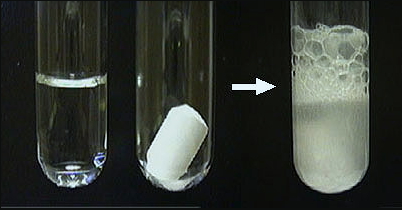
How could we make this reaction happen more quickly?
Decrease the concentration of the acid
crush the chalk to increase the surface area
Put the test tube in an ice bath
The major theory of reaction rate is called
Collision theory
Crash theory
Newton's laws
Thermodynamics
Which one of the following is NOT a key concept of the collision theory:
particles must collide in order to react
particles must move slowly when they collide, otherwise they simply “bounce off” one another
particles must collide with the proper orientation
particles must collide with sufficient energy to reach the activated complex in order to react
Activation energy is the amount of energy required to
break the bonds between the reacting molecules
convert the reactants into the activated complex
make the reacting particles collide
form the bonds between the product molecules

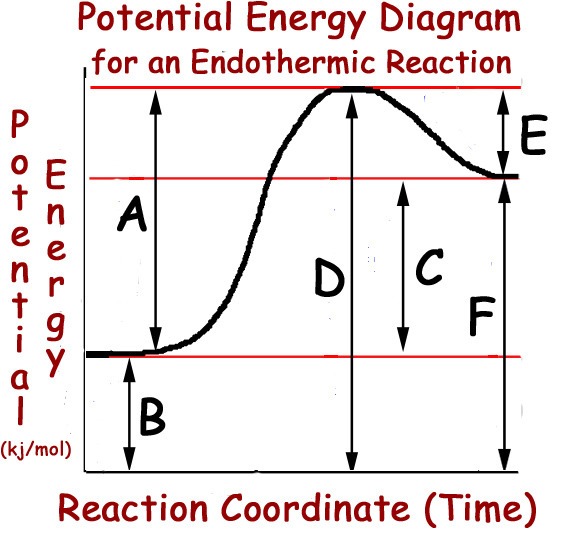
The activation energy, Ea, for the reverse reaction is
+ 50 kJ
+ 200 kJ
-150 kJ
+ 150 kJ
Which one of the following statements concerning rates of reactions is FALSE?
The higher the activation energy barrier, the faster the reaction.
Increasing the concentration of a reactant may increase the rate of a reaction.
Adding a catalyst speeds up the rate of reaction for both the forward and reverse reactions.
Increasing the concentration increases the rate of a reaction, because it increases the number of collisions.
Increasing pressure causes the reacting particles
to bond together
to repel from each other
gain more kinetic energy
to move closer together

B represents
Potential Energy of Products
Potential Energy of Reactants
Change in Enthalpy
Activation Energy

Which component of collision theory is represented in the image?
Correct orientation of molecules
molecules collide with sufficient energy
Products become reactants
Molecules form an activated complex

which factor that affect reaction rate is represented?
Temperature
Catalyst
Surface Area
Concentration
Indicate whether each of the following will: Increase / Decrease / have No effect on the rate of reaction.
Increasing temperature
Increase
Decrease
No Effect
Indicate whether each of the following will: Increase / Decrease / have No effect on the rate of reaction.
Decrease Particle Size
Increase
Decrease
No Effect
Indicate whether each of the following will: Increase / Decrease / have No effect on the rate of reaction.
Decrease Reactant Concentration
Increase
Decrease
No Effect

Which energy diagram line represents the catalyzed reaction?
The black line
The red line
It can not be determined
Why does a higher concentration increase the rate of reaction?
it increases the amount of reactants
it lowers the activation energy
it increases the energy of particle collisions
it increases the frequency of particle collisions
Why does a higher temperature increase the rate of a reaction?
it increases both the frequency and energy of particle collisions
it only increases the frequency of particle collisions
it only increases the energy of particle collisions
it reduces the activation energy of the reaction
Breaking up a lump of potassium into smaller pieces increases the rate of reaction due to increased
concentration
surface area
temperature
reactants

Which of the following would increase the rate of CO2 made using marble chips and HCl?
Lowering the temperature
Crushing the marble chips
Using less acid
Using bigger marble chips

The total area under the distribution curve represents
total energy.
activation energy.
total number of reacting molecules.
total number of molecules present.
What does increasing the concentration of reactants in a chemical reaction generally do to the reaction rate?
Increases the reaction rate
Has no effect on the reaction rate
Halts the reaction completely
Decreases the reaction rate
What happens to the number of successful collisions between reactant particles when the concentration of reactants increases?
Increases
Decreases
Becomes unpredictable
Remains the same
Which statement accurately describes the relationship between concentration and reaction rate?
Higher concentration increases the reaction rate.
Concentration has no effect on the reaction rate.
Lower concentration increases the reaction rate.
Higher concentration decreases the reaction rate.
If the concentration of a reactant in a chemical reaction is doubled, what happens to the reaction rate, assuming all other factors remain constant?
It doubles
It remains the same
It decreases by half
It quadruples
What is the primary reason behind the increase in reaction rate when the concentration of reactants is increased?
Increase in the number of successful collisions
Decrease in the activation energy
Decrease in the number of collisions
Increase in the activation energy
If the concentration of a reactant is halved, what happens to the reaction rate, assuming all other factors remain constant?
It decreases by half
It doubles
It quadruples
It remains the same
What must occur to have an effective reaction to occur? (Select all answers that apply).
Sufficient energy
Correct orientation
Two different reactants.
minimum activation energy
What can prevent a chemical reaction to occur?
Corrent orientation of reactants
Increasing the concentration of products
Insufficient activation energy
What determines the rate at which the reaction occurs?
Mass of the products
Concentration of products
The frequency of effective collisions.
What does a catalyst do to speed up a reaction?
It reduces the surface area of the reactants
It increases the surface area of the reactants.
It reduces the required energy for a chemical reaction to occur and provides an alternative pathway.
It increases the required energy for a chemical reaction to occur
Select the factors that can speed up a chemical reaction (can select multiple answers).
Increase temperature
Increase pressure (gases only)
Increase surface area
Add catalyst
Increase concentration
If the temperature is increased, then the rate is ........... and the time required for the reaction is ............
Increases, decreases
Increases, increases
decreases, increases
decreases, decreases
A catalyst ........... the rate of reaction by .......... the energy of activation.
Decrease, increasing
increase, increasing
Increases, decreasing
If the concentration of a reactant is decreased, then the rate is (increased or decreased ) and the time required for the reaction is (increased or decreased ).
decreased, increases
increased, increases
decreases, decreases
Increasing the number of collisions between reactants causes the rate to......... This happens by ...... the concentration or by ......the temperature.
Increases, increase, increase
increases, decrease, decrease
decreases, increase, increase
A reaction with very large energy of activation would be a ( fast or slow ) reaction rate.
slower
fast
neither
Emily and Makayla are discussing a science experiment. Emily suggests that grinding a sugar cube into powder before adding it to a cup of tea will make it dissolve faster, while Makayla disagrees. Who do you think is correct?
Emily
Makayla
Natasha, Lewis, and Harry are discussing their science project. Natasha argues that all chemical reactions require activation energy. Lewis and Harry are skeptical. Whose side are you on?
I support Natasha's argument (True)
I oppose Natasha's argument (False)
During a science project, Xavier and Isabelle are discussing cool Science stuff. Xavier suggests that an enzyme in the human body can speed up digestion, but Isabelle isn't sure. Who do you think is correct?
Xavier
Isabelle
Charlotte, Amelia, and Lewis are discussing about their science project on chemical reactions. Charlotte suggests that if they increase the temperature of their experiment, it will __________ the rate of the reaction. What do you think?
increase
decrease
Imagine Elizabeth, Charlotte, and Oscar are master chefs in a busy kitchen. If the temperature of the kitchen increases, what could potentially happen to them?
They start to slow down their cooking
They allow less effective interactions between each other
They start to lose their cooking speed
They start to interact more frequently, thus increasing the rate of their cooking activities
Isobel, Harry, and Nischal are feeling Science-y so start investigating chemistry stuff. They are crushing an antacid tablet into a fine powder for their project. According to their hypothesis, this process speeds up the reaction due to an increase in what?
concentration
surface area
temperature
reactants
Emma, Lewis, and Kiarra are cooking in their home kitchen. They are arguing heatedly over which factors can speed up the caramelization of sugar. Can you help them settle this debate?
increasing the temperature
increasing the sugar concentration
increasing the surface area of the sugar
all of these
Isabelle, Amelia, and Lewis are representing the College in a science competition. They are given a mystery substance and told that it is used in car engines to increase the rate of fuel combustion without being consumed in the process. What is this mystery substance likely to be?
catalyst
product
reactant
solute
Ebony, Kiarra and Audrey are baking a cake. Ebony suggests that using finely ground sugar instead of granulated sugar will allow for a _________ surface area to be exposed for the reaction in the baking process. What does Ebony mean?
larger
smaller
Emily, Capri, and Lewis are discussing the film Wonka in chemistry class. Emily suggests that if they increase the concentration of the reactants in a chemical reaction taking place in Wonka's chocolate factory factory, it will slow down the production rate. Is Emily correct?
Nah bro
Yes
Emma, Isobel, and Makayla are making a pizza for their friend Lewis's birthday because he's a fan of Italian cuisine. They are curious about why the pizza bakes faster when the oven temperature is higher. Can you help them understand? Why does a higher temperature increase the rate of a reaction?
it increases both the frequency and energy of particle collisions
it only increases the frequency of particle collisions
it only increases the energy of particle collisions
it reduces the activation energy of the reaction
Lewis, Natasha, and Xavier are working in their school's science lab at lunch for fun. They are conducting an experiment on the rate of reaction and are puzzled as to why a higher concentration increases the rate of reaction. Can you help them understand this concept?
it increases the amount of reactants
it lowers the activation energy
it increases the energy of particle collisions
it increases the frequency of particle collisions because there are more collision sites
Isobel, Lucinda, and Makayla are doing some Science on the weekend for fun. Their project involves speeding up the reaction time of a homemade volcano. What should they do to ensure their volcano erupts faster?
Increase the size of the baking soda particles.
Decrease the temperature of the vinegar.
Increase the concentration of the vinegar.
Do not stir the baking soda and vinegar mixture.
Charlotte, Nischal, and Lucinda are in a bakery, experimenting with baking different types of bread...as one does. They notice that the bread can burn quickly when there is a large amount of a certain characteristic of the flour used. Can you guess what that characteristic might be?
temperature
surface area
concentration
pressure
Imagine Harry, Ebony, and Nischal are baking a cake for their friend Lucinda's birthday. They are curious to know what they are actually observing when they investigate the rate of the cake's baking process. Are they looking at...
the amount of cake Harry, Ebony, and Nischal have baked
the speed of the baking process they are observing
the concentration of ingredients in their cake mix
the process of combining ingredients with the baked cake
Imagine Harry, Ebony, and Nischal are making potato bake for their friend Lucinda's dinner party. They are curious to know what they are actually observing when they investigate the rate of the potato bakes cooking process. Are they looking at...
the amount of potato bake Harry, Ebony, and Nischal have cooked
the speed of the baking process they are observing
the concentration of ingredients in their potato bake mix
the process of combining ingredients with the potato bake
Alessandra, Natasha, and Emily are in the library, reading textbooks for fun and studying the collision theory and chemical reactions. They come across a statement that doesn't quite align with the key concepts of the theory. Can you identify it?
particles must collide in order to react
particles must move slowly when they collide, otherwise they simply “bounce off” one another
particles must collide with the proper orientation
particles must collide with sufficient energy to reach the activated complex in order to react
Makayla, Emma, and Nischal are working on a chemistry project about the factors affecting the rate of a chemical reaction. They are stuck on identifying the factor that does not influence the reaction rate. They have listed down humidity, concentration, temperature, and nature of the reactants. Can you help them identify the irrelevant factor?
humidity
concentration
temperature
nature of the reactants
Picture this, Xavier, Ebony, and Capri are in a chemistry lab. They have a piece of ignited charcoal which is glowing. Suddenly, Capri places it into a jar of pure oxygen she carries around with her. They observe it burns more intensely. Can you guess why this happened? This is due to an increase in
surface area
temperature
concentration
volume
What is the collision theory?
a theory to do with atoms moving as quick as cars
states that atoms, ions and molecules must collide in order to react
that reactants that bump into each other will always rebound
Which condition is not needed for a successful collision of reactant molecules to form a product?
correct orientation
reactants must collide
reactants need enough energy upon collisions
must be heated to at least 373K
What the Activation energy?
The maximum energy a reaction can release
The minimum amount of energy that reacting particles must have when colliding to form products
The energy added by a catalyst
The energy possessed by the products
A high activation energy means the rate of the reaction will be...
fast
slow
medium
When we investigate the rate of reaction we are looking at the...
amount of product formed
speed of reaction
concentration of reacting particles
combining reactants with products

A
B
C
D
When we investigate the rate of reaction we are looking at the...
amount of product formed
speed of reaction
concentration of reacting particles
combining reactants with products
The major theory of reaction rate is called
Collision theory
Crash theory
Newton's laws
Thermodynamics
The higher the temperature a substance has the
more energy it has
less energy it has
In a solution when particles collide, most of the collisions
are successful
are unsuccessful
result in a chemical reaction
do not result in a chemical reation
What factors affect reaction rate?
size of atoms
temperature
concentration
surface area
catalysts
A log is burning in a campfire. If the concentration of oxygen reaching the log is increased, what will happen to the reaction rate?
reaction rate decreases
reaction rate increases
reaction rate remains the same
What is necessary for a chemical reaction to occur?
Correct orientation of particles when they collide
particle collisions
an increase or decrease in temperature
particle collisions with sufficient energy
a catalyst
What happens to reaction rate if surface area is decreased?
it increases
it decreases
it stays the same
What happens to reaction rate when a reactants concentration is increased?
it increases
it decreases
it remains the same
What happens to reaction rate when temperature is decreased?
it increases
it decreases
it stays the same.
What does a catalyst do to speed up a reaction?
It reduces the surface area of the reactants
It increases the surface area of the reactants.
It reduces the required energy for a chemical reaction to occur
It increases the required energy for a chemical reaction to occur
A reactants surface area is increased. What happens?
more collisions occur
the same number of collisions occur
greater collision energy
less collision energy
the same collision energy
A reactants concentration is increased. What happens?
more collisions occur
the same number of collisions occur
greater collision energy
less collision energy
the same collision energy
A reactants temperature is increased. What happens?
more collisions occur
the same number of collisions occur
greater collision energy
less collision energy
the same collision energy
The minimum quantity of energy which the reacting species must possess in order to undergo a specific reaction.
collision theory
activation energy
reaction rate
chemical reaction
the rate at which a chemical reaction takes place
activation energy
collision theory
reaction rate
chemical reactions
A substance that increases the rate of a chemical reaction without itself undergoing any permanent chemical change.
catalyst
products
reactants
chemical reaction
A substance that takes part in and undergoes change during a reaction.
products
reactants
catalyst
collision
A substance that is formed as the result of a chemical reaction.
products
reactants
catalyst
collision
Describes the 3 reasons chemical reactions occur.
collision theory
reaction rate
chemical reaction
activation energy
A process that involves rearrangement of the molecular or ionic structure of a substance, as opposed to a change in physical form or a nuclear reaction.
collision theory
reaction rate
chemical reaction
activation energy
When we investigate the rate of reaction we are looking at the...
amount of product formed
speed of reaction
concentration of reacting particles
combining reactants with products
Place the reaction in hot water
Add more reactants
Place the reaction in a ice bath
How could we make this reaction happen more quickly?
Decrease the concentration of the acid
crush the chalk to increase the surface area
Put the test tube in an ice bath
The major theory of reaction rate is called
Collision theory
Crash theory
Newton's laws
Thermodynamics
When zinc reacted with hydrochloric acid, what was the result of this reaction?
a white powder
a blue liquid
a brown precipitate
a gas
Which of the following is evidence of a chemical reaction?
Tearing paper.
Change in color.
Production of a gas.
Change in temperature.
Production of a precipitate.
List four factors that affects the rate of a reaction
temperature
concentration
surface area
volume
catalysts
A temperature increase causes the particles ......
to slow down
move faster
collide higher
in the right order
A catalyst be regenerated or used again and again
False
True
roll the magnesium strip into a small ball
Grind up the strip of magnesium
When we investigate the rate of reaction we are looking at the...
amount of product formed
speed of reaction
concentration of reacting particles
combining reactants with products
Place the reaction in hot water
Add more reactants
Place the reaction in a ice bath
A catalyst be regenerated or used again and again
False
True
Grinding a solid into fine particles (ex: sugar granules)
Increases rate of reaction
Decreases rate of reaction
Leaving a solid in one large block (Ex: Sugar cube)
Increases rate of reaction
Decreases rate of reaction

Increasing the temperature will
Increase rate of reaction
Decrease rate of reaction

Decreasing pressure, allowing particles to move with more space (the 1st container has a decreased pressure) will...
Increase rate of reaction
Decrease rate of reaction
Changing the concentration of the particles from 80% to 40% will
Increase rate of reaction
Decrease rate of reaction

Fill in the blank with the correct words:
A catalyst ___________ the rate of reaction by _________ the activation energy.
Increases; increasing
Increases; decreasing
Decreases; decreasing
Decreases; increasing
In order for a chemical reaction to occur, there must always be... (select all that apply)
a bond that breaks in a reactant particle
reacting particles with a high charge
an effective collision between reacting particles
enough energy
A temperature increase causes the particles ......
to slow down
move faster
collide higher
in the right order
How does a catalyst work in speeding up a reaction?
By lowering the activation energy or reaction
by giving them more energy
by making them more available
Why does a higher concentration increase the rate of reaction?
it increases the amount of reactants
it lowers the activation energy
it increases the energy of particle collisions
it increases the frequency of particle collisions
Why does a higher temperature increase the rate of a reaction?
it increases both the frequency and energy of particle collisions
it only increases the frequency of particle collisions
it only increases the energy of particle collisions
it reduces the activation energy of the reaction
The ______________is required to break the bonds of the reactants.
Carbonic energy
Activation energy
Plutonic energy
Energi Gaib
A temperature increase causes the particles ......
to slow down
move faster
collide higher
in the right order
Why does a catalyst increase the rate of reaction?
it produces extra energy for the reactants
it increases the speed of the reactant particles
it increases the frequency of particle collisions
it provides a lower energy alternate pathway
A temperature increase causes the particles to_____
slow down
move faster
collide less often
dance macarena
Why does a higher concentration increase the rate of reaction?
it increases the surface area of products
it lowers the activation energy
it increases the energy of particle collisions
it increases the frequency of particle collisions
Which of the following CAN affect reaction rates? Check all that apply?
temperature
concentration
surface area
catalysts
pressure
How will a rate of reaction be altered if temperature is increased?
reaction rate decreases (goes slower)
reaction rate increases (goes faster)
reaction rate is constant (stays the same)
Products will form faster if which of the following occurs? Select all that apply.
surface area is increased
temperature is decreased
reactant concentration is increased
the reactant solution is not stirred
Which of the following increases a reaction rate without being used up?
catalyst
product
reactant
How does a catalyst affect a reaction rate?
it makes the reaction faster by lowering the activation energy and energy needed to form the activated complex
it makes the reaction faster by raising the activation energy and energy needed to form the activated complex
it makes the reaction slower by lowering the activation energy and energy needed to form the activated complex
it makes the reaction slower by raising the activation energy and energy needed to form the activated complex
When surface area increases, the reaction rate does which of the following?
goes faster (rate increases)
goes slower (rate decreases)
Increasing the temperature will increase the kinetic energy of particles, therefore increasing the frequency of the collisions among particles.
false
true
If solution A is put into an ice water bath before being combined with solution B, how would the reaction rate be altered?
it would be faster (rate increases)
it would be slower (rate decreases)
How does increasing the concentration affect a reaction rate?
makes it go faster (increases rate)
makes it go slower (decreases rate)
Which of the following will increase the reaction rate (make it go faster) on an all gas system?
decreasing the surface area of a reactant
lowering the temperature of a reactant
adding an inhibitor
increasing reactant molarity
Which of the following best describes how a catalyst works?
lowers the pressure
raises the temperature
lowers the activation energy
raises the activated complex
Which of the following best describes the Collision Theory?
reactants must collide, collide with proper orientation, and enough activation energy
products must collide, collide with proper orientation, and enough activation energy
the activated complex must collide, collide with proper orientation, and enough activation energy
reactants and products together must collide, collide with proper orientation, and enough activation energy
A reaction between which of the following would increase the rate of a reaction and make it occur the fastest? What variable is being manipulated?
10 g of aluminum strip and 0.5 M hydrochloric acid at 20°C
10 g of aluminum strip and 0.5 M hydrochloric acid at 60°C
10 g of aluminum strip and 0.5 M hydrochloric acid at 20°C; concentration is being altered
10 g of aluminum strip and 0.5 M hydrochloric acid at 60°C; concentration is being altered
10 g of aluminum strip and 0.5 M hydrochloric acid at 20°C; temperature is being altered
10 g of aluminum strip and 0.5 M hydrochloric acid at 60°C; temperature is being altered
A reaction between which of the following would increase the rate of a reaction and make it occur the fastest? What variable is being manipulated?
10 g of aluminum strip and 0.5 M hydrochloric acid at 20°C
10 g of aluminum strip and 1 M hydrochloric acid at 20°C
10 g of aluminum strip and 0.5 M hydrochloric acid at 20°C; concentration is being altered
10 g of aluminum strip and 1 M hydrochloric acid at 20°C; concentration is being altered
10 g of aluminum strip and 0.5 M hydrochloric acid at 20°C; temperature is being altered
10 g of aluminum strip and 1 M hydrochloric acid at 20°C; temperature is being altered
A reaction between which of the following would increase the rate of a reaction and make it occur the fastest? What variable is being manipulated?
10 g of aluminum strip and 0.5 M hydrochloric acid at 20°C
10 g of granular aluminum and 0.5 M hydrochloric acid at 20°C
10 g of aluminum strip and 0.5 M hydrochloric acid at 20°C; concentration is being altered
10 g of granular aluminum and 0.5 M hydrochloric acid at 20°C; concentration is being altered
10 g of aluminum strip and 0.5 M hydrochloric acid at 20°C; surface area is being altered
10 g of granular aluminum and 0.5 M hydrochloric acid at 20°C; surface area is being altered
You have 1 M HCl reacting with 5 g of granular magnesium at room temperature. If you add water to the 1 M HCl, how will this alter the reaction rate?
it will make the reaction faster because you are increasing the concentration
it will make the reaction slower because you are increasing the concentration
it will make the reaction faster because you are decreasing the concentration
it will make the reaction slower because you are decreasing the concentration
You have a solution of 0.1 M silver nitrate reacting with a 5 g chunk of salt at room temperature. If you crush/pulverize the salt chunk, how will this alter the reaction rate?
it will make the reaction faster because you are increasing the surface area of the salt
it will make the reaction slower because you are increasing the surface area of the salt
it will make the reaction faster because you are decreasing the surface area of the salt
it will make the reaction slower because you are decreasing the surface area of the salt
What is the minimum amount of energy needed for colliding particles to react?
Chemical Energy
Kinetic Energy
Activation Energy
Potential Energy
A catalyst can be "recycled" and used again and again and again...
False
True
How can you increase the surface area of a solid?
crush/pulverize the solid into smaller pieces
add a larger mass of the solid particles
melt the solid into a liquid
increase the temperature
How does increasing concentration increase the rate of a reaction?
fewer collisions occur among reactants
more kinetic energy is provided to the reactants
more collisions occur among reactants
less kinetic energy is provided to the reactants

Examine the model between the two reactants which are red and blue. Which variable is being changed and how does it alter the reaction rate?
concentration is increasing and will increase the reaction rate (it goes faster)
concentration is decreasing and will decrease the reaction rate (it goes slower)
surface area is increasing and will increase the reaction rate (it goes faster)
surface area is decreasing and will decrease the reaction rate (it goes slower)
How can you increase the concentration of a reactant?
crush/pulverize the reactant into smaller pieces
increase the molarity of a reactant
add more water to the test tube
increase the temperature of the reacting solutions
what is a reaction rate?
Amount of time it takes the reactants to create products.
Study of chemical reactions
endothermic reaction
activation energy
what are kinetics?
variables to slow down reaction
variables to speed up reaction
study of chemical reactions and reaction rates
amount of time it takes reactants to create products.

what does the letter C stand for on the graph?
activation energy
product
exothermic
reactant
what would speed up the reaction?
adding pressure
increase in volume
concentration decreases
increase of product.
what is activation energy?
catalyst
balance of reactants and products
potential energy
amount of energy needed for a reaction to occur.

