wayground logo

Free Printable Worksheets

Font size

S
M
L
XL
Worksheets

Physical Science Final Practice 1

Total questions: 191

Worksheet time: 6hrs 42mins

Name
Class
Date
1.
A series of steps used by scientists to solve a problem or answer a question. 
a)
scientific method
b)
recipe
c)
data collection
d)
metric system
2.

Performing a test or experiment allows you to test your ___________.

a)

draw conclusions

b)

hypothesis

c)

senses

d)

battery

3.
Should experiments be repeated over and over to see if the results are the same each time?
a)
yes
b)
no
4.
All factors that can change in an experiment.
a)
variable
b)
data
c)
conclusion
d)
result
5.

How can you tell motion occurs?

a)

The object's speed decreases in regards to the reference point.

b)

The object and the reference point both move at the same speed.

c)

The object's speed increases in regards to a reference point.

d)

The object's position changes in regards to a reference point.

6.

Rachel walks 12 feet from her locker to her class, remembers that she forgot her calculator and walks back to her locker. Then she walks back to class. What was her displacement?

a)

36 feet

b)

24 feet

c)

0 feet

d)

12 feet

7.

This is how far you are from your starting point.

a)

displacement

b)

distance

c)

length

d)

meters

8.

Which of the following is correct?

a)

Initial Position = -2 m

Final Position = 0 m

Distance = 14 m

Displacement = 2 m

b)

Initial Position = 0 m

Final Position = -2 m

Distance = 14 m

Displacement = -2 m

c)

Initial Position = -2 m

Final Position = 0 m

Distance = -2 m

Displacement = -2 m

d)

Initial Position = -2 m

Final Position = 0 m

Distance = 14 m

Displacement = 14 m

e)

None are correct.

9.

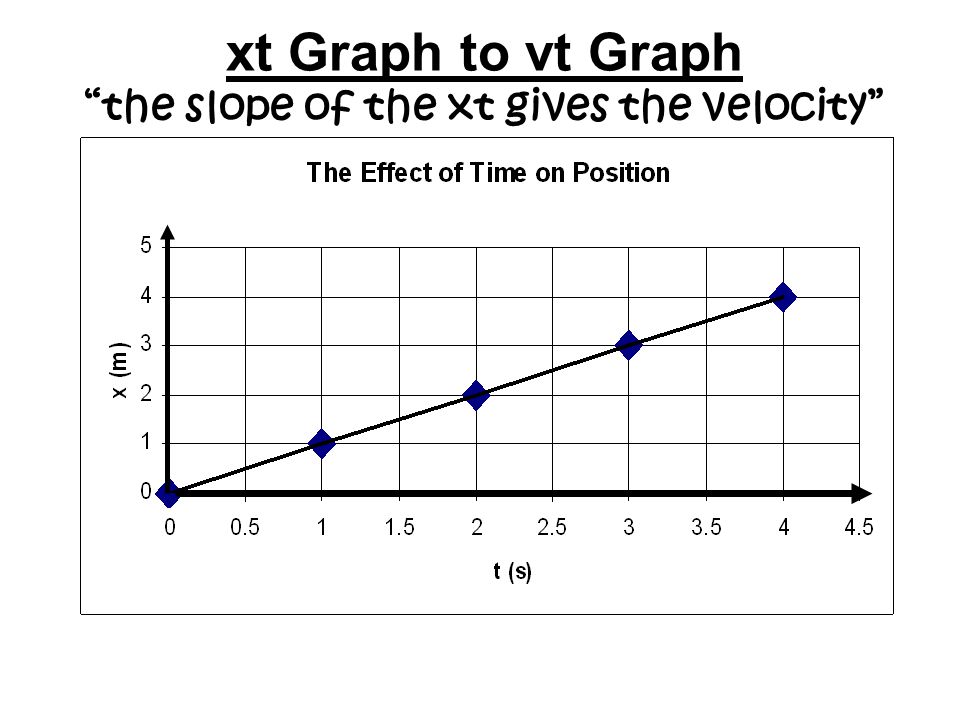
How fast is this object moving?

a)

1 meter

b)

1 meter /second

c)

2 meters/second

d)

4 seconds

10.

At what time does this object have a negative velocity?

a)

3 seconds

b)

7 seconds

c)

11 seconds

d)

never

11.

Consider the position vs. time graph below for cyclists A and B.

Do the cyclists start at the same point?

a)

Yes

b)

No

12.

At t= 7s, which cyclist is ahead?

a)

A

b)

B

13.

Total distance divided by total time is

a)

average speed

b)

constant speed

c)

instantaneous speed

d)

acceleration

14.
You walk 10 meters to math class in 20 seconds. Your average speed is
a)
2 m/s
b)
0.5 m/s
c)
200 m/s
d)
5 m/s
15.

Position

a)

a specific point in space

b)

the amount of space between one point and another

c)

the change in position of an object

d)

the point or place where something begins

16.

velocity

a)

the speed and direction of moving objects

b)

distance traveled per unit of time

c)

a specific point in space

d)

a pull or push that is applied to an object

17.

acceleration

a)

a change in the velocity (speed, direction, or both) of a body (related word: accelerate)

b)

distance traveled per unit of time

c)

a change in the position of an object compared to another object (related term: move, movement)

d)

the change in position of an object

18.

What will happen if you were to drop a 16mm steel marble and a 16mm cork marble onto the floor from the same height and at the same time?

a)

The steel marble will land first.

b)

The cork marble will land first.

c)

Both the steel marble and the cork marble will land at the same time.

19.

A student places a ball on the ground and kicks it hard. The ball moves along the ground. Which statement is true?

a)

The kick decreases the weight of the ball

b)

The kick applies force, which changes the direction of the ball.

c)

The kick decreased the force of gravity acting on the ball.

d)

The kick removes friction between the ball and the ground.

20.

When you slide a box across the floor, what force must your push be stronger than?

a)

Support Force

b)

Friction Force

c)

Gravity

d)

Air resistance

21.

A force is described as . . .

a)

a push only

b)

a pull only

c)

a push or a pull

d)

none of the above

22.

Which person in the diagram is moving the fastest?

a)

A

b)

B

c)

C

d)

D

23.

What unit do scientists use to measure force?

a)

Newton

b)

Grams

c)

Meters

d)

Meter per second per second

24.

What is the net force on the box shown in the picture?

a)

10 N to the left

b)

10 N to the right

c)

60 N to the left

d)

50 N to the right

25.

The moon has a smaller mass than the Earth. If you were able to travel to the moon your weight would...

a)

Increase

b)

Decrease

c)

Stay the same

d)

Vary with day and night

26.

Test paper is sitting at rest on your desk. Which of the following statements best describes this situation?

a)

There are no forces acting on your paper.

b)

Your paper pushes on the desk only.

c)

The desk pushes on your paper only.

d)

The forces acting on the paper are balanced.

27.

Which ball will hit the ground first?

a)

Metal first, then plastic, then wood last

b)

Wood first, then plastic, then metal last

c)

They will all hit at the same time

d)

There is no way to tell

28.

A change to an object's motion is caused by . . .

a)

Balanced forces

b)

Unbalanced forces

c)

Acceleration

d)

Velocity

29.
Acceleration of an object happens when things ________
a)
slow down
b)
go faster
c)
change direction (turn)
d)
All of the above
30.
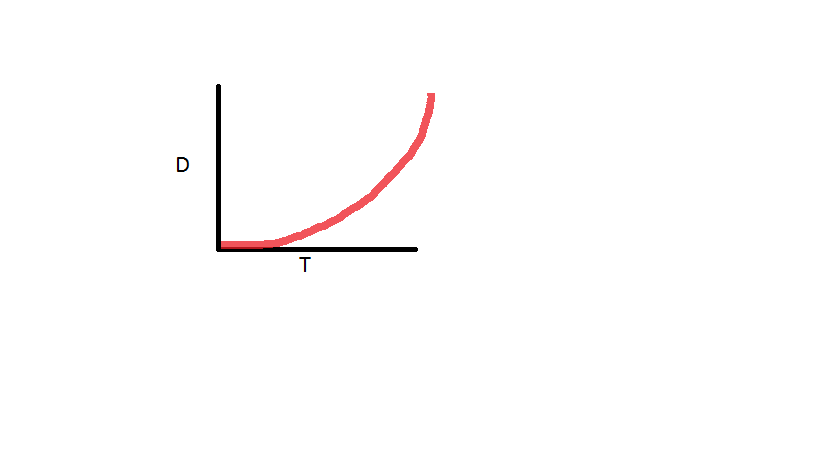
In the distance vs. time graph, what type of motion does the line represent? 
a)
Speed
b)
Velocity
c)
Acceleration
d)
Deceleration
31.
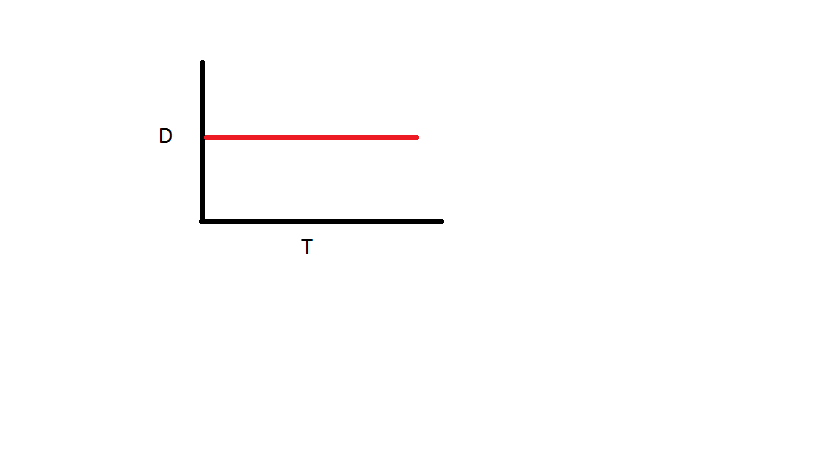
In the distance vs. time graph, what type of motion does the line represent?
a)
No motion
b)
Constant velocity
c)
Acceleration
d)
Deceleration
32.
A car traveling 300 miles in 5 hours is an example of _____. 
a)
Speed
b)
Velocity
c)
Acceleration
d)
Direction
33.
Describe the speed of the object from
0-2 seconds using the distance vs. time graph.
a)
Constant speed
b)
Speeding up
c)
Slowing down
d)
Not moving
34.

Colin skateboards down the sidewalk in front of the school, traveling at 24 km/h. How much time would it take him to travel 6.0 km?

a)

0.25 h

b)

0.4 h

c)

5.4 h

d)

12 h

35.

Sharis decides to be brave and go skydiving. If she accelerates at 9.81 m/s2 (m/s2 = m/s/s) for 4.9 s, what would her speed be at that time?

a)

48.1 m/s

b)

0.6 m/s

c)

0.0015 m/s

d)

7.1 m/s

36.

A little freshman moves down the hall at 3.2 m/s. When he sees Luke coming, he slows down. After 3.2 s, he is moving at 1.2 m/s. What is his acceleration?

a)

-0.25 m/s2

b)

-42.9 m/s2

c)

-0.625 m/s2

d)

-12 m/s2

37.

Kendra is coming home late, past her curfew. As she sneaks quietly into her house trying not to wake up her parents, she slinks up the stairs moving 10.7 m in 26.8 s. Find her speed.

a)

0.4 m/s

b)

2.0 m/s

c)

7.1 m/s

d)

10.2 m/s

38.

Jeff stays after class to work on his science homework is late for hockey practice. He decides to run so the coach won't be mad. If the locker room is 300 m from the classroom and Jeff can run a surprising 25 m/s, how long would it take him to get there?

a)

7.5 s

b)

12 s

c)

42.9 s

d)

0.25 s

39.

A car moving at 4.5 m/s accelerates at 2.5 m/s2. After 7 s, how fast will it be moving?

a)

22 m/s

b)

18.3 m/s

c)

4.9 m/s

d)

7.6 m/s

40.

Velocity is different from speed because...

a)

Velocity is distance/time. Speed is displacement/time.

b)

Velocity is speed in a certain direction and can be positive or negative.

c)

Speed is velocity in a certain direction. Both can only be positive.

d)

Velocity is how much speed changes over time.

41.

The image shows two cars with the same speed moving in different directions. What is true about the velocity of the cars?

a)

Each car has the same velocity because the speeds are the same.

b)

Each car has a different velocity because they are going in different directions.

42.

Observe the motion of the washer as the notecard is pulled quickly out from under it. Which of Newton's Laws does this represent?


Observar el movimiento de la moneda mientras saca rápidamente el papel de debajo. ¿Cuál de las leyes de Newton representa esto?

a)

Newton's 1st Law, inertia

b)

Newton's 2nd Law, Force = m x a

c)

Newton's 3rd Law, action/reaction

43.
Pushing a child on a swing is easier than pushing an adult on the same swing, because the adult has more inertia.
a)
Newton's 1st Law
b)
Newton's 2nd Law
c)
Newton's 3rd Law
d)
None of them
44.
This law is often called "the law of inertia."
a)
Newton's 1st Law
b)
Newton's 2nd Law
c)
Newton's 3rd Law
d)
None of them
45.
A soccer ball accelerates more than a bowling ball when thrown with the same force.
a)
Newton's 1st Law
b)
Newton's 2nd Law
c)
Newton's 3rd Law
d)
None of them
46.
A student leaves a pencil on a desk and the pencil stays in the same spot until another student picks it up.
a)
Newton's 1st Law
b)
Newton's 2nd Law
c)
Newton's 3rd Law
d)
None of them
47.
For every action there is an equal and opposite reaction.
a)
Newton's 1st Law
b)
Newton's 2nd Law
c)
Newton's 3rd Law
d)
None of them
48.

When two equal forces act in opposite directions on an object, they are called ______________________.

a)

frictional force

b)

balanced force

c)

centripetal force

d)

gravitational force

49.

When an unbalanced force acts on an object, the force ______________________.

a)

changes the motion of the object

b)

is cancelled by another force

c)

does not change the motion of an object

d)

is equal to the weight of the object

50.
Momentum is a ____________________ quantity
a)
science
b)
scalar
c)
vector
d)
energy
51.

The momentum of an object depends upon the object's ___________&_____________.

a)

size and shape

b)

mass and speed

c)

mass and veloctiy

d)

mass and energy

52.
In any collision (crash) the ______ is ALWAYS constant
a)
Total Momentum
b)
total speed
c)
total Velocity
d)
Energy
53.
What is the net force?
a)
40 N left
b)
0 N Balalnced
c)
400 N right
d)
40 N right
54.
A 0.250 kg cart moving at 0.400 m/s has how much momentum?
a)
0.1 kg-m/s
b)
1 kg-m/s
c)
10 kg-m/s
d)
100 kg-m/s
55.
When the speed of an object is doubled, its momentum
a)
remains unchanged in accord with the conservation of momentum.
b)
doubles
c)
quadruples
d)
decreases
56.
Which object listed below has the greatest momentum?
a)
A 0.05 kg object rolling at 0.2 m/s.
b)
A 0.15 kg object rolling at 2 m/s.
c)
A 0.15 kg object rolling at 1 m/s
d)
A 0.4 kg object rolling at 2 m/s.
57.
The total momentum before a collision is _________ the total momentum after a collision.
a)
equal to 
b)
less than 
c)
more than
d)
It depends on the type of collision
58.

A weightlifter lifts two 300 newton weights 1.5 meters off the ground. How much work has she done?

a)

600 J

b)

450 J

c)

900 J

d)

1200 J

59.
The amount by which a machine multiplies input force is known as the 
a)
work.
b)
power.
c)
output force.
d)
mechanical advantage.
60.
You do 90 joules of work in 30 seconds. How much power have you generated?
a)
30 watts
b)
3 watts
c)
120 watts
d)
270 watts
61.

You move a 8 N object five meters in 4 seconds. How much power have you generated?

a)

160 watts

b)

10 watts

c)

6.4 watts

d)

17 watts

62.

When you rub your hands together on a cold day, you use friction to convert

a)

Mechanical energy into thermal energy

b)

Thermal energy into nuclear energy

c)

Chemical energy into mechanical energy.

d)

Electrical energy into thermal energy

63.
Light is an example of _________
a)
thermal energy
b)
radiant energy
c)
mechanical energy
d)
nuclear energy
64.

50 J of work is done lifting a 20.0 N book in the air. How high was it lifted?

a)

2.5 m

b)

3.5 m

c)

0.4 m

d)

25 m

65.

What are two things required for work to be done? Check all that apply.

a)

Force

b)

Distance

c)

Constant Speed

d)

Friction

66.
How much work is done in holding a 15 N sack of potatoes while waiting in line at the grocery store for 3 minutes?
a)
15 J
b)
45 J
c)
0 J
d)
5 J
67.
Identify this simple machine
a)
Lever
b)
Wheel & Axle
c)
Inclined Plane
d)
Screw
68.
Which of the following does a simple machine do?
a)
allows the users to apply less force over a longer distance
b)
reduce the amount of force needed to do work
c)
change the direction of the applied force
d)
all of the above
69.
Which is an example of someone using a simple machine to do work?
a)
a boy runs across a football field
b)
a banker counts money
c)
a mother pushes a stroller up a ramp
d)
a girl eats a sandwich
70.
A simple machine that consists a rigid bar that pivot about a fixed point
a)
lever
b)
pulley
c)
wheel and axle
d)
fulcrum 
71.
What is effort (input) force?
a)
the force required by a machine in order to accomplish work (the force you put on the machine)
b)
the force which an effort force must overcome in order to do work on an object via a simple machine.
c)
the force the machine exerts on a object
d)
the output work times the input distance
72.
Using a lever, Joe is able to lift a 10,000 N car off of the ground with a force of 1000 N. What is the mechanical advantage of the lever?
a)
1
b)
10
c)
100
d)
1000
73.
The mechanical advantage of this inclined plane is.....
a)
2.4
b)
3.4
c)
4.4
74.
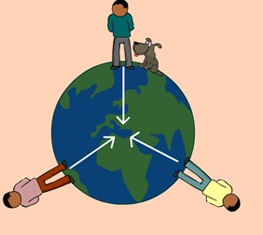
What is gravity?
a)
A force
b)
Energy
c)
A push
d)
All of them
75.
What is mass?
a)
How much MATTER makes up an object.
b)
How much GRAVITY is pulling an object.
76.
The amount of matter in an object is 
a)
pressure
b)
weight
c)
mass
d)
force
77.
If the mass of an object on Earth is 18 grams, what would the mass of the same object be on the Moon?
a)
18 g
b)
4 g
c)
0 g 
d)
32 g 
78.
A child has a mass of 30 Kg on Earth. If the gravity on Moon is one sixth that of the Earth what is the mass of the child on Moon? 
a)
30 Kg
b)
180 Kg
c)
5 Kg
d)
0 Kg
79.
The scientific unit of weight is
a)
Kg
b)
N
c)
pounds
d)
Kgm/s
80.
The scientific unit for mass is
a)
Kg
b)
N
c)
pounds
d)
ounces
81.
If an object mass =30 Kg on the Earth, what would be it's weight on Earth?
a)
30 N
b)
300 kg
c)
3000N
d)
300 N
82.
The force of gravity on Jupiter is a little more than 2 times the gravitational force on Earth. If an object has a mass of 50 kg and a weight of 490 N on Earth, what would be the object's approximate mass and weight on Jupiter?
a)
50 kg and 490 N
b)
100 kg and 490 N
c)
50 kg and 980 N
d)
100 kg and 980 N
83.

Gravity attracts all objects towards one another.

a)

False

b)

True

c)

It depends

84.

Weight is _________.

a)

the quantity of matter in an object.

b)

the measure of an object's inertia.

c)

the force exerted by gravity on an object's mass.

d)

equal to the mass of an object.

85.
Warm air rises and the cool air sinks demonstrates this type of heat transfer. 
a)
conduction
b)
convection
c)
radiation
d)
Insolation 
86.
The heat from a hot burner to a pot is transferred by ______.
a)
convection
b)
insulation
c)
radiation
d)
conduction
87.
The sun warming your skin is an example of heat transfer through 
a)
conduction
b)
convection
c)
radiation
d)
thermal electricity
88.
Radiation is a method of thermal energy transfer that moves -
a)
through empty space.
b)
when objects touch.
c)
only through solids.
d)
in the motion of fluids.
89.

What type of heat transfer takes place in liquids and gasses?

a)

Conduction

b)

Convection

c)

Radiation

d)

Thermal Equilibrium

90.
Which example below is an example of convection?
a)
Standing on a hot metal bridge
b)
The attic is warmer than the basement
c)
The Sun heating the Earth
d)
Touching hot sand with your feet
91.
What happens to particles as they heat up?
a)
They slow down
b)
Nothing
c)
They don't move
d)
They speed up
92.
Why is there more thermal energy in an iceberg than in a pot of boiling water?    
a)
a.  The pot insulates the heated molecules
b)
b.  Most icebergs are fairly warm to the touch
c)
  c.  Icebergs contain many more molecules than pots of water
d)
  d.  Water does not hold heat very well
93.

Kinetic Energy is the energy of _________

a)

thermal

b)

movement

c)

potential

d)

atoms

94.

Thermal energy is the __________ _________ energy of moving particles

a)

total potential

b)

average potential

c)

average kinetic

d)

total kinetic

95.

Temperature is the __________ _________ energy of moving particles

a)

average potential

b)

average kinetic

c)

total potential

d)

total kinetic

96.

Objects with MORE MASS have______________

a)

lower potential energy

b)

lower number of atoms

c)

higher thermal energy

d)

higher temperature

97.

As temperature increases, molecules _____________

a)

move slower

b)

move the same

c)

move faster

d)

stop moving

98.
A student was doing a science investigation in school.  Her teacher asked her to fill two beakers with water.  What would be the temperature of the water when it started to boil?
a)
100 degrees celsius
b)
50 degrees celsius
c)
32 degrees celsius
d)
20 degrees celsius
99.

Thermal energy always moves from hot to cold.

a)

true

b)

false

100.
To measure the temperature difference between two cups of water, you would use a _____.
a)
measuring cup
b)
ruler
c)
thermometer
d)
balance scale
101.
No more energy can be removed from matter at:
a)
its freezing point
b)
0°C
c)
absolute zero
d)
273 K
102.
Specific heat is....
a)
The measure of kinetic energy of an objects particles
b)
A measure of the energy needed to increase the average kinetic energy of the particles
c)
The heating caused by the motion of flluid due to temperature difference
d)
The transfer of energy by electromagnetic radiation
103.
How does heat flow?
a)
Always from cold to warm
b)
Always from warm to cold
c)
Both warm to cold & cold to warm
d)
It depends on the temperature
104.
The amount of energy required to raise the temperature 1ºC for every kilogram is called____?
a)
Thermal Energy
b)
Specific Heat
c)
Temperature
d)
Kinetic Energy
105.
What is the symbol for Thermal Energy in the specific heat formula?
a)
Q
b)
t
c)
m
d)
C
106.
There are four cups of hot cocoa. The cup sizes are shown. The temperature of the cocoa in each cup is 25 degrees celsius. Which cup has the MOST thermal energy?
a)
Large cup (Trenta)
b)
Small cup (Tall)
c)
Medium cup (Venti)
d)
All three are the same temperature so they have the same thermal energy
107.
What unit do you use to measure Thermal Energy?
a)
J/Kg ºC
b)
Kg
c)
ºC
d)
J
108.
Copper, Stainless Steel, Carbon Steel, and Zinc were all heated using 10,000 JOULES of thermal energy.  What material would be have the LARGEST change in temperature?
a)
Copper
b)
Carbon Steel
c)
Zinc
d)
Stainless Steel
109.
A high specific heat means...
a)
It requires less energy to change temperature
b)
It requires more energy to change temperature
c)
It heats up very quickly
110.
The specific heat of aluminum is 0.21 cal/g°C.  How much heat(Q) is released when a 10 g piece of aluminum foil is taken out of the oven and cools from 100° to 50°?
a)
105 J
b)
10.5 J
c)
1.05 J
d)
50 J
111.
If 200 grams of water is to be heated from 24.0° C to  100.0° C to make a cup of tea, what is the mass and what is the change in temperature?
a)
m=100g,  ∆t= 224 C
b)
m=200g,  ∆t=124 C
c)
m=100g,  ∆t=24 C
d)
m=200g,  ∆t=76 C
112.
20 g of water. specific heat of water is 4.18 J/g°C.  temperature changes from 25° C to 20° Chow much heat energy (Q) moves from the water to the surroundings?
a)
418 Joules
b)
209 J
c)
83 J
d)
4.18 J
113.
lowest possible temperature on the Kelvin scale
a)
boiling point
b)
insulation
c)
absolute zero
d)
heat
114.

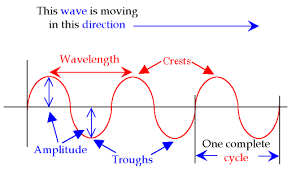
What is transferred from place to place by waves?

a)

matter

b)

energy

c)

particles

d)

light

115.

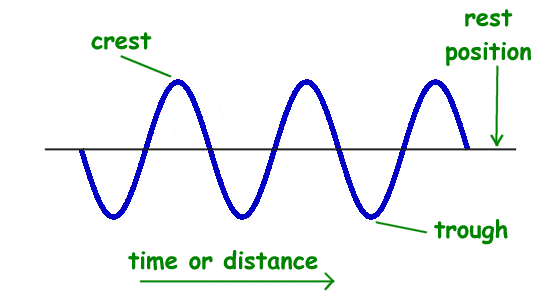
What does the arrow in the picture represent?

a)

amplitude

b)

wavelength

c)

frequency

d)

trough

116.

What does the arrow in the picture represent?

a)

wavelength

b)

echolocation

c)

amplitude

d)

peak

117.

If the amplitude increases, the energy of the wave:

a)

increases

b)

decreases

c)

stays the same

118.

The highest point of a wave is called what?

a)

trough

b)

wavelength

c)

peak

d)

amplitude

119.

Waves that require a medium to travel are:

a)

mechanical waves

b)

transverse waves

c)

electromagnetic waves

d)

light waves

120.

What happens when you increase the amplitude of a sound?

a)

it makes the sound louder

b)

it makes the sound travel faster

c)

it makes the sound softer

d)

it changes the pitch or note of the sound

121.

What kind of wave is pictured below?

a)

compressional wave

b)

transverse wave

c)

longitudinal wave

d)

mechanical wave

122.

What can electromagnetic waves travel through (select all that apply)?

a)

solids

b)

empty space

c)

liquids

d)

gases

123.

Which wave is pictured?

a)

Transverse

b)

Longitudinal

c)

Electromagnetic

d)

Light

124.

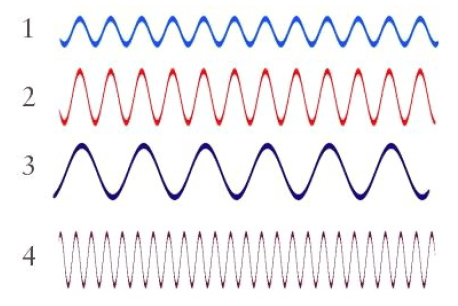
Which wave in the diagram has the greatest frequency?

a)

1

b)

2

c)

3

d)

4

125.

Which wave in the diagram has the longest wavelength?

a)

1

b)

2

c)

3

d)

4

126.

Which of the following can a mechanical wave travel through (select all that apply)?

a)

solid

b)

liquid

c)

gas

d)

empty space

127.

What is measured from crest to crest or trough to trough?

a)

mediums

b)

resting position

c)

wavelength

d)

origin

128.

If a wave has a greater frequency, what happens to the wavelength?

a)

increases

b)

decreases

c)

stays the same

129.

This sound has high pitch, which means it has a(n):

a)

Higher frequency

b)

Lower frequency

c)

Higher amplitude

d)

Lower amplitude

130.

How are the frequency of a wave and the period related?

a)

They both equal the wavelength.

b)

They are both the inverse of the wavelength.

c)

They are the inverse of each other

d)

They are both related to the amplitude.
131.

One hertz is equal to:

a)

1 cycle or wave per second

b)

the distance from crest to crest or trough to trough

c)

the distance from one rarefaction to the next rarefaction.

d)

the maximum displacement of the wave

132.

Longitudinal waves move __________ to the energy of the wave (select all that apply).

a)

Parallel

b)

Perpendicular

c)

At a 90 degree angle

d)

In the same direction

133.

Transverse waves move __________ to the energy in the wave (select all that apply).

a)

Parallel

b)

Perpendicular

c)

At 90 degree angle

d)

In the same direction

134.

The area of a longitudinal wave where particles are pushed close together are called:

a)

rarefactions

b)

compressions

c)

amplitude

d)

wavelength

135.

The areas of a longitudinal waves where particles are spread far apart from each other are called:

a)

rarefactions

b)

compressions

c)

amplitude

d)

wavelength

136.

When two waves are superimposed on each other, their positions are:

a)

added

b)

subtracted

c)

multiplied

d)

divided

137.

When these waves interact, which type of interference will occur?

a)

constructive interference

b)

destructive interference

c)

restrictive interference

d)

no interference

138.

Two waves with amplitude 4 and 3 interfere and are in phase. What is the amplitude of the resulting wave?

a)

12

b)

-1

c)

1

d)

7

139.

Two waves with amplitude 4 and 3 interfere and are out of phase. What is the amplitude of the resulting wave?

a)

1

b)

2

c)

7

d)

12

140.

What factors affect how fast a sound wave travels?

a)

The medium or material in is moving through

b)

The amplitude

c)

The wavelength

d)

The perpendicular motion in which it travels to the direction of the wave.

141.

A light wave travels through the air, passes into this glass and then travels back into the air as seen in the picture. Which best describes what is happening.

a)

The light wave is

refracted

b)

The light wave is diffused

c)

The light is reflected.

d)

The light is diffracted.

142.

The region of the Electromagnetic Spectrum where color can be seen is called visible light. Which of the following is correct?

a)

The lowest frequency is red and the highest is violet

b)

The highest is red and the lowest is violet

c)

green has the highest frequency

d)

Yellow has the highest frequency.

143.

Sound travels fastest in............

a)

solids because the particles are closer together than air particles.

b)

air because the particles are moving slowly

c)

Liquid

d)

Air because the particles are moving quickly and the particles are far apart.

144.

A _____________ is any disturbance that transmits energy.

a)

Amplitude

b)

Frequency

c)

Transverse

d)

Wave

145.
Wave __________ is the number of complete waves that pass a given point in a certain amount of time.
a)
Frequency
b)
Wavelength
c)
Amplitude
d)
Compression
146.
Waves that move the medium at right angels to the direction in which the wave travel
a)
Longitudinal Waves
b)
Compressional Waves
c)
Transverse Waves
147.
Speed = wavelength x frequency
The speed of a wave on a rope is 50 cm/s and its wavelength is 10 cm. What is the wave's frequency?
a)
50 cm/s
b)
5 Hz
c)
10 cm
148.

How is an electromagnetic wave different from a mechanical wave?

a)

An electromagnetic wave travels slower than a mechanical wave.

b)

An electromagnetic wave has a larger amplitude than a mechanical wave.

c)

An electromagnetic wave can travel through a vacuum, but a mechanical wave cannot.

d)

An electromagnetic wave has no wavelength, but a mechanical wave has a wavelength.

149.

Which of the following are not a part of the Electromagnetic Spectrum?

a)

Gamma Rays

b)

Radio waves

c)

Magnetic waves

d)

x-rays

150.

Why does this car appears red under a white light?

a)

The car is absorbing the red light and reflecting the blue and green.

b)

The car is reflecting only the red light while absorbing the blue and green.

c)

The car is absorbing the red and green light while reflecting the blue.

d)

The car is absorbing the red, blue and green, but our eyes can only see the red.

151.
What property of light makes this pencil appear to be bent or broken?
a)
Reflection
b)
Refraction
c)
Diffraction
d)
Absorption
152.
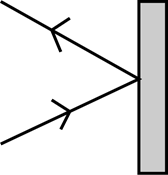
The illustration shows a light ray striking an object.
In the illustration, the light ray striking the object is-
a)
absorbed
b)
stopped
c)
reflected
d)
refracted
153.

Which of the following gadgets best shows the transformation of energy from electrical to mechanical with the correct reasoning?

a)

A light bulb because electricity is being used to create light and heat.

b)

A fan because electricity is being used to spin the blades of the fan.

154.

Electricity happens with the flow of

a)

electrons.

b)

water

c)

sand

155.
An object becomes charged when the atoms in the object gain or lose
a)
electrons
b)
protons
c)
neutrons
d)
all of the above
156.
If you rub a glass rod with a piece of silk, the rod becomes positively charged. This means that
a)
friction destroyed electrons in the rod.
b)
the silk has become negatively charged.
c)
protons have moved to the rod.
d)
glass attracts more protons.
157.

The accumulation of excess electric charge on an object is called

a)

Static electricity

b)

Electric discharge

c)

Resistance

d)

Current electricity

158.

Mr. Anady rubbed two balloons against his wool sweater for 30 seconds each. What will happen when the balloons are brought near each other?

a)

The balloons will repel each other.

b)

The balloons will attract each other.

c)

The balloons will become positively (+) charged.

d)

The balloons will pop.

159.
Which of the following is caused by static electricity?
a)
a stove getting hot when it is turned on
b)
a magnet being attracted to a refrigerator
c)
a lightning strike during a storm
d)
a light bulb coming on when a switch is turned on
160.
Is it possible to CREATE electrons?
a)
Yes, that's what static electricity is.
b)
No, you can move them, but they are never created or distroyed.
c)
Sometimes, it depends on the voltage.
d)
Sometimes, it depends on the element.
161.
What charge does a proton have?
a)
negative (-)
b)
positive (+)
c)
neutral or no charge (0)
162.
What charge does an electron have?
a)
negative (-)
b)
positive (+)
c)
neutral or no charge (0)
163.
If a substance has a higher number of electrons than protons on its surface, what type of charge does it have?
a)
A positive charge.
b)
A negative charge.
c)
A neutral charge
d)
No charge at all
164.
What size resistor would produce a 3 Amp current flow with a 12 Volt battery
a)
1 Ohm
b)
3 Ohms
c)
4 Ohms
d)
12 Ohms
165.
What is current measured in?
a)
Ω (Ohms)
b)
V (Volts)
c)
A (Amps)
d)
W (Watts)
166.
What is Resistance?
a)
The flow of electrons
b)
Electric potential difference
c)
A battery
d)
The ability to reduce the flow of electrons
167.
Electricity that flows in a closed path is called a
a)
path
b)
current
c)
circuit
d)
light
168.
What is the Voltage of a circuit that has a resistance of 5 Ω and a current of 2 A?
a)
25 V
b)
10 V
c)
2.5 V
d)
0.4 V
169.
What types of charges attract?
a)
Positive and Positive
b)
Positive and Neutral
c)
Negative and Neutral
d)
Positive and Negative
170.
What is the Voltage of a circuit that has a resistance of 5 Ω and a current of 2 A?
a)
25 V
b)
10 V
c)
2.5 V
d)
0.4 V
171.
If the Voltage stays the same and Resistance is increased, Current will 
a)
Increase
b)
Decrease
c)
Stay the same
d)
X
172.

If the battery produced 12.6 Volts what would be the current flow for a 6 Ohm resistor?

a)

2.1 Amps

b)

2.4 Amps

c)

1.71 Amps

d)

15 Amps

173.
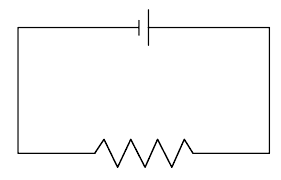
This circuit has a 24 volt battery and the resistor is 8 ohms. How many amps are running through the circuit?
a)
3 Amps
b)
192 Amps
c)
2 Amps
d)
4 Amps
174.
What word means how fast the electrons flow.
a)
Current
b)
Voltage
c)
Resistance
d)
Power
175.
To complete a circuit the switch must be
a)
unattached
b)
open
c)
closed
d)
It depends
176.

When the voltage in a circuit increases, what happens to the current?

a)

Current Increases

b)

Current Decreases

c)

Current Remains the same

177.

Which of the following would be a measurement of Resistance?

a)

3 Ω

b)

1.7 V

c)

23 A

d)

67 W

178.

Which of the following would be a measurement of Voltage?

a)

21 Watts

b)

9 V

c)

2.0 Amps

d)

7 Ω

179.

Which of the following represents the rate of the flow of electricity, expressed in unit of amps?

a)

current

b)

circuit

c)

voltage

d)

resistance

180.
This is an example of a _______ circuit
a)
open
b)
series
c)
parallel
d)
square
181.
This is an example of a ______ circuit
a)
Series
b)
Parallel
c)
Open
d)
Dihexihedral
182.
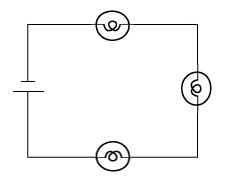
The picture shows an electrical circuit. This circuit is a series circuit because: 
a)
It has 3 light bulbs.
b)
The same current flows through all three light bulbs.
c)
It uses a single battery.
d)
The electrical current is divided between the three light bulbs.
183.
This circuit has more than one loop. When one light goes out, the others stay on. 
a)
closed circuit
b)
series circuit
c)
parallel circuit
d)
open circuit
184.
As resistors are added in series to a circuit, the total resistance will...
a)
increase
b)
decrease
c)
stay the same
185.
As the resistance of a circuit increases, the current will...
a)
increase
b)
decrease
c)
stay the same
186.
In a parallel circuit which of the following is the same value throughout the circuit?
a)
Voltage
b)
Current
c)
Resistance
d)
Charge
187.
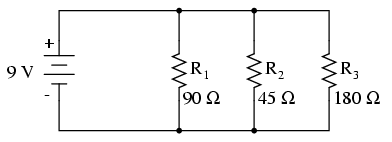
Does this diagram represent a series or parallel circuit?
a)
series circuit
b)
parallel circuit
188.
Parallel circuits are
a)
a circuit that has only one path for current to travel
b)
has more than one path for current to travel
c)
a circuit that does not allow electricity to travel through it
d)
magnets that cause electric current
189.
In a parallel circuit if one of the light bulbs burns out the rest _________.
a)
stop the flow of electricity
b)
 can still light up
c)
 will go out
d)
of the light bulbs burn out also
190.

When a resistor in a series circuit is replaced by another resistor with an increased resistance value, the total circuit current will __________.

a)

stay the same

b)

decrease

c)

increase

d)

double in value

191.

The lamps in a string of decorative lights are connected in parallel across a constant-voltage power source. What happens if one lamp burns out? (Assume negligible resistance in the wires leading to the lamps.)

a)

The brightness of the lamps will not change appreciably.

b)

The other lamps get brighter equally.

c)

The other lamps get brighter, but some get brighter than others.

d)

The other lamps get dimmer equally.

e)

The other lamps get dimmer, but some get dimmer than others.