
NEW
Font size
 Worksheets
Addie/Natural Selection
Total questions: 26
Worksheet time: 14mins
Which type of bacteria would be considered most "fit"?
bacteria with 6 pores
bacteria with 4 pores
bacteria with 3 pores
bacteria with 5 pores
What is the process bacteria use to reproduce?
Binary Fission
Budding
Regeneration
Sexual Reproduction
Who was the founder of Penicillin?
Louis Pasteur
Howard Florey
Albert Einstein
Alexander Fleming
Why are there increased numbers of antibiotic-resistant infections?
Overuse/ overprescribing antibiotics
Skipping doses/not finishing prescribed doses
Bacteria being exposed to antibiotics in hospitals (hospital acquired resistant)
All of the above
A change in a species over time; can occur quickly or slowly
Adaptation
Evolution
Variation
Natural Selection
The theory also known by the phrase "Survival of the Fittest". Organisms with favorable variations that increase their fitness will be more likely to survive and reproduce.
Evolution
Natural Selection
Variation
Adaptation
A physical or behavioral trait that makes an organism better able to survive and reproduce in a particular environment, such as a finch having a strong beak that is able to crack open large seeds
Differences in phenotype (physical appearance) within a population
Fitness
Evolution
Adaptation
Variation
A measure of how a particular trait affects an individual's survival and reproductive status
Fitness
What is the Zone of Inhibition?
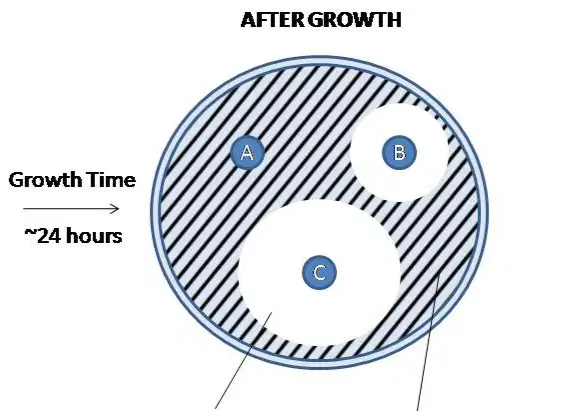
Which antibiotic was the most effective in preventing bacterial growth?
A
B
C
They were equally effective
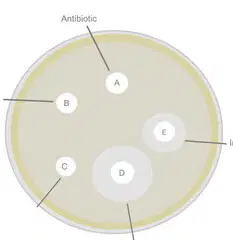
The most resistant bacteria would be around which antibiotic discs?
A, D, E
A, B, C
D, E
A, B, D
Beta-Lactum antibiotics (like Penicillin) prevent bacterial growth by...
Stopping DNA Replication
Destroying the cell wall of the bacteria
Interfering with protein production
All of the above
What are limiting factors that affect a population of bacteria in the human body?
Space
Nutrients
Immune system attacking bacteria
Antibiotics
All of the above

The lion on right that is Albino will not be able to camouflage/blend in and ambush prey as easily as the one on the left. This means it has a low degree of __________ in it's environment.
fitness
resistance
mutation
gene flow

How did the Industrial revolution impact the Peppered moth in England?
It did not impact them at all
Pollution caused tree bark to be darker. Light moths got eaten easier and dark moths were better adapted and the population became darker over time
The light colored moths blended into the environment making them less likely to be eaten by predators.
There was an equal number of light and dark colored moths.
Which is NOT part of Darwin's theory of Natural Selection?
Overpopulation of offspring
Variation in Traits
Individual adaptation
Struggle to Survive/Competition
If a female peacock prefers to mate with a male peacock that has a bright, colorful tail this is an example of________________
Artificial Selection
Stabilizing Selection
Sexual Selection
Disruptive Selection
What is MRSA?
A dangerous virus
A medical association
A type of antibiotic only used in hospitals
A type of antibiotic resistant bacteria
If you start with 50 bacteria and they can double every 30 minutes how many bacteria do you have after 2 hours?
800
400
600
200

What process is being shown in this image?
Variation
Natural Selection
Selective Breeding
Homeostasis
How do adaptations benefit an organism in its environment?
By making the organism less noticeable to predators.
By increasing the organism's chance of survival and reproduction.
By decreasing the organism's lifespan.
By making the organism more susceptible to diseases.
Why is genetic variation important for natural selection?
It ensures that all individuals in a population are identical
It decreases the survival rate of a species
It provides a range of traits that selection can act upon
It has no role in natural selection

The image shows light and dark colored moths that live on a tree. Which result is most likely to occur to the moth population over time due to predation?
The number of light colored moths in the population will increase
There will be more dark colored moths than light colored moths
The number of light colored moths will decrease
The dark colored moths will move to a different type of tree
The giant octopus lays 20,000 to 100,000 fertilized eggs. After hatching, most octopuses become prey to larger marine organisms, and less than 5% will reach adulthood to reproduce.
One benefit of the giant octopus laying many eggs is to--
increase the average body size for surviving individuals to avoid predation
decrease competition between different octopus species to maintain resources in the population
increase the chance that more individuals will survive to maintain the population
decrease the likelihood of offspring being consumed by predators
Charles Darwin studied finches in the Galapagos Islands which inspired his theory of evolution and natural selection. What did he notice about the finches that surprised him?
They were all different colors and blended in with the flower on their own island
They were all exactly the same regarless of what island they lived on
The were are similar but have different beaks based on the food available on their island
Charles Darwing has nothing to do with finches, islands, or Natural Selection

