
 Worksheets
Year 3 review Semester 1 2024
Total questions: 100
Worksheet time: 2hrs 6mins

When one side of the Earth is having day-time the other side of the Earth does not get sunlight?
TRUE
FALSE
When it is night on one side of the Earth, what is it on the other side of the Earth?
Day
Night

When part of the earth faces the sun, it is ......
day time
night time
no time

When part of the earth faces AWAY from the sun, it is....
no time
day time
night time

Which part of the Earth has daytime?
A
B
C

Which part of the Earth has night time?
A
B
C
Why CAN'T we see the sun at night?
Because the sun stop shining at night.
Because the Earth keeps spinning and it faces away the sun.
Because the sun disappears at night.
The sun looks like it moves across the sky because of the Earth's rotation.
true
false
From the 8 in morning to 11 o'clock the sun is getting _____
higher
middle
lower
On which part of the day is the sun on its highest position?
morning
midday
evening
From the 1 in the afternoon to 4 o'clock the sun is getting _____
higher
middle
lower
The sun looks like it moves across the sky because the Earth _______.
is big
flies
spins
is in space
Which statement below is WRONG?
The sun does not move. It always stays on its position.
The Earth moves around the sun.
The sun moves across the sky.
The location of a shadow depends on where the light source is coming from.
true
false
Choose the right shadow that can be created based on the sun position.


Which direction is right for creating this shadow
1
2
3

Where will the tree's shadow be?
A
B
C
Long shadows are formed when the sun is _____
high in the sky
low in the sky
Short shadows are formed when the sun is _____
high in the sky
low in the sky
Shadows are shortest ...
at night
in the morning
in the middle of the day
in the evening
Shadows are longest during _______.
morning and evening
noon
night
What causes the length of a shadow to change throughout the day?
The Earth's rotation
The moon's position
The sun's brightness
At what time of day are shadows the longest?
Morning
Midday
Evening
Why do we have day and night?
Because the sun moves around the Earth
Because the Earth rotates on its axis
Because the moon blocks the sun
When an object blocks the path of light, what is formed?
A problem
A fog
A reflection
A shadow
When an object moves closer to a light source, its shadow...
Gets smaller
Gets bigger
Changes shape
Stays the same size
When the Sun is behind you, your shadow is ...
behind you
in front of you
at the side of you
not there
Why do shadows made by the Sun move throughout the day?
Because the weather changes
Because someone moves the objects
Because the sun appears to move across the sky
Because it's magic!
When the sun gets higher in the sky, shadows get ______.
longer
gone
shorter
darker
Which object allows you to see your reflection?
rock
mirror
paper
12.Translucent is?
When light bounces off an object
Material that only allows a little light to pass through
Our main source of light
Opaque is?
Material that allows light to pass through
Light made by nature
Material that allows no light to pass through
Transparent is?
A material that allows light to pass through
The colors of the rainbow
Light made by man
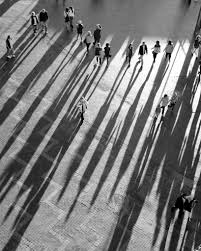
When was this picture most likely taken?
(Hint: think about the shadow's length)
morning or evening
night
noon
afternoon

When was this picture most likely taken?
(Hint: think about the shadow's length)
morning or evening
night
noon

Where will the tree's shadow be?
A
B
C

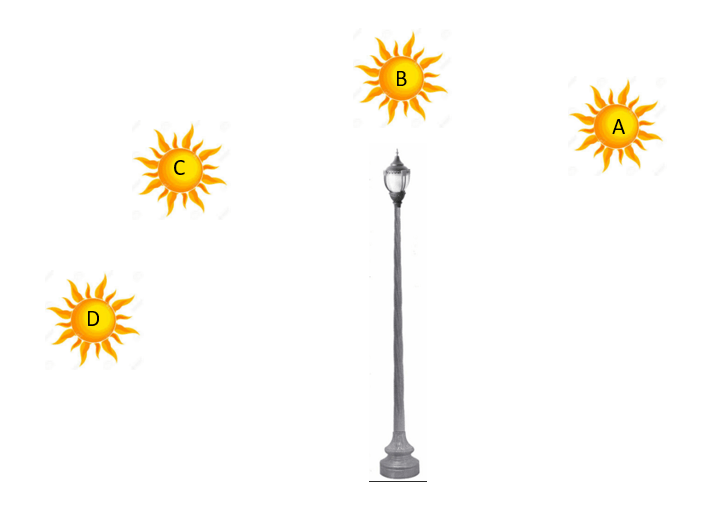
Which position of the sun will make the longest shadow?
A
B
C
What do shadows on Earth help show?
Earth's rotation
Earth's revolution
Earth's equator
Earth's axis


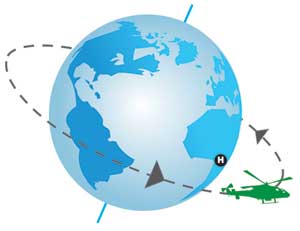
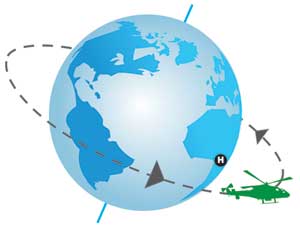
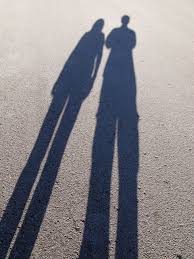
When the sun gets higher in the sky, shadows get ______.
longer
gone
shorter
darker
How do sound waves travel?
Very high in the sky.
In cars.
With two suitcases
Through vibrations.

The object that the flashlight is shining on can be described as.
transparent
translucent
opaque

What helps our eyes to SEE?
light
sound
heat

A thermometer measures
temperature
weight
sound
light

Which object below does not produce sound?
a piano
thunder
clapping
a cotton ball
Vertebrate animals have an ______________
Internal skeleton
Exoskeleton
Soft body
Long legs
Mammals, fish, reptiles, amphibians and birds are ________________
Invertebrates
viviparous
oviparous
vertebrate animals.
Which one is a mammal?


Which one is a bird?


Reptiles are....
vertebrates
invertebrates
arthropods
Which one is an amphibian?


Which one is a reptile?


Birds have
fur
scales
feathers
moist skin
Fish have
feathers
scales
fur
Vertebrates do not have a backbone.
True
False
Mammals, birds and reptiles breathe with lungs.
True
False
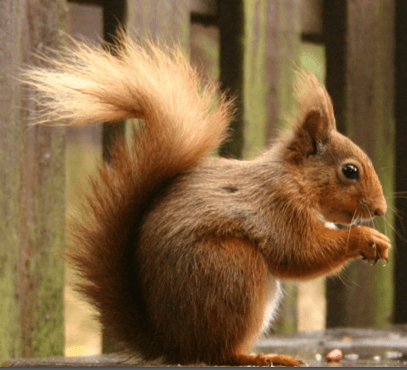
I have fur, I breathe with lungs, and I am warm blooded. What am I?
Mammal
Amphibian
Bird
Reptile
I LAY EGGS. I breathe with my LUNGS. My body is dry and covered with SCALES. What am I?
amphibian
bird
reptile
mammal
My body is covered with FEATHERS. I LAY EGGS and hatch my young. What am I?
amphibian
bird
reptile
mammal
Which is NOT a characteristic of a fish.
gills
fins
lungs
scales
Vertebrates have a backbone and invertebrates do not.
true
false
What type of animals don't lay eggs?
reptiles
amphibians
Fish
mammals
What is an examples of a mammal?
newt
dolphin
Iguana
bass

Look at this picture, which animal has a vertebrate?
The bird
The butterfly


Do plants need sunlight to grow?
After you clean up what's a good idea to do before you leave the lab?
Touch your hair
Talk to friend
Wash your hands
The first step of the scientific method is?
perform an experiment
share what you’ve learned, communicate your results
think of a question, state the problem
Why do scientists sometimes repeat experiments?
to see if they get the same results
because they forgot how they did them
for fun
What is a carnivore?
an animal that eats plants
an animal that eats plants and animals
an animal that only eats other animals
What is an herbivore?
a plant that produces its own food
an animal that eats plants and animals
an animal that eats only plants
Which list describes the basic needs of all plants?
air, worms, rocks
air, water, sunlight
sunlight, water, rocks
sunlight, worms, water
flowers --> moth --> bat --> snake --> fox
A food chain is show above. How does the bat gets its food?
by eating foxes
by eating moths
by eating snakes
by eating flowers
Which of these is a non-living thing?
a fish
rocks
dragonfly
plants
Which of these were made by humans?
cave
river
tunnel
waterfall

A student is measuring a rock sample in science class.
What is the length of this sample?
25 mm
30 mm
35 mm
40 mm
Apple juice has which of these properties?
It is rough.
It mixes with oil.
It is a liquid.
It is hard to the touch.
Which diagram shows how Earth rotates each day?


The Sun is a -
planet
giant star
natural satellite
an asteroid

The image shows the Earth-
Revolving around the Sun.
Rotating around the Sun.

