
 Worksheets
Unit 11 Test Review - Optional
Total questions: 100
Worksheet time: 7hrs 24mins


Reduce, or simplify
the rational expression.
( x + 5 )( x - 5 ) / ( x + 5 )( x - 2 )
( x - 5 ) / ( x - 2 )
( x + 5 ) / ( x - 2 )
-25 / ( 3x - 10 )


Divide
1/6
x+10/ 6x+60
x+8/ 6x+60
(x+10)(x+8)/ 6x+60

Divide the Rational Expression
A
B
C
D


A
B
C
D


Simplify the expression.


Simplify the expression.


Simplify the expression.


x−54x−x−63 Simplify
(x−6)(x−5)4x2−27x+15
2x+14x−3
(x−6)(x−5)4x2−27x+21
(x−5)(x+6)4x2+21x+15

Add or Subtract: 3x22x−1−x33x+2−5x4
3x3−2(x2+2x+1)
15x32(x2−4x−1), x=0
3x310x2−15x+9, x=0
15x3−2(x2−2x−1), x=0
What is the least common denominator for 3x22x−1−x33x+2−5x4 ?
3x2
5x2
15x3
x3
Add/Subtract: 5x+25x+4−15x−752x−2
15(x−5)(x+5)x2−11x−50, x=±5
15(x+5)(x−5)x2+5x−70, x=±5
5(x+5)(x−5)x2+5x−10, x=±5
It can't be subtracted :(
Add/Subtract: x−35−3−x6
x−311
−x−31
−3−x11
3−x1
What is the common denominator in the complex fraction x+310+x55 ?
x
x(x+3)
x+3
10x(x+3)
Simplify: x+310+x55
3(x+1)x(x+3), x=0,−1,−3
(x+1)(x+3)x=−1
x(x+1)x+3, x=0, −1
x(x+3)5(x+1)x=0,−1, −3
Simplify
x+12x2⋅3x5x+1

Simplify
a
b
c
d
Simplify.
x2+14x+40x2+11x+28⋅8x+56x2−100
Simplify
b2+2b−33b2−6b⋅b−2b2−8b+7
b(b−2)1
3b2(b+6)b−3
b−8
b+33b(b−7)
Simplify
x−5⋅x2−7x+102x
Simplify
x2−25x+1⋅x2+8x+7x+5
(x+5)(x+7)x+1
(x+5)(x+7)1
(x−5)(x+7)1
(x−5)(x−7)1

What are the restricted values?
x = - 3 and x = 4
x = 3 and x = - 4
x = 3 only
x = - 4 only

Identify the restricted values
x≠-6
x≠-6, 3
x≠3
x≠-18

Divide the Rational Expression
A
B
C
D
Simplify. Leave answer factored.
x+412x−36÷x2−163x−9
Simplify
3x−185x+7÷x−65x+7

Simplify
Simplify
x2−3x+2x2−4x−5÷x2−4x2−3x−10
Simplify
x2−363x−27÷x2−x−30x−9
Leave your answer in factored form.
Divide (b−a)4ab(a−b)3a3b3
(a−b)3a3b3⋅4ab(b−a)
(a−b)3a3b3⋅(a−b)4ab
43a2b2
−43a2b2
Simplify: 52d⋅cd10
5cd20d
5c20
c4
4
80n2+10n+9×n2+10n+98
64
n+627n3
101
67n(n+10)

Find the excluded value(s).
n = 0
n = 24
n = -24
n can be any real number

Find the excluded value(s).
v = 5
v = 10
v = -25
v = -5

What are the domain restrictions of the following rational expression:
x ≠ 4
x ≠ -4, 4
x ≠ -16, 16
x ≠ 0, 4

Determine the excluded values.
x = 5, -1
x = -5, 1
x = 5, 1
x = -5, -1
Find the excluded value(s). (x2−16)x(x+4)
x = 4
x = -4, 4
x = -16, 16
x = 0, 4
What are the excluded values for this function? h(x)=x−2x
(a)
Select all of the excluded values: (x−2)(x+1)(x−3)÷(x+8)(x−1)(x+5)
x=3
x=2
x=−8
x=1
x=−5
What would be the common denominator (LCD) when adding these rational expressions: (x+3)+(x−7)
(x+3)(x−7)
(x+3)
(x−7)
(x−3)(x+7)
Select all of the excluded values: (x−3)(x+1)(4x−1)×2x(4x−1)(x−3)(x+5)
x=0
x=−41
x=41
x=3
x=−5
Select all of the excluded values/restrictions: x2−9x−3
x=3
x=9
x=−3
x=−9
Match the parts of a division problem to their description.
the number doing the dividing
(the number outside the house)
Divisor
the number being divided
(the number under the house)
Dividend
the answer to a division problem
(the number on top of the house)
Quotient
the portion of the dividend that cannot be fairly divided
Remainder
There is always a remainder in division.
True
False
Divide.
(8x4+6x3−10x2)÷2x2
Simplify using long division.
(8x2+6x−20)÷(4x−5)

After we subtract and bring down, the next step is to...
divide 27x2 by 3x
divide 3x by 27x2
Subtract 3x−3x=0
calculate the remainder
Simplify using long division.
(x4−7x2+8x−5)÷(x−2)

Simplify using long division.
(8x3−17x2−x+2)÷(x−2)
Simplify using long division.
(3x3+5x−1)÷(x+1)
xy = 25 represents:
If y = 22.5 when x = 15, find y when x = 20.
If y = 150 when x = 2, find y when x = 25.
Which table represents a direct variation?


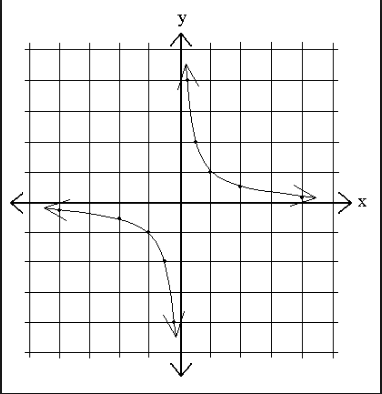
x and y are in inverse variation
x=6 and y=7
Given y=k/x... Find k


A
B
C
D
Solve. Don't forget to check for extraneous solutions. x+3x+1=x+31+x2+3x1
A. x =−1
B. x = 1
C. x=−1, x=1
D. x=1, x=2
7)
2x+42x = x+23xx = 0, −2
x=0
x=±4
x=8

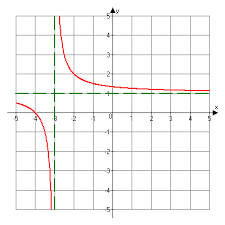
What is the VERTICAL asymptote of this function? (click on the graph to enlarge)
x=1
x=-3
y=1
y= -3

What is the equation of the rational function graphed?
f(x)=x−21
f(x)=x+21
f(x)=x1+2
f(x)=x1−2
What is the HORIZONTAL asymptote of this function? (click on the graph to enlarge)
x=1
x=-3
y=1
y= -3

What is the DOMAIN?
(−∞,−3)U(−3,∞)
(−∞,1)U(1,∞)
(−∞,−3)U (−3, 1) U(1,∞)
All Real Numbers

Select ALL values that are excluded from the DOMAIN.
x=1
x=-1
y=1
x=0
What is the RANGE?
(−∞,−3)U(−3,∞)
(−∞,1)U(1,∞)
(−∞,−3)U (−3, 1) U(1,∞)
All Real Numbers

y = x / (2x - 6)

Which is the graph of the rational equation:



What is the domain and range?
D: (−∞,1)∪(1,∞)
R: (−∞,2)∪(2,∞)
null
R: (−∞,21)∪(21,∞)
D: (−∞,−2)∪(−2,∞)
R: (−∞,−1)∪(−1,∞)
Identify the domain and range of the function:
f(x)=x+14+1
Domain: (−∞,1)U(1,∞)
Range:
(−∞,4)U(4,∞)
Domain: (−∞,4)U(4,∞)
Range:
(−∞,−1)U(−1,∞)
Domain: (−∞,1)U(1,∞)
Range:
(−∞,−1)U(−1,∞)
Domain: (−∞,−1)U(−1,∞)
Range:
(−∞,1)U(1,∞)
Identify the domain and range of the function:
f(x)=x−23+2
Domain: (−∞,−2)U(−2,∞)
Range:
(−∞,2)U(2,∞)
Domain: (−∞,3)U(3,∞)
Range:
(−∞,−2)U(−2,∞)
Domain: (−∞,2)U(2,∞)
Range:
(−∞,2)U(2,∞)
Domain: (−∞,−3)U(−3,∞)
Range:
(−∞,2)U(2,∞)
Identify the domain and range of the function:
f(x)=−x+31
Domain: (−∞,−3)U(−3,∞)
Range:
(−∞,0)U(0,∞)
Domain: (−∞,3)U(3,∞)
Range:
(−∞,0)U(0,∞)
Domain: (−∞,0)U(0,∞)
Range:
(−∞,3)U(3,∞)
Domain: (−∞,0)U(0,∞)
Range:
(−∞,−3)U(−3,∞)
Find the domain of
y=x−72+4
(−∞,−7)∪(−7,∞)
(−∞,4)∪(4,∞)
(−∞,−4)∪(−4,∞)
(−∞,7)∪(7,∞)

