wayground logo

Free Printable Worksheets

Font size

S
M
L
XL
Worksheets

Algebra 1 Sem 1 Review

Total questions: 99

Worksheet time: 5hrs 41mins

Name
Class
Date
1.
a)

y=4x+1y=4x+1

b)

y=14x3y=\frac{1}{4}x-3

c)

y=x+9y=-x+9

d)

y=3x1y=-3x-1

2.
Which point below is NOT part of the solution set?
a)
(0, 0)
b)
(5,5)
c)
(3, 5)
d)
(0, -3)
3.
a)

Yes

b)

No

4.

Given

 f(x)=4(2x)f(x)=4(2-x) , what is the value of  f(6)f(-6)  ?

a)

32

b)

-32

c)

-16

d)

16

5.

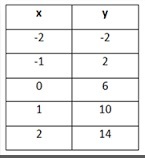
Find the rate of change from the table.

a)

4

b)

1/4

c)

-4

d)

-1/4

6.

Find the slope of the line that passes through the points

(2, 4) and (6, 12).

a)

1/2

b)

-1/2

c)

2

d)

-2

7.

 y=5x4y=5x-4  

What is the y-intercept in the equation?

a)

5

b)

-4

c)

-5

d)

4

8.

Find the equation of the line in slope-intercept form.

a)

y=14x3y=-\frac{1}{4}x-3

b)

y=13x+3y=\frac{1}{3}x+3

c)

y=14x+2y=-\frac{1}{4}x+2

d)

y=13x3y=\frac{1}{3}x-3

9.

Which is the graph of  y=x+2y=-x+2  ?

a)

A

b)

B

c)

C

d)

D

10.

Find the equation for the line in slope-intercept form.

a)

y=5x3y=5x-3

b)

y=4x+2y=4x+2

c)

y=2x+5y=-2x+5

d)

y=2x+4y=-2x+4

11.

What is the x and y intercept for the following equation ?
 4x-10y=20  

a)

x - int = 4  

y-int = -10

b)

x-int = 5

y-int = 2

c)

x - int = 5

y int = -2

d)

x -int = 4

y -int = -10

12.

If a question asks you to find f(2), what does that mean?

a)

Let x = 2

b)

Let y = 2

13.
Evaluate f(-2) if f(x) = x + 3
a)
-1
b)
1
c)
5
d)
-5
14.
w(x) = 3x - 7.
If w(x) = 14, find x.
a)
7
b)
35
c)
2.33333
d)
-49
15.
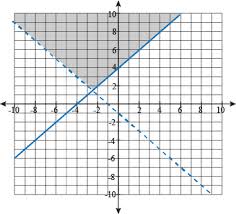
Which system of linear inequalities is represented by the graph?
a)
y≤2x-1
y>-2x+3
b)
y>2x-1
y≤-2x+3
c)
y<2x-1
y≥-2x+3
d)
y≤2x-1
y>2x+3
16.
Which point below is NOT a part of the solution set?
a)
(0, 0)
b)
(0, 1)
c)
(-100, -3)
d)
(5, 10)
17.

What is the slope of the graph below?


Slope = rise/run

a)

2

b)

2/3

c)

3/2

d)

-3/2

18.

What is the equation of the inequality below?

a)

y2x 3y\ge2x\ -3

b)

y32x 3y\le\frac{3}{2}x\ -3

c)

y > 2x 3y\ >\ 2x\ -3

d)

y < 32 x 3y\ <\ \frac{3}{2\ }x\ -3

19.

Given the function f(x) = 3x + 1 what is f(-2)?

a)

-2

b)

7

c)

-5

d)

-6

20.

Given the function f(x) = -5x - 6 , what is f(-3)?

a)

21

b)

9

c)

15

d)

-15

21.
a)
y < 5x + 1 
b)
y > 5x + 1 
c)
y ≤ 5x + 1 
d)
y ≥ 5x + 1  
22.
Is (-2,4) a solution to the system?
a)
Solution
b)
Not a solution
23.
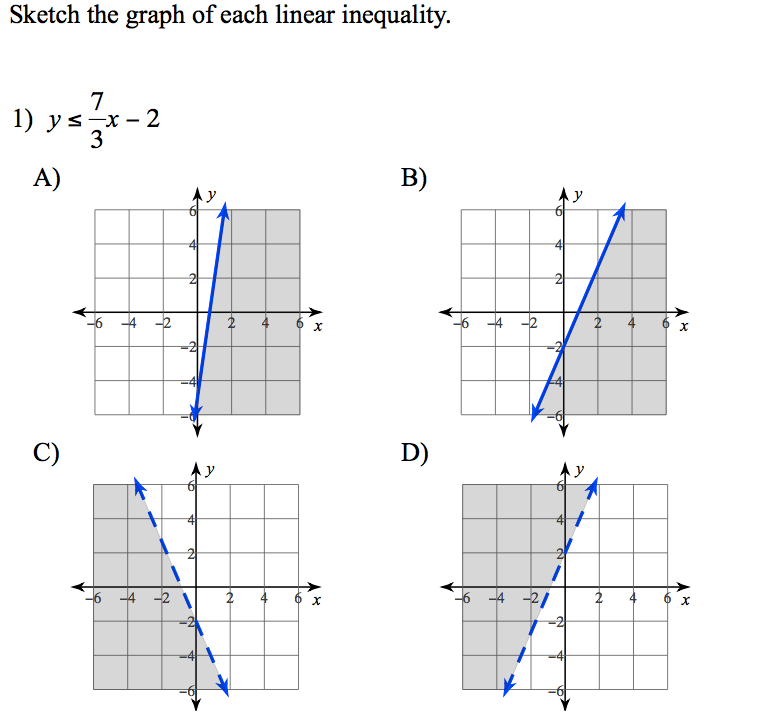
Select the correct graph for each inequality.
a)
A
b)
B
c)
C
d)
D
24.
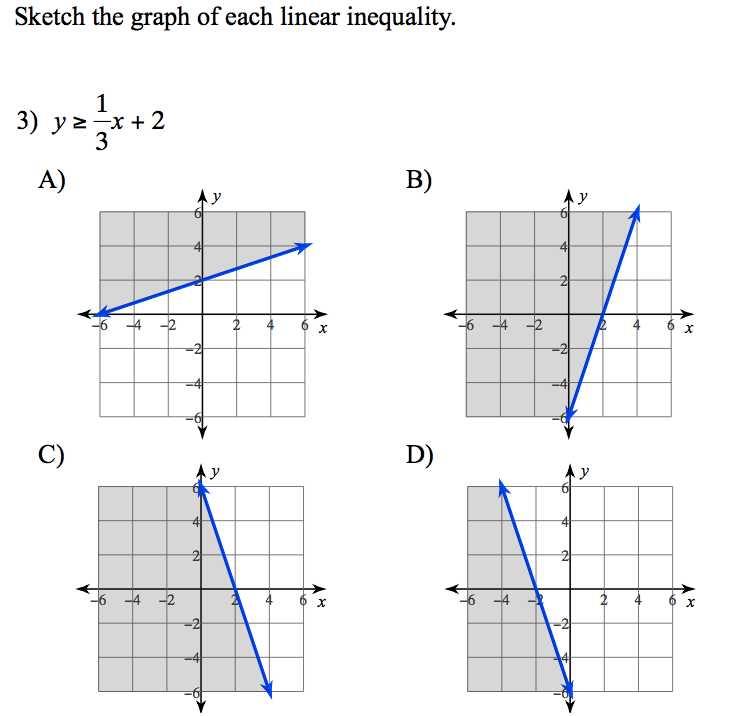
Select the correct graph for each inequality.
a)
A
b)
B
c)
C
d)
D
25.
Write the linear inequality in standard form for this situation: The CRHS science department can spend no more than $2700 on textbooks this year. The department needs to buy both Biology text books, which cost $57 each, and Chemistry textbooks, which cost $72 each.
a)
57x + 72y ≥ 2700
b)
57x + 72y > 2700
c)
57x + 72y < 2700
d)
57x + 72y ≤ 2700
26.
Write the linear inequality in standard form for this situation: Ms. Savva is ordering pizzas and breadsticks for a school party and has a budget of no more than $81. An order of breadsticks costs $7 and a pizza costs $13. 
a)
7x + 13y < 81
b)
7x + 13y ≥ 81
c)
7x + 13y ≤ 81
d)
7x + 13y > 81
27.
√2
a)
Rational
b)
Irrational
28.
5
a)
Rational
b)
Irrational
29.
-17.5
a)
Rational
b)
Irrational
30.
√25
a)
Rational
b)
Irrational
31.

Which of the following is an irrational number?

a)

22/7

b)

√64

c)

√50

d)

2.5

32.
.141414141414...
a)
Rational 
b)
Irrational 
33.

_____________ number is a number that cannot be written as a ratio of two integers.

a)

An integer

b)

A rational

c)

An irrational

d)

A repeating

34.

A decimal that never ends or repeats is which type of number?

a)

Rational

b)

Irrational

35.

Product of  20\sqrt{20}  and  5\sqrt{5}  is...

a)

Rational

b)

Irrational

36.

Sum of 3\sqrt{3}  and  10\sqrt{10}  is...

a)

Rational 

b)

Irrational

37.
What is the definition of an integer
a)
All positive and negative whole numbers
b)
Decimals or fractions that terminate for repeat
c)
All positive whole numbers
d)
0
38.
Simplify the following radical: √24
a)
2√6
b)
4√6
c)
2√12
d)
3√8
39.
Simplify the following radical: √300
a)
3√10
b)
2√150
c)
100√3
d)
10√3
40.
a)

A

b)

B

c)

C

d)

D

41.

Simplify the radical...

√20a²b⁴

a)

2ab²√5

b)

4ab²√5

c)

5ab²√2

d)

2a²b²√5

42.
√45x⁴y⁷
a)
3x²y³√5
b)
9x²y³√5y
c)
3x²y³√5y
d)
3x⁴y⁷
43.
Add:  4√7 - 10 √7 + 7√7
a)
-6√7
b)
14√7
c)
-3√14
d)
√7
44.
Simplify 4√75
a)
4√5
b)
12√5
c)
20√3
d)
7√3
45.
a)
x4y4√y
b)
72xy
c)
xy√y
d)
x2y3√x2
46.
√98a20c15
a)
7c√a¹⁰c⁷
b)
7a¹⁰c⁷√2
c)
49a¹⁰c⁷√2c
d)
7a¹⁰c⁷√2c
47.

 4x7y5z9\sqrt{4x^7y^5z^9}  Simplify

a)

 2x3y2z3xy2x^3y^2z^3\sqrt{xy}  

b)

 2z3x7y52z^3\sqrt{x^7y^5}  

c)

 2xyzx6y5z82xyz\sqrt{x^6y^5z^8}  

d)

 2x3y2z4xyz2x^3y^2z^4\sqrt{xyz}  

48.

What is the Range?

a)

y ≥ 6

b)

y6y\le6  

c)

-10 ≤ y ≤ 6

d)

-10 ≤ x ≤ 6

49.
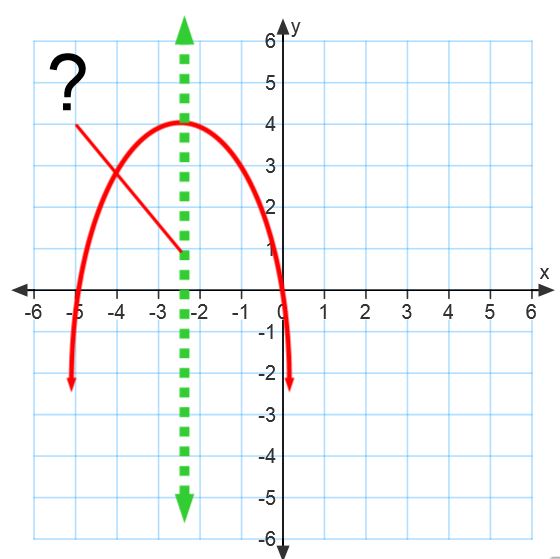
Does this graph have a maximum or minimum?
a)
Minimum
b)
Maximum
50.
What is the green dashed line called?
a)
roots or x-intercepts
b)
parabola
c)
axis of symmetry
d)
line of dashes
51.
What is the axis of symmetry for this graph?
a)
y=2
b)
x=2
c)
x=0
d)
y=0
52.
Which of the following equations matches standard form of a quadratic?
a)
ax + by = c
b)
y = a(x - h)2 + k
c)
y = ax2 + bx + c
d)
y = mx + b
53.
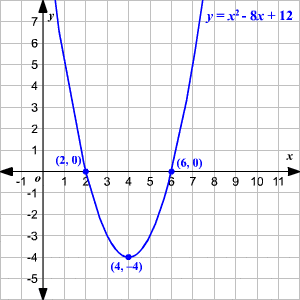
What is the vertex?
a)
(4,-4)
b)
(2,0)
c)
(0,2)
d)
(6,0)
54.

Which of the following is a quadratic function?

a)
b)
c)
d)
55.

Find the y-intercept of

f(x) = 2x2 - 2x + 1

a)

(1,0)

b)

(-2,0)

c)

(0,1)

d)

(0, -1)

56.

What are the x-intercepts of this function?

a)

(1,0) and (5, 0)

b)

(0, 3) and (0, -5)

c)

(1, 5) and (5, 1)

d)

(0, 1) and (0, 5)

57.
Determine the interval of this function's DOMAIN.
a)
(-5, -1)
b)
(-∞, ∞)
c)
No solution
d)
(-∞, -3)
58.
Determine the interval of this function's RANGE.
a)
(-4, ∞)
b)
(-3, ∞)
c)
No solution
d)
(-∞, -4)
59.
If the blue graph is
f(x) = x2 
then the red must be...
a)
g(x) = x- 5
b)
g(x) = x+ 5
c)
g(x) = (x - 5)2
d)
g(x) = (x + 5)2
60.
What transformations occurred to get f(x), the red graph, to become g(x), the blue graph?
a)
horizontal shift down and vertical shift left
b)
horizontal shift left and vertical shift down
c)
horizontal shift right and vertical shift up
d)
horizontal shift up and vertical shift right
61.
Simplify fully: 
√32 + √12
a)
4√2 +2√3
b)
6√5
c)
√44
d)
2√11
62.
What represents the rate of change over the domain [1,3]?
a)
2
b)
3
c)
-2
d)
1
63.

Which of the following best represents the solutions to the quadratic equation

f(x)=x2+x1f\left(x\right)=x^2+x-1 ?

a)

1±32\frac{-1\pm\sqrt[]{3}}{2}

b)

1±52\frac{1\pm\sqrt[]{5}}{2}

c)

1±52\frac{-1\pm\sqrt[]{5}}{2}

d)

1±32\frac{1\pm\sqrt[]{3}}{2}

64.

What are the zeros of the function?

Choose two correct answers.

a)

(-4, 5)

b)

(2, 5)

c)

(-3, 0)

d)

(1, 0)

e)

(0, 3)

65.

Which of the following is the graph of f(x)=3(x1)2+12f\left(x\right)=-3\left(x-1\right)^2+12 ?

a)

b)

c)

d)

66.

Identify the zeros of the function shown.

a)

-4

b)

6

c)

2

d)

0

e)

10

67.

What are the roots for this quadratic equation?

46.F.IF.4 interpret key features of quadratic functions represented in graphs, tables, equations, and verbal descriptions

a)

(0,0)

b)

(0,0) and (0,4)

c)

(0,0) and (4,0)

d)

(0,0) and (-4,0)

68.

What are the solutions to the graphed system?

a)

(0,-2) and (3,1)

b)

(-2,0) and (2,0)

c)

(0,-2) and (3,1)

d)

(2,2) and (1,0)

69.
Solve by factoring: x2-2x-35=0
a)
(-6,-8)
b)
(-7,5)
c)
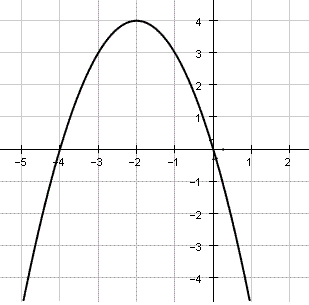
(7,-5)
d)
(7,8)
70.
Find the vertex of 
f(x) = -x- 4x + 12.
a)
(-2, 16)
b)
(2, 0)
c)
(2, 4)
d)
(-2, 4)
71.

Using the graph of the quadratic function, identify the y-intercept.

a)

(4, -6)

b)

(0, 2)

c)

(.5, 0)

d)

(7.5, 0)

72.

Using the graph of the quadratic function, identify the vertex.

a)

(4, -6)

b)

(0, 2)

c)

(.5, 0)

d)

(7.5, 0)

73.

Using the graph of the quadratic function, identify the domain.

a)

y > -6

b)

-2 < x < 10

c)

-∞ < x < ∞

d)

y < -6

74.
What are the x-intercepts?
a)
0 and 2
b)
-4 and 0
c)
2 and 3
d)
0 and 4
75.
Name the parent function.
a)
linear
b)
quadratic
c)
cubic
d)
logarithmic
76.

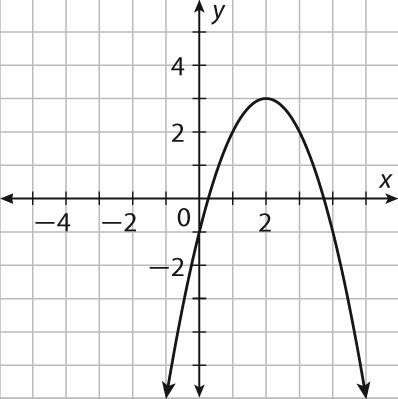
What is the increasing interval on the function shown?

a)

(, 1)\left(-\infty,\ 1\right)

b)

(, 2)\left(-\infty,\ 2\right)

c)

(2, )\left(2,\ \infty\right)

d)

(1, )\left(1,\ \infty\right)

77.

What is the decreasing interval on the function shown?

a)

(, 1)\left(-\infty,\ 1\right)

b)

(, 2)\left(-\infty,\ 2\right)

c)

(2, )\left(2,\ \infty\right)

d)

(1, )\left(1,\ \infty\right)

78.

What is the range of the function?

*Hint: Range is all of the y-values included in the function.

a)

<y3-\infty<y\le3

b)

3y<-3\le y<\infty

c)

All real numbers

d)

-6≤y≤3

79.

Identify the domain and range of the function.

a)

Domain: -6 ≤ x ≤ 2

Range: -3 ≤ y ≤ 5

b)

Domain: All real number

Range: -3 ≤ y ≤ 5

c)

Domain: All real numbers

Range: -∞ < y ≤ 3

d)

Domain: All real numbers

Range: -3 ≤ y < ∞

80.

 What are the solutions to (x+3)2=64\left(x+3\right)^2=64 ?

a)

-88 and 74

b)

-11 and 5

c)

-74 and 88

d)

-5 and 11

81.

If the graph of the quadratic parent function is translated 5 units to the left and 4 units up, which of the following equations describes the translated graph? f(x)=x2f\left(x\right)=x^2  

a)

 f(x)=(x5)2+4f\left(x\right)=\left(x-5\right)^2+4  

b)

 f(x)=(x+5)2+4f\left(x\right)=\left(x+5\right)^2+4  

c)

 f(x)=(x+4)2+5f\left(x\right)=\left(x+4\right)^2+5  

d)

 f(x)=(x4)25f\left(x\right)=\left(x-4\right)^2-5  

82.
Which transformation maps the graph of
f(x) = x2 to the graph of g(x) = (x + 4)2?
a)
a reflection across the line x = -4
b)
a reflection across the line y = -4
c)
a translation shifting f(x) 4 units to the left
d)
a translation shifting f(x) 4 units to the right
83.

Find the axis of symmetry of

 y=3(x2)2+3y=3\left(x-2\right)^2+3  

a)

 x=2x=2  

b)

 x=2x=-2  

c)

 x=3x=3  

d)

 x=3x=-3  

84.

Find the vertex of

 y=3(x2)2+3y=3\left(x-2\right)^2+3  

a)

 (2,3)\left(2,3\right)  

b)

 (2,3)\left(-2,3\right)  

c)

 (2,3)\left(2,-3\right)  

d)

 (2,3)\left(-2,-3\right)  

85.

Find the y-intercept of

 h(x)=x28x+12h\left(x\right)=x^2-8x+12  

a)

12

b)

-12 

c)

-8 

d)

86.
When factoring
x2 - 4x + 4 = 20,
what goes in the blank?
(x - __ )2 = 20
a)
4
b)
2
c)
8
d)
20
87.
Complete the square for
x2 + 12x + ____
a)
x2 + 12x + 144
b)
x2 + 12x + 36
c)
x2 + 12x - 36
d)
x2 + +12x - 144
88.

If each mark on the x-axis represents one second, when did the object reach the ground?

a)

2.5 seconds

b)

4.5 seconds

c)

5.5 seconds

d)

6.5 seconds

89.
Factor completely: 3x² - 7x + 2
a)
(x - 1) (3x + 2)
b)
(x - 2) (3x -1)
c)
(x - 1) (3x - 2)
d)
(x + 2) (3x + 1)
90.
Factor Completely: 6x² + 7x - 3
a)
(2x + 3)(3x-1)
b)
(2x - 3)(3x + 1)
c)
(2x + 3)(6x - 2)
d)
(3x - 3)(2x + 1)
91.
Describe the transformation of y = x2 - 5
a)
Shift UP
b)
Shift DOWN
c)
Shift LEFT
d)
Shift RIGHT
92.
Describe the transformation of y = (x + 7)2
a)
Shift UP
b)
Shift DOWN
c)
Shift LEFT
d)
Shift RIGHT
93.
Given f(x) = (x-3)2 + 5.  What transformations took place from the original function f(x)?
a)
Left 3 and up 5
b)
Right 3 and down 5
c)
Left 3 and down 5
d)
Right 3 and up 5
94.
Identify the transformation from the graph of f(x)=x2 to the graph g(x)= -(x+5)2 
a)
shifted up five units
reflection in x-axis
b)
shifted down five units
reflection in x-axis
c)
shifted left 5 units
reflection x-axis
d)
shifted right 5 units
reflection x-axis
95.

Change x2-16x+64 to vertex form.

a)

(x-16)2

b)

(x+16)2

c)

(x-8)2

d)

(x+8)2

96.

How does the graph of y=(x+3)24y = (x + 3)^2 - 4 compare to the graph of y=x2y = x^2 ?

a)

It is shifted 3 units to the left and 4 units down.

b)

It is shifted 3 units to the right and 4 units up.

c)

It is shifted 3 units to the left and 4 units up.

d)

It is shifted 3 units to the right and 4 units down.

97.
Which quadratic function is represented by the graph?
a)
y = 2(x - 4)2 + 5
b)
y = 2(x + 4)2 + 5
c)
y = -2(x - 4)2 + 5
d)
y = -2(x + 4)2 + 5
98.

A swim team member performs a dive from a 14-foot-high springboard. The graph shows the path of her dive. Based on the graph, which of the following is not true?

a)

The diver was at their maximum height at 3 seconds.

b)

The diver took approximately 8 seconds to reach the water.

c)

The maximum height the diver reached was 24 feet.

d)

The diver's height was decreasing for 5 seconds.

99.

Morty throws a ball up into the air. The height of the ball above the ground, in feet, is modeled by the function h(t)=16t2+24th\left(t\right)=-16t^2+24t , where t represents the time, in seconds, since the ball was thrown.  Which key feature represents the maximum height the ball reaches?

a)

The x-intercept

b)

The y-intercept

c)

The vertex

d)

The roots