
 Worksheets
Bio Cycles
Total questions: 114
Worksheet time: 2hrs 38mins
What is the energy source for the water cycle?
the Sun
the Earth
water
the Moon


The image shows various stages in the water cycle. During which stage does water flow back towards the sea as runoff?
W
X
Y
Z
Rain and snow are two different forms of precipitation that fall on Earth's surface. Which factor is responsible for there being different forms of precipitation?
Evaporation
Run-off
Temperature
Transpiration
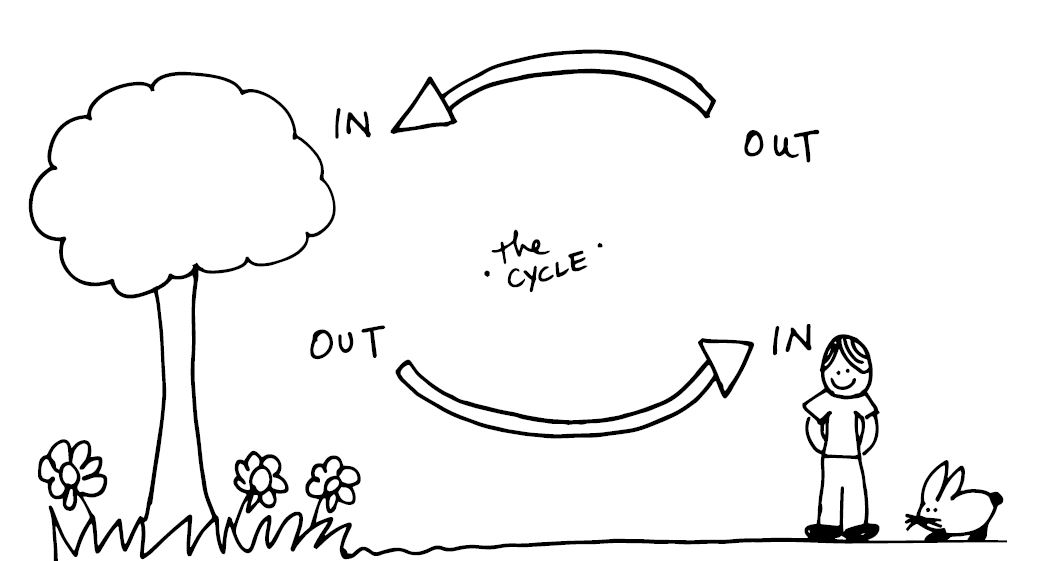
The carbon dioxide/oxygen cycle is important to animals because it provides
oxygen they take in when breathing
carbon dioxide that animals need for respiration
All of the carbon that exists on Earth is continually recycled in the carbon cycle
True
False
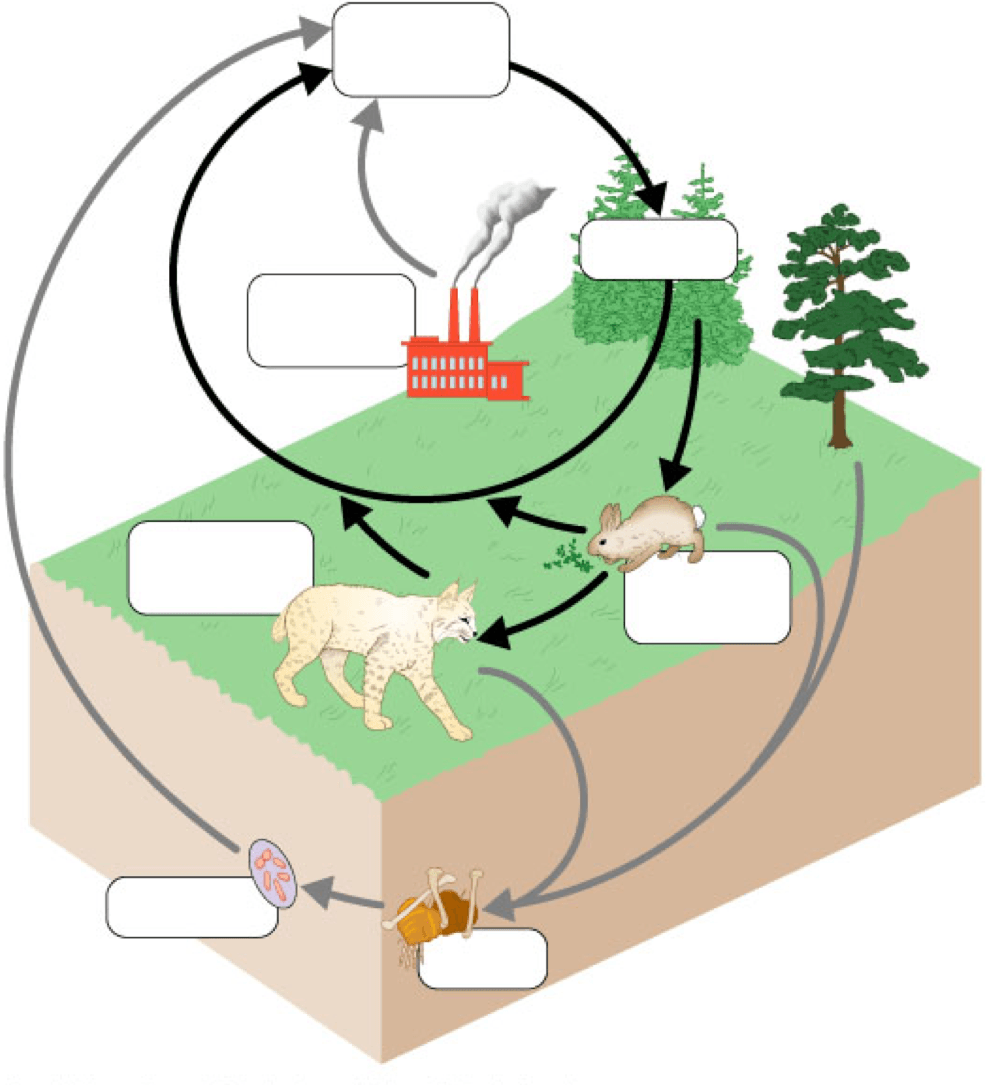
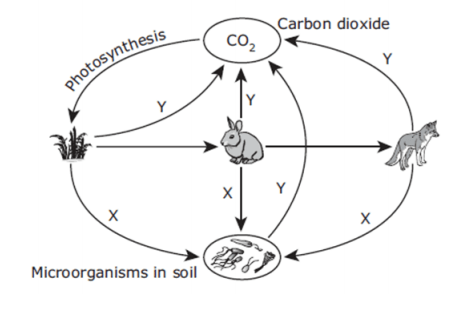
Y : Predation
Y : Decomposition
Y : Nitrogen Fixation
Y : Respiration
How do animals get carbon?
By eating plants and or other animals.
They absorb it from the atmosphere.
From the ground
They do not get carbon from anywhere.
Which of the following are fossil fuels?
Coal, water, oil
Oxygen, coal, oil
Coal, Oil, Natural Gas
None of the above
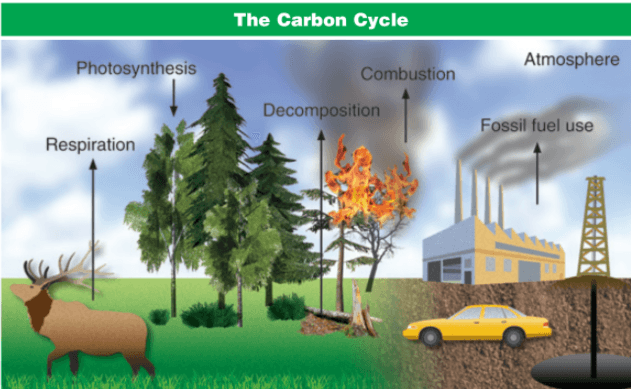
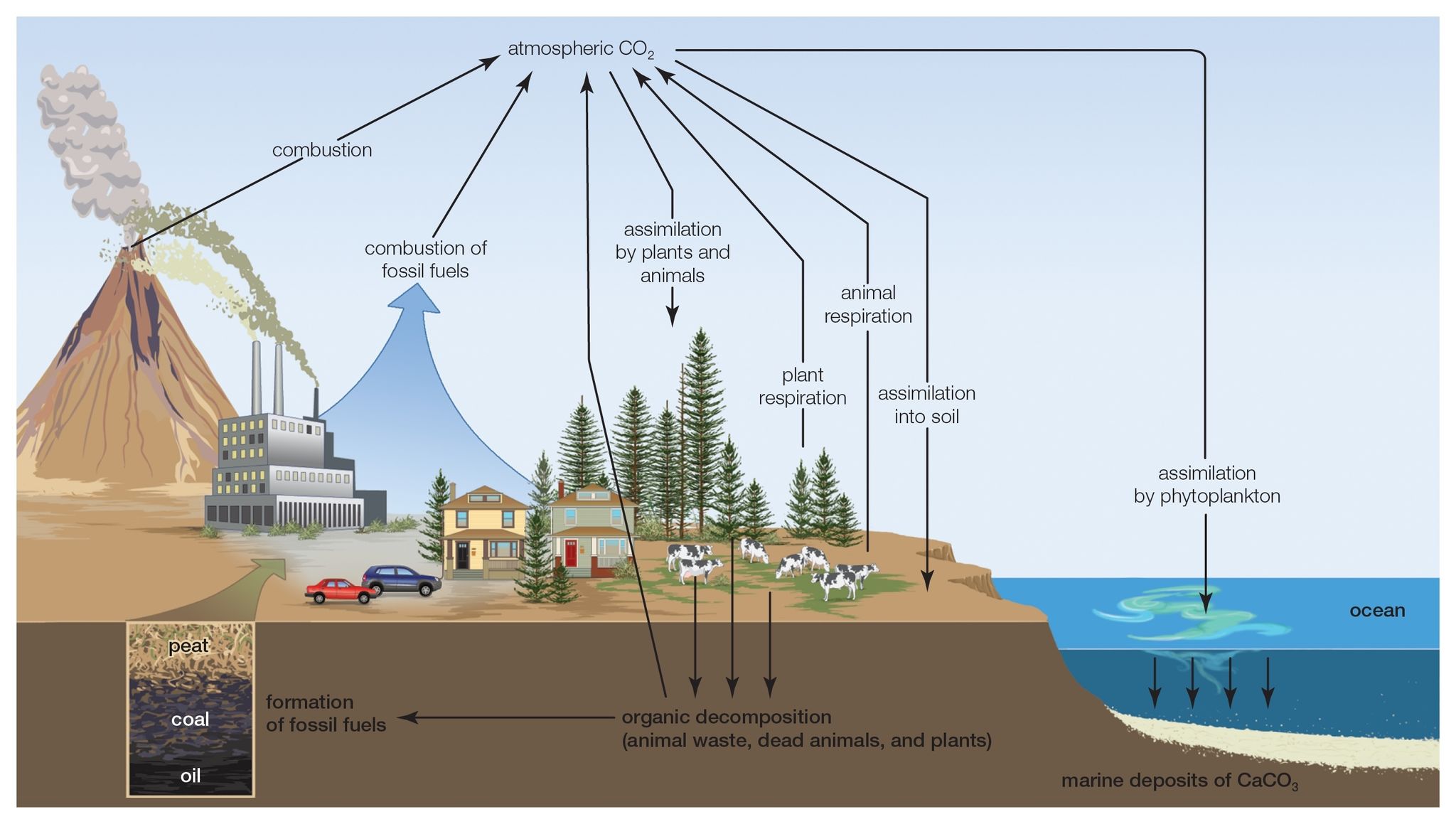
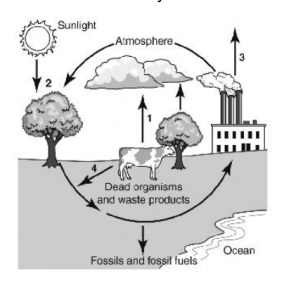
What is happening at 2?
respiration: releasing CO2
decomposing CO2 in the soil
photosynthesis: absorbing CO2
turning CO2 from the atmosphere into organic molecules
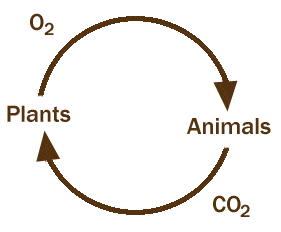


________________ could increase the amount of oxygen in the air.
Building more houses
Burning more oil
Paving more streets
Planting more trees
Humans contribute to the amount of released carbon dioxide through all of the following except -
the expansion of urban centers.
burning of fossil fuels.
dstroying forests for use as agricultural land.
using wind energy.
Select all answers below that correctly describe the movement of carbon dioxide in the carbon cycle.
During photosynthesis, plants use carbon dioxide to make glucose and store it as starch.
The decomposition of plants and animals releases carbon dioxide into the atmosphere.
Oceans release carbon dioxide into the atmosphere at an extremely slow rate.
Animals consume carbon stores in plants and then release carbon dioxide during cellular respiration.
What is the correct equation for photosynthesis?
6CO2 + 6H2O + Sunlight --> C6H12O6 + 6O2
None of these is correct.
6CO2 + 6O2 + sunlight --> C6H12O6 + 6O2 + Energy
C6H12O6 + 6O2 --> 6CO2 + 6H2O + Sunlight
Carbon is an element with an atomic number of 6 that is found in all living things and in the atmosphere as carbon (a) .
The circulation of carbon between the living and nonliving parts of an environment is called -
the carbon cycle.
weathering.
global warming.
recycling.
A(n) _________________ is a substance that is discharged from a source.
decomposition
combustion
fuels
emission
Carbon is released to the environment through all of the following except -
combustion.
photosynthesis.
volcanic activity.
decomposition.
The largest reservoir of carbon is in the -
ocean.
coal deposits.
atmosphere.
bodies of living things.
Carbon dioxide is a waste product of -
photosynthesis.
cellular respiration.
osmosis.
DNA replication.
Decomposers break down dead and decaying (a) matter.

Which process converts atmospheric nitrogen into a form usable by plants?
DENITRIFICATION
NITROGEN FIXING BACTERIA
NITRIFICATION
AMMONIFICATION
Pick 2 ways that nitrogen in the atmosphere enters the soil.
sunlight
wind
snow
rain
What process of the nitrogen cycle occurs in the roots of plants?
Denitrification
Nitrogen fixation
Photosynthesis
Cellular Respiration

The process that allows organisms to use nitrogen
assimilation
denitrification
fixation
ammonification
The nitrogen cycle includes ___________. (Pick 3)
the atmosphere
the sun
the animals
the soil
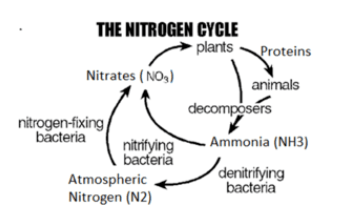
According to this diagram, plants absorb
nitrates
nitrogen fixing bacteria
animals
decomposers
Animals get nitrogen by ____________.
breathing air
eating plants
dying
being struck by lightning
_____________ bacteria change the nitrates back into nitrogen gas that is then released back into the atmosphere.
Denitrifying
Nitrogen fixing
Ammonifying
Phagocytotic
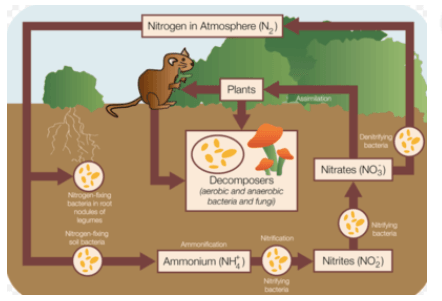
A correct path that nitrogen could take would be
air -> animals -> plants -> bacteria
animals -> air -> bacteria -> plants
bacteria -> air -> plants -> animals
air -> bacteria -> plants -> animals
Plants and animals cannot use nitrogen directly from the air.
True
False
What is the process of combining nitrogen gas with other elements to make nitrogen into usable compounds?
nitrogen composition
nitrogen fixation
ammonia
denitrification
What is the formula for atmospheric nitrogen?
N
N2
NH3
NO3
What process occurs when dead plant and animal matter decomposes and nitrogen is released back into the atmosphere?
Assimilation
Fixation
Ammonification
Denitrification
Plants and animals cannot use nitrogen directly from the air.
True
False
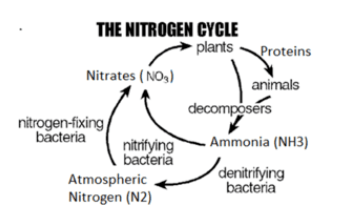
According to this diagram, plants use nitrogen to make _________________________
bacteria
animals
proteins
decomposers
According to this diagram, plants absorb
nitrates
nitrogen fixing bacteria
animals
decomposers
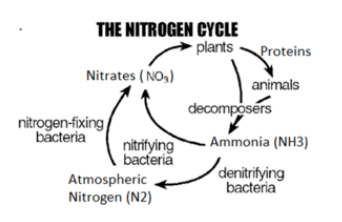
According to this diagram, animals get proteins from eating ________________________
decomposers
bacteria
plants
sunlight
The process that allows organisms to use nitrogen
assimilation
denitrification
fixation
ammonification
A correct path that nitrogen could take would be
air -> animals -> plants -> bacteria
animals -> air -> bacteria -> plants
bacteria -> air -> plants -> animals
air -> bacteria -> plants -> animals
Bacteria fix nitrogen from the atmosphere into a form plants can use.
True
False
Bacteria create a form of nitrogen that animals can use directly.
True
False
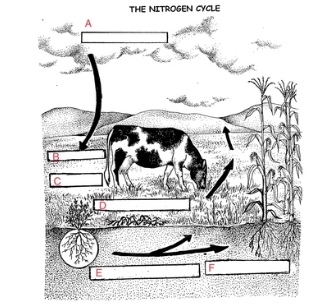
In the nitrogen cycle, what does label A in the diagram represent?
Gas
Clouds
Carbon dioxide in the atmosphere
Nitrogen in the atmosphere
What converts nitrogen gas into a usable form for plants and animals?
bacteria
rain
fungi
car exhaust
What process occurs when dead plant and animal matter decomposes and nitrogen is released back into the atmosphere?
Assimilation
Fixation
Ammonification
Denitrification
According to this diagram, plants use nitrogen to make _________________________
bacteria
animals
proteins
decomposers
A correct path that nitrogen could take would be
air -> animals -> plants -> bacteria
animals -> air -> bacteria -> plants
bacteria -> air -> plants -> animals
air -> bacteria -> plants -> animals
The biological transformation of ammonia or ammonium to nitrites and nitrates.
ammonification
denitrification
nitrification
nitrogen fixation

Which process makes nitrites from ammonia?
ammonification
denitrification
nitrification
nitrogen fixation
What converts nitrogen gas into a usable form for plants and animals?
bacteria
rain
fungi
car exhaust
How is nitrogen "fixed" into a usable form for plants?
Through action of bacteria only
Through lightning only
Through action of bacteria and lightning
Through photosynthesis
What is the process of combining nitrogen gas with other elements to make nitrogen into usable compounds?
nitrogen composition
nitrogen fixation
ammonia
denitrification
What is the formula for atmospheric nitrogen?
N
N2
NH3
NO3
What process occurs when dead plant and animal matter decomposes and nitrogen is released back into the atmosphere?
Assimilation
Fixation
Ammonification
Denitrification
Plants and animals cannot use nitrogen directly from the air.
True
False
Match the following steps of the nitrogen cycle to how they move bacteria.
Atmosphere to Geosphere
Nitrogen Fixation
Geosphere to Biosphere
Assimilation
Biosphere to Geosphere
Ammonification
Geosphere to Atmosphere
Denitrification
What is the original, and biggest reservoir of phosphorus on the planet?
live plants and animals
groundwater
the atmosphere
rocks
Carbon is cycled on a global scale. Why does phosphorus cycling tend to occur more locally?
it primarily involves the weathering of rocks, which are mostly stationary
it only involves land animals that cannot swim across oceans to transport the nutrient
it occurs in areas where cloud formation is low, so it rarely gets trapped in water vapors
all of the answers are correct
The phosphorus cycle occurs much more quickly than the carbon and nitrogen cycles.
true
false
Phosphorus enters the cycle as
atmospheric phosphate
diphosphorus
rock phosphate
organic phosphate
This is NOT a part of the phosphorus cycle.
Phosphate is incorporated into sedimentary rocks
Phosphate bound to soil
Atmospheric phosphate
Phosphate is absorbed from the soil by plants
Too much phosphorus in waterways (rivers, lakes) can lead to___________.
eutrophication
Nothing
Death
diseases

In general, algal blooms occur when
toxins accumulate in shellfish.
nutrients decrease in the water.
nutrients increase in the water.
water runoff
An algal bloom is the rapid growth of a population of
fungi
protozoans
algae
Once inorganic phosphate has been released by weather of rocks, which of the following might be it's next step in the phosphorus cycle?
it can become part of surface water and runoff into the ocean, and eventually become new rock at the bottom of the ocean through the process of sedimentation
it can become part of the soil and be taken up by plant roots and used to make lipids, ATP, nucleic acids and other cellular molecules
it can become part of groundwater and leech into the ocean, and eventually become new rock through the process of sedimentation
all of the answers are possible pathways for phosphorus
What is the original, and primary reservoir of inorganic phosphate (PO43-)in terrestrial ecosystems?
live plants and animals
groundwater
the atmosphere
rocks
Plants are the only organisms that can directly absorb inorganic phosphorus ions (PO43-) and turn them into organic molecules that can support all other life processes in an ecosystem.
true
false
Inorganic phosphate (PO43-) is added to the soil by which three processes?
uplift; sedimentation; consumption
live plants; animal decomposition; bacterial fixation
precipitation; runoff; weathering of rock
animal excretion; decomposition; weathering of rock
Why is phosphorus important to biology?
it works alongside the nitrogen cycle to fertilize plants
it is the primary component of mountains, which serve as habitats for animals
it enhances decomposition of organic matter
it is a component of many biological molecules, such as nucleic acids, some lipids, ATP, and bony structures
Nitrogen and carbon are cycled on a global scale. Why does phosphorus cycling tend to occur more locally?
it primarily involves the weather of rocks, which are mostly stationary
it only involves land animals that cannot swim across oceans to transport the nutrient
it occurs in areas where cloud formation is low, so it rarely gets trapped in water vapors
all of the answers are correct
The phosphorus cycle occurs much more quickly than the carbon and nitrogen cycles.
true
false
This is NOT a part of the phosphorus cycle.
Phosphate is incorporated into sedimentary rocks
Phosphate bound to soil
Atmospheric phosphate
Phosphate is absorbed from the soil by plants
_____ brings phosphorous into our waterways. .
Precipitation
Runoff
Transpiration
Condensation
This is released by the weathering of rocks.
Carbonate
Phosphate
Phosphorus
Nitrogen
Too much phosphorus in waterways (rivers, lakes) can lead to___________.
eutrophication
nothing
decreased pH levels
diseases
What is the phosphorus' symbol on the periodic table?
P
pH
Ph
PO
The major sink for phosphorus is
sedimentary rock
atmospheric gases
seawater
plants
In order to make a complete cycle for phosphorus, you need to make new rocks through heat, time, and pressure.
TRUE
FALSE
What things add phosphorus to the soil? Check all that apply.
Decomposition
Erosion
Excretion
Lightning
Respiration

