
 Worksheets
Spring Final Review
Total questions: 100
Worksheet time: 55mins
What was the main concern of Reservationists about the Treaty of Versailles?
Article 6 would make all previous treaties with Germany and France invalid.
Article 8 would cause the United States to lose France and Britain as allies.
Article 10 would draw the United States into wars without Congress' approval.
Article 12 would weaken the U.S. economy by participating in international trade.
According to President Wilson, how would the League of Nations maintain peace?
by excluding from its membership any country that started a war
by requiring all member countries to eliminate their armaments
by providing collective security to handle any threats as they arose
by outlawing war and requiring all nations to help create a world police force
What was the ultimate fate of the Treaty of Versailles in the United States?
It was vetoed by President Wilson.
It was declared unconstitutional by the Supreme Court.
It was rejected by Congress in its original form, but was ratified with reservations.
It was rejected by Congress, which then signed a separate peace treaty with Germany.
Which of the following countries was not part of the Big Four at the Paris Peace Conference?
Italy
Russia
Germany
Britain
Which of these was NOT an effect of the New Deal?
It ended the Great Depression.
It laid the foundations of the welfare state.
It expanded the power of the federal government.
It attracted new groups of voters into the Democratic Party.
One objective of the Social Security Act was:
To provide financial assistance to the elderly
To improve public transportation
To increase military spending
To promote space exploration
What was the right-wing criticism of the New Deal?
It did not provide enough money and aid to the poor people.
It had expanded the role of the federal government too much.
It created too many agencies, which used up a lot of money.
It was focused too much on helping banks and businesses.
How did the Agricultural Adjustment Administration try to help farmers?
by increasing competition among farmers
by reducing production to raise crop prices
by asking banks to lower interest rates for farmers
by increasing production to boost crop surpluses
On December 7, 1941, President Roosevelt asked Congress for a declaration of war. Which of these events led to this request?
Churchill's desperate need for help in the Battle of Britain
Germany's lightning war that ended with the fall of France
Stalin's agreement to sign a nonaggression pact with Hitler
Japan's surprise attack on a U.S. naval base in Pearl Harbor
Which of these allowed the United States to send 'all aid short of war' to Britain despite its status as a neutral nation early in World War II?
Atlantic Charter
Double V campaign
Lend-Lease Act
Selective Training and Service Act
Which of these events caused Great Britain and France to declare war against Germany?
Germany's seizure of the Sudetenland
Germany's political union with Austria
Germany's occupation of the Rhineland
Germany's invasion of neighboring Poland
How did Hitler break the Nonaggression Pact in 1941?
He became allies with Britain
He attacked the Soviet Union
He did not send aid to Poland
He withdrew his troops from France
Which of the following was an achievement of Benito Mussolini?
He founded the first fascist political movement
He conquered part of the Soviet Union
He was the first leader to oppose Adolf Hitler
He established the Communist Party in Italy
What achievement did the Battle of Midway make for the Allied nations?
It ended Japan's expansion and forced Japan to focus on defense
It forced Japan to use most of its resources and surrender
It resulted in a peace treaty between Japan and the Allies
It caused Japan to go against Germany and join the Allies
What prompted Japan to surrender to the Allies on August 14, 1945?
The Doolittle raid on the city of Tokyo
The firebombing of major Japanese cities
The atomic bomb attacks on Hiroshima and Nagasaki
The loss of more than 100,000 troops in the Battle of Okinawa
Which of the following military options did the Allies choose in the Pacific war?
launch a massive invasion of the Japanese islands from China
limit Japan's expansion but do little more until the war in Europe is won
build bases in the Aleutian Islands from which to launch an air war against Japan
follow a leapfrogging campaign to secure bases leading across the ocean to Japan
On June 6, 1944, Allied forces stormed the beaches of Normandy in northern France. What was this event called?
D-Day
V-E Day
Battle of the Bulge
Battle of the Atlantic
What was the outcome of the Allies invading Sicily in 1943?
Italy greatly weakened the Allies' armed forces.
Mussolini resigned and Italy surrendered to the Allies.
Britain and China decided to join sides with Italy.
The United States lost most of its troops in the fight.
Which of the following was a serious problem during the Great Depression?
low prices
buying on margin
high unemployment
business consolidation
The landmark Civil Rights Act of 1964 outlawed racial discrimination in all of the following areas EXCEPT:
employment.
housing.
public accommodations.
public schools.
Black nationalists rejected the goals of the civil rights movement in the 1960s because they
supported a doctrine that called for blacks completely separating from white society.
believed that nonviolent protesting was necessary for achieving racial equality.
did not want to associate with the conformity and materialism in American culture.
were more concerned with spreading propaganda about whites than gaining equal rights.
Which of these groups sent observers into the streets armed with law books and shotguns to protect blacks from police mistreatment in the 1960s?
Black Panthers
Nation of Islam
Congressional Black Caucus
Student Nonviolent Coordinating Committee (SNCC)
Which of these statements BEST explains the development of trench warfare in World War I?
U-boats cut off supplies to the troops.
Airplanes made it easier to spot enemy positions.
The invention of tanks made ground assault impossible.
New long-range weapons turned battlefields into death traps.
The Germans developed _____ to move undetectably undersea and sink opposing ships.
U-boats
battleships
convoys
howitzers
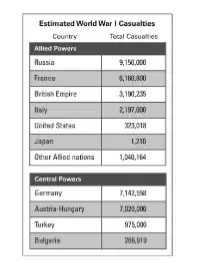
Examine the table below. Which of these statements supports the data in the table?
World War I lasted longer than earlier European wars.
Leaders of the Central powers were incompetent military planners.
The Americans arrived too late to be of any help to the Allied powers.
The costs of World War I included immense suffering and loss of human life.
Which of the following statements is not true of the fighting methods during World War I?
The rifle was the most widely used weapon on the battlefields.
Chemical weapons became widely used in World War I.
The use of the nuclear bomb made the war more dangerous.
Improvements to airplanes brought fighting to the sky.
What was the 369th Regiment during World War I?
The Russian regiment formed after the Russian revolution
The all-Black U.S. regiment that partook in active combat
The U.S. regiment that won a major battle against the Germans
The regiment that combined American and French soldiers
Why was the timing of the arrival of the American Expeditionary Force in Europe crucial to the Allies?
The Germans had recently enlisted Italy as an ally in the war.
The British had recently lost all their battleships in a large sea battle.
The French had just retreated from the battlefront after heavy losses.
The Russians had just signed a peace treaty with Germany and left the war.
How did the U.S. government build the large fighting force it would need to enter World War I?
It encouraged women to enlist as well as men.
It allowed blacks to train and fight alongside whites.
It offered high wages to anyone who volunteered to fight.
It established a national draft for young men aged 21 to 30.
Which of these did the most to trigger a worldwide collapse in trade during the 1930s?
Black Tuesday
Dawes Plan
Dust Bowl
Hawley-Smoot Tariff Act
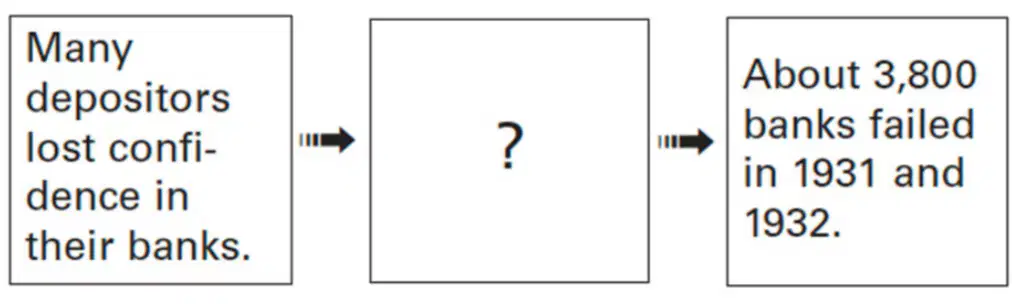
Examine the flowchart below. Which statement belongs in the center box?
Depositors withdrew their cash from banks.
Depositors demanded that banks raise interest rates.
Depositors called for government regulation of banks.
Depositors borrowed money from banks to invest in the stock market.
What was the main contributor to many banks failing between 1930 and 1933?
People often did not take out loans because of the high interest rates.
People were no longer interested in using credit to purchase goods.
People lost trust in the banks and many tried to withdraw their money.
People usually purchased goods instead of saving money in a bank.
Which of the following is NOT considered a cause of the Great Depression?
overproduction
stock speculation
underconsumption
foreign competition
Why was there not a demand for all the goods being produced in the late 1920s?
Companies outside of the United States offered lower-priced goods.
Banks began refusing credit to people who did not have steady jobs.
People could not afford to buy all the goods that were being produced.
Monopolies dominated the market and set extremely high prices.
Which of the following statements BEST describes what happened on Black Tuesday?
Stock prices fell and the stock market crashed.
Bank runs forced many banks to close their doors.
Federal troops attacked the Bonus Army marchers.
The Supreme Court ruled that the NRA was unconstitutional.
By 1968, a poll showed that 26 percent of Americans
thought President Johnson would turn the United States into a communist country.
felt the war in Vietnam should end immediately.
participated in protests against the war.
supported President Johnson's conduct of the war.
Which of the following was one of the U.S. pacification programs to promote security and stability in South Vietnam?
a program that tried to deter support for the Viet Cong by charging sympathizers fees
a program that called for a series of meetings between the United States and the Viet Cong
a program that had the ARVN remove the Viet Cong and its sympathizers from villages
a program that placed an embargo on all villages that housed Viet Cong sympathizers
Why did the United States' pursuit of limited war against Vietnam prove ineffective?
South Vietnam randomly attacked U.S. soldiers.
There were too many enemy forces to eliminate.
Violence broke out between France and Vietnam.
The Vietnamese had more advanced equipment.
Which of these terms BEST describes the kind of military campaign General William Westmoreland proposed for the U.S. forces early in the Vietnam conflict?
total war
defensive war
war of attrition
war of conquest
Which of these factors greatly frustrated U.S. troops fighting in Vietnam?
The Viet Cong could quickly fade into the landscape.
The Viet Cong was equipped with superior weapons.
The Viet Cong was able to total up higher body counts.
The Viet Cong excelled in conventional large-scale battles.
What kind of government system did Joseph Stalin establish in the Soviet Union by the early 1930s?
fascism
Nazism
totalitarianism
militarism
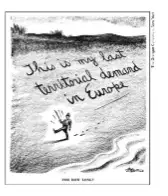
The following cartoon was created in response to the signing of the Munich Pact in 1938. Which of the following best reflects the cartoonist's point of view towards this event?
Hitler's promises are not worth much.
Hitler can be trusted to keep his word.
Appeasement is the way to deal with Hitler.
Keeping peace with Hitler is worth any price.
How did civil rights activists achieve an accord with Birmingham to undergo desegregation of public facilities?
Protesters participated in large sit-ins until the governor honored their demands.
Photographs of protesters being harmed by police evoked sympathy from Americans.
Pamphlets about discrimination in Birmingham were spread throughout the nation.
Store owners convinced the city to desegregate public facilities.
How did President Eisenhower respond to the refusal to desegregate a school in Little Rock, Arkansas?
He took the governor and school board to the Supreme Court.
He sent in federal troops to enforce the school's integration.
He had Congress implement laws requiring the desegregation.
He visited Little Rock and walked the black students into the school.
The photograph below was taken during a civil rights protest in Birmingham, Alabama, in 1963. What resulted from the event shown in the photograph and the publicity it generated?
Civil rights activists in Birmingham began to carry weapons.
Martin Luther King Jr. organized a bus boycott in Birmingham.
City leaders agreed to desegregate public facilities in Birmingham.
The Supreme Court ordered Birmingham schools to be desegregated.
Read the descriptions below. • promoted extreme nationalism and racism • called for territorial expansion to create 'living space' • abolished civil liberties • forcibly eliminated all opposition Which government does this list BEST describe?
the fascist government of Italy
the Nazi government of Germany
the militarist government of Japan
the communist government of the USSR
Which of the following was the primary cause of the natural disaster on the Great Plains known as the Dust Bowl?
dam building
crop reduction
black blizzards
prolonged drought
During the early years of the Great Depression, widespread unemployment contributed to a rise in all of the following EXCEPT
birth rates.
malnutrition rates.
eviction rates.
foreclosure rates.
Which of these pull factors drew Okies to California?
promises of steady farm work
a mild climate near the ocean
cheap homes on large plots of land
the prospect of plentiful factory jobs
Which of the following was a serious problem during the Great Depression?
high property values
high tariffs
high unemployment
high income taxes
How did people contribute to the desertification of the Great Plains that occurred in the 1930s?
Farmers overused the land, which stripped the soil of drought-resistant vegetation.
Families who lived in cities migrated to the Great Plains, which caused overpopulation.
Settlers used all the available water in the area, which left all water sources empty.
People dug in the Great Plains in search of valuable minerals, which ruined the land.
Which of these is the main reason President Harry Truman sent military aid to French Indochina during the early 1950s?
to support an independent Vietnam
to maintain French control of Vietnam
to keep the Chinese from invading Vietnam
to block the spread of communism into Vietnam
The Geneva Accords of 1954 led to all of the following EXCEPT
the end of the First Indochina War.
the division of Vietnam into two states.
the holding of elections to unify Vietnam.
the departure of the French from Indochina.
The Viet Minh was a Vietnamese movement led by Ho Chi Minh that
opposed foreign occupation.
supported the Indochina War.
fought against communism.
tried to colonize Japan.
One of the main arguments used to support U.S. military involvement in Vietnam was the fear that if Vietnam fell to communism, other nations in Southeast Asia could as well. This argument was known as the
appeasement trap.
domino theory.
hegemony effect.
red scare.
Which of the following is a reason that most of President Johnson’s advisors supported Operation Rolling Thunder?
They thought that would help gain military support from France and Britain.
They felt that it was necessary to avoid the collapse of South Vietnam.
They argued that it would convince Americans to support the involvement.
They believed that it would result in a peace treaty with North Vietnam.
Which of these empowered President Lyndon Johnson to greatly increase U.S. military involvement in Vietnam?
Gulf of Tonkin Resolution
Operation Rolling Thunder
Pentagon Papers
War Powers Act
In the 1960s, President Johnson’s advisors that were called hawks
argued for negotiation and peace with Vietnam.
favored U.S. military involvement in Vietnam.
felt that the war with Vietnam was unwinnable.
thought that Vietnam had the right to communism.
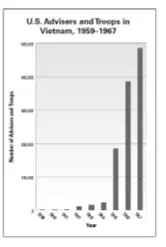
Examine the graph below. Based on the graph, in which year did President Johnson's Americanization of the Vietnam War begin?
1959
1961
1963
1965
Which of the following was NOT a contributing factor to the outbreak of war in Europe in 1914?
a policy of militarism
a complex system of alliances
a growing sense of nationalism
a shift in public opinion toward isolationism
Read the quotation below from President Woodrow Wilson's message to Congress in 1914. What was the president asking the nation to do?
adopt a policy of neutrality
make the world safe for democracy
offer loans and sell supplies to our allies
compete for trade and territory with our enemies
How did Germany's U-boats violate international law?
by disguising themselves with flags of neutral nations
by stopping vital supplies from reaching the front lines
by attacking merchant ships without letting passengers flee to safety
by conducting surprise searches of merchant ships in neutral waters
How did President Wilson respond to the sinking of the Lusitania in 1915?
by demanding that Germany stop unrestricted submarine warfare
by calling on Congress to approve a declaration of war against Germany
by sending navy ships to patrol Atlantic waters and sink any U-boats they found
by warning American citizens that they traveled on foreign ships at their own risk
In the Zimmermann note, what did Germany promise Mexico in return for its support during World War I?
When Congress voted in 1917, it was determined that the United States would declare war on
Serbia.
Mexico.
Russia.
Germany.
What was the main effect of Executive Order 9066?
the establishment of the Women's Army Auxiliary Corps
the evacuation of Japanese Americans to internment camps
the opening of centers for Jewish refugees in former army camps
the creation of the first African American combat unit in the army air corps
Which of the following is NOT true of women fighting in war?
Women had their own branch in the coast guard.
Women in the WAC sometimes fought in combat.
Women were allowed to hold jobs in the U.S. Navy.
Women were mechanics and radio operators in the war.
Which of these groups was targeted by white mobs in the Zoot Suit Riots?
African American migrants
Jewish American servicemen
Mexican American teenagers
German American enemy aliens
The Double V Campaign sought to fight against fascism and
end racism in the United States.
create a new League of Nations.
promote a communist government.
revert back to the policy of neutrality.
Which of these territories did the United States acquire by using the foreign policy tool of armed force?
Alaska
California
Florida
Louisiana
Which of the following newspaper headlines best illustrates the practice of yellow journalism in 1898?
"266 Killed in USS Maine Accident"
"USS Maine Sinks in Havana Harbor"
"USS Maine Destroyed by Spanish Treachery"
"Investigators Search for Cause of USS Maine Explosion"
Which of these factors increased U.S. public opinion in favor of a war with Spain to free Cuba?
the death of José Martí in combat
the passage of the Teller Amendment
the publication of the de Lôme letter
the popularity of the Yellow Kid cartoons
How did the outcome of the Spanish-American War change U.S. foreign policy?
It shifted U.S. policy toward neutrality.
It shifted U.S. policy toward imperialism.
It shifted U.S. policy toward unilateralism.
It shifted U.S. policy toward noncolonialism.
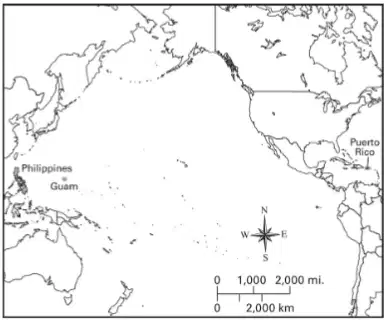
Examine the map below. What do the islands labeled on the map have in common?
They were all battle sites during the Spanish-American War.
They all gained their independence after the Spanish-American War.
They all became U.S. spheres of influence after the Spanish-American War.
They were all territories ceded to the United States after the Spanish-American War.
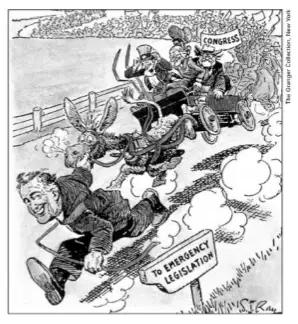
The cartoon below shows President Roosevelt leading both Congress and the nation along the path toward emergency legislation. What did Roosevelt call his program of emergency legislation?
the New Deal
the Square Deal
the New Freedom platform
the Share Our Wealth program
How did New Deal programs like the Civilian Conservation Corps and the Works Progress Administration provide relief to the needy?
by giving loans to the needy
by creating jobs for the needy
by distributing food to the needy
by providing pensions to the needy
What was the MAIN impact of the Tet Offensive in the United States?
It motivated President John Kennedy to send U.S. military advisers to Vietnam to prop up the Diem regime.
It fueled a credibility gap between what President Lyndon Johnson said about the Vietnam War and what Americans saw on television.
It triggered President Richard Nixon's decision to order the secret bombing of Viet Cong bases and supply routes in Laos and Cambodia.
It convinced President Gerald Ford not to interfere when the North Vietnamese Army surrounded the city of Saigon.
What was Agent Orange used for in the Vietnam War?
to poison food crops grown by Viet Cong supporters
to pollute wells supplying water to Viet Cong guerrillas
to blow up tunnel systems used to shelter Viet Cong troops
to clear forest vegetation that could hide Viet Cong soldiers
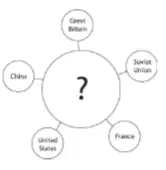
Examine the diagram below. Which term belongs in the center circle?
Allied powers
Axis powers
Central powers
United powers
What did Nazis decide was the "final solution" to the "Jewish question"?
deporting Jews to North Africa
confining Jews to urban ghettos
exterminating Jews in death camps
encouraging Jews to emigrate to the United States
The Manhattan Project was a U.S. government project that worked on
hiring spies for the war
creating colonies in Japan
improving aircraft technology
developing the atomic bomb
Which of these tactics did Martin Luther King Jr. and the Southern Christian Leadership Conference use most effectively in their struggle to win equal rights for African Americans?
armed rebellion
affirmative action
nonviolent resistance
reverse discrimination
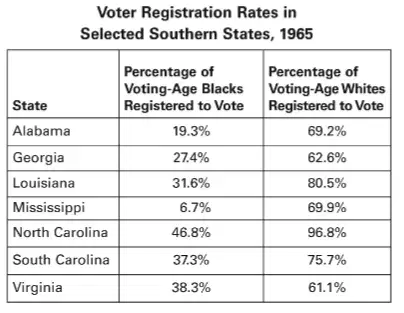
Examine the table below. Which of these campaigns was aimed at registering African Americans in the state with the lowest percentage of black voters?
Freedom Rides
Freedom Summer
March on Washington
Montgomery Bus Boycott
Why did the Korean War begin in June 1950?
The Soviets bombed North Korea.
North Korean troops invaded South Korea.
South Korea built missile-launching sites in Cuba.
Congress declared them a threat to the United States.
The buffer zone created along the 38th parallel in Korea is called the
thirty-eighth zone.
armistice zone.
mid-peninsula zone.
demilitarized zone.
The United States supported which side in the Korean War?
South
North
East
West
Which statement best describes the outcome of the Korean War?
North and South Korea were annexed by China.
North and South Korea remained divided into two countries.
North and South Koreans were reunited under a communist government.
North and South Koreans were reunited under a democratic government.
Which of these committed the United States to a foreign policy based on containment of communism?
the Baruch Plan
the Four Freedoms
the Long Telegram
the Truman Doctrine
Which of these statements is a way in which other countries besides the United States tried to gain support during the war?
They attacked any opposing countries.
They launched propaganda campaigns.
They promised tax-free imports to allies.
They refused to trade with any neutral nations.
In 1899, the United States urged other nations to allow free trade in China. This approach to dealing with China was known as the
Monroe Doctrine
Open Door Policy
Teller Amendment
Roosevelt Corollary
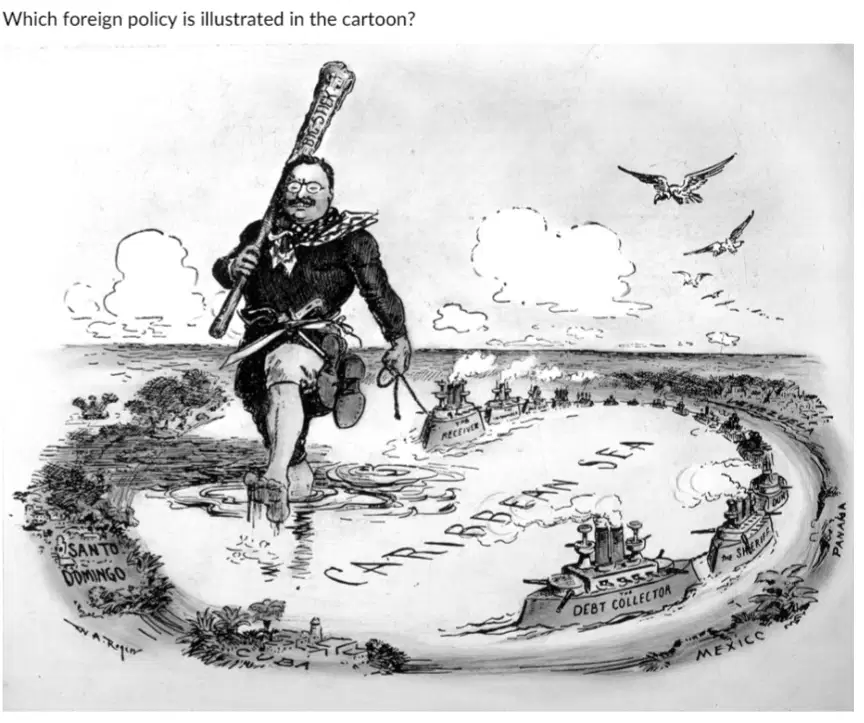
Examine the political cartoon below. Which foreign policy is illustrated in the cartoon?
Big Stick Policy
Dollar Diplomacy
Moral Diplomacy
Open Door Policy
What aspect of foreign policy did William Howard Taft focus on during his presidency?
(a)
President Woodrow Wilson’s foreign policy focused on
working quietly and patiently in oversea affairs, but using force.
encouraging U.S. trade and investment in Latin American and Asia.
using warfare to conquer most of the land in Latin American and Asia.
taking a moral approach by promoting democratic ideals abroad.
What provoked war between the United States and the Philippines in 1899?
The Philippines attempted to become allies with France and England to fight against the United States.
The United States refused to export their goods to the Philippines to weaken the Filipinos' economy.
The United States would not grant the Philippines independence after the Spanish-American war.
The Philippines had sided and fought with the Spanish during the Spanish-American war.
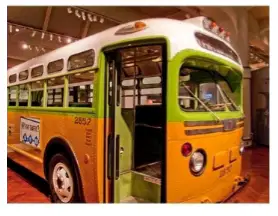
What action aboard this bus from Montgomery, Alabama, inspired African Americans to boycott the bus system there?
the requirement that all African Americans pay double fares
the change in the bus route on West Edgemont Avenue
the arrest of Rosa Parks for refusing to give up her seat
the hiring of E. D. Nixon as a bus driver
The bus law that Rosa Parks was protesting in 1955 required African Americans
to ride on separate buses owned and operated by African Americans.
to give up their seats to whites when buses were full.
to stand on the bus at all times, even if seats were available.
to leave the bus whenever a white passenger entered.
In 1957, Arkansas civil rights leader Daisy Bates reported on events at Central High School to Roy Wilkins, the executive secretary of the national NAACP. Conditions are yet pretty rough in the school for the children. Last week, Minnie Jean's [MinniJean's] mother, Mrs. W. B. Brown, asked me to go over to the school with her for a conference with the principal, and the two assistant principals. Subj of conference: "Firmer disciplinary measures, and the withdrawal of Minnie Jean [MinniJean] from the glee club's Christmas program." The principal had informed Minnie Jean [MinniJean] in withdrawing her from the program that "When it is definite decided that Negroes will go to school here with the whites, and the troops are removed, then you will be able to participate all activities." We strongly challenged this statement, which he denied making in that fashion. We also pointed out that the treatment of the children had been getting steadily worse for the last two weeks in the form of kicking, spitting, and general abuse. As a result of our visit, stronger measures are being taken against the white students who are guilty of committing the offenses. For instance, a boy who had been suspended for two weeks, flunked both six-weeks tests, and on his return to sch the first day he knocked Gloria Ray [Karlmark] into her locker. As a result of our visit, he was given an indefinite suspension. superintendent of schools also requested a conference the same afternoon. Clarence and I went down and spent about two hours. Here, again we pointed out that a three-day suspension given Hugh Williams for a sneak attack perpetrated on one o the Negro boys which knocked him out, and required a doctor's attention, was not sufficient punishment. We also informed that our investigation revealed that there were many pupils willing to help if given the opportunity, and that President Eisenhower was very much concerned about the Little Rock crisis. He has stated his willingness to come down and address t student body if invited by student leaders of the school. This information was passed on to the principal of the school, but w have not been assured that leadership would be given to children in the school who are willing to organize for law and order letter from Daisy Bates to Roy Wilkins, December 17, 1957] A. organizing informal get-togethers to help white and black students get to know each other better. B. persuading principals to give appropriate punishments white students who attacked black students. C. teaching them self-defense techniques so that they could protect themselves in case of attack. D. helping the African American students transfer to more welcoming schools.
organizing informal get-togethers to help white and black students get to know each other better.
persuading principals to give appropriate punishments white students who attacked black students.
teaching them self-defense techniques so that they could protect themselves in case of attack.
helping the African American students transfer to more welcoming schools.

These men are staging a protest at this Nashville lunch counter. This protest was called
a be-in.
reverse discrimination.
a sit-in.
black nationalism.
Nonviolent protests, such as sit-ins, were acts of
civil disobedience.
cowardice.
filibusters.
resegregation.
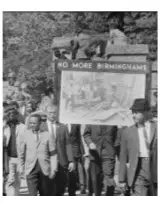
What happened when African American students gathered to march in Birmingham on May 3, 1963?
The students burned down the Sixteenth Street Baptist Church.
Civil rights activists put them on buses to leave town for their own protection.
The police used attack dogs and high-pressure fire hoses on them.
White clergy members took out a newspaper ad condemning their actions.

