
Font size
 Worksheets
Function & Transformation Quiz
Total questions: 171
Worksheet time: 6hrs 21mins
Graph the function f(x) = x^2.
Graph of the function f(x) = x^2 is a circle.
Graph of the function f(x) = x^2 is a hyperbola.
Graph of the function f(x) = x^2 is a parabolic curve opening upwards.
Graph of the function f(x) = x^2 is a straight line.
Find the composite function (f o g)(x) given f(x) = 2x and g(x) = x + 3.
x + 6
2x + 3
2x - 3
2x + 6
Determine the inverse function of f(x) = 3x - 5.
f^(-1)(x) = 3 / (x + 5)
f^(-1)(x) = 3x + 5
f^(-1)(x) = (x - 5) / 3
f^(-1)(x) = (x + 5) / 3
Perform a reflection of the point (2, 4) over the x-axis.
(2, -4)
(2, 4)
(4, 2)
(2, -2)
Translate the function y = x^3 two units to the right.
y = (x+2)^3
y = (x-2)^3
y = x^3 + 2
y = x^3 - 2
Rotate the point (3, 5) 90 degrees counterclockwise about the origin.
(-5, 3)
(-3, -5)
(3, -5)
(5, -3)
Graph the function f(x) = |x|.
The graph of the function f(x) = |x| is a V-shaped graph with the vertex at the origin (0,0) and extending upwards and to the right.
The graph of the function f(x) = |x| is a circle
The graph of the function f(x) = |x| is a parabola opening downwards
The graph of the function f(x) = |x| is a straight line passing through the origin
Calculate the composite function (g o f)(x) given f(x) = x^2 and g(x) = 2x.
4x^2
4x
x^4
2x^2
Identify the inverse function of f(x) = 4x + 7.
f^{-1}(x) = (x + 7) / 4
f^{-1}(x) = 4x - 7
f^{-1}(x) = (x - 7) / 4
f^{-1}(x) = 4 / (x - 7)
Apply a reflection of the line y = 2x over the y-axis.
y = -2x
y = x/2
y = -x/2
y = 2x
Translate the function y = sqrt(x) three units down.
y = sqrt(x) - 3
y = sqrt(x) - 2
y = sqrt(x) + 3
y = sqrt(x) * 3
Rotate the point (1, 2) 180 degrees about the origin.
(1, 2)
(2, 1)
(-1, -2)
(0, 0)
Sketch the graph of f(x) = sin(x).
The graph of f(x) = sin(x) is a circle
The graph of f(x) = sin(x) is a straight line
The graph of f(x) = sin(x) is a parabola
The graph of f(x) = sin(x) is a wave that oscillates between -1 and 1, crossing the x-axis at multiples of π.
Find the composite function (f o g)(x) with f(x) = x^2 and g(x) = 3x.
x^6
6x^2
9x^2
3x^2
Determine the inverse function of f(x) = (1/2)x - 3.
f^-1(x) = 2(x - 3)
f^-1(x) = -2(x - 3)
f^-1(x) = 2(x + 3)
f^-1(x) = (1/2)(x + 3)
Perform a reflection of the point (-2, 3) over the y-axis.
(-2, 3)
(-2, -3)
(2, 3)
(2, -3)
Translate the function y = 2x^2 four units to the left.
y = 2(x - 2)^2
y = 2(x + 2)^2
y = 2(x - 4)^2
y = 2(x + 4)^2
Rotate the point (-1, 4) 270 degrees counterclockwise about the origin.
(1, 4)
(4, -1)
(4, 1)
(1, -4)
Graph the function f(x) = log(x).
The graph of f(x) = log(x) will be a curve starting from the point (1, 0) and increasing slowly as x increases.
The graph of f(x) = log(x) will be a parabola
The graph of f(x) = log(x) will be a decreasing curve
The graph of f(x) = log(x) will be a straight line
Calculate the composite function (g o f)(x) given f(x) = sqrt(x) and g(x) = x + 1.
x + 1
sqrt(x + 1)
x + sqrt(1)
sqrt(x) + 1
What is the Vertex coordinates for the following parabola:
2(x - 3) 2 + 4
(2,4)
(3,4)
(-3,4)
(-2,4)
If the a value is negative, which direction does the function open?
up
down
left
right

What is the vertex of this graph?
x=2
y=-3
(2, 1)
y=1
Which transformation maps the graph of
f(x) = x2 to the graph of g(x) = (x + 4)2?
a translation shifting 4 units up
a translation shifting 4 units down
a translation shifting 4 units to the left
a translation shifting 4 units to the right
Which transformation will occur if f(x) = x2 is replaced with f(x) = 2x2 ?
Vertical Compression by a factor of 2
Vertical Stretch by a factor of 2
Vertical translation up by 2 units.
Reflection across the x-axis.
Which transformation will occur if f(x) = x2 is replaced with f(x) = 1/2x2?
Vertical Compression by a factor of 1/2
Vertical Stretch by a factor of 1/2
Vertical translation up by 2 units.
Reflection across the x-axis.
Which transformation will occur if f(x) is replaced with f(x) + 2?
Translation left 2 units
right 2 units
translation up by 2 units
left 2 units
y = f(x) + 5
Describe the transformation of y = f(x) for the new function
y = 5f(x)
The graph of y = f(x) was shifted right 5
The graph of y = f(x) was shifted up 5
The graph of y = f(x) was compressed vertically by a factor of 5
The graph of y = f(x) was stretched vertically by a factor of 5
Describe the transformation of y = f(x) for the new function
y = - f(x)
The graph of y = f(x) was flipped vertically.
The graph of y = f(x) was shifted left.
The graph of y = f(x) was shifted down.
The graph of y = f(x) was shifted up
Describe the transformation of y = g(x) for the function
y = 3(x - 3) + 5
Shifted up 5 units
Shifted right 3 units
Stretched vertically by a factor of 3
Shifted down 5 units
Shifted right 3 units
Stretched vertically by a factor of 3
Shifted down 5 units
Shifted left 3 units
Stretched vertically by a factor of 3
Shifted down 5 units
Shifted left 3 units
Stretched vertically by a factor of 1/3

What is the equation of the graph below?
f(x) = - I x + 2 I
f(x) = - I x - 2 I
f(x) = I x + 2 I
f(x) = I x - 2 I

f(x) = |x| is shown in blue and the graph of g(x) is shown in red. What is the equation for the graph of g(x)?
g(x) = |x + 3| + 1
g(x) = -|x + 3| -1
g(x) = -|x -3| + 1
g(x) = |x - 3| -1


Left 3
Right 3
Left 3
Right 3
State the transformation of the function below.
y = (3x - 2)2 + 1
Vertical Stretch by 3, right 2, up 1
Horizontal Stretch by 3, right 2, up 1
Vertical Compression by 3, right 2, up 1
Horizontal Compression by 3, right 2, up 1
What is the Vertex coordinates for the following parabola:
2(x - 3) 2 + 4
(2,4)
(3,4)
(-3,4)
(-2,4)
If the a value is negative, which direction does the function open?
up
down
left
right
What is the vertex of this graph?
x=2
y=-3
(2, 1)
y=1
Which transformation maps the graph of
f(x) = x2 to the graph of g(x) = (x + 4)2?
a translation shifting 4 units up
a translation shifting 4 units down
a translation shifting 4 units to the left
a translation shifting 4 units to the right
Which transformation will occur if f(x) = x2 is replaced with f(x) = 2x2 ?
Vertical Compression by a factor of 2
Vertical Stretch by a factor of 2
Vertical translation up by 2 units.
Reflection across the x-axis.
Which transformation will occur if f(x) = x2 is replaced with f(x) = 1/2x2?
Vertical Compression by a factor of 1/2
Vertical Stretch by a factor of 1/2
Vertical translation up by 2 units.
Reflection across the x-axis.
Which transformation will occur if f(x) is replaced with f(x) + 2?
Translation left 2 units
right 2 units
translation up by 2 units
left 2 units
y = f(x) + 5
Describe the transformation of y = f(x) for the new function
y = 5f(x)
The graph of y = f(x) was shifted right 5
The graph of y = f(x) was shifted up 5
The graph of y = f(x) was compressed vertically by a factor of 5
The graph of y = f(x) was stretched vertically by a factor of 5
Describe the transformation of y = f(x) for the new function
y = - f(x)
The graph of y = f(x) was flipped vertically.
The graph of y = f(x) was shifted left.
The graph of y = f(x) was shifted down.
The graph of y = f(x) was shifted up
Describe the transformation of y = g(x) for the function
y = 3(x - 3) + 5
Shifted up 5 units
Shifted right 3 units
Stretched vertically by a factor of 3
Shifted down 5 units
Shifted right 3 units
Stretched vertically by a factor of 3
Shifted down 5 units
Shifted left 3 units
Stretched vertically by a factor of 3
Shifted down 5 units
Shifted left 3 units
Stretched vertically by a factor of 1/3
What is the equation of the graph below?
f(x) = - I x + 2 I
f(x) = - I x - 2 I
f(x) = I x + 2 I
f(x) = I x - 2 I
f(x) = |x| is shown in blue and the graph of g(x) is shown in red. What is the equation for the graph of g(x)?
g(x) = |x + 3| + 1
g(x) = -|x + 3| -1
g(x) = -|x -3| + 1
g(x) = |x - 3| -1
Left 3
Right 3
Left 3
Right 3
State the transformation of the function below.
y = (3x - 2)2 + 1
Vertical Stretch by 3, right 2, up 1
Horizontal Stretch by 3, right 2, up 1
Vertical Compression by 3, right 2, up 1
Horizontal Compression by 3, right 2, up 1
3f(x)
f(1/4x)
Describe the transformation that occurred
g(x) =2f(x)
Up 2 units
vertical compression
vertical stretch
Right 2 Units
y=(x-2)3+4
Write in function form: translation 3 units right
g(x) = f(x − 3)
g(x) = f(x) − 3
g(x) = -3f(x)
g(x) = f(-3x)
horizontal compression
g(x) = 3f(x)
g(x) = ½f(x)
g(x) = f(¼x)
g(x) = f(5x)
Which equation represents the parent quadratic function being vertically stretched by a factor of 2, translated 5 units to the right and translated 3 units down?
y=2(x−5)2−3
y=2(x+5)2−3
y=21(x+5)2−3
y=21(x−5)2−3
Given h(x)=−2x2+1 , describe the transformations from the parent function.
reflect in the x-axis, vertically stretched by a factor of 2 and translate 1 unit up
reflect in the x-axis, vertically compressed by a factor of 2 and translate 1 unit up
reflect in the x-axis, vertically stretched by a factor of 2 and translate 1 unit right
reflect in the y-axis, vertically stretched by a factor of 2 and translate 1 unit left
Find the inverse of f(x)=3x+2
f−1(x)=3x−2
f−1(x)=2+3x
f−1(x)=3x−2
Find the inverse of f(x)=2x+1
f−1(x)=2x
f−1(x)=2x−1
f−1(x)=2
Find the inverse of f(x)=4x
f−1(x)=4x
f−1(x)=4
f−1(x)=41
Find the inverse of f(x)=3x−5
f−1(x)=53+x
f−1(x)=3x+5
f−1(x)=5x+3
Find the inverse of f(x)=10+7x
f−1(x)=10x−7
f−1(x)=7x−10
f−1(x)=10+7x1
The inverse of f(x)=x+30 is f−1(x)=x−30 .
True
False
I have no idea how to do this.
The inverse of f(x)=8x+30 is f−1(x)=308 .
True
False
The inverse of f(x)=x2−1 is f−1(x)=(x+1)21 .
True
False
Find the inverse of f(x)=x1 .
f−1(x)=x1
f−1(x)=x
no solution
The notation for an inverse is
f−1(x)
g−1(x)
All of the above
f(x) = 1/4x - 7
and
g(x) = 4x


its inverse, f-1(x) =
and
g(x) = 4x


Determine the inverse for the function:
P (x) = 2x2 + 1
P-1(x) = 2x2−1
P-1(x) = 2x2+1
P-1(x) = 2x−1
P-1(x) = 2x+1
Determine the inverse for the function:
R (x) = 2x + 1
R-1(x) = 2x−1
R-1(x) = 2x+1
R-1(x) = x−3
R-1(x) = x +3
Determine the inverse for the function:
Q(x) = 42x −7
Q-1(x) = 72x−4
Q-1(x) = 24x+7
Q-1(x) = 47x −2
Q-1(x) = 72x +4
Determine the inverse for the function:
S (x) = 42x2 −7
S-1(x) = 72x−4
S-1(x) = 24x+7
S-1(x) = 24x+7
S-1(x) =
42x+7
Determine the inverse for the function:
T(x) = 6x − 7
T-1(x) = 6x−7
T-1(x) = 6x+7
T-1(x) = 7x −6
T-1(x) = 7x +6
g(x) = x - 2
Find (f∘g)(0)
and g(x) = x - 2
Find f(g(5))
f(x) = 1/4x - 7

What is the inverse function of a quadratic (x2)?
A square root function
2x
Another quadratic
A linear function
1st you replace f(x) with y
2nd switch the x's and y's
What do you do next?

A
B
C
D

A
B
C
D
and h(x) = x3+1,
find j(h(x)).
If f(3) = 12, what is the value of f−1(12) ?
48
Not enough information
3
0

Inverse Functions
Not Inverse Functions
Find the inverse of:
f(x)=3x+2
f−1(x)=2x+3
f−1(x)=3x−2
f−1(x)=−3x−2
f−1(x)=31x−2
Find the inverse of:
f(x)=5x−9
f−1(x)=2x+3
f−1(x)=5x−9
f−1(x)=−5x−9
f−1(x)=5x+9
Find the inverse of:
f(x)=−3x+1
f−1(x)=3x+1
f−1(x)=1x−3
f−1(x)=3x−1
f−1(x)=−3x−1
Find the inverse of:
f(x)=x2
f−1(x)=x
f−1(x)=2x
f−1(x)=2x
f−1(x)=x−21
Find the inverse of:
f(x)=x2−3
f−1(x)=x+3
f−1(x)=2x−3
f−1(x)=x+3
f−1(x)=x+31


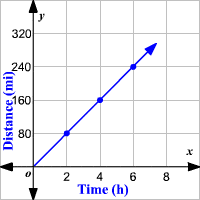

The graph represents the height of a paper airplane falling.
What is occurring at the point (8,0)?
The paper plane is 8 feet in the air to start
The paper plane is 0 feet in the air after 8 seconds
The paper plane has just been thrown
Which of the following is the graph of 5x + 2y = 10 ?


Which of the following is the graph of x − 2y = −8 ?


Which of the following is the graph of x + 2y = 4 ?


3x + 8y = 24
4x - 10y = 20
y-int = -10
y-int = 2
y int = -2
y -int = -10
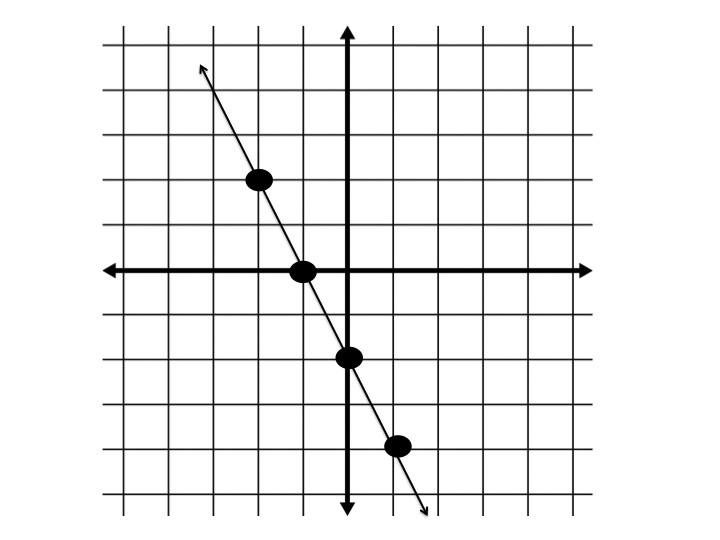
What is the function represented by the given graph?
y = x
y = -x^2
y = -x
y = x^2
What are the coordinates of point A on the graph?
(2, 0)
(6, -6)
(3, -3)
(11, -9)
What are the coordinates of point B on the graph?
(-5, 0)
(-4, -2)
(-6, 2)
(-7, 16)
What is the value of y when x = 18?
-10
15
-12
10
What is the value of y when x = -3?
15
10
-10
-16
What are the coordinates of point C on the graph?
(-10, -20)
(-5, -10)
(0, 0)
(5, 10)
What is the value of y when x = 4?
14
9
4
-1
What are the coordinates of point D on the graph?
(30, 0)
(25, 24)
(20, -20)
(15, -10)
What is the value of y when x = 25?
19
24
9
-4
What is the function represented by the given graph?
y = -x^2
y = x
y = -x
y = x^2


The point (8, 4) is on the graph. What does this point represent in terms of this graph?
4 cups of sugar are needed per jar of jam.
8 cups of sugar are needed per jar of jam.
8 jam jars require 4 cups of sugar
4 jam jars require 8 cups of sugar.
Jerry is 6 years younger than Henry. Which table correctly represents the relationship between x, Jerry's age, and y, Henry's age?


How many cups of sugar will be needed for 28 jars of jam?
(a)


What is the equation of this line?
x = 3
x = -3
y = 3
y = -3

What is the equation of this line?
x = 3
x = -3
y = 3
y = -3

Which coordinates lie in this line?
(-3,1)
(1,-3)
(-3, 20)
(20,-3)

Which coordinates lie in this line?
(3,-3)
(13,-3)
(-3,3)
(-3,13)

How many boxes of cookies were sold in Tuesday?
1
4
7
9

How far was Edward from home when he visited Nicola?
20 MILES
30 MILES
40 MILES
HOW LONG DID EDWARD STOP FOR?
1 HOUR AND 30 MINUTES
2 HOURS
2 HOURS AND 30 MINUTES

How far from Bristol is Anne at 08:00?
2O MILES
1O MILES
30 MILES

How far does the cyclist travel between A and B?
600 meters
800 meters
1200 meters
How long does it take the cyclist to cover 800 meter distance?
60 seconds
80 seconds
120 seconds
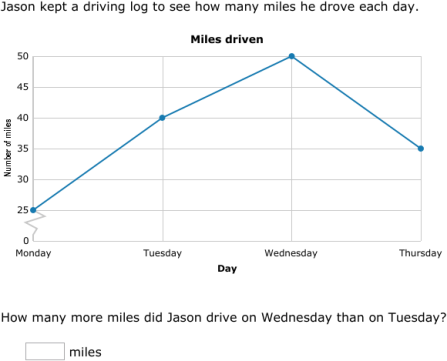
Horizontal lines have
Undefined gradient
Zero gradient
Negative gradient
Positive gradient

What gradient is represented here
negative
zero
undefined
positive

What gradient is represented here
Positive
negative
undefined
zero
3f(x)
f(1/4x)
Describe the transformation that occurred
g(x) =2f(x)
Up 2 units
vertical compression
vertical stretch
Right 2 Units
y=(x-2)3+4
Write in function form: translation 3 units right
g(x) = f(x − 3)
g(x) = f(x) − 3
g(x) = -3f(x)
g(x) = f(-3x)
horizontal compression
g(x) = 3f(x)
g(x) = ½f(x)
g(x) = f(¼x)
g(x) = f(5x)
Which equation represents the parent quadratic function being vertically stretched by a factor of 2, translated 5 units to the right and translated 3 units down?
y=2(x−5)2−3
y=2(x+5)2−3
y=21(x+5)2−3
y=21(x−5)2−3
Given h(x)=−2x2+1 , describe the transformations from the parent function.
reflect in the x-axis, vertically stretched by a factor of 2 and translate 1 unit up
reflect in the x-axis, vertically compressed by a factor of 2 and translate 1 unit up
reflect in the x-axis, vertically stretched by a factor of 2 and translate 1 unit right
reflect in the y-axis, vertically stretched by a factor of 2 and translate 1 unit left

