
Font size
 Worksheets
23/24 Final Exam Review
Total questions: 42
Worksheet time: 26mins
Shawn is planning a scientific experiment. He wants to learn whether the time of day has an effect on how far the roses in his mother's garden are open. He plans to measure the diameter of each flower on three rose bushes every hour during a week in the spring. What is the independent variable in Shawn's experiment?
The time of day
The diameter of the flowers
The number of flowers
The time of year

What is the measurement shown here on the triple beam balance?
130.2 g
132.0 g
132.5 g
137.0 g
Adrian was mixing chemicals in the science lab when some of the chemicals accidentally splashed up into his eyes. What will Adrian’s teacher tell him to do?
Flush his eyes with running water for at least 15 minutes.
Put contact lenses in.
Put his safety goggles on.
Look directly into the sun.
Microfossil is viewed under a microscope high power objective. If the magnification of the eyepiece is 10X and the magnification of the high power objective is 40X, how many times larger does the microfossil appear?
4
4000
40
400
The matter you see is made of particles you cannot see. The smallest part of an element is a(n) ________.
element
mixture
molecule
atom
Substances that cannot be broken down into any other substances by chemical or physical means is a (n) ___________.
element
mixture
molecule
compound
Two or more different elements chemically combined is a (n) _____________.
atom
mixture
molecule
compound
On the periodic table, identify the rules for writing element symbols.
All letters are capitalized
First letter is capitalized, second letter is lowercase
All letters are lowercase
First letter is lowercase, second letter is capitalized
Ashley made a mixture of sugar and water and a mixture of sand and water. Which of the following is true?
Both mixtures are homogeneous
Both mixtures are heterogeneous
The sugar and water is heterogeneous
The sand and water is heterogeneous
The mass of the cube is 15 grams and the volume is 5 milliliters. What is the density of the cube?
(a)
You can describe a lemon as being oval, yellow colored, and sour tasting. All of these are ___________.
Chemical properties
Physical properties
Chemical changes
Physical change
According to the law of conservation of matter, which statement about chemical reactions is true?
Energy is created as atoms are destroyed in chemical reactions.
Atoms are created by some reactions and destroyed by chemical reactions.
Atoms cannot be created or destroyed by chemical reactions.
Every atom destroyed in a chemical reaction must be replaced.
As the kinetic energy of an object increases, so does the ________ energy produced.
heat
potential
atomic
light
A father and his 6 year old son race down a mountain on skis. If they're traveling at the same speed, who has more kinetic energy?
the father
the son
they have the same kinetic energy
neither the father or the son will have kinetic energy
A hair dryer converts
electrical energy into chemical energy
electrical energy into thermal energy
chemical energy into mechanical energy
thermal energy into mechanical energy
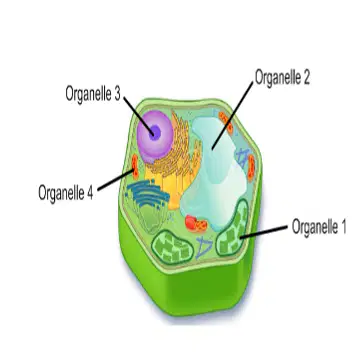
Which organelle uses energy from the sun in order to form food?
Organelle 1 – chloroplast
Organelle 2 – vacuole
Organelle 3 – nucleus
Organelle 4 – mitochondria

What cycle is the diagram showing?
Carbon dioxide is necessary for respiration.
Oxygen is produced during respiration.
Oxygen is produced during photosynthesis.
Carbon dioxide is produced during photosynthesis.
The main reason that cells carry out cellular respiration is to _________.
Release energy
Eliminate waste
Get glucose
Breathe
Which choice below shows the organization of the biosphere from most specific to the broadest category?
Organism → Population → Community → Ecosystem → Biosphere
Organism → Community → Population → Biosphere → Ecosystem
Organism → Community → Population → Ecosystem → Biosphere
Organism → Population → Community → Biosphere → Ecosystem
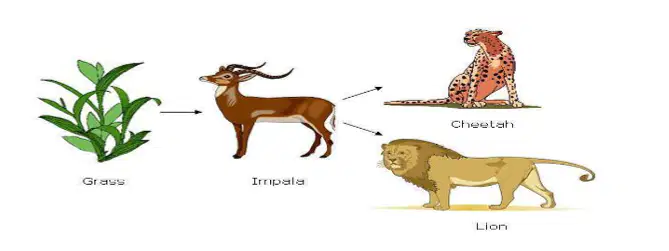
Based on the food web above, which of the following lists only predators?
Impala, cheetah
Cheetah, lion
Grass, impala
Lion, grass
According to the energy pyramid, which level has the most energy available to it?
Producers
Primary consumers
Secondary consumers
Tertiary consumers
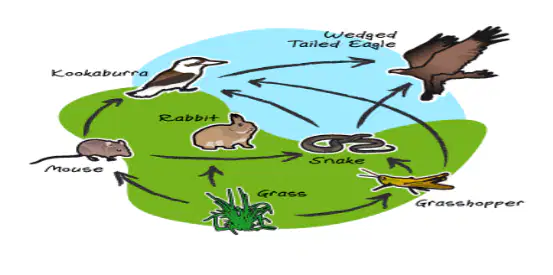
Which of the following organisms is a producer in the food web shown above?
Grass
Duck
Snake
Grasshopper

What would be the result of an increase in the population of the snake?
a decrease in the population of the grasshopper, and kookaburra
an increase in the population of rabbits and mouse
an increase in the population of both kookaburra and wedge-tailed eagle
an increase in the grasshopper and mouse
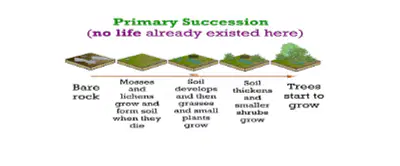
The process by which a new community forms where no community lived before is called ________?
A pioneer species is
a large organism.
the best organism
the first organism to adapt to a new environment
abiotic factor
What abiotic factor is formed during primary succession that doesn’t need to be formed during secondary succession?
pioneer species
soil
climax community
lichens
What is the difference between a primary vs. secondary succession?
secondary succession occurs when there was no previous community
they are both the same
secondary succession occurs only in an area that was partially destroyed
primary succession occurs only in an area that was partially destroyed
An increase in Earth’s average temperature due to the buildup of carbon dioxide and other gases in Earth's atmosphere is called
global warming
thermal pollution
ozone buildup
bioremediation
Ice cores from Antarctica allow scientists to measure the amounts of atmospheric carbon dioxide from long ago. These samples would BEST provide evidence for
the big bang theory
magnetic field reversal
climate change
continental drift
Every year the number of vehicles running on the roads is increasing. These vehicles release many harmful gases into the atmosphere. What effect does this have on living things?
The gases mix with rain and add more nutrients to aquatic ecosystems.
Microorganisms thrive under these conditions and grow in number.
It causes respiratory disorders in humans and animals.
Plants cannot complete the process of photosynthesis.
The result of global warming is an increase in the earth's temperature. Which ecosystem would most likely be eliminated as a result of this temperature increase?
desert
tundra
grassland
marine

Fresh water is one of the most important natural resources on earth. The chart shows how water is used by a typical family. Below are four ways you can conserve water. Which would conserve the most water?
Stopping all the leaks in your house.
Taking showers only, no baths.
Handwashing dishes instead of using a dishwasher.
Taking showers that are only half as long.
Wind energy is currently being used in the production of electricity. One way is through the use of windmills. What is the main advantage of using windmills?
They are non-polluting.
They are 90 percent efficient.
They can be used anywhere.
They are quiet.
Farmer Brown is planting crops in his fields. He wants to prevent the topsoil from being blown away by the wind or washed away by water. Which of these steps should he take?
leave the land free of crops for a long time
plant crops close together
water the crops often to wet soil
plow the soil many times
Emily writes on both sides of her paper at school. Her family also recycles newspapers at home. Which natural resource is Emily and her family conserving?
energy
animals
water
trees
Beth's mother uses cloth bags to carry her groceries home from the grocery store. How does using cloth bags instead of paper bags help the environment?
More paper bags are made.
Fewer trees are cut down.
More trees are cut down.
There is more trash.
Most countries have outlawed whaling, but some countries have few or no laws protecting whales. Why are conservation groups pushing for worldwide restrictions on whaling?
Whale oil is desperately needed as fuel worldwide.
Whales are dangerous threats to fishing grounds.
Oceans are overpopulated with whales and their numbers need to be reduced or many will starve.
Unrestricted whaling could lead to their extinction.
Which resource is a non-renewable and non-recyclable resource?
iron
rainforests
beef cattle
gasoline
What is an advantage of recycling?
Scientists have discovered how to use electricity to power cars. We have all seen ads for the new hybrids on television. Running cars on electricity could help
use up mineral resources.
the big oil companies.
pollute the atmosphere.
conserve gasoline.
These solar panels help us conserve nonrenewable natural resources that we use as fuel, such as
wood.
coal and oil.
wind power.
electricity.
Which of the following is NOT a synthetic product?
Plastic
Bread
Makeup
cotton

