
 Worksheets
Social Studies Final Exam Review 2024
Total questions: 148
Worksheet time: 1hrs 11mins

Close reading the map, with the Missouri Compromise, what state was allowed to enter as a slave state?
Missouri
Maine
Kentucky
Ohio

Close reading the map, with the Missouri Compromise, what state was allowed to enter as a free state?
Missouri
Maine
Kentucky
Alabama


Which of the following is true about the Missouri Compromise?
It was only a temporary solution
The Unorganized Territory permitted slavery
It solved all issues concerning slavery in the west
What was the Underground Railroad used for?
To transport cotton from the south to factories in the northeast.
It was used to help slaves escape from the south and get to the north.
It was used to connect the eastern and western states.
Conductors on the Underground railroad were:
Places where the slaves could hide
Slaves who were escaping the south
People who helped lead the slaves from the south to the north
Abolitionists were:
People who worked to end slavery
People who owned large factories in the north
People who owned large farms in the west.
What important work did Harriet Tubman do?
She led over 100 slaves to freedom
She wrote an important book about the evils of slavery
She opened a factory to help create jobs for former slaves
What did federal law say about escaped slaves?
Once they reached the north, they were now free
If captured, they had to be returned to the south
The conflict over slavery between the northern and southern states eventually caused what war?
The Revolutionary War
The War of 1812
The Civil War
In what direction did most of the slaves escape to?
South
West
East
North
Was the Underground Railroad a real railroad, with trains and stations?
Yes
No

Who wrote Uncle Tom's Cabin?
Frederick Douglass
Harriet Beecher Stowe
Angelina Grimke
William Lloyd Garrison
What is an abolitionist
Someone who wants to violently free enslaved people
Someone who promotes the expansion of slavery
Someone who advocates for the end of slavery
People who fought to end slavery were called...
liberators
emancipators
abolitionists
suffragists
Which statement best summarizes the influence of Uncle Tom’s Cabin?
The book’s shocking and emotional details turned many Northerners against slaves.
The book’s shocking and emotional details turned many Southerners against slaves.
The book’s shocking and emotional details turned many Northerners against slavery.
The book’s shocking and emotional details turned many Southerners against slavery.
Which man was not only a famous Black abolitionist, but also a champion of women's rights?
(a)
The (a) th amendment gave women the right to vote.
The 19th amendment was granted women (a) , which is the right to vote.

War between England and France over North American territory
French & Indian War
Revolutionary War
Settler's War
5 Years' War

American Colonists can not settle west of the Appalachian Mountains
Stamp Act
Townshend Acts
Proclamation of 1763
The Tea Act
An "Act" is another word for...
Law
Battle
Boycott
Trade

This act required colonists to house and feed British Troops
Quartering Act
Townshend Acts
Intolerable Acts
Proclamation of 1763

This act required colonists to buy a stamp each time they registered a legal document, bought newspapers, pamphlets, and almanacs.
Tea Act
Sugar Act
Intolerable Acts
Stamp Act

Clash between Boston rioters and British Troops that left 5 colonists dead.
Boston Tea Party
Intolerable Acts
Boycott
Boston Massacre

Delegates meet to discuss Intolerable acts and boycott British trade
1st Continental Congress
2nd Continental Congress

Americans who wanted to split from England
Patriots
Loyalists
Rebels
Revolutionaries

British Colonists who did not want to split from England
Patriots
Loyalists
Tories
Pacifists
Group who led the Boston Tea Party.
Daughters of Liberty
Sons of Liberty
Liberty Boys
The Rebels


What is a primary source?
First hand account of an event
(someone that was there)
Second hand account of an event
(someone who was not there, but heard about it.)
What is a secondary source?
First hand account of an event
(someone that was there)
Second hand account of an event
(someone who was not there, but heard about it.)
Why did Native Americans all develop differently?
Why do explorers explore?
Gold
Glory
God
All of the above
What was the Northwest Passage?
A passage that leads to the north and west
Some explorers travel to find an all water route through North America to Asia (a shortcut) Does not exist
France, England, Netherlands
What was the Columbian Exchange?
The Columbian Exchange was the exchange of goods, plants, animals, germs, and ideas between the Eastern and Western hemisphere (new world and old world)
What were some effects of the Columbian Exchange on the Europeans. Select 2 correct answers.
Begin to create colonies
Countries gain wealth from natural resources of Americas
Less goods were produced
Diseases spread to the old world (Europe)
What were some effects of the Columbian Exchange on the Native Peoples. Select 2 correct answers.
New crops are introduced in Europe- helps to increase food supply and population
Diseases spread to the Natives and millions died
They began to create factories.
Europeans take over their land
How is the Iroquois Confederacy similar to the U.S. government? Select 2 correct answers.
They lived in the same time period.
Both examples of democracy (government ruled by the people)
The Iroquois Confederacy joined (unites) 5 tribes together under one large government
True or False:
A government that united the Iroquois, made laws, and solved problems for all the Iroquois tribes was called the Iroquois Confederacy.
True
False

Who wrote the Declaration of Independence?
George Washington
Sam Adams
John Adams
Thomas Jefferson

The idea that the power to rule comes from the people is known as
right to rebel
natural rights
popular sovereignty

What was the first battle of the American Revolution?
Guilford Courthouse
Trenton
Yorktown
Lexington & Concord
This document ends the American Revolution, and recognizes the former British colonies as an independent nation.
Treaty of Paris (1783)
Treaty of Paris (1763)
Declaration of Independence
Common Sense
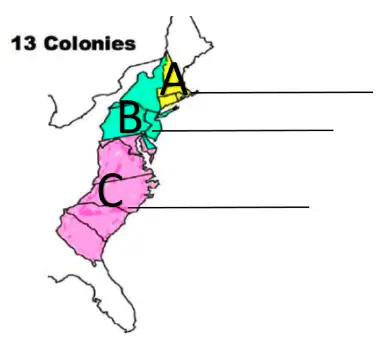
Which region on the map represents the Southern colonies?
A
B
C
How did MOST settlers hope to make money in the Southern Colonies?
by fishing
by logging
by mining
by farming
Which region on the map represents the New England colonies?
A
B
C
Which region on the map represents the Mid-Atlantic colonies?
A
B
C
What were the colonists protesting against?
money
ships
taxes
freedom
Where did the very first colonists live?
Jamestown, Virginia
Chapel Hill, North Carolina
New York, New York
Charlotte, North Carolina
Which European country ruled the 13 colonies?
Spain
France
Britain
the Netherlands
Select the answer that bests matches the following description, "the belief that colonies exist to make the mother country richer"
Economics
Mercantilism
The Mayflower Compact
The Columbian Exchange

Head of the Texas army and later elected as President of the Republic of Texas.
Davy Crockett
James Polk
Sam Houston
Zachary Taylor
One of the more than 80,000 who went to California in search of gold.
pioneer
forty-niner
vigilante
Californios

The U.S. agreed to share claim over Oregon Territory with what country.
Britain
Spain
France
Russia

American General who was sent into the disputed area of Texas by President Polk?
Winfield Scott
Davy Crockett
Sam Houston
Zachary Taylor
Agreement where the U.S. got California and New Mexico Territory from Mexico and the U.S. gave Mexico $15 million.
Bear Flag Republic
Mexican Cession
Treaty of Guadalupe-Hidalgo
Treaty of Paris

Located in San Antonio, it is the site of a famous battle of the Texas War for Independence.
San Jancinto
The Alamo
Veracruz
Goliad
Select the two causes of the Mexican War.
California Gold Rush
Massacre at the Alamo
Manifest Destiny
Annexation of Texas by U.S.
This issue was always argued over whenever new land or a new state was added to the U.S.
slavery
border lines
freedom of religion
2nd Amendment rights
American General who captured Veracruz and the Mexico City.
Winfield Scott
Davy Crockett
Sam Houston
Zachary Taylor
The American belief that it was our god given right to expand our borders from coast to coast.
Oregon Trail
Annexation Destiny
Mexican Cession
Manifest Destiny

To open and prepare for others to follow.
annexation
boomtown
Oregon Trail
pioneer

The Mexican General and dictator.
Jim Bowie
Hidalgo
Santa Anna
Juan Seguin
Nickname for the independent country of Texas.
Lone Star Republic
Gopher State Republic
Bear Flag Republic
Republic of Remember the Alamo

U.S. President who said he would go to war to achieve Manifest Destiny.
John O'Sullivan
Sam Houston
Zachary Taylor
James K. Polk
What is the U.S. purchase of nearly 30,000 square miles of land in present day southern Arizona and New Mexico known as?
Why did the U.S. want the land they purchased from Mexico for $10 million in 1853?
To establish a military base for future conflicts
To build a transcontinental railroad
What major purchase doubled the size of the United States?
Treaty of Augusta
Compact of 1802
Louisiana Purchase
Yazoo Land Fraud
Which problem did George Washington encounter when he became president?
Southern states were threatening to secede from the Union.
The United States had large debts from the American Revolution.
Great Britain was refusing to trade with the United States.
The Articles of Confederation needed to be replaced with a stronger constitution.

Disagreements between these two cabinet members led to —
the creation of reservations for American Indians
a struggle to ratify the Bill of Rights
the establishment of the first U.S. political parties
a compromise over slavery in western territories
The Federalists and the Democratic-Republicans emerged as separate political parties partly as a result of disagreement over —
how the nation should develop economically
whether to enforce the Monroe Doctrine
whether to enforce the Monroe Doctrine
whether to approve the Declaration of Independence
In Marbury v. Madison, the Supreme Court first stated the principle that —
only the courts may regulate interstate commerce
the president may veto federal legislation
the courts may declare a federal law unconstitutional
only the president may issue an executive order
The Embargo Act of 1807
banned all U.S. imports and exports
increased the amount of exports to France
placed a heavy tax on all imported goods
led to war with England
In 1803, Jefferson purchased this tract of land from France for 15 million dollars, doubling the size of the United States
Ohio Territory
Louisiana Territory
Oregon Territory
Texas
What is judicial review?
When the Judicial Branch removes a president from office
The Supreme Court’s power to say laws of Congress are unconstitutional
A judge's ability to make their own laws


The president appointed a group of advisors to help do his job, what is this called?
Cabinet.
The Avengers.
Board of Presidency.
Secretary of State.
This enslaved person’s journey from Africa to the Americas across the Atlantic Ocean on a slave-trading ship.
Middle Passage
Triangular trade
Slave trade
Journey

If a mother was a slave, her child was:
Free for life
A slave for life
A slave for a short time
Free for a short time

Who were abolitionists?
People who fought to keep slavery alive
People who owned slaves
People who fought to end slavery
No one
Slavery was the inhumane part of the
Triangle Trade Route
Square Trade Route
Hexagon Trade Route
Circular Trade Route
The person who watched over the field slaves was called the
boss man
plantation owner
Master Browne
overseer
Machines with __________ _________ helped with the production of goods.
Electricity
Interchangeable parts
Realism
Labor Union
Who invented the steamboat?
Eli Whitney
Samuel Slater
Elias Howe
Robert Fulton
Who invented interchangeable parts?
Elias Howe
Robert Fulton
Samuel Slater
Eli Whitney
What man invented the "Spinning Jenny" in 1764?
Thomas Newcomen
Eli Whitney
James Hargreaves
James Watt
Who was "The Great Compromiser"?
Frederick Douglass
Abraham Lincoln
Henry Clay
Andrew Jackson
What connected the Mississippi River and the Hudson River making transportation of goods easier?
The Hudson Bridge
The Erie Canal
The National Road
Railroads
This invention turned rivers into busy routes for traders and travelers.
Railroads
Telegraph
Steamboats
Mechanical reaper

a period of rapid growth in using machines for manufacturing and production
Transportation Revolution
American Revolution
Industrial Revolution
Technology Revolution
Who was the 4th President of the US?
James Madison
Dolley Madison
James Monroe
Francis Scott Key
Who wrote our national anthem, The Star-Spangled Banner?
James Madison
Dolley Madison
James Monroe
Francis Scott Key
Who saved important documents and a picture of George Washington before her home was burned?
James Madison
Dolley Madison
James Monroe
Francis Scott Key
What is the name of the war fought between France, Britain, and America?
American Revolution
Civil War
French and Indian War
War of 1812
Where was the American Flag hung during the War of 1812?
Fort McHenry
Washington D.C.
on a boat
Fort Mandan
Which place did the British want to defeat?
Canada
England
Washington D.C.
Pennsylvania
What did Congress hope the Missouri Compromise would accomplish?
make Maine a part of the Missouri Territory
allow southerners to control Congress
a permanent solution to the slave problem
Why did the British want to take Washington, DC during the War of 1812?
It was an import city.
James Madison beat them in an arm wrestling match.
It was the capital of the United States.
Someone who makes goods is called a ______________________
manufacturer
president
congress
mall
A tax on imports or exports is called a __________________.
tariff
tax
veto
amendment

