wayground logo

Free Printable Worksheets

Font size

S
M
L
XL
Worksheets

#23-27 Reproduction & Inheritance

Total questions: 56

Worksheet time: 1hrs 7mins
Name
Class
Date
1.
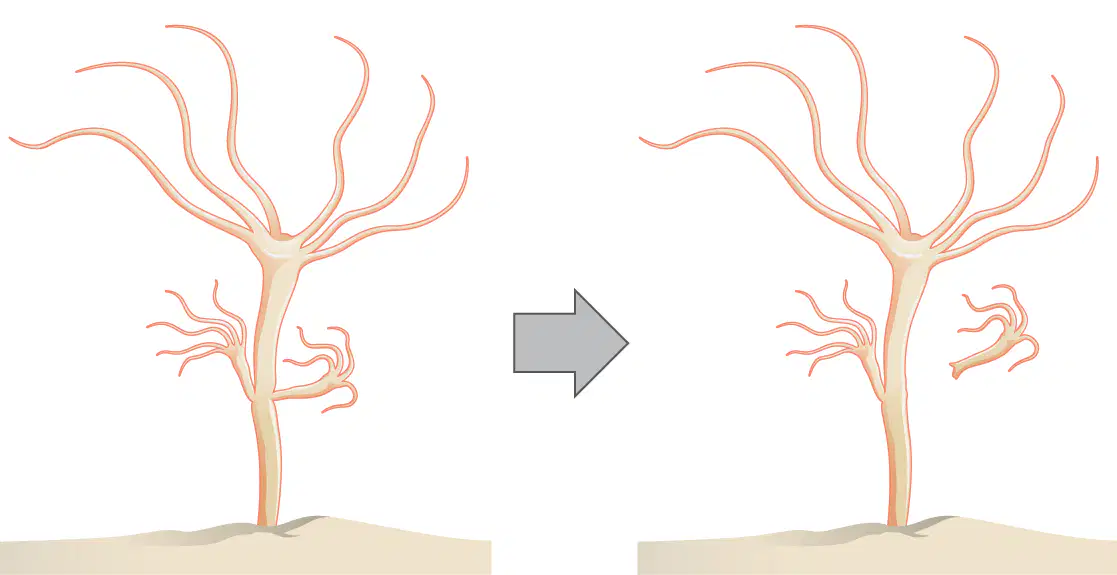
What are the 2 MAIN forms of reproduction?
a)
asexual reproduction
b)
fragmentation
c)
budding
d)
sexual reproduction
2.
Fragmentation is a type of...
a)
asexual reproduction
b)
sexual reproduction
3.
What do we call the type of allele that will ALWAYS show up in an organism?
a)
dominant
b)
recessive
4.
What is the term that describes the way an organism reacts to its internal or external conditions?
a)
stimlus
b)
behavior
c)
hormones
d)
adaptations
5.
What is the term for a behavior that is known without being taught?
a)
instinct
b)
behavior
c)
hormones
d)
adaptations
6.
What are the 2 goals that almost all animal behaviors help them to do?
a)
reproduce
b)
migrate
c)
survive
d)
fight
7.
Which one is an example of a courtship behavior?
a)
a peacock's feathers
b)
two male rams locking horns
c)
a walrus making clicking noises underwater
d)
a bird flying south for the winter
8.
What is the term for a chemical released by one animal to affect the behavior of another?
a)
hormone
b)
pheromone
c)
cologne
d)
water vapor
9.
What is one reason two animals may be aggressive toward one another?
a)
to migrate
b)
to help raise their young
c)
to mate
d)
to protect their territory
10.
There are some species of animals that are able to survive without help from their parents.
a)
true
b)
false
11.
What is the term for a regular seasonal journey of an animal from one place to another and back again?
a)
herding
b)
hibernation
c)
migration
d)
travel
12.
Some species will look after the young of other animals that do not belong to them.
a)
true
b)
false
13.
All plants reproduce the same way.
a)
True
b)
False
14.
What is one reason you see so much variety in different plant types?
a)
a lot of sun shine
b)
reproduction
c)
a lot of water
d)
special soil
15.
What is one way that human can control the traits of plants?
a)
playing music for them
b)
planting
c)
watering
d)
grafting
16.
Do gymnosperms have cones or flowers?
a)
cones
b)
flowers
17.
5. Which kind of cone holds the ovule?
a)
male
b)
female
18.
Which kind of cone holds the pollen?
a)
male
b)
female
19.
What is the female reproductive part of an angiosperm?
a)
septal
b)
pistil
c)
stamen
d)
pollen
20.
What is the male reproductive part of an angiosperm?
a)
septal
b)
pistil
c)
stamen
d)
pollen
21.
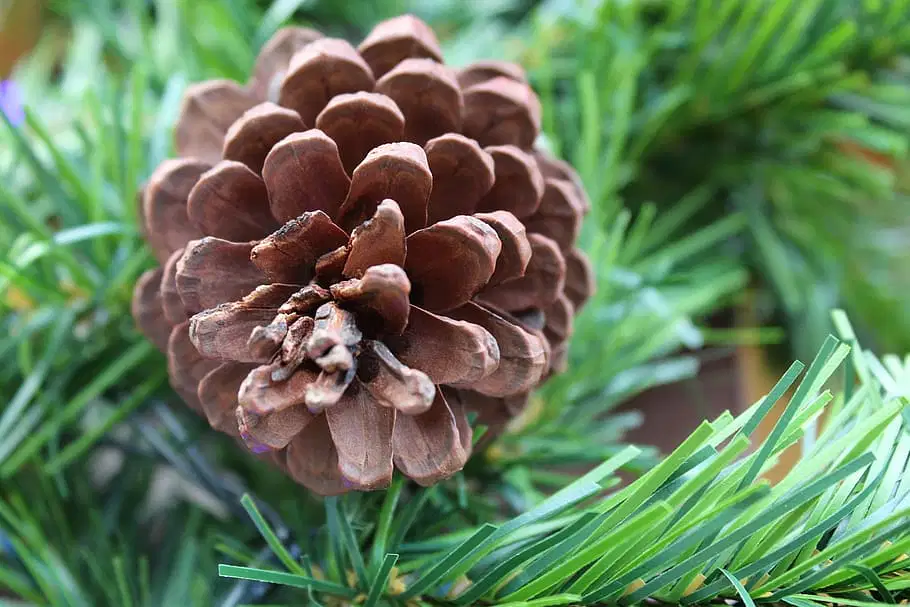
Is this a picture of an angiosperm or a gymnosperm?
a)
angiosperm
b)
gymnosperm
22.
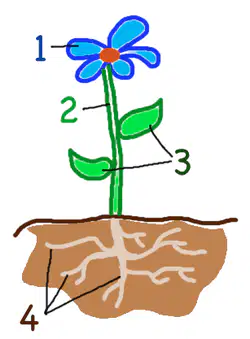
Is this a picture of an angiosperm or a gymnosperm?
a)
angiosperm
b)
gymnosperm
23.
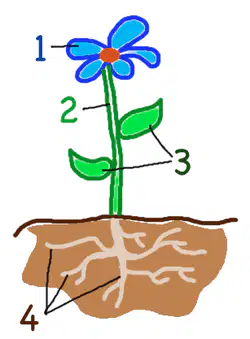
What part of the plant is #4?
a)
petal
b)
roots
c)
stem
d)
leaves
24.
What part of the plant is #2?
a)
petal
b)
roots
c)
stem
d)
leaves
25.
What do we call the type of allele that is HIDDEN in an organism?
a)
dominant
b)
recessive
26.
How do we show a recessive allele when we write a genotype?
a)
capital letter
b)
lowercase letter
c)
number
27.
How could you describe the genotype Bb?
a)
heterozygous
b)
homozygous
28.
What do we call a number that expresses how likely it is that an event will occur?
a)
heterozygous
b)
genotype
c)
probability/percent
d)
allele
29.
What do we call a model that can be used to predict genetic outcomes?
a)
Punnett Square
b)
flipping a coin
c)
probability
d)
heredity
30.
If your dad is 6 feet tall and your mom is 4 feet tall, that means you will be exactly 5 feet tall.
a)
true
b)
false
31.
What is are the possible genotypes for the punnett square below? Check all that apply.
a)
gg
b)
GG
c)
Gg
d)
green
e)
yellow
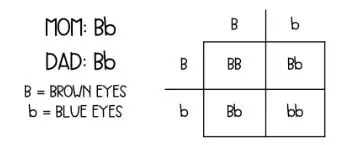
32.
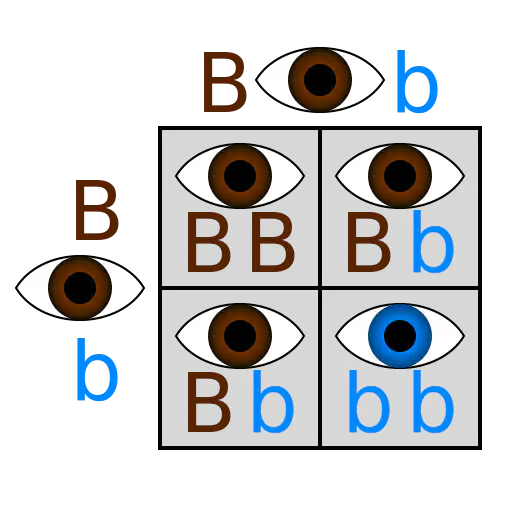
What are the possible phenotypes for the punnett square below? Check all that apply.
a)
BB
b)
Bb
c)
bb
d)
brown
e)
blue
33.
What is the probability that the offspring will be white?
a)
0%
b)
25%
c)
50%
d)
75%
e)
100%
34.
Check ALL of the possible genotypes of the offspring.
a)
brown
b)
BB
c)
Blue
d)
Bb
e)
bb
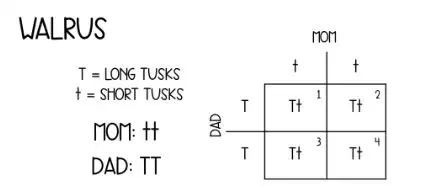
35.
What is the probability of the offspring having short tusks?
a)
0%
b)
25%
c)
50%
d)
75%
e)
100%
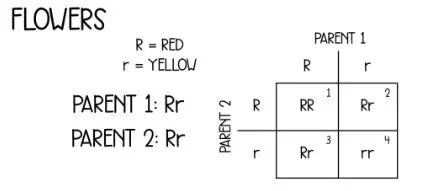
36.
What is the probability of the offspring having yellow flowers?
a)
0%
b)
25%
c)
50%
d)
75%
e)
100%
37.
What type of reproduction involves only 1 parent?
a)
asexual reproduction
b)
sexual reproduction
38.
What type of reproduction allows for more diversity of life?
a)
asexual reproduction
b)
sexual reproduction
39.
When an egg cell and a sperm cell are joined together, that is called:
a)
budding
b)
fragmentation
c)
fertilization
d)
cloning
40.
A specific characteristic that an organism can pass on to its offspring is called?
a)
gene
b)
trait
c)
species
d)
cloning
41.
A sequence of DNA that determines a trait is called:
a)
gene
b)
nucleus
c)
species
d)
cloning
42.
The process by which offspring receive genes from its parents is called:
a)
gene
b)
inheritance
c)
species
d)
cloning
43.
Where are your chromosomes located?
a)
allele
b)
RNA
c)
DNA
d)
gene
44.

What are the actions of animals called?

a)

Reactions

b)

Actions

c)

Behaviors

d)

None of These

45.

Which of these creatures go together and mimic the other? (pick 2)

a)
b)
c)
d)
46.

Click on all the animals that hibernate. (there are three)

a)
b)
c)
d)
47.

What would this beak be most useful for?

a)

cracking and eating seeds

b)

sipping nectar from tubular flowers

c)

ripping and tearing prey animals

d)

scooping and filtering water

48.

The male peacock uses these spectacular tail feathers in a display to try to attract the attention of females of the same species, and to try to find a mate. What is this called?

a)

hibernation

b)

migration

c)

courtship behavior

d)

territorial behavior

49.

The ability to blend in with one's environment.

a)

Mimicry

b)

Camouflage

c)

Adaptation

50.

Bears hibernating for the winter is _______ adaptation.

a)

Structural

b)

Behavioral

c)

Functional

51.

Birds flying south 800 miles to find food and to escape cold winters is an example of

a)

Hibernating

b)

Migrating

c)

Camouflage

52.

A green snake blends in so predators can NOT find it. This is an example of?

a)

Hibernation

b)

Mimicry

c)

Migration

d)

Camouflauge

53.

This animal is vertebrate or invertebrate?

a)

Invertebrate

b)

Vertebrate

54.

This animal is vertebrate or invertebrate?

a)

Vertebrate

b)

invertebrate

55.

This animal is vertebrate or invertebrate?

a)

Vertebrate

b)

Invertebrate

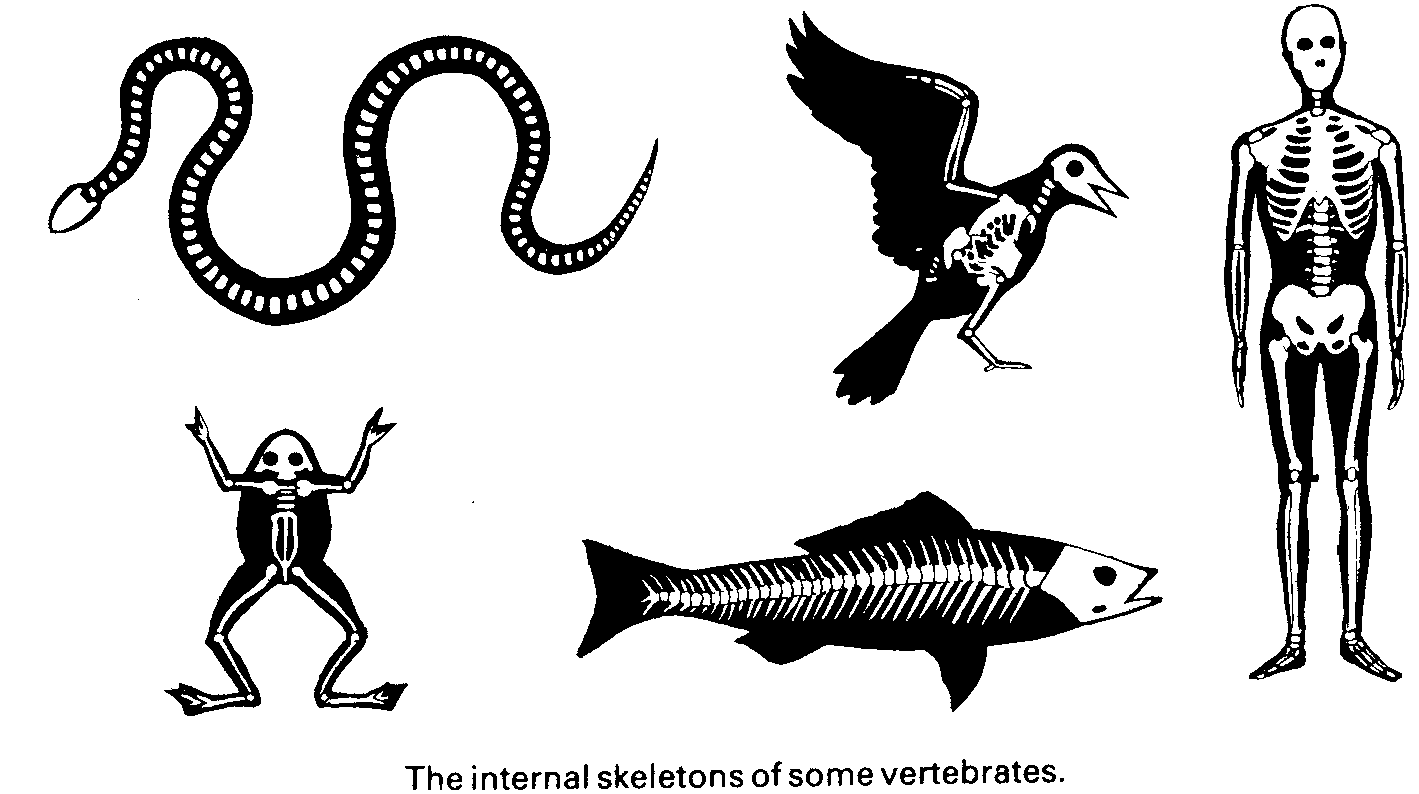
56.
All vertebrates have a ___________.
a)
last name
b)
tail
c)
backbone
d)
neck