
Font size
 Worksheets
Science Topic 5 lessons 3&4
Total questions: 86
Worksheet time: 5hrs 37mins
What is the part of the plant that protects the seeds? (choose 2 answers)
the flower
fruit
stem
roots

Classify the plant.
Flowering
Non-Flowering
Sara looks at the roots of a plant. What do the roots of a plant do?
They take in water from the ground.
They make food for the plant.
They take in sunlight.
Cones are found in which type of plant?
Ferns
Fruit trees
Mosses
Coniferous Trees

Non Flowering
Flowering
Owen looks at five plants. He classifies a fern, moss, and pine tree in one group. He classifies an orange tree and sunflowers in another group. Which characteristics did Owen use to classify the plants?
woody stems and soft stems
long, thin leaves and wide, round leaves
flowering plants and non-flowering plants
Plants that grow on rocks and plants that grow in soil

What type of plant is this?
Deciduous
Flowering
Evergreen
An example of a flowering plant is
a pine tree
an orange tree
a fern
moss
What type of plant is this?
Deciduous
Flowering
Evergreen

This plant produces cones instead of flowers.
True
False

Mark noticed the tree in his front yard has cones and needles. What conclusion can he draw about the tree?
It has flowers
It has fruit
It makes seeds
It makes spores
What is the name of trees that lose their leaves in the fall?
deciduous
spore
coniferous
invertebrate
What is the name of a tree that keeps their leaves all year long?
flowers
cone
deciduous
coniferous
Coniferous Forest


Which biome is the driest? It receives less than 10 inches of rain a year.
desert
grassland
deciduous forest
tropical rain forest
A plant that produces flowers with seeds is called a _________ _____?
non
flowering plant
coniferous
flower

Coniferous or Deciduous?
Coniferous
Deciduous

Coniferous or Deciduous?
Coniferous
Deciduous

Coniferous or Deciduous?
Coniferous
Deciduous

Coniferous or Deciduous?
Coniferous
Deciduous

Coniferous or Deciduous?
Coniferous
Deciduous

Coniferous or Deciduous?
Coniferous
Deciduous

Coniferous or Deciduous?
Coniferous
Deciduous

Coniferous or Deciduous?
Coniferous
Deciduous

Coniferous or Deciduous?
Coniferous
Deciduous

Coniferous or Deciduous?
Coniferous
Deciduous

Coniferous or Deciduous?
Coniferous
Deciduous
Which type of tree has cones as seeds?
Coniferous
Deciduous
Which type of tree has flowers as seeds?
Coniferous
Deciduous
Which type of tree are fruit trees?
Coniferous
Deciduous
Which type of tree are Evergreens?
Coniferous
Deciduous
The golden yellow color of a lion’s fur helps it bend into the African grasslands to help it hide from predators. This is an example of -
Mimicry
Camouflage
Dormancy
Migration
A behavior that an animal is born with
mimicry
Instinct
learned behavior
behavioral adaptation
Something that an animal does that helps it survive
instinct
physical adaptation
behavioral adaptation
learned behavior
An animal uses _____ to help it blend in with its environment.
camouflage
migration
shelter
hibernation
Some animals make a seasonal journey called ____ .
adaptation
migration
hibernation
mimicry
A trait that helps a plant or animal survive
instinct
adaptation
population
camouflage
A ____ is a group of organisms of the same kind that live in the same place.
instinct
adaptation
population
community
A ___ is an impression of an organism in a petrified form as a mold or rock.
claws
adaptation
fossil
hibernation
This is when an animal imitates (copies) the look of another animal.
Camoulage
Hibernation
Mimicry
Adaptation
Which of these shows an animal hibernating?


This is something that an animal does without needing to be taught.
learned behavior
instinct behavior
hunting
community

What would be a good title for this list of observations that a student made about animals?
Physical Adaptations
Types of Camouflage
Types of Populations
Behavioral Adaptations
Which of the following is a type of physical adaptation?
a baby deer standing shortly after birth
a bear hibernating in the winter
birds migrating as the seasons change
sharp claws on a tiger
In order to survive, animals act in different ways to gather and store food, find shelter, and ____.
defend themselves
form packs
migrate
save supplies
Which of these is NOT a basic need for all animals?
water
protection from predators
food
friends
Which of these birds can most likely swim?


A paleontologist studies _____
Ways that animals use adaptations to survive
The food that animals eat
How populations adapt to their environment
Fossil evidence to learn about the past
Which of the following is a learned behavior?
A baby duck following it's mother in the pond.
A bird flying south in the winter
A seal balancing a ball on it's nose.
A spider spinning a web to catch food.
The place where an organism lives in an ecosystem.
habitat
resource
adaptation
community
This is when an animal goes into a deep sleep causing it's body activity to slow down due to seasonal changes.
mimicry
migration
hibernation
camflage
What does behavior mean?
how an animal acts
what an animal eats
when an animal sleeps
where an animal lives
What is it called when an animal acts like another animal to survive?
prey
camouflage
mimicry
habitat
An animal needs a shelter for
hiding from its enemies
staying dry when it is raining
staying warm in the winter
all of the above
Long pointed teeth are an adaptation for an animal that eats
tree leaves
grass
meat
insects
Some animals have colors and shapes which allow them to blend into their environments. This is called _____.
mimicry
camouflage
hibernation
instinct
An ____________ is any body part, body covering, or behavior that helps keep an animal alive.
hibernation
migration
observation
adaptation
A behavior that an animal has at birth and does not need to learn:
habitat
instinct
learned behavior
body coverings
When animals travel from one are to another and back as the seasons change, they are _________.
migrating
hibernating
preying
growing
A bird will not eat a Viceroy butterfly because it looks like a Monarch butterfly. This is an example of ____.
Camouflage
Mimicry
Predators
Migration
Because birds eat different kinds of food, they have different kinds of __________.
feet
wings
nests
beaks
Check the four things animals need to live:
food
friends
air
water
shelter
When a dog knows how to do tricks like speak, shake, or roll over , it is called _________.
learned behavior
instinct
mimicry
physical adaptations
Which are examples of physical adaptations?
hibernation
sharp claws
playing dead to escape
heavy fur
large ears for cooling down
Which are examples of behavioral adaptations?
migration
hibernation
a curved beak
huddling in groups for warmth
camouflaged feathers
A tiger has striped fur. Why does it have this adaptation?
to look scarier to its prey
to blend in so it can sneak up on prey
to keep warm
to let other tigers know it is nearby
The collection of eight planets and their moons in orbit around the sun is known as the...
Solar System
Milky way
Universe
Galaxy
A system of millions or billions of stars, together with gas and dust, held together by gravitational attraction is considered a...
Milk way
Asteroid
Sun
Galaxy
The star at the center of the solar system is called the...
Super Star
Sun
Moon
Asteroid
Any massive self-luminous celestial body of gas that shines by radiation derived from its internal energy sources is called a...
Sun
Planet
Star
Asteroid
A large natural object that orbits or travels around stars is called a...
Planet
Asteroid
Rock
Moon
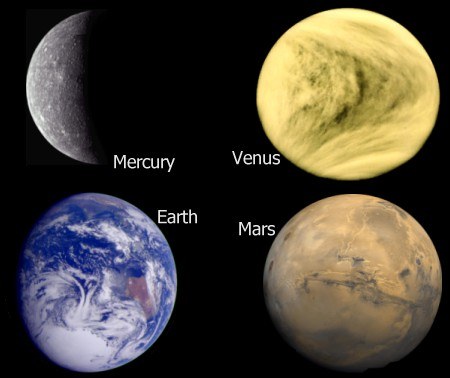


Which planet is closest to the sun?
Uranus
Mercury
Neptune
Earth

Which planet is third from the sun?
Mars
Pluto
Venus
Earth

One of the main differences between the outer and inner planets is __________.
The inner planets all have water
the inner planets are much bigger than the outer planets
the outer planets are gas planets
the outer planets have rings, and the inner planets don't

This planet is the same size as Earth and is the brightest of all planets.
Jupiter
Saturn
Venus
Mars
What is the only planet in our Solar System that life can survive on?
Neptune
Jupiter
Earth
Mars

What holds the planets in their orbits around the sun?
gravity
speed
string
air currents
What's the order of the outer planets
Jupiter, Pluto Saturn, Mars
Jupiter, Saturn, Uranus, Neptune
Mercury, Venus, Earth, Mars
Pluto, Mars, Saturn, Jupiter

How many days does it take the Earth to revolve around the Sun?
30 days
365 days
100 days
40 days

