wayground logo

Free Printable Worksheets

Font size

S
M
L
XL
Worksheets

Economics Final Exam Review

Total questions: 100

Worksheet time: 1hrs 20mins

Name
Class
Date
1.
This type of tax is one that increases the more money that you make
a)
Progressive
b)
Regressive
c)
Proportional
d)
Alternative
2.
Which item works as a compliment for Pizza?
a)
Breadsticks
b)
Phone Charger
c)
Cheeseburger
d)
Tacos
3.
Which of the following is not a factor that impacts change in demand?
a)
Consumer Income
b)
Consumer Tastes
c)
Number of Consumers
d)
Production Possibilities
4.
Which of these industries has the least elastic supply curve?
a)
the toy industry
b)
the nuclear industry
c)
the automobile industry
d)
the entertainment industry
5.
Which of the following causes prices to change?
a)
Changes in Demand
b)
Competitive Markets
c)
Changes in Supply
d)
All of the above.
6.
Which of the following is not one of the three necessary conditions of pure competition?
a)
Very large number of buyers/sellers
b)
Perfect mobility of resources
c)
Identical products
d)
Freedom of entry/exit
7.
What is the opportunity cost of a decision?
a)
the series of alternative decisions that could have been made
b)
the best possible way the question could have been decided
c)
the different ways that a different person might have made the decision
d)
the most desirable alternative given up for the decision
8.
What incentive do manufacturers have to sell their products?
a)
making profits on sales
b)
pleasing the consumer
c)
putting others out of business
d)
popularity of the product
9.
What is a compliment?
a)
A good that you buy to go with another good
b)
A nice thing you tell others
c)
A good that you use to replace a good
d)
A good that is replaced by a better quality good.
10.
What is a change in supply
a)
When the Supply Curve shifts to the left or right
b)
When the point on the supply curve goes up or down the curve
c)
When you exchange one good for another
d)
When you buy a new phone and sell your old one
11.
What determines the price and the quantity produced of most goods?
a)
the consumer’s perception of necessity
b)
the interaction of supply and demand
c)
the availability of substitutes for the goods
d)
the quality of the goods that are produced
12.
The Law of Supply states that as ______ goes up then _____ goes up
a)
Price, Supply
b)
Price, Demand
c)
Supply, Demand
d)
Demand Supply
13.
Select All of the Different Market Structure
a)
Pure Competition
b)
Monopolistic Competition
c)
Oligopoly
d)
Monopoly
e)
Tripoli
14.
What is inflation
a)
The rising price of goods and services measured over time
b)
The declining price of goods and services measured over time
c)
The rate at which stocks go up
d)
Where the federal reserve floats away
15.
The resources used to make all goods and services are the
a)
production possibilities.
b)
factors of production.
c)
production trade-offs.
d)
opportunity costs.
16.
What is the term for the total value of all goods and services produced in a particular country's economy?
a)
net worth
b)
open market value
c)
gross domestic product
d)
standard of living
17.
Which of the following is NOT a key economic question?
a)
What goods and services should be produced?
b)
How should these goods and services be produced?
c)
Who consumes these goods and services?
d)
How should it be ensured that goods and services are paid for?
18.
What are the Four Factors of Production?
a)
Land
b)
Labor
c)
Capital
d)
Entrepreneurs
e)
Plants
19.
What is the function of an economic system?
a)
to make sure all people have equal access to goods
b)
to produce and distribute goods and services
c)
to give all producers the same access to consumers
d)
to make sure people are paid for their labor
20.
What are some of the ways Unions try to gain better benefits and wages
a)
Striking
b)
Collective Bargining
c)
Boycott
d)
All of the Above
21.
What is the effect of import restrictions on prices?
a)
They cause prices to rise.
b)
They cause prices to drop.
c)
They often cause prices to rise steeply and then drop.
d)
They usually do not have any lasting effect on price.
22.
Select all of the reasons as to why a nation would want to limit trade to other countries. Select three.
a)
To protect the nation
b)
To protect growing industries
c)
To avoid a trade deficit
d)
To protect local jobs and money
e)
To protect the world from their goods
23.
Which of the following is an example of currency being divisible
a)
Cutting up money
b)
Having monetary value that you can divide by 7
c)
Breaking down money into smaller units of currency
d)
None of the Above
24.
Who has the power to raise or lower interest rates?
a)
The President
b)
Federal Open Market Committee (FOMC)
c)
The Senate
d)
Consumers
25.
Which of these fiscal policies focus on the people and providing them safety nets like unemployment
a)
Mixed Side
b)
Supply Side
c)
Demand Side
d)
None
26.
Which of the following is one way the Federal Reserve Bank serves the government?
a)
making loans to the government
b)
selling government securities
c)
minting coins for the government
d)
financing state government projects
27.
What is the purpose of the Federal Deposit Insurance Corporation (FDIC)?
a)
to make sure that banks do not fail
b)
to make sure that customers do not lose money if a bank fails
c)
to make sure that banks charge a fair amount of interest on loans
d)
to make sure that the government has enough gold to cover its expenses
28.
A ______ Market is when stock prices go up, A ________ market is when Stock Prices go Down
a)
Bull, Bear
b)
Bear, Bull
c)
Penguin, Bear
d)
Penguin, Bull
29.
What is the interest the Fed charges on loans to financial institutions?
a)
Discount Rate
b)
Force Rate
c)
Tender Rate
d)
Real Rate
30.
Which of the following is included when measuring GDP?
a)
Second Hand Sales
b)
Non-market Transactions
c)
Intermediate Products
d)
Final Products
31.
What are the financial intermediaries?
a)
Banks/Credit Unions
b)
Life insurance
c)
Retirement Funds
d)
Finance Companies
e)
FDIC
32.
Which of the following intermediaries is a fund that collects and invests income until payments are made to people when they retire?
a)
Credit Union
b)
Cooperative
c)
Bank
d)
Pension Fund
33.
Which of the following is used to track daily changes in stock prices?
a)
Leading Economic Indicators
b)
Dow Jones Industrial Average (DJIA)
c)
Econometric Models
d)
Speculation
34.
Which of the following is not a consequence of inflation?
a)
Reduced Purchasing Power
b)
High Demand for Scarce Resources
c)
Encouraged Speculation
d)
Distorted Distribution of Income
35.
What is the biggest expenditure of Tax Revenue in America?
a)
Medicare/Social Security
b)
Education
c)
Infastructure
d)
Finances
36.
________ Is when the government spends more money than it makes and so it needs to borrow.
a)
Deficit
b)
Lag spending
c)
Late Spending
d)
Pork
37.
What are the goods and services that a nation buys from other nations?
a)
Imports
b)
Exports
c)
Embargo
d)
Opportunity Cost
38.
What type of advantage does a county have if it is able to produce more goods than another?
a)
Relative Advantage
b)
No Advantage
c)
Absolute Advantage
d)
Comparative Advantage
39.
What type of advantage does a country have if it can produce goods relatively more efficiently than another country?
a)
Relative Advantage
b)
No Advantage
c)
Absolute Advantage
d)
Comparative Advantage
40.

Opportunity Cost is...

a)

giving up one benefit to gain a greater benefit

b)

losing money on an investment

c)

a resource

d)

the communication of economic information

41.

Which is NOT a factor of production

a)

Land

b)

Capital

c)

Industry

d)

Labor

42.

A consumer good is...

a)

a good that is used to produced a good or service

b)

a good that is intended to be used by a consumer as its final use

c)

a good that consumers use to create products

d)

a good that is always sold in stores

43.

which of these is not a market structure?

a)

monopoly

b)

pure competition

c)

oligopoly

d)

capitalism

44.

There are four different types of unemployment and they each affect the economy differently

a)

true

b)

false

45.

Extras that make life more enjoyable

a)

need

b)

want

c)

savings

46.
A general increase in prices
a)
price
b)
inflation
c)
scarcity
d)
demand
47.
Something we use from nature
a)
natural resource
b)
human resource
c)
capital resource
d)
entrepreneur
48.

the mutual exchange of goods and services for mutual gain

a)

Scarcity

b)

Opportunity Costs

c)

Trade

d)

Comparative Advantage

49.

Which of the following would be an impact of the image?

a)

Increased staff sizes

b)

Decreased capital

c)

Increased productivity

d)

Decreased efficiency

50.

Economics:

a)

economic problem facing all societies resulting from a combination of scarce resources and people’s virtually unlimited needs and wants 

b)

basic requirement for survival, including food, clothing, and shelter

c)

tangible economic product that is useful, transferable to others, and used to satisfy wants and needs

d)

social science dealing with how people satisfy seemingly unlimited and competing needs and wants with the careful use of scarce resources

51.

Cost-benefit anaylsis:

a)

market in which goods and services are bought and sold simplified version of complex concept or behavior expressed in the form of a graph, figure, quation, or diagram 

b)

comparison of the cost of an action to its benefits

c)

gross domestic product on a pre person basis; can be expressed in current or constant dollars

d)

conversion of state-owned factories and other property to private ownership

52.

What is a Savings Account?

a)

Where an investor pools together several people's money and invests it in stocks and bonds. Good if you don't have the money to diversify and want to make more money than a CD or savings account.

b)

Where you can deposit your money into a bank. You earn a small amount of interest off this investment method. You can access your money, but the bank will penalize you if you withdraw from it too much.

c)

You own part of a company. You may earn a dividend where you get part of the company's prot. You want to buy this when the price is low and sell when it's high.

d)

Where you can deposit your money into a bank for a specied amount of time to earn a higher amount of interest. You cannot touch your money during the time it is invested this way.

53.

A producer wants to....

a)

supply goods while charging the lowest price

b)

buy goods while paying the lowest price

c)

supply goods while charging the highest price

d)

buy goods while paying the highest price

54.

During economic crisis, the primary role of the Federal Government is to promote a healthy economy by...

a)

controlling the budget

b)

setting spending levels

c)

manipulating taxes and government spending

d)

loaning out money

55.

What is the purpose of Fiscal Policy?

a)

contribute to economic growth and stability

b)

keep rich people from getting too rich

c)

functions exactly like Fiscal Policy

d)

give Congress and the political parties more control of the economy

56.

Fiscal Policy is controlled by...

a)

The Government

b)

The Federal Reserve System

c)

The states

d)

The Department of Commerce

57.

What makes up the largest area of government spending?

a)

Food Stamps

b)

Medicare

c)

Social Security

d)

Interest payments

58.

Fiscal policy is actions taken by ______________ to stabilize the economy.

a)

The federal Reserve

b)

The Air force

c)

the government

d)

Wall street

59.

Under pure competition, products are

a)

always cheap

b)

differentiated

c)

accurately priced

d)

identical

60.

The game console industry is an example of which market structure?

a)

Monopoly

b)

Pure Competition

c)

Oligopoly

d)

Monopolistic competition

61.

A price floor...

a)

would be below the equilibrium

b)

would be at the equilibrium

c)

would be above the equilibrium

62.

A price ceiling...

a)

would be below the equilibrium

b)

would be at the equilibrium

c)

would be above the equilibrium

63.

The physical place where buyers and sellers meet to trade stocks is known as the

a)

brokerage desk

b)

stock or securities exchange

c)

trading floor

d)

equities trader

64.

A mean market when prices move down for several months or years in a row is known as a

a)

bull market

b)

bear market

65.

A strong market with prices moving up for several months or years in a row is known as a

a)

bull market

b)

bear market

66.

What is the index of 30 representative stocks used to monitor changes in the overall stock market

a)

New York Stock Exchange

b)

Euronext

c)

Bear Market

d)

Dow Jones Industrial Averages

67.
EP?
a)
$2
b)
$4
c)
$6
d)
$8
68.
How many animals are demanded at $5?
a)
0
b)
20
c)
60
d)
90
69.
The degree to which the quantity demanded responds to changes in price is called
a)
elasticity
b)
revenue
c)
schedule
d)
utility
70.
True or False:
Strikes during the Industrial Revolution were always peaceful.
a)
True
b)
False
71.
What did workers want when they went on strike?
a)
Higher wages
b)
Better working conditions
c)
Fewer hours 
d)
All of the above
72.
What typically happened to individual employees who complained about working conditions?
a)
They were given a pay raise
b)
They were promoted
c)
They were fired
d)
They quit their jobs
73.
Why did labor unions first form?
a)
To protect the rights of business owners
b)
To protect the rights of workers
c)
To protect the rights of customers
d)
Allof the above
74.

Nonunion workers hired to do the jobs of striking workers

a)

Strikebreaker

b)

Injunction

c)

Grievance

d)

Boycott

75.

Mr. Sherman goes to the ticket booth to buy tickets for a Lakers game. Mr. Sherman is told that the game is sold out and no tickets are available. Which best explains why there are no basketball tickets available? 

a)
The arena forgot to print enough tickets.
b)
The supply of tickets was greater than the demand.
c)
The arena charged too much money for each ticket.
d)
The demand for tickets was greater than the supply.
76.

Which statement expresses a central idea of how the laws of supply and demand work?

a)

The government sets the prices for goods and services.

b)

Prices are determined by the interaction of producers and consumers.

c)

Consumers alone determine the prices for goods and services.

d)

Technology dictates the prices charged for goods and services.

77.

goods and services PURCHASED from other countries

a)

Imports

b)

Exports

c)

Absolute Advantage

d)

Comparative Advantage

78.

goods and services SOLD to other countries

a)

Imports

b)

Exports

c)

Absolute Advantage

d)

Comparative Advantage

79.

occurs when a country possesses unique resources or capabilities allowing for the lowest cost of production for a product

a)

Absolute Advantage

b)

Exports

c)

Imports

d)

Comparative Advantage

80.

occurs when a country is able to produce a product more efficiently and at a lower cost than another country

a)

Comparative Advantage

b)

Absolute Advantage

c)

Exports

d)

imports

81.

Who is in charge of Monetary Policy

a)

The Government

b)

The Federal Reserve System

c)

The states

d)

The Department of the Treasury

82.
Which of these is NOT a monetary policy tool?
a)
Discount rate
b)
Balance Accounts
c)
Open Market Operation
d)
Reserved Requirements
83.

An expansionary policy means that the Fed is attempting to

a)

increase the size of the nation's money supply

b)

decrease the size of the nation's money supply

84.

A contractionary policy means that the Fed is attempting to

a)

increase the size of the nation's money supply

b)

decrease the size of the nation's money supply

85.

Which policy would help fight inflation?

a)

Expansionary

b)

Contractionary

86.

Which policy would help fight unemployment?

a)

Expansionary

b)

Contractionary

87.

Who controls fiscal policy?

a)

The Federal Reserve

b)

The Federal Government

c)

The FBI

d)

Federal Income Tax

88.

What is the purpose of Fiscal Policy?

a)

contribute to economic growth and stability

b)

keep rich people from getting too rich

c)

functions exactly like Fiscal Policy

d)

give Congress and the political parties more control of the economy

89.

During economic crisis, the primary role of the Federal Government is to promote a healthy economy by...

a)

controlling the budget

b)

setting spending levels

c)

manipulating taxes and government spending

d)

loaning out money

90.

Which of the following scenarios would cause the nation’s money supply to increase?

a)

Decreasing government spending

b)

Raising interest rates

c)

Selling bonds to investors

d)

Decreasing Taxes

91.

Deficit Spending:

a)

If the Government decreases spending without decreasing taxes they will decrease the annual deficit and the national debt.

b)

If the Government increases spending without increasing taxes they will increase the annual deficit and the national debt.

92.

when annual government spending and transfer payments are greater than tax revenue.

a)

Budget Deficit

b)

Budget Surplus

c)

National Debt

d)

Global Debt

93.

when annual government spending and transfer payments are less than tax revenue.

a)

Budget Deficit

b)

Budget Surplus

c)

National Debt

d)

Global Debt

94.

The Business Cycle measures ___ over time.

a)

wealth

b)

inflation

c)

economic growth

95.

A trend line will show-

a)

an increase in Real GDP over time.

b)

only economic recessions.

c)

only economic expansions.

96.

The business cycle rises above the trendline during-

a)

rescessions

b)

expansions

c)

troughs

97.

GDP declines during a(an)

a)

peak

b)

contraction

c)

expansion

98.

Economic recovery begins-

a)

above the trend line

b)

at the end of a recession (trough)

c)

at the "boom" period

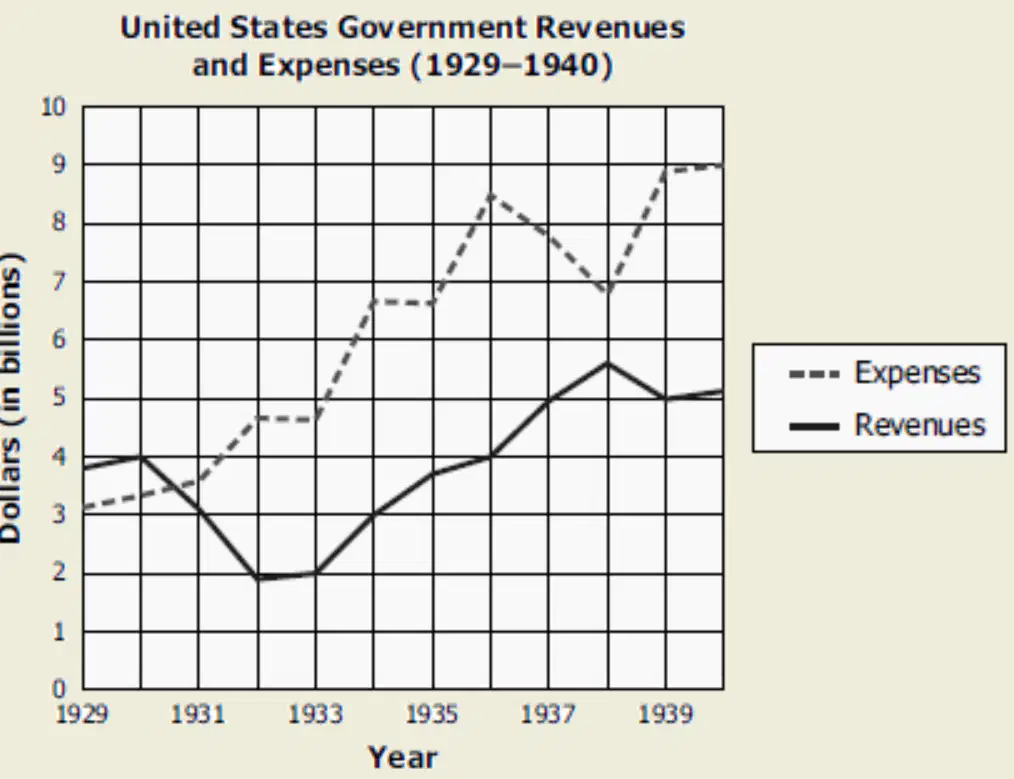
99.

This graph shows that from 1931 to 1939, the...

a)

government received more money than was spent.

b)

amount of money spent decreased every year.

c)

government spent more money than it received.

d)

amount of money collected increased every year.

100.
GDP is calculated by
a)
adding up the cost of goods used in producing the item
b)
subtracting all costs from total revenue
c)
adding consumption + investment +government spending+ (exports sold - imports bought)