
 Worksheets
WORLD HISTOY II FINAL EXAM
Total questions: 69
Worksheet time: 35mins
Who is the founder of Judaism?
Jesus
Abraham
David
Moses
Who is the founder of Buddhism?
Abraham
Muhammad
Asoka
Siddhartha Gautama
What about Jesus do Christians not believe?
The New Testament contains the teachings of Jesus
His teachings complete those of Judaism and Islam
He was the Son of God
He is known as the messiah, or savior
How did Buddhist teachings spread from India?
Chinese traders were converted to Buddhism
Buddhist missionaries were sent out by Asoka into Asia
Ancient writings were found along the Silk Road
Indian invaders into China forced the people to adopt the Buddhist religion
Who is the founder of Islam?
Abraham
Jesus
Muhammad
Siddhartha
Who sculpted the statue of David and painted the ceiling of the Sistine Chapel?
Leonardo
Raphael
Donatello
Michelangelo

In addition to his paintings, The Last Supper and Mona Lisa, this artist was known as the “Renaissance Man” for his inventions, contributions, and vision.
Leonardo da Vinci
Michelangelo
Raphael
Donatello

The above characteristics depict what Renaissance writer?
Machiavelli
Erasmus
William Shakespeare
Thomas More
What is Machiavelli’s book that advises rulers on how to obtain, maintain and use power?
Utopia
The Praise of Folly
The Prince
King Lear
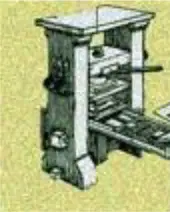
One impact of the invention below was the increase of the sale of books and literacy. Who was the inventor?
Johannes Gutenberg
James Watt
Eli Whitney
William Harvey
What was the South American empire that was conquered by the Spanish led by Francisco Pizarro?
Inca
Aztec
Olmec
Maya
What was the name of the Islamic empire in northern India that was responsible for the building of the Taj Mahal?
Ottomans
Songhai
Indians
Mughals

The above characteristics depict what civilization?
ottomans
mughals
china
What was the empire located in modern-day Mexico that was conquered by the Spanish led by Cortez?
Inca
Aztec
Olmec
Maya
What was the Islamic empire that controlled the gold-salt trade in West Africa?
Ottomans
Songhai
Mughals
Maya

The above characteristics depict what civilization?
Japanese
Ottomans
Chinese
Mughals

Which of the following expressed the views identified in the above box?
John Calvin
King Henry VIII
John Tetzel
Martin Luther
Who was the English monarch that broke from the Catholic Church and took the title “head of the Church of England”?
Elizabeth I
Peter the Great
Henry VIII
Charles I

Which of the following expressed the views identified in the above box?
John Calvin
King Henry VIII
John Tetzel
Martin Luther
Who was the head of the Anglican Church in England who was tolerant towards dissenters?
Elizabeth I
Peter the Great
Henry VIII
Charles I
Who was the French Catholic official known for refocusing the Thirty Years’ War from religious to political?
Pope Leo
Cardinal Richelieu
King Louis XIV
John Calvin
Which of the following explorers traveled to India by an all sea route under the Portuguese flag?
Jacques Cartier
Francisco Pizarro
Ferdinand Magellan
Vasco da Gama

The pioneering role of Prince Henry the Navigator is best described in which of the following statements?
He discovered the western hemisphere while looking for asia
he established trading post along the silk road.
he set up a school in portugal to teach navigation
he sent out missionaries to convert native americans to the protestant faith
Who was the French navigator and explorer who claimed Canada for France?
Vasco da Gama
Ferdinand Magellan
Francis Drake
Jacques Cartier
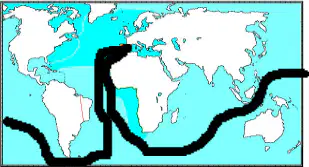
Whose crew from Spain was the first to circumnavigate the world?
Vasco da Gama
Ferdinand Magellan
Francis Drake
Jacques Cartier
What was Johannes Kepler's contribution to science?
development of the heliocentric theory
discovery of the laws of gravity
use of the telescope to support the heliocentric theory
discovery of planetary motion
What is William Harvey known for discovering?
circulation of the blood
chemical interactions
heliocentrism
gravitation
What was Peter the Great's contribution to Russia?
replacing the Orthodox Church with the Roman Catholic Church
bringing Western ideas to Russia
eliminating the influence of the nobility in political affairs
expanding the rights of all Russians
Who developed the laws of gravity and motion?
Galileo Galilei
Johannes Kepler
William Harvey
Isaac Newton
Who was the "Sun King" in France who claimed his power was divine right and had the Palace of Versailles built?
Peter the Great
Louis XIV
Frederick the Great
Louis XVI
What scientist supported the heliocentric theory using the telescope he invented, and was later put on house arrest by the Catholic Church for his "heretical views"?
Galileo
Copernicus
Kepler
Harvey
Who introduced the theory that the sun was the center of the universe, not the earth?
Galileo Galilei
Nicolas Copernicus
Johannes Kepler
Isaac Newton
Which of the following men was significant in the independence movements of South American countries such as Bolivia and Venezuela?
Toussaint L'Ouverture
Marquis de Lafayette
Simon Bolivar
Napoleon Bonaparte
What was the result of the Glorious Revolution in England?
the execution of Charles I
the military dictatorship of Oliver Cromwell
William and Mary taking the throne and an end to absolutism
James II reclaiming the throne and dissolving the Parliament
Influenced by the American and French Revolutions, what former slave led a successful revolt in Haiti against the French government?
Toussaint L'Ouverture
Marquis de Lafayette
Simon Bolivar
Napoleon Bonaparte
Who established a military dictatorship after the French Revolution and established a code of laws that is the basis of modern European laws today?
Oliver Cromwell
Napoleon Bonaparte
Louis XVI
Klemens von Metternich
Who helped to start the independence movement in Mexico from Spain's control with a speech at a church?
Klemens von Metternich
Simon Bolivar
Napoleon Bonaparte
Father Miguel Hidalgo
What was the result of the English Civil War?
The execution of the Puritan military general, Oliver Cromwell
the invasion of England by Mary and William of Orange from the Netherlands
the execution of Charles I and the beginning of a military dictatorship
the establishment of the first political parties, the Roundheads and the Cavaliers
From which Enlightenment thinker did our Founding Fathers borrow the idea of a "separation of powers" and a three-branch government, and wrote the Spirit of Laws?
John Locke
Thomas Hobbes
Baron von Montesquieu
Jean Jacques Rousseau
Whose ideas of "life, liberty, and property" influenced the author of the Declaration of Independence and wrote Two Treatises of Government?
John Locke
Thomas Hobbes
Baron von Montesquieu
Jean Jacques Rousseau
Who advocated absolute and central government and wrote the Leviathan?
John Locke
Thomas Hobbes
Baron von Montesquieu
Jean Jacques Rousseau
What French philosopher advocated religious tolerance and the separation of church?
Montesquieu
Voltaire
Rousseau
L'Ouverture
By the late 1700's, the Enlightenment influenced the arts, including what writer of Don Quixote?
Miguel de Cervantes
Voltaire
Eugene Delacroix
Johann Sebastian Bach
Who are two Enlightenment era composers?
Mozart and Bach
Voltaire and Hobbes
Delacroix and Beethoven
Robespierre and Locke
What French artist who painted Liberty Leading the People?
Mozart
Voltaire
Delacroix
Bach
Who led the kingdom of Sardinia in the unification of northern Italy?
Count Cavour
Otto von Bismarck
Giuseppe Garibaldi
Napoleon Bonaparte
Which leader used war and the appeal to nationalistic feelings to unify Germany?
Camillo di Cavour
Kaiser Wilhelm I
Giuseppe Garibaldi
Otto von Bismarck
Who is best known for his contributions towards steam engine capability in factories and faster transportation?
Henry Bessemer
James Watt
Eli Whitney
John Kay
Which inventor improved the process for making steel?
John Kay
Eli Whitney
Edward Jenner
Henry Bessemer
Who wrote the Wealth of Nations, defending capitalism and free markets?
Adam Smith
Karl Marx
Friedrich Engels
John Locke
Whose invention of the cotton gin increased the demand for American slavery?
Henry Bessemer
James Watt
Eli Whitney
John Kay
Who discovered the presence of bacteria and developed the process of pasteurization?
Louis Pasteur
Henry Bessemer
Edward Jenner
James Watt
What person is known as the father of communism and wrote Communist Manifesto and Das Kapital?
Adam Smith
Karl Marx
Friedrich Engels
John Locke
Who developed the first vaccine for smallpox?
Louis Pasteur
Henry Bessemer
Edward Jenner
James Watt
What was the event that triggered World War I?
the refusal of Russian Czar Nicholas II to assist the German war effort
the assassination of Franz Ferdinand of Austria-Hungary
the election of a communist leader in France
a German blockade of Britain
What American president created the Fourteen Points after World War I to promote peace?
Nicholas II
Wilhelm II
Woodrow Wilson
Winston Churchill
Who was the Tsar of Russia during World War I?
Wilhelm II
Alexander III
Otto von Bismarck
Nicholas II
Who was the leader of the Bolsheviks during the Russian Revolution and the first Communist leader of the USSR?
Leon Trotsky
Joseph Stalin
Vladimir Lenin
Mikhail Gorbachev
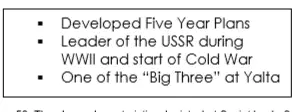
The above characteristics depict what Soviet leader?
Leon Trotsky
Joseph Stalin
Vladimir Lenin
Mikhail Gorbachev
Who was the Fascist dictator of Italy during the 1930's and early 40's?
Adolf Hitler
Benito Mussolini
Josef Stalin
Giuseppe Garibaldi
Who was the US general who devised the D-Day invasion and later became an American president?
Woodrow Wilson
Franklin D. Roosevelt
Douglas MacArthur
Dwight D. Eisenhower
Who was the Japanese military leader during World War II?
Hirohito
Hideki Tojo
Adolf Hitler
Benito Mussolini
Which American president was responsible for the dropping of the atomic bombs in Japan and developed the theory of containment?
Woodrow Wilson
Franklin D. Roosevelt
Harry Truman
Dwight D. Eisenhower
Who was the British prime minister during World War II?
Neville Chamberlain
George Marshall
Douglas MacArthur
Winston Churchill
Who led the Indian independence movement against the British using nonviolence?
Jomo Kenyatta
Mao Zedong
Mohandas Gandhi
Ho Chi Minh
Who developed the economic plan to rebuild Europe after World War II?
Dwight D. Eisenhower
George Marshall
Douglas MacArthur
Winston Churchill
Who was the communist leader of Cuba during the Cuban Missile Crisis?
Mao Zedong
Fidel Castro
Jomo Kenyatta
Mohandas Gandhi
Jomo Kenyatta led the violent independence movement against the British in what African country?
Algeria
South Africa
Kenya
Egypt
The above terms describe what 20th century leader? - Chinese Civil War 1945-49 - Communist leader of China - "Cultural Revolution"
Chiang Kai-Shek
Ho Chi Minh
Mikhail Gorbachev
Mao Zedong

