
 Worksheets
HOMS Review: Changes in Matter
Total questions: 70
Worksheet time: 1hrs 28mins
A _________ is formed when two or more elements combine chemically.
element
compound
mixture
A formula is used to represent a __________.
element
compound
mixture
A ____________ is a combination of many different elements not chemically combined.
element
compound
mixture
A _______ is the smallest particle in an element or compound.
atom
molecule
symbol
H2O
element
compound
mixture
CO2
element
compound
mixture
Au
element
compound
mixture
Mud
element
compound
mixture
NaCl
element
compound
mixture
A __________ is the smallest particle in a chemical element or compound. It is made up of two or more atoms.
molecule
element
atom

How would you classify the matter in the picture above?
Element
Compound
Homogeneous Mixture
Heterogeneous Mixture

How would you classify the matter in the picture above?
Element
Compound
Homogeneous Mixture
Heterogeneous Mixture

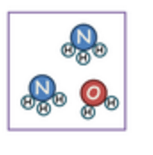

What type of substance is being modeled here?
Element
Compound
Homogeneous Mixture
Heterogeneous Mixture

What type of substance is being modeled here?
pure substance of one element
mixture of two elements
mixture of two compounds
pure substance of one compound


A chemical property describes how matter __________.
smells
reacts with another type of matter
looks under a microscope
dissolves when made into a solution

Is this an example of a physical or chemical change?
physical
chemical
Rusting metal is an example of a ____ change.
chemical
phase
state
physical
What happens in EVERY chemical change?
A gas is produced.
A temperature change occurs.
At least 3 substances combine
A new substance is formed.
A teacher is demonstrating physical and chemical changes to her class. Which action should they use to demonstrate a chemical change?
Cutting a piece of paper with scissors.
Folding a piece of paper into an airplane.
Ripping a piece of paper with their hands.
Burning a piece of paper with a match.


Select the chemical change.
grounding flour
melting crayons in the sunshine
fireworks exploding
roads expanding when its cold

The solution below is...
An Element
A compound
A mixture of element and element molecules
A mixture of two elements

The solution below is...
An element
A compound
A mixture of a compound and a element
A mixture of two compounds

The solution below is...
An element
A compound
A mixture of a compound and a element
A mixture of two compounds

The solution below is...
An element
A compound
A mixture of a compound and a element molecule
A mixture of two compounds

The solution below is...
An element molecule
A compound
A mixture of a compound and a element
A mixture of two elements
One of the signs of a chemical reaction taking place is:
Bubbles are produced
Reactants are not combining
Products are not forming
Color is not changing
Which is NOT an indication of a chemical change?
temperature change
formation of a precipitate
shape change
production of light
Which of the following is an example that includes evidence of a chemical reaction?
A sample of zinc is placed in water and it settles to the bottom
A solid block of ice is heated and it completely melts into a liquid.
Sugar that is burned gives off an odor and turns brown and then black.
A tomato is placed into a blender and chopped up into smaller pieces.
In NH3, how many Nitrogen's are there?
1
2
3
4

Does this equation follow the law of conservation of mass?
Yes
No
Sometimes
According to the law of conservation of mass, which statement is true?
The atoms of the reactants and products are different
The atoms of the reactants and products are equal
The subscripts must be the same
The compounds must be the same

Does this follow the law of conservation of mass?
Yes, because there are the same number of atoms.
Yes, because there are not the same number of atoms.
No, because there are the same number of atoms.
No, because there are not the same number of atoms.

Does this equation follow the law of conservation of mass?
Yes, because the mass is the same.
Yes, because the mass is not the same.
No, because the mass is the same.
No, because the mass is not the same.
Which equation follows the law of conservation of mass?
Na + Cl2 --> NaCl
Na + Cl2 --> 2NaCl
2Na + Cl2 --> NaCl
2Na + Cl2 --> 2NaCl
10g of H2 + 20 g of Cl2 --> 30 g of 2HCl. What are the products?
H2 + HCl
H2 + Cl2
HCl
Cl2 + HCl
In 6CO2, identify the subscript.
C
O
6
2
In 6CO2, identify the coefficient.
C
O
6
2
This chemical equation represents what happens when a nail rusts: 4Fe + 3O2 –› 2Fe2O3. The total mass after the reaction is
not considered before the reaction.
5 times less than before the reaction.
exactly the same as before the reaction.
about twice as much as before the reaction.
Iron chloride is formed when 44 g of iron and 56 g of chlorine react completely. What is the expected mass of iron chloride?
12 g
44 g
56 g
100 g
What are the products in the following chemical equation?
NaCl + AgF → NaF + AgCl
NaCl, NaF
NaCl, AgF
NaF, AgCl
AgF, AgCl
What are the reactants in the following chemical equation?
NaCl + AgF → NaF + AgCl
NaCl, NaF
NaCl, AgF
NaF, AgCl
AgF, AgCl
When acetic acid and baking soda are mixed together, carbon dioxide, water, and sodium acetate are formed. What are the reactants of this reaction?
acetic acid and baking soda
baking soda and carbon dioxide
acetic acid and sodium acetate
carbon dioxide, water, and sodium acetate
What coefficient should be placed in the ? spot in the equation to balance it:
C+?H2-->CH4
1
2
3
4


![[TyD] Repaso UD03: Propiedades de los materiales de uso técnico](https://cf.quizizz.com/image/image-loader.svg)
