
 Worksheets
Civics Quiz
Total questions: 64
Worksheet time: 32mins
Which of the following rights is guaranteed by the first amendment?
trial by jury of peers
freedom to assemble
no self incrimination
no cruel and unusual punishment
The idea that government is BEST able to protect the liberty of its citizens through the creation of different branches of government all with their own unique powers that can be checked by the other branches is called
limited government
separation of powers
rule of law
popular sovereignty
Which statement best explains how third parties can have a positive effect on national politics?
Third parties often bring attention to topics that are under the radar or unknown.
Third parties shift voters’ attention away from major-party candidates.
Third parties promote the concerns of special-interest groups.
Third parties help bridge the gap between state and federal legislators.
There are how many justices on the Supreme Court?
Five
Seven
Nine
Twelve
Which phrase BEST defines the concept of inalienable rights?
rights denied to constitutional monarchs
rights granted to elected officials by the people
rights that are unable to be taken away
rights that are outlined in government documents
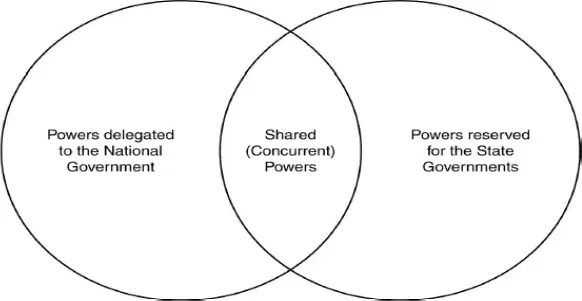
Which government action would be considered an enumerated power?
collecting taxes
enforcing laws
building roads
coining money
Voter turnout for Presidential elections tends to increase when
The economy is doing well and citizens are generally happy with the incumbent
The country is at peace
The election is projected to be a blow-out
The country is at war
The statement, “Congress shall make no law respecting an establishment of religion or prohibiting the free exercise thereof,” is found in which document?
Emancipation Proclamation
Declaration of Independence
U.S. Bill of Rights
Compromise of 1850
What is a disadvantage of a confederate form of government?
States are unable to print paper currency.
There is no system to try citizens accused of crimes.
There is no system to manage governmental affairs.
The central government is unable to resolve conflicts between regions.
All of the following are functions of political parties in the U.S. EXCEPT
Serve as a watchdog on the party in control of the government
Nominate candidates and support campaigns
Which of the following type of committee is established with specific timeline to complete a specific task, such as investigating government activity?
Select Committee
Standing Committee
Joint Committee
Conference Committee
What was the provision called that required citizens to pay a fee in order to vote?
Poll Tax
Literacy Test
Servitude
Grandfather Clause
What is the MAIN power of the judicial branch?
to make laws
to defend laws
to enforce laws
to interpret laws

Which role of a political party is best demonstrated by this headline?
Monitoring the government
Informing the public
Nominating candidates
Creating public policy
How are the U.S. presidential elections different from congressional elections?
Candidates attempt to appeal to undecided voters in rural areas.
Candidates can win the electoral vote without winning the popular vote.
Political parties base campaigns on data from public polls.
Political parties influence the selection of the candidate.
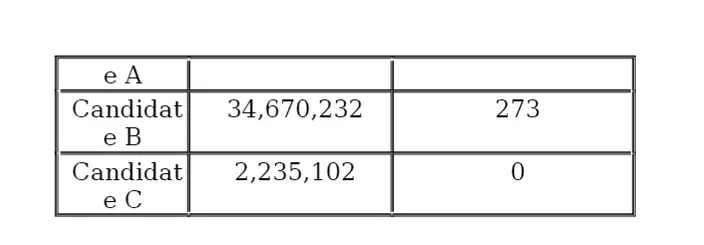
According to the information on the table above, which statement is correct?
Candidate A won by securing the most popular votes.
Candidate B won by securing the most Electoral College votes.
Due to the split result of the Electoral College votes, there will be a runoff election.
Due to the split result of the popular vote, Congress will select the winner.
Which power is exercised by state and local governments?
declare war
print money
sign treaties
establish schools
The United States government is considered a federal system because
the people elect national officials
powers are divided between the State and National Governments
foreign policy is handled by state governments
each state has equal representation in the United States Senate
For a bill to become officially a national law, which of the following must always occur?
The bill must pass both houses of the Legislative branch.
The bill must be reviewed by the U.S. Supreme Court for accuracy.
The bill must originate in the Senate and be passed by the House.
The President must introduce the bill to the Senate.
This type of court hears cases for the first time.
Trial court
Appellate Court
Court of Appeals
Supreme Court
Preserving air quality was one reason for the creation of the
Environmental Protection Agency (EPA).
Federal Maritime Commission (FMC).
Occupational Safety and Health Administration (OSHA).
Which committee resolves differences between the House and Senate versions of the same bill?
joint committee
standing committee
conference committee
committee of the whole
Which of the following is NOT a clause included in the Preamble of the Constitution?
Ensure the health and wellness of all citizens
Provide for the common defense
Establish justice
Promote the general welfare
The Fourth Amendment protects individuals from unlawful searches and seizures. What does that mean?
An individual can be searched only when on public property.
An individual can be searched only when there is probable cause.
An individual can be searched only with his/her consent.
An individual can be searched only when a judge is present.
The first one of these, private meetings of party leaders to choose a candidate for the office of President, in each Presidential election year occurs in Iowa.
Convention
Caucus
Election
Inauguration
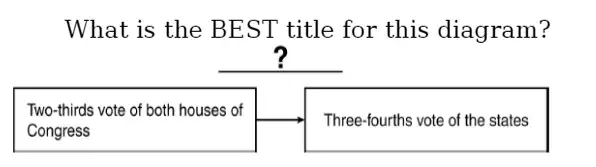
What is the BEST title for this diagram?
Amending the U.S. Constitution
Signing a Bill Into a Law
Confirming Executive Appointments
Nominating U.S. Supreme Court Justices
Which aspect of the U.S. Constitution applies when a federal court overrides a state law?
necessary and proper clause
supremacy clause
First Amendment
Preamble

Which philosophy is expressed by Speaker 2?
judicial review
judicial activism
judicial immunity
judicial restraint
What is the primary reason U.S. citizens pay income taxes?
to fulfill their civic responsibility to support the federal government
to share financial data for the creation of federal programs
to register for participation in the federal political process
to provide information for federal election districts
Having three branches of federal government is an example of this kind of system that keeps any one part of the government from becoming too powerful.
Judicial Review
Checks and Balances
Social Agreement
Autocracy
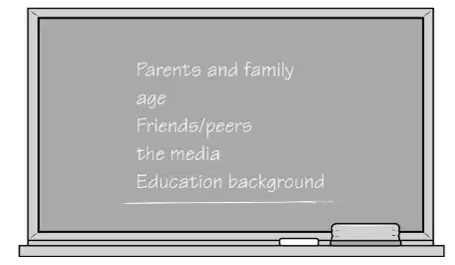
What could be the title of this list?
Factors Used to Determine Job Income Level
Factors Influencing Individual Political Attitudes
Factors Influencing Personal Ethnic Identification
Factors Used in Developing Career Objectives
In Miranda v. Arizona the U.S. Supreme Court created and imposed a new procedure for interrogating suspects in custody, introducing the famous Miranda warning. Why is this case often cited as an example of judicial activism?
The separation of powers was clearly defined.
The decision was based on the personal views of the justices.
The ruling was in line with previous court decisions.
The case was decided by a unanimous vote.
Which feature must a nation have to be considered a democracy?
a. a strong president
b. citizen participation in government
c. elected judges to conduct trials
d. a set of laws
Which of the following is NOT a right granted to every American citizen in the Bill of Rights?
a. freedom of speech
b. right to bear arms
c. freedom of religion
d. right to vote
In the case of Mapp v. Ohio, the Supreme Court established
a. the "reading of rights" rule.
b. the "clear and present danger" rule.
c. the right to counsel rule.
d. the exclusionary rule.
How is membership of the House of Representatives determined?
a. By the apportioned population of the states.
b. By the state legislature of each state.
c. By two representatives from each state.
d. By appointment of the governor of the state according to a formula established by Congress.
Since 9/11, the federal government has increased security at major airports, large venues, and federal buildings. Of the six purposes stated in the Preamble of the United States Constitution, which of the following is MOST closely related to this example?
a. “insure domestic Tranquility”
b. “to establish Justice”
c. “to secure the Blessings of Liberty”
d. “promote the general Welfare”
Under the Constitution, the president can ask for a declaration of war, but it is up to whom to declare war?
a. the Congress
b. the president
c. the people
d. the judiciary
Why did the Founding Fathers create a government based on federalism?
to prevent policy disputes between levels of government
to allow state control over national issues
to limit the power of the national government
to write a document that was difficult to change
The President signs a bill providing a free college education to all high school graduates.
Chief Executive
Commander in Chief
Chief of Party
Chief Diplomat
Chief Legislator
The President meets with his Cabinet at least once every two months.
Chief Executive
Commander in Chief
Chief of Party
Chief Diplomat
Chief Legislator
The President decides to send troops into Syria to assist with the Syrian civil war.
Chief Executive
Commander in Chief
Chief of Party
Chief Diplomat
Chief Legislator
The President visits China to improve relations in that country.
Chief Executive
Commander in Chief
Chief of Party
Chief Diplomat
Chief Legislator
The President holds a fundraising dinner to raise money for a candidate in a highly contested Senatorial campaign.
Chief Executive
Commander in Chief
Chief of Party
Chief Diplomat
Chief Legislator
Maintains the Armed Forces.
Department of Justice
Department of Defense
Department of State
Department of Homeland Security
Department of the Treasury
Runs the FBI.
Department of Justice
Department of Defense
Department of State
Department of Homeland Security
Department of the Treasury
Secures and manages U.S. borders.
Department of Justice
Department of Defense
Department of State
Department of Homeland Security
Department of the Treasury
Collects taxes.
Department of Justice
Department of Defense
Department of State
Department of Homeland Security
Department of the Treasury
Represents the U.S. at the United Nations.
Department of Justice
Department of Defense
Department of State
Department of Homeland Security
Department of the Treasury
To run for office, you must be at least 30 years old and a U.S. citizen for 9 years.
Senate
House
Congress
Chooses the President if the Electoral College fails to pick a winner.
Senate
House
Congress
Members serve 2-year terms.
Senate
House
Congress
Has the power to propose amendments to the Constitution.
Senate
House
Congress
Has approval power over the President’s choices for judges, ambassadors and other appointments.
Senate
House
Congress
When an appellate court overturns a trial court’s decision.
Appeal
Affirm
Remand
Reverse
Verdict
To uphold a decision reached by a lower court.
Appeal
Affirm
Remand
Reverse
Verdict
The decision at the end of a case.
Appeal
Affirm
Remand
Reverse
Verdict
To ask a higher court to review a case.
Appeal
Affirm
Remand
Reverse
Verdict
When an appellate court sends a case back to the trial court for further review.
Appeal
Affirm
Remand
Reverse
Verdict
Held that statements made in response to interrogation by defendant in police custody can be used at trial only if the prosecution can show that the defendant was informed of the right to counsel and of the right against self-incrimination prior to questioning by police.
Engel v. Vitale
Miranda v. Arizona
Roe v. Wade
Gideon v. Wainwright
Texas v. Johnson
Right to due process of law, freedom from self-incrimination, double jeopardy.
1st Amendment
2nd Amendment
3rd Amendment
4th Amendment
5th Amendment
The power of a court to hear a case on appeal is called original jurisdiction.
True
False
“Life, liberty, and property” were considered by John Locke to be a person’s natural, unalienable rights.
True
False
Which branch of the U.S. government is responsible for making laws?
Executive
Legislative
Judicial
Bureaucratic

