
Font size
 Worksheets
Gears Quiz
Total questions: 53
Worksheet time: 27mins
What is the primary function of gears?
To increase the weight of a machine
To mesh together and transmit power from one location to another
To change the color of a machine
To reduce the size of a machine
How can the direction of rotation be changed in a gear system?
By using gears of the same size
By using a different number of gears
By increasing the weight of the gears
By changing the material of the gears
What factor can change the rotation speed of the output gear?
The color of the gears
The material of the gears
The size of the gears
The weight of the gears
Why is selecting the correct size and number of gears important?
To make machines look better
To make machines work as required
To reduce the cost of machines
To increase the weight of machines
What are gears used to transmit?
Linear motion
Rotary motion
Oscillating motion
Vibrating motion
What materials are gears typically made from?
Wood and rubber
Metal and plastic
Glass and ceramic
Paper and fabric
Why do gears need to be hard wearing?
To reduce noise
To be lightweight
For continual use
To be flexible
In which of the following applications can gears be found?
Televisions
Clocks
Smartphones
Laptops
Which of the following is NOT an application of gears?
Automotive steering systems
Electric food mixers
Clocks
Solar panels
What is the primary function of gear trains?
To increase the speed of a vehicle
To transmit rotary motion through many gears
To reduce noise in machinery
To change the color of gears
What dictates the direction that the driven gear rotates?
The size of the gear
The speed of the gear
The driver gear
The material of the gear
In the case of two meshed gears, how does the driven gear rotate in relation to the driver gear?
In the same direction
In the opposite direction
At a faster speed
At a slower speed
What is the purpose of an idler gear in a gear train?
To increase the speed of the driven gear
To reduce the size of the gear train
To ensure the driven gear turns in the same direction as the driver gear
To change the material of the gears
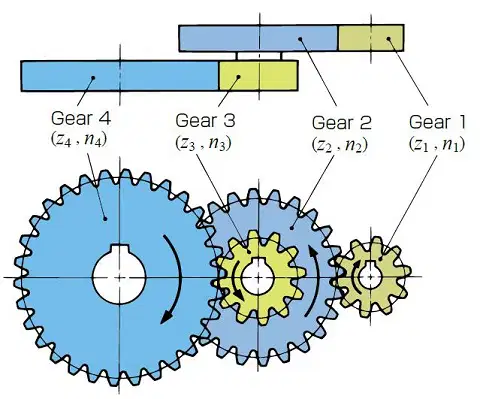
Which gear is the idler gear?
Gear 4
Gear 2
Gear 3
gear 2 &3
Which gear is the idler gear?
Gear A
Gear B
Gear C
None of the above
What is required for one gear to turn another freely and with maximum efficiency?
The gears must be of the same size.
The gears must be made of the same material.
The gears must be meshed together correctly.
The gears must be lubricated.
When does correct meshing of gears occur?
When the teeth of the driver gear fit halfway between the teeth of the driven gear.
When the teeth of the driver gear fit exactly on top of the teeth of the driven gear.
When the teeth of the driver gear are larger than the teeth of the driven gear.
When the teeth of the driver gear are smaller than the teeth of the driven gear.
What happens if the teeth of the two gears are too close together?
They will rotate faster.
They will prevent each other from turning.
They will rotate more smoothly.
They will make less noise.
What happens if the teeth of the two gears are too far apart?
They will rotate faster.
They will make more noise.
They will miss each other and no rotation will take place.
They will wear out quickly.
Which diagram shows correctly meshed gears?
Diagram A
Diagram B
Diagram C
None of the above
Which diagram shows correctly meshed gears?
Option A
Option B
Option C
None of the above
What determines the speed of the driven gear?
The size of the gears
The number of teeth on the driver and driven gears
The material of the gears
The color of the gears
What happens if the driver and driven gears have the same number of teeth?
The driver gear rotates faster
The driven gear rotates faster
They will rotate at the same speed
The driven gear will not rotate
If the driven gear has fewer teeth than the driver gear, what will happen?
The driven gear rotates slower than the driver gear
The driven gear rotates faster than the driver gear
The driver gear will not rotate
Both gears will stop rotating
If the driven gear has more teeth than the driver gear, what will happen?
The driven gear rotates slower than the driver gear
The driven gear rotates faster than the driver gear
The driver gear will not rotate
Both gears will rotate at the same speed
What is the gear ratio if the driver gear has 10 teeth and the driven gear has 20 teeth?
1:2
2:1
1:1
3:1
How is the gear ratio calculated?
Number of driver gear teeth divided by number of driven gear teeth
Number of driven gear teeth divided by number of driver gear teeth
Number of driver gear teeth multiplied by number of driven gear teeth
Number of driven gear teeth subtracted by number of driver gear teeth
What happens to the driven gear when the driver gear rotates twice?
The driven gear rotates twice
The driven gear rotates once
The driven gear does not rotate
The driven gear rotates three times
What does a gear ratio of 2:1 indicate?
The driver gear is slower than the driven gear
The driver gear is faster than the driven gear
Both gears rotate at the same speed
The driver gear does not rotate
How is the gear ratio 20/10 simplified?
(a)
What is the term used when the driver gear has more teeth than the driven gear?
Gearing down
Gearing up
Gear reduction
Gear multiplication
What is the gear ratio if the driver gear has 20 teeth and the driven gear has 10 teeth?
1:1
2:1
1:2
1:3
How many times does the driven gear rotate for every revolution of the driver gear if the gear ratio is 1:2?
Once
Twice
Three times
Four times
How is the gear ratio calculated?
Number of driver gear teeth / Number of driven gear teeth
Number of driven gear teeth / Number of driver gear teeth
Number of driver gear teeth + Number of driven gear teeth
Number of driven gear teeth - Number of driver gear teeth
What is the formula for calculating the gear ratio?
Number of driver gear teeth / Number of driven gear teeth
Number of driven gear teeth / Number of driver gear teeth
Number of driver gear teeth + Number of driven gear teeth
Number of driven gear teeth - Number of driver gear teeth
If a driver gear has 8 teeth and a driven gear has 36 teeth, what is the gear ratio?
4.5:1
3:1
2:1
5:1
What does a gear ratio of 4.5:1 mean in terms of rotations?
The driver gear rotates once for every 4.5 rotations of the driven gear.
The driven gear rotates once for every 4.5 rotations of the driver gear.
Both gears rotate at the same speed.
The driver gear rotates 4.5 times for every rotation of the driven gear.
What is the gear ratio of these gears?
36:8
1:8
4.5:1
1:4.5
What is the gear ratio of these gears?
36:8
1:8
4.5:1
1:4.5
What is the formula to calculate the speed of the driven gear?
Driven gear speed = Driver gear speed × Gear ratio
Driven gear speed = Driver gear speed ÷ Gear ratio
Driven gear speed = Gear ratio ÷ Driver gear speed
Driven gear speed = Gear ratio × Driver gear speed
If the driver gear rotates at 45 revolutions per minute (rpm) and the gear ratio is 4.5:1, what is the speed of the driven gear?
5 rpm
10 rpm
20 rpm
45 rpm
What is the gear ratio given in the document?
3.5:1
4.5:1
5.5:1
6.5:1
What is the speed of the driven gear?
1.5 rpm
15 rpm
30 rpm
150 rpm
What is the speed of the driven gear?
1.5 rpm
15 rpm
30 rpm
150 rpm
What is the gear ratio when the driver and driven gears have the same number of teeth and an idler gear is used?
1:1
2:1
3:1
4:1
What effect does an idler gear have on the total gear ratio between different sized driver and driven gears?
It increases the gear ratio.
It decreases the gear ratio.
It has no effect on the gear ratio.
It doubles the gear ratio.
What is the primary function of an idler gear in a gear train?
To increase the speed of the driven gear.
To change the direction of the driven gear's rotation.
To decrease the speed of the driver gear.
To increase the torque of the driven gear.
When calculating the total gear ratio for gear trains of three or more gears, when should this calculation be done?
After determining the driven gear speed.
Before determining the driven gear speed.
After determining the driver gear speed.
Before determining the driver gear speed.
What is the gear ratio between the driver gear and the idler gear?
0.5:1
1:2
1.5:1
2:1
How many teeth does the idler gear have?
24
12
18
45
What is the total gear ratio in the 3-gear train?
0.5
1.5
0.75
2.0
How is the total gear ratio calculated in a 3-gear train?
Driver gear to idler gear + Idler gear to driven gear
Driver gear to idler gear × Idler gear to driven gear
Driver gear to driven gear ÷ Idler gear to driven gear
Driver gear to driven gear × Idler gear to driver gear
What is the gear ratio between the idler gear and the driven gear?
0.5:1
1:2
1.5:1
2:1

