
 Worksheets
Microbiology 2117L- Labs 9-11
Total questions: 50
Worksheet time: 38mins

AATCATGGA

What are the three components of a nucleotide?
sugar, hydrogen, nitrogen base
sugar, oxygen, nitrogen base
sugar, phosphate, nitrogen base
sugar, phosphate, protein
What are the 4 nitrogen bases in DNA?
adenine, thymine, uracil, and guanine
adenine, thymine cytosine, and guanine
adenine, thymine, cytosine, and uracil
adenine, thymine, cytosine, and glucose
Guanine bonds with ______________.
Adenine
Guanine
Cytosine
Thymine

Which sequence of DNA bases would pair with this partial strand
CAT TCA CTG
ATG TGA CAG
TAC ACT GTC
GTA AGT GAC
CAT TCA CTG
DNA is built in this direction
5' to 3' (new nucleotides added to the 3' end)
3' to 5' (new nucleotides added to the 5' end)
3' to 5' (new nucleotides added to the 3' end)
5' to 3' (new nucleotides added to the 5' end)
Adenine pairs with
uracil
thymine
cytosine
adenine
The DNA strands are held together
with covalent bonds
with sugar molecules
with hydrogen bonds between bases
Given the template strand, what is the mRNA strand?
5'- GATGAAC -3'
5'- GUUCAUC -3'
5'- CUACUUG -3'
5'- GAACUAC -3'
5'- GTTCATC -3'
Transcription occurs in the _______ of prokaryotes, and in the _________ of eukaryotes.
Cytoplasm ; cytoplasm
Nucleus ; ribosome
Nucleolus ; nucleus
Cytoplasm ; nucleus
Nucleoid ; cytoplasm
What is the central dogma?
DNA --> mRNA --> tRNA --> rRNA
Template strand --> coding strand --> mRNA
Nucleus --> cytoplasm --> ribosome
DNA --> mRNA --> protein
Given the coding strand, what is the template strand?
5'- AGCTTA -3'
5'- ATTCGA -3'
5'- UCGAAU -3'
5'- TAAGCT -3'
5'- TCGAAT -3'
Transcription converts a gene into a double stranded molecule.
True
False
RNA contains which sugar?
deoxyribose
Ribose
glucose
fructose
Which RNA forms part of the ribosomes?
tRNA
mRNA
rRNA
Which RNA carries the message?
mRNA
rRNA
tRNA
Translation occurs in the _______ and requires a(n) _________.
Nucleus; mRNA
Cytoplasm; ribosome
Cytoplasm; RNA polymerase enzyme
Nucleoid; ribosome
The start codon is ______ and it codes for the amino acid _______.
AUG; Methionine
UAG; Cysteine
UGA; ribosomal binding site
AUG; ribosomal binding site
CUG; Leucine
Codons are located on....
DNA
mRNA
tRNA
rRNA
Anti-codons are located on...
DNA
mRNA
tRNA
rRNA
What cellular structure uses RNA as the blueprint to build proteins?
Cytoplasm
Nucleus
Ribosome
Golgi

A codon consists of ____ RNA base(s)
one
three
six
two
What does tRNA do during translation?
it brings a specific segment of DNA to the ribosome for transcription
it brings any amino acid to the ribosome
it brings the ribosomes to the rRNA to initiate translation
it brings a specific amino acid (which depends upon the codon) to the ribosome for translation
How many amino acids are coded for by this sequence of nucleotides in mRNA: AUG GGA ACU CCA
4
2
6
12
What signals where translation will end?
introns
termination sequence
stop codon
operons
TRANSCRIBE this DNA sequence: TACGTTACT
AUGCAAUGA
ATGCAATGA
AUGGATUGA
TACGTTACT
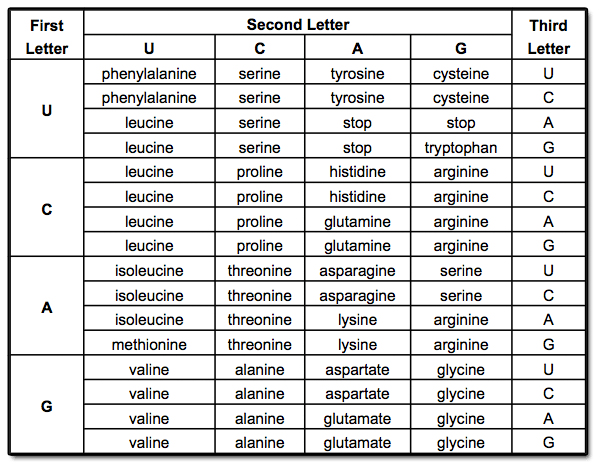
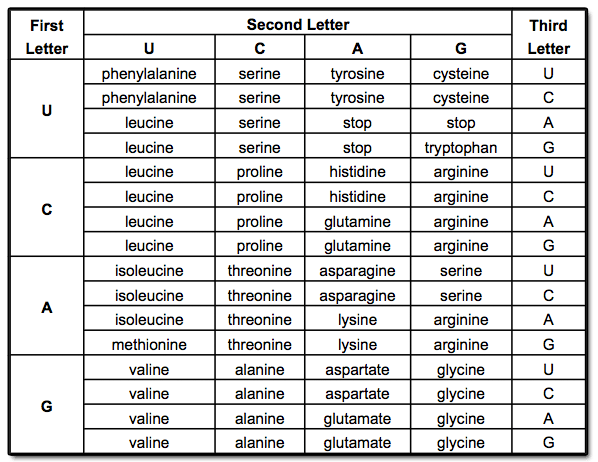
TRANSLATE this RNA sequence: AUGCAAUGA
Met-Glu-Stop
Met-His-Stop
Thr-Glu-Stop
Thr-Pro-Stop
GTAGTCA
TGGCAAGTACGT

Select all that apply to these bacterial colonies.
Shape: round
Margin: entire (smooth)
Shape: Irregular
Margin: Undulate

Identify the form (overall shape) of the colony.
round
irregular
filamentous
punctiform

The margins (edges) of this colony are wavy or:
undulate (wavy)
entire
smooth
filamentous

Identify the form (overall shape) of these bacterial colonies.
filamentous
round
irregular
rhizoid

Most of the bacterial colonies we have looked at are dome-shaped in elevation or:
convex
flat
crateriform
umbonate
Bacteria colonies that are greater than 1 mm in diameter are considered ____.
small
large
variable
None of the other options.
Colony morphology involves all of the following traits/characteristics except ...
form
elevation
margins
cell shape

The image shows an example of a(n):
Streak plate
Spread plate
Ordinary inoculation
Stroke inoculation
Round colonies less than 1.5mm in diameter are called:
Circular
Irregular
Rhizoid
Punctiform

Broth characteristic where bacteria can be seen throughout the culture - the culture appears "cloudy".
Sediment
Pellicle
Turbid
Ring

Growth pattern in which bacteria that "love" oxygen float at the top of a broth.
Turbid
Pellicle
Ring
Sediment
What are obligate aerobes?
Organisms in which oxygen is toxic
Organisms that must have oxygen
Organisms that prefer oxygen, but don't necessarily have to have it
Organisms that "breathe" anaerobically (without oxygen), but they are able to survive when oxygen is present
What are aerotolerant anaerobes?
Organisms that must have oxygen
Organisms in which oxygen is toxic
Organisms that prefer oxygen, but don't necessarily have to have it.
Organisms that "breathe" anaerobically (without oxygen), but they are able to survive when oxygen is present
Organisms that prefer oxygen, but don't necessarily have to have it to survive are called:
Obligate aerobes
Obligate anaerobes
Facultative anaerobes
Aerotolerant anaerobes

