wayground logo

Free Printable Worksheets

Font size

S
M
L
XL
Worksheets

End of year revision

Total questions: 158

Worksheet time: 2hrs 7mins

Name
Class
Date
1.

Coal is...

a)

A renewable source of energy

b)

A non-renewable source of energy

2.

Wind is ...

a)

clean, safe & available

b)

clean, cheap & limited

c)

cheap, unlimited & safe

d)

unavailable, expensive & clean

3.

Flowing water is..

a)

A non-renewable source of energy

b)

A renewable source of energy

4.

Uranium is a....

a)

A renewable source of energy

b)

A non-renewable source of energy

5.

Natural gases are..

a)

A renewable source of energy

b)

A non-renewable source of energy

6.

What type of source do you need in this power plant?

a)

Uranium

b)

Petroleum

c)

Plant remains

d)

Water

7.

What type of source do you need in a nuclear plant?

a)

Plant remains

b)

Water

c)

Uranium

d)

Petroleum

8.

What type of source do you need in a thermal power plant?

a)

Wind

b)

Petroleum

c)

Sunlight

d)

Heat

9.

What type of source do you need in a biomass power plant?

a)

Coal

b)

Sunlight

c)

Plant remains

d)

Uranium

10.

Resources that are not able to be reproduced as quickly as they are used are called _____.

a)

renewable resources

b)

replaceable resources

c)

non renewable resources

d)

non replaceable resources

11.

Geothermal energy uses heat from ____ to produce electricity.

a)

the earth

b)

coal

c)

oil

d)

natural gas

12.

Renewable resources ...

a)

are not replaceable

b)

are used more frequently than non renewables

c)

are never going to run out

d)

going to run out

13.

What are fossil fuels?

a)

coal, oil, uranium

b)

oil, natural gas, uranium

c)

coal, oil, natural gas

d)

geothemals, coal, natural gas

14.

What type of power plant uses scraps from farming, waste products and wind to generate electricity?

a)

Hydroelectric Power Plant

b)

Geothermal Power Plant

c)

Biomass Power Plant

d)

Nuclear Power Plant

15.

Uranium atoms are split to create a tremendous amount of heat in a _____ power plant.

a)

biomass

b)

geothermal

c)

nuclear

d)

hydroelectric

16.

Name the type of power station.

a)

Thermal Power Station

b)

Nuclear Power Station

c)

Hydroelectric Power Station

d)

Biomass Power Station

17.

Name the type of power station.

a)

Thermal Power Station

b)

Nuclear Power Station

c)

Wind Power Station

d)

Solar Power Station

18.

Resources that are not able to be reproduced as quickly as they are used are called _____.

a)

renewable resources

b)

replaceable resources

c)

non renewable resources

d)

non replaceable resources

19.

Geothermal energy uses heat from ____ to produce electricity.

a)

the earth

b)

coal

c)

oil

d)

natural gas

20.

Coal is burned to heat water so that the _______ can turn turbines.

a)

fire

b)

steam

c)

water

d)

heat

21.

Renewable resources ...

a)

are not replaceable

b)

are used more frequently than non renewables

c)

are never going to run out

d)

going to run out

22.

What are fossil fuels?

a)

coal, oil, uranium

b)

oil, natural gas, uranium

c)

coal, oil, natural gas

d)

geothemals, coal, natural gas

23.

What type of power plant uses scraps from farming, waste products and wind to generate electricity?

a)

Hydroelectric Power Plant

b)

Geothermal Power Plant

c)

Biomass Power Plant

d)

Nuclear Power Plant

24.

Name the type of power station.

a)

Thermal Power Station

b)

Nuclear Power Station

c)

Hydroelectric Power Station

d)

Biomass Power Station

25.

Name the type of power station.

a)

Thermal Power Station

b)

Nuclear Power Station

c)

Wind Power Station

d)

Solar Power Station

26.

Energy that uses heat from within the earth is ____.

a)

Nuclear

b)

Geothermal

c)

Wind

d)

Solar

27.

What do geothermal and solar energy have in common?

a)

Both rely on the movement of turbines

b)

Neither is expensive

c)

Neither produces greenhouse gases

d)

Sunlight is needed for both

28.

Which of the following is renewable energy?

a)

Wind energy

b)

Petroleum

c)

Natural gas

d)

Fossil fuels

29.
What form of energy comes from the sun?
a)
Solar
b)
Potential
c)
Nuclear
d)
Chemical
30.
What form of energy comes from food?
a)
Nuclear
b)
Kinetic
c)
Chemical
d)
Mechanical
31.

What is energy?

a)

moving energy

b)

stored energy

c)

renewable energy

d)

The ability to do work.

32.

What is NOT a renewable energy source?

a)

coal

b)

wind

c)

solar

d)

water

33.

Identify the type of energy

a)

Thermal energy

b)

Sound energy

c)

Mechanical energy

d)

Electrical energy

34.

Identify the type of energy

a)

Electrical Energy

b)

Mechanical energy

c)

Sound energy

d)

Thermal energy

35.

Identify the type of energy that powers this laptop.

a)

Thermal energy

b)

Mechanical energy

c)

Sound energy

d)

Electrical energy

36.
Animals obtain their energy from ....... 
a)
Food
b)
Sun
c)
Air
d)
Uranium
37.

We should use low energy light bulb to ……. the electricity

a)

save

b)

affect

c)

invest

d)

limit

38.

We should ….. the use of fossil fuels and others non-renewable source of energy.

a)

waste

b)

save

c)

increase

d)

reduce

39.

They will install a network of wind turbines to ……. electricity

a)

generate

b)

come

c)

make

d)

produce

40.

The sun's energy will be used to …… water

a)

hot

b)

heat

c)

freeze

d)

frozen

41.

Choose renewable sources of energy

a)

fossil fuels

b)

nuclear power

c)

solar energy

d)

coal

e)

wind power

42.

Choose the answer that best describes the picture.

a)

carbon footprint

b)

carbon dioxide

c)

hydro

d)

biogas

43.

Choose the picture that best describes the word/phrase.

polluted

a)
b)
c)
44.

Wind power is one of the earliest ___________ sources of energy used by humankind.

a)

alternative

b)

polluted

c)

harmful

d)

exhausted

45.

Nobody can predict exactly when supplies of fossil fuels will be ___________. However, we all know they quickly reduce in quantity.

a)

installed

b)

polluted

c)

harmful

d)

exhausted

46.

Biogas can be used to ___________ natural gas in cooking, heating, or electrical generation.

a)

use up

b)

replace

c)

pollute

d)

install

47.

Solar energy can be used for ___________ electricity, and for hot water heating.

a)

investing

b)

polluting

c)

generating

d)

installing

48.

The non-renewable sources of energy that we are using are ___________ and are bound to expire one day.

a)

limited

b)

plentiful

c)

abundant

d)

alternative

49.

Choose the answer that best describes the picture.

a)

coal

b)

electricity

c)

fossil fuel

d)

natural gas

50.

Choose the answer that best describes the picture.

a)

dam

b)

turbine

c)

solar panel

d)

electricity

51.
Nonrenewable resources are natural resources, such as fossil fuels, that will eventually be used up and can never be replaced
a)
True
b)
False
52.
An example of a biofuel is
a)
gasoline
b)
oil
c)
animal waste
d)
minerals
53.

Newtons are the correct unit for which of the following?

a)

Force

b)

Work

c)

Power

d)

Acceleration

54.
In order to do work on an object, the force you exert must be...
a)
The maximum amount of force you are able to exert.
b)
In the same direction as the object's motion.
c)
In a direction opposite to Earth's gravitational force.
d)
quick and deliberate.
55.

How do we calculate work?

a)

W = F * d

b)

w = F / d

56.

Which is the correct unit for work?

a)

Joules

b)

Newton

c)

meter

d)

Watts

57.
The rate at which work is done.
a)
Joules
b)
Power
c)
Watts
d)
Newtons
58.
How do you calculate power?
a)
P = W/t
b)
P = E/t
c)
P = w * t
d)
P = bbq/chicken
59.

What is the correct unit for power?

a)

Watt

b)

Joules

c)

Newtons

d)

seconds

60.

It took 500 Newtons of force to push a car four meters. How much work was done?

a)

2000 J

b)

125 J

c)

0.008 J

d)

500 J

61.
1. A book weighing 1.0 newton is lifted 2 meters.  How much work was done?
a)
2 J
b)
0.5 J
62.
A force of 15 newtons is used to push a box along the floor a distance of 3 meters.  How much work was done?
a)
3 J
b)
45 J
63.
It took 500 newtons of force to push a car 4 meters.  How much work was done?
a)
2,000 J
b)
125 J
64.

How much power is used if a force of 35 Newtons is used to push a box a distance of 10 meters in five seconds? (Hint: Solve for work first. This is a 2-step problem.)

a)

70 W

b)

3.5 W

c)

7 W

d)

350 J

65.
A set of pulleys is used to lift a piano weighing 1,000 newtons.  The piano lifted 3 meters in 60 seconds  How much power is used?
a)
16.67 watts
b)
50 watts
66.
How much power is used if a force of 35 newtons is used to push a box a distance of 10 meters in 5 seconds?
a)
70 watts
b)
1750 watts
67.
What is the difference between calculating power and work?
a)
Power takes into account the time it takes to complete a task
b)
Work takes into account the time it takes to complete a task
c)
Power is force/area
d)
Work is force/area
68.

Diagram shows a student lifting a weight of 500 g 0.5 m vertically from the floor. If the force recorded on the spring balance is 5 N, calculate the work done by the student.

a)

2500 J

b)

250 J

c)

2.5 J

d)

0 J

69.

A boy pushed a 20 kg box over a distance of 2 m. Calculate the work done. (Assume gravitational force acting on an object of mass 1 kg = 10 N)

a)

0 J

b)

4 J

c)

40 J

d)

400 J

70.

The mass of a student is 45 kg. Calculate work done by this student when he carrying a load of 1.5 kg while climbing a stair of a vertical height of 3 m.

a)

45 J

b)

1395 J

c)

1350 J

d)

135 J

71.

What is the power of a kitchen blender if it can perform 3,750 Joules of work in 15 seconds?

a)

250 W

b)

0.004 W

c)

56,250 W

d)

25 W

72.

If a 100 N force acts on a 50 kg car, what will be the acceleration of the car?

a)

2 m/s2

b)

0.5 m/s2

c)

5,000 m/s2

d)

50 m/s

73.
How much work is being done with 200 N of force over 426 meters?
a)
85,200 J
b)
45,620 J
c)
90,480 J
d)
62,329 J
74.
If 150 Joules of work is needed to move a box 10 meters, what force was used? 
a)
1500 N
b)
15 N
c)
1.5 N
d)
150 N
75.
Work is done when a weightlifter holds a barbell still above his head.
a)
True
b)
False
76.

You push against the back of your friends car that is stuck. You push and be become very tired, but the car does not move. Did you do work?

a)

Yes, work was done

b)

No, work wasn't done

77.
The amount of work done in a certain amount of time is known as 
a)
work
b)
effort force
c)
resistance force 
d)
power
78.

If you increase your work and decrease your time, you will have

a)

more power

b)

less power

c)

same amount of power

d)

power rating can not be determined

79.

If you have the same work as someone, but in less time

a)

You are more powerful

b)

You are less powerful

c)

You have the same power

80.

Person A and Person B are both using the same amount of work to lift something. Person A takes half as much time to do it. Who has greater power.

a)

Person A

b)

Person B

81.
Force is a _____ or _______
a)
simple    complex
b)
push     pull
c)
up      down
d)
in      out
82.
How much work is done in holding a 15 N sack of potatoes while waiting in line at the grocery store for 3 minutes?
a)
15 J
b)
45 J
c)
0 J
d)
5 J
83.
The more POWER you use to move an object, the more work you do. 
a)
True
b)
False
84.
If 68 W of power is produced in 18 seconds, how much work is done?
a)
1,224 J
b)
0.264 J
c)
3.77 J
d)
12.24 J
85.
How much time is needed to produce 720 Joules of work if 90 watts of power is used? 
a)
0.125 s
b)
8 s
c)
64800 s
d)
80 s
86.
If 68 Joules were necessary to move a 4 Newton crate, how far was the crate moved?
a)
272 m
b)
17 m
c)
4.05 m
d)
272 cm 
87.
The unit used to measure power is the 
a)
Watt
b)
Newton
c)
Joule
d)
Newton*meter
88.
Which of the following is a true statement about work?
a)
It measures how quickly an object accelerates 
b)
It measures how much effort is applied over a certain distance
c)
It measures the change in an object's rate of speed
d)
It measures how much time it takes to move a massive object
89.
What does one newton exerted over a distance of one meter equal?
a)
One watt
b)
One hertz
c)
One volt 
d)
One joule 
90.
A kid applies a force of 70 N to a ball over 1.1 meters. How much work did he do on the ball? 
a)
77 J
b)
7.7 J 
c)
0.7 J 
d)
770 J 
91.
A weightlifter lifts two 300 newton weights 1.5 meters off the ground. How much work has he done?
a)
600 J 
b)
660 J
c)
900 J 
d)
1200 J 
92.
Simple machines make work easier by increasing what?
a)
The distance over which work is done 
b)
The force needed to do work 
c)
The time required to do work
d)
The acceleration of a massive object 
93.
Which of these is a measure of force?
a)
100 newtons
b)
100 meters per second
c)
100 joules
d)
100 watts
94.
You move a 12-newton box up a 6-meter ramp. In order to find out how much power you created, what would you need to know?
a)
The mass of the box
b)
The slope of the ramp 
c)
The direction the box moved
d)
How long the task took
95.
You do 90 joules of work in 30 seconds. How much power have you generated?
a)
30 watts
b)
3 watts
c)
120 watts
d)
270 watts
96.
You move an 8-newton weight five meters in 4 seconds. How much power have you generated?
a)
160 watts
b)
10 watts
c)
6.4 watts
d)
17 watts
97.
Which of the following would produce the most power?
a)
A mass of 10 kilograms lifted 10 meters in 10 seconds 
b)
A mass of 10 kilograms lifted 10 meters in 5 seconds
c)
A mass of 5 kilograms lifted 10 meters in 5 seconds
d)
A mass of 5 kilograms lifted 5 meters in 10 seconds
98.
What is the equation for work?
a)
W = mass * acceleration
b)
W = force * distance
c)
W = force/distance
d)
W = speed/time
99.
Work requires force and _______.
a)
distance
b)
time
c)
position
100.
When a force moves an object, work is done.
a)
True
b)
False
101.
The equation used to find power is ________________?
a)
force*distance
b)
work/time
c)
mass*velocity
d)
work*time
102.
The equation used to find work is_________________?
a)
Force/Distance
b)
Work/Time
c)
Force*Distance
d)
Time*Distance
103.
If you push very hard on an object but it does not move, has work been done?
a)
Yes
b)
No
104.
Which is doing work?
a)
pushing a wall
b)
holding a box
c)
picking up a pencil
d)
sitting in a chair
105.
How is power calculated?
a)
time x energy
b)
energy x distance
c)
energy/time
d)
force/time
106.
What does work transfer?
a)
force
b)
power
c)
energy
d)
gravity
107.
Force is a _____ or _______
a)
simple    complex
b)
push     pull
c)
up      down
d)
in      out
108.
How much work is being done with 200 N of force over 426 meters?
a)
85,200 J
b)
45,620 J
c)
90,480 J
d)
62,329 J
109.
If 150 Joules of work is needed to move a box 10 meters, what force was used? 
a)
1500 N
b)
15 N
c)
1.5 N
d)
150 N
110.
Work is done when a weightlifter holds a barbell still above his head.
a)
True
b)
False
111.

You push against the back of your friends car that is stuck. You push and be become very tired, but the car does not move. Did you do work?

a)

Yes, work was done

b)

No, work wasn't done

112.
The amount of work done in a certain amount of time is known as 
a)
work
b)
effort force
c)
resistance force 
d)
power
113.

If you increase your work and decrease your time, you will have

a)

more power

b)

less power

c)

same amount of power

d)

power rating can not be determined

114.

If you have the same work as someone, but in less time

a)

You are more powerful

b)

You are less powerful

c)

You have the same power

115.

Person A and Person B are both using the same amount of work to lift something. Person A takes half as much time to do it. Who has greater power.

a)

Person A

b)

Person B

116.
Force is a _____ or _______
a)
simple    complex
b)
push     pull
c)
up      down
d)
in      out
117.
How much work is done in holding a 15 N sack of potatoes while waiting in line at the grocery store for 3 minutes?
a)
15 J
b)
45 J
c)
0 J
d)
5 J
118.
The more POWER you use to move an object, the more work you do. 
a)
True
b)
False
119.
If 68 W of power is produced in 18 seconds, how much work is done?
a)
1,224 J
b)
0.264 J
c)
3.77 J
d)
12.24 J
120.
How much time is needed to produce 720 Joules of work if 90 watts of power is used? 
a)
0.125 s
b)
8 s
c)
64800 s
d)
80 s
121.
If 68 Joules were necessary to move a 4 Newton crate, how far was the crate moved?
a)
272 m
b)
17 m
c)
4.05 m
d)
272 cm 
122.
The unit used to measure power is the 
a)
Watt
b)
Newton
c)
Joule
d)
Newton*meter
123.
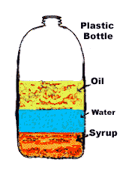
Which liquid is the least dense?
a)
oil
b)
water
c)
syrup 
d)
plastic bottle
124.
What is the formula for density?
a)
density = mass x volume
b)
density = mass / volume
c)
density = mass + volume
d)
density = mass - volume
e)

density = volume / mass

125.
Jack has a rock. The rock has a mass of 14 g and a volume of 2 cm3. What is the density of the rock?
a)
7 mL
b)
7 g/cm3
c)
28 g/cm3
d)

.14 g/cm3

126.

Nathan has an eraser. It has a mass of 4 g, and a volume of 2 cm3. What is its density?

a)
8 g/cm3
b)
2 g/cm3
c)

.5 g/cm3

d)
24 g/cm3
127.

Claire has a liquid. It has a mass of 9g and a volume of 3mL. What is its density?

a)

3 g/mL

b)

.33 g/mL

c)

27 g/mL

d)

39 g/mL

128.
Why do some substances float on water?
a)
they are warmer than water
b)
they are cooler than water
c)
they are more dense than water
d)
they are less dense than water
129.
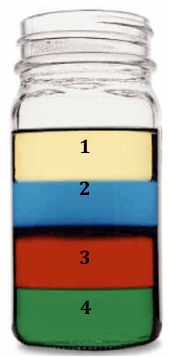
Put the liquids in order from most dense to least dense?
a)
4, 3, 2, 1
b)
1, 2, 3, 4
c)
3, 4, 2, 1, 
d)
4, 3, 1, 2
130.
Helium balloons rise on earth because
a)
helium is less dense than air
b)
helium is more dense than air
c)
helium is cooler than air
d)
helium is warmer than air
131.

What is the formula for Mass?

a)

Mass/Volume

b)

Density x Volume

c)

Mass/Density

d)

Density/Mass

e)

Volume/Mass

132.

What is the formula for Volume?

a)

Mass/Volume

b)

Density x Volume

c)

Mass/Density

d)

Volume/Mass

e)

Density/Mass

133.
If an object has a density of .6 g/mL and you put it into water, will it sink or float?  
a)
sink
b)
float
134.
If an object has a density of 3.6 g/mL and you put it into water, will it sink or float?  
a)
sink
b)
float
135.
Why does ice float?
a)
Liquid water is less dense than solid water.
b)
Solid water is less dense than liquid water.
c)
Gaseous water is less dense than solid water.
d)
Liquid water is less dense than gaseous water.
136.

What is the volume of 55 grams of lead if it has a density of 11 g/cm3?

a)

605 cm3

b)

5 cm3

c)

66 cm3

d)

.2 cm3

137.

What is the volume of a 40 gram liquid if it has a density of 4 g/mL?

a)

.1 mL

b)

10 mL

c)

160 mL

d)

44 mL

138.

What is the mass of a 100mL liquid if it has a density of 3 g/mL?

a)

300 g

b)

33.3 g

c)

.03 g

d)

103 mL

139.

What is the mass of a 25 cm3  liquid if it has a density of 5 g/cm3?

a)

125 g

b)

5 g

c)

30 g

d)

.2 mL

140.
What is the volume of this prism?
a)
24 cubic cm
b)
240 cubic cm
c)
60 cubic cm
141.
What is the volume of this prism?
a)
18 cubic cm
b)
6 cubic cm
c)
9 cubic cm
142.

Find the mass.

a)

550.4 g

b)

559.4 g

c)

550.6 g

143.

Find the mass.

a)

285.3 g

b)

275.5 g

c)

275.3 g

144.
Why does ice float?
a)
Liquid water is less dense than solid water.
b)
Solid water is less dense than liquid water.
c)
Gaseous water is less dense than solid water.
d)
Liquid water is less dense than gaseous water.
145.
Put the liquids in order from most dense to least dense?
a)
4, 3, 2, 1
b)
1, 2, 3, 4
c)
3, 4, 2, 1, 
d)
4, 3, 1, 2
146.
What is the formula for density?
a)
density = mass x volume
b)
density = mass / volume
c)
density = mass + volume
d)
density = mass - volume
147.
Frank has an eraser. It has a mass of 4g, and a volume of 2cm3. What is its density?
a)
8 g/cm3
b)
2 g/cm3
c)
1/2 g/cm3
d)
24 g/cm3
148.
Jack has a rock. The rock has a mass of 14g and a volume of 2cm3. What is the density of the rock?
a)
7 mL
b)
7 g/cm3
c)
28 g/cm3
d)
1/7 g/cm3
149.
Why do some substances float on water?
a)
they are warmer than water
b)
they are cooler than water
c)
they are more dense than water
d)
they are less dense than water
150.
Helium balloons rise on earth because
a)
helium is less dense than air
b)
helium is more dense than air
c)
helium is cooler than air
d)
helium is warmer than air
151.
What is the measuring unit for mass?
a)
centimeter 
b)
millimeter 
c)
grams 
d)
pounds
152.
Which units of measurement are used for volume?
a)
grams
b)
centimeters
c)
grams/milliliter
d)
milliliter
153.
What units are used to measure Density?
a)
cm3/g
b)
g
c)
g/cm3
d)
cm3
154.
A crayon has a mass of 10g and volume of 5 mL. What is the density?
a)
30 g/mL
b)
15 g/mL
c)
1 g/mL
d)
2 g/mL
155.
What is this tool to get volume?
a)
triple beam balance
b)
ruler
c)
thermometer
d)
graduate cylinder
156.
What is this tool to get mass?
a)
triple beam balance
b)
ruler
c)
thermometer
d)
graduate cylinder
157.
Frank has an eraser. It has a mass of 4 g, and a volume of 2 cm3. What is its density?
a)
8 g/cm3
b)
2 g/cm3
c)
1/2 g/cm3
d)
24 g/cm3
158.
An object with which of the following densities will float on water?
a)
0.7 g/cm3
b)
1.2 g/cm3
c)
3.5 g/cm3
d)
11.4 g/cm3