wayground logo

Free Printable Worksheets

NEW

Font size

S
M
L
XL
Worksheets

Chem S2 Final

Total questions: 51

Worksheet time: 1hrs 12mins

Name
Class
Date
1.
Pb + FeSO4 ----> PbSO4 + Fe
a)
Synthesis (or combination)
b)
Decomposition
c)
Single displacement
d)
Double displacement
2.
KOH + H3PO4 --> K3PO4 + H2O
a)
Synthesis (combination)
b)
Decomposition
c)
Single replacement
d)
Double replacement
3.
Pb(NO3)2 --> PbO + NO2 + O2
a)
Synthesis (combination)
b)
Decomposition
c)
Single replacement
d)
Combustion
4.

Which type of chemical reaction has two or more reactants to make one product?

a)

combustion

b)

single displacement

c)

double displacement

d)

synthesis

e)

decomposition

5.

Which chemical reaction always starts with a hydrocarbon that reacts with oxygen and produces carbon dioxide and water?

a)

Decomposition

b)

Synthesis

c)

Combustion

d)

Single Replacement

6.
What is the right part of a chemical equation called...
2H2 + O2 --> 2H2O
a)
Reactants
b)
Products 
c)
Yields 
d)
Chemical Equation 
7.
What does the Law of Conservation of Mass state?
a)
Matter cannot be gained or lost in a chemical reaction.
b)
Matter can only be lost in a chemical reaction.
c)
Matter can only be gained in a chemical reaction.
d)
Matter can be gained and lost in a chemical reaction. 
8.

Balance this equation

_Al +_HCl --> _H2 +_AlCl3

a)

2,6,3,2

b)

it's already balanced

c)

4,12,3,4

d)

2,1,4,5

9.

Balance this equation:

H2 + Cl2 ---> HCl

a)

It is balanced.

b)

H2 + Cl2 ---> 2HCl

c)

3H2 + Cl2 ---> 6HCl

d)

H2 + 3Cl2 ---> 6HCl

10.
What are the products of this reaction?
Cu+ AgNO3--> 
a)
Cu(NO3)2+Ag
b)
CuNO3 + Ag
c)
CuAg+NO3
d)
Cu+ AgNO3
11.
Predict the products for the this reaction:
K + HCl --> 
a)
KCl + H2
b)
KHCl 
c)
KH + Cl2
d)
KCl + H
12.
What is the molar mass of table salt (NaCl)?
a)

116.89 g/mol

b)

35.45 g/mol

c)

22.99 g/mol

d)

58.44 g/mol

13.
What is the mass of one mole of aluminum?
a)

26.98 g

b)
13 g
c)
54 g
d)

14.99 g

14.
What is the molar mass of CO2?
a)

44.01 g

b)

28.01 g

c)

28.01 g/mol

d)

44.01 g/mol

15.
How many particles are in a mole?
a)
602
b)
602 million
c)
602 moles
d)
6.02 x 10²³
16.
You need 2 pieces of bread, 1 tablespoon of peanut butter and 2 tablespoons of jelly to make a sandwich.  If you have 10 pieces of bread, 4 tablespoons of peanut butter and 20 tablespoons of jelly, what is the limiting reactant?
a)
bread
b)
jelly
c)
peanut butter
d)
sandwich
17.
Identify the limiting reagent when 6.00 moles HCl combines with 5.00 moles Mg to form MgCl2.
 
1 Mg +  2 HCl --> 1 MgCl2  +  1 H2   
 
a)
Mg
b)
H2
c)
MgCl2
d)
HCl
18.
When does a chemical reaction stop?
a)
When the lab is finished.
b)
When the excess reactant is used. up
c)
When the limiting reactant is used up.
d)
Chemical reactions never stop.
19.
2H2   +   O2  →  2H2O
How many moles of water can be produced if 8 moles H2 are used?
a)
4 moles
b)
8 moles
c)
16 moles
d)
2 moles
20.
2H2  +   O2  →  2H2O
How many moles of oxygen are consumed if 8 moles H2 are used?
a)
2
b)
4
c)
6
d)
8
21.
How do gas molecules move? 
a)
in an orderly fashion 
b)
constantly and randomly
c)
in straight line paths
d)
in a circular motion
22.
When the temperature of matter increases the particles...
a)
speed up and move closer
b)
speed up and move farther apart
c)
slow down and move closer together
d)
slow down and move farther apart
23.
When Pressure increases then the Volume must...
a)
Increase
b)
decrease
24.
What type of relationship to pressure and volume have?
a)
direct
b)
inverse
c)
no relationship
d)
I don't know
25.
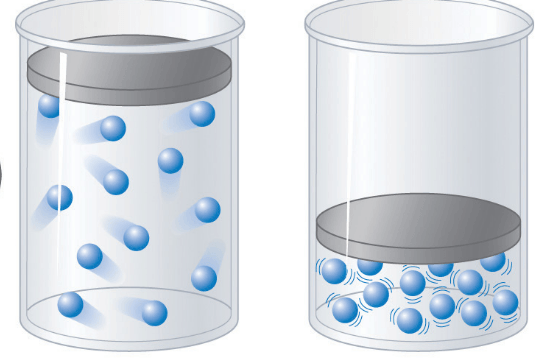
Which container will have a lower pressure?
a)
left
b)
right
c)
they both have the same pressure
d)
I don't know
26.
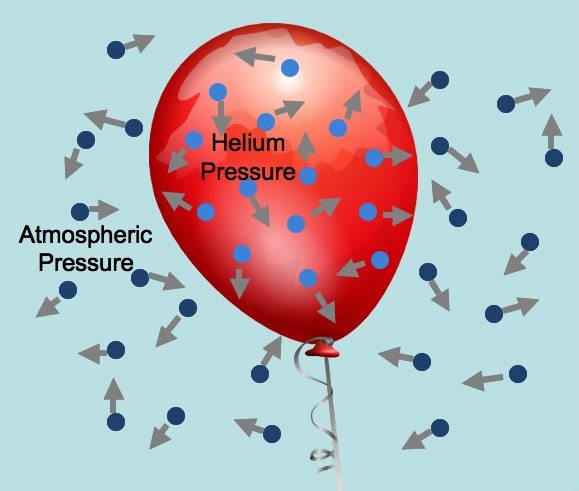
What causes pressure?
a)
The walls of the container
b)
The vacuum in the container
c)
The collisions of the particles
d)
Atmospheric pressure acting on the outside walls
27.
Boyle's PV law : When _______ is held constant, the pressure and volume of a gas are ________  proportional
a)
temperature,  equally
b)
mass, inversely
c)
temperature, inversely
d)
mass, equally
28.
Gases have...
a)
A definite shape and volume
b)
A definite shape but no definite volume
c)
No definite shape but a definite volume
d)
No definite shape or volume
29.
A gas of volume V is placed in a balloon.  Determine the new volume of the balloon if the pressure is tripled. The new volume will be ____ what it was originally.  
a)
1/3 of
b)
1/6 of
c)
1/9 of
d)
 9 times
30.
A gas of volume V is placed in a balloon. The absolute (Kelvin) temperature is tripled. The volume will be _____ what it was originally. 
a)
1/3
b)
1/6
c)
3 times
d)
6 times
31.
If you collect 22.4 L of oxygen (O2) at standard conditions, you will have ____.  
a)
1 mole of gas
b)
6.02 x 10²³ molecules of gas
c)
32 g of gas
d)
All of these answers
32.

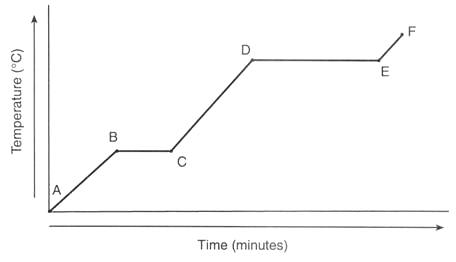
Between which points is the temperature of the substance remaining constant?

a)

A-B only

b)

A-B, C-D, and E-F

c)

B-C only

d)

B-C and D-E

33.

The melting point of the sample is

a)

-60 ºC

b)

20 ºC

c)

60 ºC

d)

100 ºC

34.

Which letter indicates where water is in both the solid and liquid phase at the same time?

a)

A

b)

B

c)

C

d)

D

e)

E

35.

In which region(s) does temperature increase?

a)

Region C only

b)

Regions B and D

c)

Regions A, C, and E

d)

Regions A and B

36.

In which region(s) of the heating curve would water be a liquid and a gas at the same time?

a)

A

b)

B

c)

C

d)

D

e)

E

37.

A given mass of gas in a rigid container is heated from 200K to 50K. Which of the following best describes what will happen to the pressure of the gas? The pressure will

a)

 decrease by a factor of 4

b)

increase by a factor of 4

c)

increase by a factor less than 4

d)

decrease by a factor greater than 4

38.
3KOH + H3PO4 --> K3PO4 + 3H2O
a)
Synthesis 
b)
Decomposition
c)
Single displacement
d)
Double displacement
39.

Adding salt to water lowers the _________ __________. That’s why it’s useful on the roads during the snowy months.

a)

boiling point

b)

molar mass

c)

melting point

d)

% composition.

40.

In an exothermic reaction, the heat of the reaction is always

a)

very small

b)

zero

c)

positive

d)

negative

41.

acid + base makes:

a)

acid + base

b)

salt

c)

water

d)

salt + water

42.

Which statement BEST describes the properties of bases?

a)

taste sour and neutralize acids

b)

feel slippery to the touch and turn litmus paper blue

c)

taste bitter and turn litmus paper red

d)

produce hydrogen gas in reactions and do not conduct electricity


43.

A ____ solution contains as much solute as it can hold at a given temperature.

a)

saturated

b)

unsaturated

c)

supersaturated

d)

suspended

44.
Convert 28.0 grams of O2 to moles.
a)
1.14 moles
b)
1.75 moles
c)
0.571 moles
d)

0.88 moles

45.
phosphorous acid
a)
H3PO4
b)
H2PO4
c)
H3P
d)

H3PO3

46.
hydrochloric acid
a)
HCl
b)

HClO

c)
H3ClO3
d)
HClO3
47.
sulfuric acid
a)
HSO3
b)
H2SO3
c)

H2SO4

d)

H3SO4

48.
Mg(OH)2
a)
magnesium hydroxide acid
b)
hydromagnesium acid
c)
magnesium oxygen hydride
d)
magnesium hydroxide
49.
What is the molarity of 3 mole of hydrochloric acid in 3 L of water. 
a)
3
b)
1
c)
6
d)
9
50.
The ___ is the thing being dissolved
a)
solute
b)
solvent
51.
What is the molarity in 650. ml of solution containing 63 grams of sodium chloride?
a)
2.4 M
b)
0.86 M
c)

1.65 M

d)
0.54 M