
 Worksheets
Advanced Concepts Quiz Five Review
Total questions: 10
Worksheet time: 5mins
A patient with gastrointestinal bleeding is awake, alert, and oriented and has the following vital sign measurements: blood pressure 130/90 mm Hg, pulse 118 beats/minute, respirations 18/minute, and temperature 98.6°F (37°C). Which finding should the nurse consider as a possible sign of early shock?
Respirations 18/min
Pulse 118 bpm
Temperature 98.6F
BP 130/90
When assessing the patient, the nurse notes that the patient responds to painful stimulus with both arms rigidly extended and with flexion and internal rotation of the hands. The nurse correctly charts this as?
decorticate posturing
decerebrate posturing
coma rigidity
impaired motor function
On arrival in the emergency department, a patient who was in a motor vehicle accident is apprehensive, confused, and hypotensive. The patient has tachycardia, oliguria, and cool clammy skin. What should the nurse do first?
Cover the patient with warm blankets
Perform a rapid head-to-toe assessment
Obtain the patient's medical history from family
Reorient the patient
A patient who is hemorrhaging has pale mucous membranes, blood pressure 92/52 mm Hg, pulse 160 beats/minute, and respirations 30/minute. The patient is receiving IV fluids at 150 mL/hour, has a blood transfusion infusing, and is being provided oxygen via a mask. What should the nurse recognize as the most likely cause of the patient’s respiratory rate?
Electrolyte imbalances
Inadequate tissue perfusion
Rapid rate of fluid replacement
Reaction to the blood transfusion
The nurse is caring for a patient in septic shock. The nurse identifies which as the contributing factor?
Blood loss
Hypersensitivity reaction
Infection
Heart failure
Data collection findings for a patient include shortness of breath with crackles in the lung bases, jugular vein distention, daily weight increased by 3 pounds from yesterday, report of chest pain, blood pressure 86/40 mm Hg. Which order should the nurse question?
Electrocardiogram (ECG) STAT
500 mL 0.9% normal saline (NS) over 30 minutes
Give Oxygen 2L/min via nasal cannula
Arterial blood gases (ABGs) STAT and repeat in 1 hour
The nurse can expect a patient who lost 2 liters of blood during surgery to experience which type of shock?
Cardiogenic
Anaphylactic
Hypovolemic
Obstructive
The nurse is receiving report on patients assigned for the next shift. Which patient should the nurse observe first?
A patient who has a pressure ulcer who is due for a dressing change
A patient with diabetes who has a blood sugar level of 85 and is eating lunch
A patient with cellulitis who is receiving the first dose of IV antibiotics and who is reporting a feeling of tightness in the throat
A patient with sickle cell anemia who is receiving a monthly transfusion of a unit of packed red blood cells who is reporting left knee pain
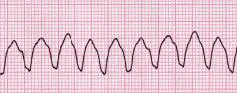
Identify this rhythm.
supraventricular tachycardia
ventricular tachycardia
atrial flutter
ventricular fibrillation
During a routine exam of a patient, the doctor feels a pulsating abdominal mass and also auscultates a bruit over the mass. These findings coincide with
varicosities
ascites
hepatomegaly
abdominal aortic aneurysm

