
 Worksheets
Year 12 Economics Quiz on exam topics
Total questions: 90
Worksheet time: 1hrs 20mins
Which statement is a positive statement?
The distribution of income and wealth in most western European countries is unequal.
The government ought to increase income tax on high earners.
There should be more legal rights given to workers to protect their status in the workplace.
Wages of those on low incomes should be increased.
What could not cause a shift in an individual’s demand curve for good Z?
a change in advertising expenditure on Z
a change in the individual’s income
a change in the individual’s tastes
a change in the price of Z
Why is national defence provided by the government?
In a free market it is excludable and rival in consumption.
In a free market it is non-excludable and non-rival in consumption.
The government has perfect information, so it can set the correct quantity required.
The private sector firm would charge a high price for its use as it is a necessity.
What is the main feature of an oligopoly market?
Few large firms dominating the market
No competition in the market
One firm dominating the market
Many small firms dominating the market
How does product differentiation occur in monopolistic competition?
By selling the same product as other companies
Through branding, advertising, and unique product features.
By reducing the quality of the product
By lowering the price of the product
What is a key feature of monopolistic competition?
High barriers to entry
Differentiated products
Identical products
Government regulation
What is the concept of scarcity in economics?
Limited availability of resources compared to unlimited wants and needs
Equal availability of resources and wants and needs
Scarcity refers to the excess of resources compared to wants and needs
Unlimited availability of resources compared to limited wants and needs
What does a point inside the production possibility curve indicate?
No impact on resource utilization
Overutilization of resources
Efficient use of resources
Underutilization of resources
What does interdependence mean?
It is where one or more groups respond to the actions of another group
It is where one group responds to the actions of another group
It is where multiple groups respond to the actions of another group
Which one of the following statements is not a characteristic of monopolistic competition?
Ease of entry into the industry
Product differentiation
A relatively large number of sellers
A homogenous product
In long-run equilibrium in a monopolistically competitive market, firms typically:
earn a normal profit
charge a price equal to marginal cost
earn an above-normal profit
charge a price equal to marginal revenue
Under monopolistic competition price discrimination can be made easily.
True
False
What type of products will firms produce in monopolistic competition?
Firms produce significantly differentiated products
Firms produce slightly differentiated products
Firms produce homogenous products with one modification
Firms produce a variety of different products
How can products be differentiated?
Brand name
Colour
Appearance
Packaging design
All of the above
Monopolistic competitors in long-run equilibrium will generally find that they are earning economic profits
True
False

Tap Water
monopoly
oligopoly
monopolistic competition
perfect competition

Coca-cola
monopoly
oligopoly
monopolistic competition
perfect competition
One of the assumptions of monopolistic competition is that it is made of a ...... number of firms
large
small
moderate
The product differentiation is also known as....
price competition
non-price competition
economics of scale
price discrimination
In the long run, in monopolistic competition, the producers will produce at a level of output .....
that is socially optimum
where AC is at a minimum
where MC=MR
A barrier to entry is
An obstacle that makes it difficult for new firms to enter a market.
A commitment on the part of big business to allow smaller companies to compete.
An obstacle that prevents additional workers from entering an industry, such as a union.
If there are many firms in an industry producing goods that are similar but slightly different, this is an example of
Monopoly
Monopolistic competition.
Since the airline industry is controlled by only a few very big companies, which type of market structure would best describe it.
Monopoly
Perfect Competition
Oligopoly
Going to the Dallas Farmers Market to buy apples, you will find this type of market structure.
Monopoly
Perfect Competition
Monopolistic Competition
Oligopoly
What are the characteristics of monopolistic competition?
Large number of small firms, high barriers to entry, homogeneous products, high market power
Large number of small firms, low barriers to entry, differentiated products, low market power
Small number of large firms, high barriers to entry, differentiated products, high market power
Small number of large firms, low barriers to entry, homogeneous products, low market power
Elsie, James, and Samuel are discussing the outcome for firms in monopolistic competition in the long-run, such as a local coffee shop. What is the most likely outcome for these firms in the long-run?
Supernormal profit
Normal profit
Losses
Maximum profit
What characterizes a free market?
Only one seller controls the market
The government does not intervene in day-to-day economic activities
The government intervenes in day-to-day economic activities
There are no buyers in the market
Which of the following is an example of an oligopoly?
The oil industry
The online retail industry
The grocery store industry
The local farmers market
An essential characteristic of a public good is that it is non-excludable. This means that
Public goods are of equal benefit to all consumers
There is no opportunity cost in the provision of public goods.
People could consume the good without paying for it.
The government should not levy a tax for providing public goods.
Which one of the following goods is excludable?
A city bus
A bridge that does not charge a toll
Protection from the police force
The atmosphere
Negative externalities in production results in market failure. This is because at the free market equilibrium
marginal social cost is greater than the marginal private cost
marginal private benefit is greater than the marginal private cost
marginal private benefit is greater than the marginal private cost
marginal social cost is less than the marginal private benefit
Public goods are provided by the government because
Private firms do not take into account the impact of external costs
Governments are more efficient than private firms at producing public goods
Private firms will make an economic profit
Free-rider problems result in underproduction by private markets
Free riding can occur if a good is
A private good
Excludable and nonrival
Non-excludable and rival
Non-excludable and non-rival
Which one of the following goods exhibits non-excludability?
Consumption by one person reduces the amount available for others
Consumption by one person does not affect others
Consumption by one person increases the amount available for others
Consumption is limited to a specific group
What is the free rider problem?
scarcity even when you pay for a good
Reaping all the benefits without contributing
Common goods that don't have a price
none of the above
What statement best explains why the government provides goods and services to its citizens?
To provide benefits to small groups of people in certain areas of the country.
To provide goods and services that would not be available if individuals had to provide them.
To compete with businesses in the private sector.
To make a large profit by providing certain goods and services to it's citizens.
What is one reason that local law enforcement is considered a public good?
Everyone in the community benefits from it.
Nobody in the community has to pay for it.
Private firms make a profit from producing it.
Individual citizens pay directly for it.
The goal of government welfare programs is to
maintain a poverty threshold that matches the median income.
eliminate the dependence of people on the welfare system.
eliminate the income gap between the richest Americans and the poorest.
raise the standard of living of certain less-fortunate members of society.
Which of the following is NOT an example of a public good?
Fireworks display
National Defense
Public transportation
Lighthouse
True or False:
Public goods/services can run out when people use them.
True
False
An example of a public good is:
McDonaldʻs hamburger
Sidewalks
Pokemon Cards
True or False:
Movie Tickets are a public good.
True
False
True or False:
Parks are a public good.
True
False
An example of a public service:
Grocery Store Cashier
Doctors
Military
An example of a public good is...
Roads
Cars
Jamba Juice smoothie
A public good
can only be consumed by one person at a time.
can be consumed simultaneously by many people.
is any good provided by a company owned by a member of the public.
is any good provided by the government.
is both rival and excludable.
Define Income Elasticity of Demand
YED measures the degree of responsiveness of quantity demanded for a good to a change in consumer's income, ceteris paribus
YED measures the degree of responsiveness of demand for a good to a change in consumer's income, ceteris paribus
YED measures the degree of responsiveness of consumer's income to a change in quantity demanded for a good, ceteris paribus
YED measures the degree of responsiveness of consumer's income to a change in demand for a good, ceteris paribus
Consumers demand less of this type of goods when their income increases.
Low grade rice
salt
bungalore
furniture
YED = 0 is referring to
Normal Goods
Inferior Goods
Luxury Goods
Necessity Goods

This car are referring to
Normal Goods
Inferior Goods
Luxury Goods
Compulsary Goods
Income elasticity is can be measured by
comparing the percentage change in demanded with the percentage change in income
comparing the percentage change in quantity demanded with the percentage change in price
comparing the percentage change in quantity demanded with the percentage change in income
comparing the percentage change in quantity supply with the percentage change in income
For normal goods, YED will typically be......
Positive
Negative
None of the above
Both of the above
The graph of a demand curve that is perfectly elastic is:
positively sloped.
horizontal.
vertical
negatively sloped.
For inferior goods, Income Elasticity of Demand will typically be...…
Positive
Negative
Both
None of these
For luxury goods, Income Elasticity of Demand will typically be.....
Positive
Negative
What is the formula to calculate income elasticity of demand?
Percentage change in quantity demanded / Percentage change in price
Percentage change in quantity demanded / Percentage change in income
Percentage change in price / Percentage change in quantity demanded
Percentage change in income / Percentage change in quantity demanded
What does an income elasticity greater than 1 indicate?
Demand for luxury products rises more than the change in income
Demand for necessities rises more than the change in income
Demand for luxury products rises less than the change in income
Demand for necessities rises less than the change in income
Tesco Value Baked Beans
Normal Good
Inferior Good
Luxury Good
If the income elasticity of demand for a car is 2, how would you classify this good?
The quantity demanded for an inferior good decreases from 300 to 240 units when consumer income increases from £20,000 to £25,000. What is the income elasticity of demand?
-0.2
-0.4
-0.6
-0.8
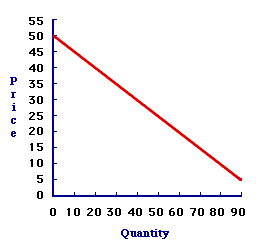
What does this curve represent?
Supply
Equilibrium
Demand
Surplus

Which diagram shows the supply curve?
A
B
C
D
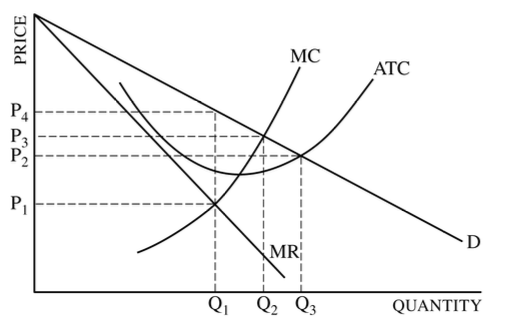

What is the profit-maximizing price and quantity?
P1, Q1
P2, Q4
P3, Q3
P4, Q2
P5, Q1
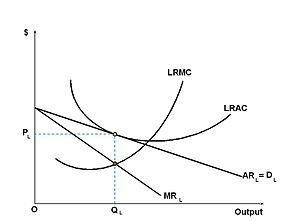
If this graph is for a monopolistically competitive firm, it best represents
short run economic loss.
short run extra-normal profit.
long run economic profit.
long run equilibrium at normal profit.
short run accounting loss.
Markets with very few barriers to entry are usually
Monopolies
Oligopolies
Competitive Markets

Rent control is an example of a ________, when the government sets a maximum price for a good/service.
Price Ceiling
Equilibrium
Black Market
Price Floor

What is the marginal product with 3 labourers?
5 unit
5.5 units
6 units
7 units
What is a barter system in economics?
An exchange system using standardized currency.
A system where goods and services are directly exchanged without money.
A digital payment system for online transactions.
A complex economic theory.
In a barter system, what is the "double coincidence of wants"?
A requirement to have two forms of currency.
The need for two parties to have matching desires for each other's goods or services.
A requirement for two intermediaries in a trade.
The need for two separate transactions to complete a trade.
Which of the following is a limitation of barter systems?
Lack of divisibility of goods
Uniformity in the value of exchanged goods.
Efficient allocation of resources.
Reduced complexity in trading.
Why is barter system considered inefficient?
Because it requires double coincidence of wants.
Because it promotes economic growth.
Because it simplifies transactions.
Because it allows for easy calculation of exchange rates.
What is the history of barter?
Barter was only used in one specific ancient civilization
Barter is a system of exchange where goods or services are directly exchanged for other goods or services without using a medium of exchange, such as money. It has been used for centuries, dating back to ancient civilizations.
Barter was invented in the 21st century
Barter was never a common practice

Which is not a characteristic of an oligopoly
Few producers in a market
Similar products
High barriers to enter
one producer in the market

A
B
C
D

A
B
C
D

A
B
C
D

The following diagram shows the production possibility frontier for an economy that produces bread and honey.
If the economy is initially at point W, then the opportunity cost of moving to point X is
6 units of honey.
8 units of honey.
12 units of bread.
23 units of bread.

The following diagram shows the production possibility frontier for an economy that produces bread and honey.
If the economy is initially at point W, then the opportunity cost of moving to point X is
6 units of honey.
8 units of honey.
12 units of bread.
23 units of bread.

Which scenario contributes towards the shifting of the curve in the picture above?
When a country is struck by a natural disaster, natural resources are either exhausted or reduced due to the incident.
Huge reduction in Construction Expenses and equipment manufacturing
Economic decline due to Covid 19
None of the above

