
 Worksheets
Quiz on Plant Scientist Experiment
Total questions: 42
Worksheet time: 2hrs 31mins
What did this scientist do prior to starting her experiment with plants?
List the terms. As you learn about each one, make notes in the Interactive Glossary.
As you read these two pages, draw a line under each main idea.
Suppose you’ve just heard an opera singer warm up her voice. Write your own science question about the sounds a singer makes.
How do different bridge designs react to strong winds?
How fast does the wind blow where a bridge will be built?
Which type of paint works best to keep a bridge from rusting?

The time until Old Faithful's next eruption is affected by how long the previous eruption lasted. The data in the table are the result of observational testing. Do the data support the statement above? Explain.
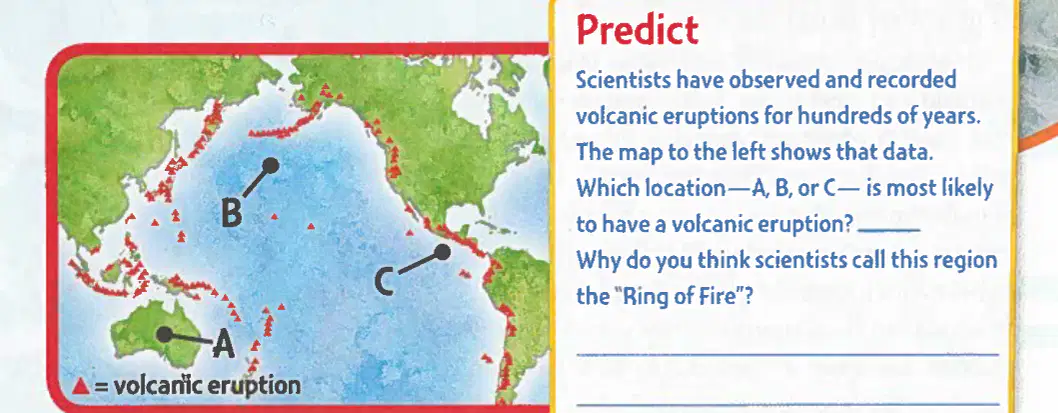
Scientists have observed and recorded volcanic eruptions for hundreds of years. The map to the left shows that data. Which location—A, B, or C—is most likely to have a volcanic eruption?
Why do you think scientists call this region the "Ring of Fire"?
How is an earthquake model made of gelatin like a real earthquake? How is it unlike a real earthquake?
Fill in the blank in the hypothesis. Any substance dissolved in water will (a) the temperature at which the mixture freezes and melts.
When you identify and control variables, you determine which conditions should stay the same and which one should be changed. Circle the variable that will be tested. Underline the variables that will remain the same.
the temperature of the freezer
the types of thermometers
the material that is dissolved in the water
the kinds of cups
the amount of water
Describe a simple experiment testing one variable that you could conduct using the same materials and procedures described in this investigation.
What conclusion can you draw based on the melting point experiment?
Decide if the hypothesis is supported or not. If not, try rethinking your hypothesis. Then design a new experiment to test it.
Ask a well-defined question you could answer using experimental testing.
Plan, describe, and implement an experiment that tests the effect of only one variable.
All start with a (a) .
Investigations differ: experiments, __________.
All have results from which to __________.
Examples: volcanoes, __________.
Types of models: diagrams and flow charts, (a) .
Types of models: diagrams and flow charts, physical models, __________.
Experiments: Ask well-defined questions, hypothesize, __________.
Experiments: Carry out the procedure, __________.
Kinds of data displays: circle graphs, (a) .
Kinds of data displays: circle graphs, bar graphs, (a) .
Kinds of data displays: circle graphs, bar graphs, time graphs, (a) .
All the ways scientists do investigations: __ __ __ __ __ __ __ __ __ __ __ __
These show how something works that can't be seen: __ __ __ __ __ __ __ __ __
(a)
The part of an experiment used to compare all the other groups: __ __ __ __ __ __ __
(a)
What scientists do that is the basis for their investigations: __ __ __ __ __ __ __ __ __ __ __ __ __ __
(a)
Any condition in an experiment that can be changed: __ __ __ __ __ __ __ __ __ __
(a)
A type of graph suited to show change over time: __ __ __ __ __ __ __ __ __ __ __ __
(a)
A statement that can be tested and that explains what you think will happen in an experiment: __ __ __ __ __ __ __ __ __ __ __ __ __ __ __
(a)
The steps you follow in your experiment: __ __ __ __ __ __ __ __ __ __ __ __ __ __ __
(a)
What kinds of birds visit a feeder at different times of the year?
Does hot water or cold water boil faster?
What are the parts of an elevator and how does it work?
How does the length of a kite’s tail affect the way it flies?
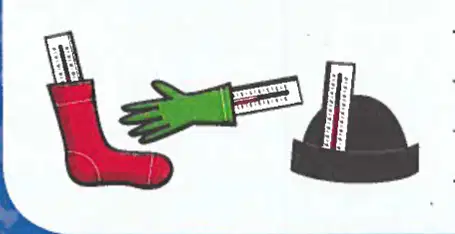
Ryan hypothesizes that darker colors heat up faster. He places a thermometer inside a red wool sock, a green cotton glove, and a black nylon hat. What’s wrong with his procedure?

