
Font size
 Worksheets
Revision June year 7
Total questions: 197
Worksheet time: 2hrs 16mins


Food webs show you everything an animal eats. Food chains show you one thing.

when drawing a food chain, do we ever start it with the sun?
Yes
No
Sometimes
Only if it is day time

What do lizards eat?
mice
grasshoppers
hawks
grass

What might happen if all the rabbits died?
There would be more hawks because there are fewer rabbits in competition with them.
There would be fewer lizards because the hawks would eat more of them.
There would be less grass because the grasshoppers would eat it.
There would be more snakes because they would not compete with the rabbits.
The arrows in a food chain show:
the flow of energy
the loss of energy
how animals use energy to move around in a habitat
how plants make their own energy.

Using the food web, choose the organisms in the correct order.
microscopic plants > water fleas > small fish > perch
microscope plants > perch > water flease > small fish
perch > waterboatmen > small fish > tadpoles
microscopic plants > tadpoles > water boatman > perch
What word describes the movement of many animals from one part of the world to another?
hibernation
changing
tourism
migration

*Remember Humans are on the top of all food chains because we do not get hunted.

Which of these organisms could not be easily counted in a quadrat?
Sparrows
Snails
Moss
Daisies
True or false? Sampling often saves time and money.
True
False
Which is the correct definition of sampling?
Looking at a section of a population to make an estimate.
A measure of the number of different species in a habitat.
All the members of a single species that live in a habitat.
Numbers used to indicate the position of a point
Which organisms would you sample in a sweep net?
Butterflies
Ants
Moss
Woodlice
Which organisms would you sample using a pooter?
Earthworms
Ladybirds
Lichen
Butterflies
If there were 26 daisies in 10% of the school field, what would be the estimate for the entire population?
26
10
90
260
What is the imaginary line in systematic sampling called?
Transect
Quadrat
Coordinate
What does biodiversity mean?
Numbers used to indicate the position of a point
A measure of the range of living organisms within an area
All the members of a single species that live in a habitat
The place where an organism lives
Where would kick sampling be used?
In a field
In a river or stream
On a hill
In a tree
Which piece of equipment would be best to sample dormice?
Pitfall trap
Pooter jar
Quadrat
Sweep net
What is a suitable way to sample plants in a field?
Counting Random Plants
Using Quadrats
Using Pooters
Using Pitfall traps
What is a quadrat
A type of bike
A sampling tool typically of one square metre, used to sample plants
A sampling tool typically of one square metre, used to sample animals
A type of hat
Which of the following is true about quadrats?
quadrats should be placed randomly so that a representative sample is taken
you should look at the results from several quadrats in an area to reduce the effect of an unusual distribution
the results are more reliable when you look at the results from many quadrats
All the above are true
What is the best way to place a quadrat?
Place it where you like
Divide the sample area into a grid and use a random number generator to choose a square.
Throw the quadrat so it's random
Divide the sample area into a grid and choose a square.
responsible for developing the classification system we use today (taxonomy). He also developed classification hierarchy.
Isaac Newton
Albert Einstein
Carolus Linnaeus
Bill Nye the Science Guy
Why do we classify things?
Grouping things helps us to understand them better
all the cool people do it
because we're better than every other organism
why not?
If you divide something in half (have a left and right side), the
sides are “mirror images.” (Most animals have this)
dichotomous
bilateral symmetry
diversity
radial symmetry
An organism is.......
a person who plays the organ
a part of speech
a dichotomous
any living thing
A device used to identify what group an organism or object is in. Most use a two choice system where you answer yes or no to each question to arrive at the correct group.
compass
dichotomous key
map
microscope
The largest of the classification groupings. Currently scientists have identified five.
kingdom
species
phylum
genus
When something can be divided into two identical halves when divided at any angle.
refraction
bilateral symmetry
reflection
radial symmetry
The smallest of the classification groupings. Any group of organisms that share common genetic information. Members are capable of breeding and producing offspring that can also reproduce.
order
phylum
species
kingdom
Which of these is NOT one of the 5 Kingdoms?
Fungi
Plantae
Linnaeus
Animal
Monera
Which of these in the correct order, from LARGEST to smallest?
Kingdom, Phylum, Class, Order, Family, Genus, Species
Species, Family, Order, Genus, Class, Kingdom, Phylum
Kingdom, Phylum, Order, Genus, Species, Family, Class
Species, Family, Class, Kingdom, Phylum, Order, Genus

What is the unit to MEASURE force?
Kilogram
Meter
Pounds
Newton

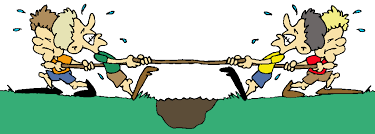


Forces that have a net force of zero Newtons
Balanced force
Unbalanced force
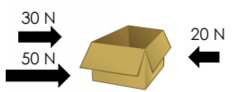


Which two of these forces act on parachutes?
Air Resistance
Gravity
Thrust
Kinetic Energy
Another name for air resistance is...
Buoyancy
Streamline
Gravity
Drag
What causes an object to fall faster?
Smaller surface area
Larger surface area
If it has a parachute
If it is softer

The larger the surface area of the moving object, the ___________ air resistance there is.
Less
More
Longer
Quicker
The larger the parachute the ____________
Less air resistance
More surface tension
Less drag
More drag

The more streamlined an object is, the...
More air resistance
Less air resistance
Slower air resistance
Faster air resistance
When dropped from the same distance, which will fall to the floor faster?


What is a parachute designed to maximize?
Gravity
Air Pressure
Air Resistance
Thrust
Complete the sentence.
It is not the difference in gravity that causes objects to fall at different speeds, it’s the difference in the amount of__________________.
Gravity
Mass
Air resistance
What is the name of the units that we measure force in?
Einsteins
Newtons
Kilograms
Metres
What is the value of the resultant force?

A type of friction that occurs when air pushes against a moving object
surface area
air resistance
velocity
gravity
Streamlining is all about trying to produce a shape that produces the smallest amount of resistance
False
True

How does streamlining affect speed?
more streamlining decreases speed
more streamlining increases speed

This car would have ....
Poor streamlining
Good streamlining
Friction can be reduced by:
providing wheels
lubricating
streamlining
All of these
Which of the following is contact force
magnetic force
electrostatic force
gravitational force
none of these
A force between two objects that are TOUCHING is a
Non-contact Force
Contact Force
Gravitational Force
Jedi Force
A force that acts between objects that are electrically charged is a(n)
Magnetic Force
Electric Force
Gravitational Force
Frictional Force
Which of these is not a contact force?
Air resistance
Gravity
Friction
Upthrust
If the forces acting on an object are balanced, the object will...
remain stationary
move faster
You can reduce friction by making the surfaces...
smoother
hotter
closer together
harder

Friction works in the _____________ direction to the object moving.
same
opposite

Complete the sentence - A compressed spring stores ..........................................
elastic potential energy
gravitational potential energy
kinetic energy
electrostatic energy

What is the best description of the relationship shown in this graph?
Linear
non-linear.
directly proportional.
There is no relationship between force and extension.
Which statement most accurately represents Hooke's Law?
a) The stretch of a spring is directly proportional to the force applied.
b) The stretch of a spring is proportional to the number of coils.
c) The stretch of a spring is inversely proportional to the force applied.
d) Thickness of a spring wire is proportional to the force applied.

An unstretched spring becomes longer when a force is applied to it. Which word describes the additional length of the spring gains?
Expansion
Extension
Stretched
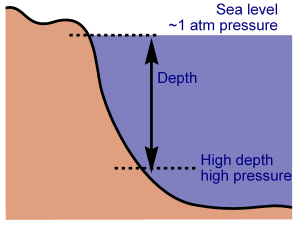
When you increase your depth under water, the water pressure on your body
increases
decreases
stays the same

Diagram shows the design of a dam. Why does the thickness of the dam increase with its depth?
The design of this structure is stronger.
Water pressure increases with depth.
The cost of construction is lower.
Water pressure acts uniformly in all directions.


Amira puts two books on a table as shown in the diagram. The books are the same size and mass. Which book exerts greater pressure on the table?
A
B
Will air pressure be higher on top of a mountain or on the beach?
beach
mountain
It's always the same
The higher the temperature, the .................................. the movement of air particles.
slower
faster
neither
same

Which word best describes the force from a liquid acting on a floating object?
Weight
Upthrust
Water resistance
Friction
When an object is floating in water, the object's weight and the upthrust of the water are ________ .
balanced
unbalanced
zero
dependent on other things
What happens if the weight of an object is equal to or less than the upthrust?
It floats
It sinks
It spins
It explodes!
What happens if the weight of an object is greater than the upthrust?
it floats
it sinks
it bounces
it vibrates

Diagram shows an investigation conducted by Mazni. How much is the buoyant force exerted on the object when it was in the water?
1.07 N
0.28 N
0.27 N
1.68 N
What is extension?
A measure of how stiff or strong a spring is.
The increase in the length of something.
When an object springs back to its original shape.
What is the control centre of the cell called?
Nucleus
Cell membrane
Cytoplasm
Mitochondria
What is the role of the cell membrane?
Site of respiration
Is the control centre of the cell.
Allows substances to enter and leave the cell.
Gives the cell structural support.
What is jelly like substance where cell reactions take place?
mitochondria
cell membrane
cytoplasm
vacuole
Which cell organelles are ONLY found in PLANT cells.
nucleus, cytoplasm, cell membrane
cell membrane, chloroplasts, large vacuole
cell wall, mitochondria, large vacuole.
cell wall, chloroplasts, large vacuole.
What is chlorophyll?
It is another name for the chloroplast.
The green pigment found in chloroplasts that absorbs light.
The green pigment found in mitochondria that absorbs light.
A pathogen

What type of cell is this?
Animal cell
Plant Cell

Which letter on the diagram represents the nucleus?
C
D
E
F

Which letter shows the site of photosynthesis?
B
C
D
F

Which letters represent organelles found in both plant AND animal cells?
A, E, F
B, E, F
B, F, D
A, C, D

Which letter represents the cytoplasm?
E
F
G
D

What is the name of this part?
base
leg
arm
eyepiece

What is the name of this part?
base
leg
arm
eyepiece

What is the name of this part?
stageclips
leg
body tube
coarse adjustment knob

What is the name of this part?
objective lens
eyepiece/ocular lens
diaphragm
slide

What is the name of this part?
fine adjustment knob
eyepiece/ocular lens
stage
body tube

What is the name of this part?
lamp
eyepiece/ocular lens
leg
objective lens

What is the name of this part?
arm
eyepiece/ocular lens
nosepiece
objective lens

What is the name of this part?
stageclips
stage
nosepiece
slide

What is the name of this part?
stageclips
stage
nosepiece
slide
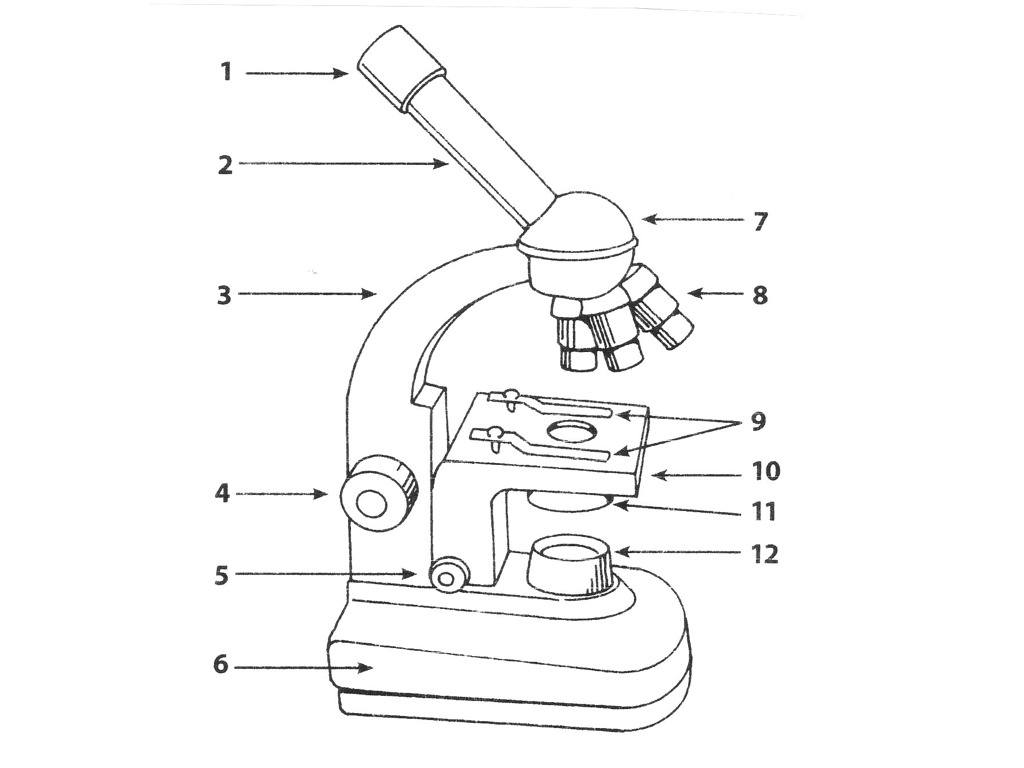
____________________________________: magnifies the image by 10x. This is where you put your eyes.
eye piece
stage
fine adjustment knob
objective lens
slide clip
____________________________________: Three separate lenses to magnify the image (4X, 10X, and 40X). The one in use is the one above the object being viewed.
objective lens
eye piece
stage
slide clip
coarse adjustment knob


What do animal and plant cells have in common?
Both have central vacuoles,cytoplasm and nucleus.
Both have chloroplasts,cytoplasm and nucleus.
Both have cell membranes, cytoplasm and nucleus.
Both have cell walls, cytoplasm and nucleus.


What is the name of the green subtance that capture light in plant cell?
Nucleus
Chlorophyll
Membrane
Organelles

A group of cells forms...
Multicellular organism
Organs
Systems
Tissues

A very easy one... check the true statement. look at the picture and put in order
Cell, tissue, organ, organ system,organism
Cell, organ, system, organism, organ system
Cell, tissue, organism, organ, system
Cell, tissue, organism, system, organ

Letter B is which organelle?
Nucleus
Cytoplasm
Vacuole
Mitochondria
Reorder the following (smallest to biggest)
Cell
Tissue
Organ
Organ System
Organism
What organelles are in plant cells only (tick all correct answers)
Cell Wall
Cell Membrane
Nucleus
Permanent Vacuole
Chloroplasts

Sperm Cell

Muscle Cell

Root Hair Cell

Palisade Cell

Ciliated Cell
Match the following cells to their adaptations
Has a streamlined shape
Contains lots of mitochondria for contracting
Has a large surface area
Contains lots of chloroplasts
Has hairs for moving mucus
Match the following cells to their functions
Swims towards an egg cell
Contracts to move
Absorbs nutrients and water
Carries out photosynthesis
Removes mucus from airways

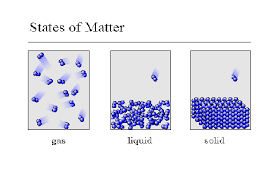
___________ is anything that has mass and takes up space.
Molecules
Matter
Volume
________ is the amount of space an object takes up.
Mass
Matter
Volume
Which state of matter does not have a definite shape but does have a definite volume?
Solid
Liquid
Gas
What is the process called when a gas turns into a liquid?
Condensation
Melting
Freezing
Evaporation
What is the process called when a solid changes to a liquid?
Freezing
Evaporation
Melting
Condensation
What is the process called when a liquid changes into a gas?
Freezing
Evaporation
Melting
Condensation
Solid to Liquid
Melting
Liquid to Gas
Evaporating
Solid to Gas
Sublimation
Gas to Liquid
Condensing
Liquid to Solid
Freezing
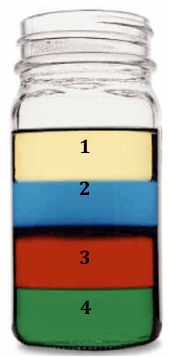
4
3
2
1
Scale
Newton meter
Force device
Top pan balance
An apple has a mass of 0.2 kg. Calculate the weight of the apple on Earth (g = 10 N/kg).
(a)

What is the net force on the car?
400 N forward (left)
0 N (balanced forces)
200 N forward (left)
200 N backward (right)

What will the net force on the soccer ball be?
50 N to the left
50 N to the right
200 N to the left
200 N to the right

Person on the left = 45 N
Person on the right = 32 N
What is the net force?
zero N
10 N
77 N
13 N

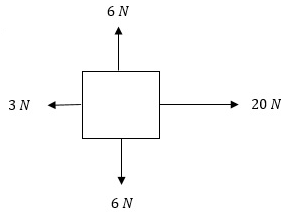
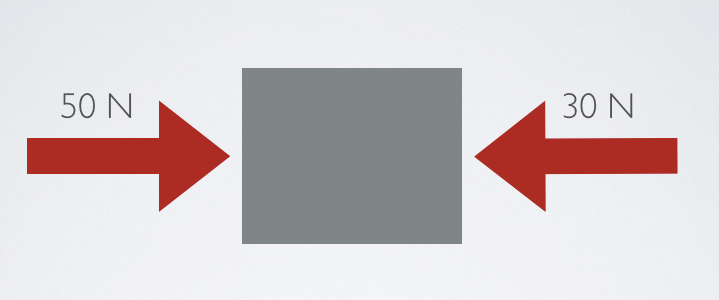
What is the NET FORCE of this diagram?
17 N, right
17 N, left
23 N, right
12 N, up

