
Font size
 Worksheets
MPYL 3 REVIEW
Total questions: 22
Worksheet time: 31mins

Name the 5 initial literacy steps
What are the 5 areas of knowledge that YLs develop when they learn literacy skills in L1?

What are the challenges that YLs face at the moment of learning to read/write in English?
What does a child have to do to be able to read?
It’s a bottom-up approach that focuses on the smallest unit of text: letters. Its objective is to help YLs decode written language using sound.
Language Experience
Phonics
Whole Language
Begins with meaning then uses language in context for further language study. It involves top-down processing
Phonics
Phonemic Experience
Whole Language
Language Experience
Mention 3 of the 11 reading strategies
Which one is not an element every writing assignment should have?
Topic
Purpose
Audience
Gender
What's the difference between the Product and the Process Approach?
Mention ONE reason why Storytelling is beneficial and explain
What are the 4 elements that make Storytelling engaging?
Script, props and gestures
Cue cards, props and theatrics
Theatrics, script and realia
Script, props, theatrics and rehearsals
What should be done BEFORE storytelling?
What should be done DURING storytelling?
Capture attention, Qs and As, TPR
Qs and As, repetition, TPR, create their own ending
Check predictions, Qs and As, TPR
Games, check predictions, check prior knowledge

What is the aim of the activity?
Capture Ss attention
Connect to prior knowledge/exp.
Review language
Pre-teach vocab.
Predict the story

What is the aim of the activity?
Capture Ss attention
Connect to prior knowledge/exp.
Review language
Pre-teach vocab.
Predict the story

What is the aim of the activity?
Capture Ss attention
Connect to prior knowledge/exp.
Review language
Pre-teach vocab.
Predict the story

What is the aim of the activity?
Capture Ss attention
Give Ss a purpose for listening.
Review language
Pre-teach vocab.
Predict the story

What is the aim of the activity?
Capture Ss attention
Give Ss a purpose for listening.
Review language
Pre-teach vocab.
Predict the story
Which activities are appropriate for beginning readers?
Pointing/circling initial or final letters in words
Arranging words in proper sequence in sentences and in text
Sorting/matching words that rhyme
ollowing along with a text while listening to it
Matching words with pictures, same words or words with same initial or final letters
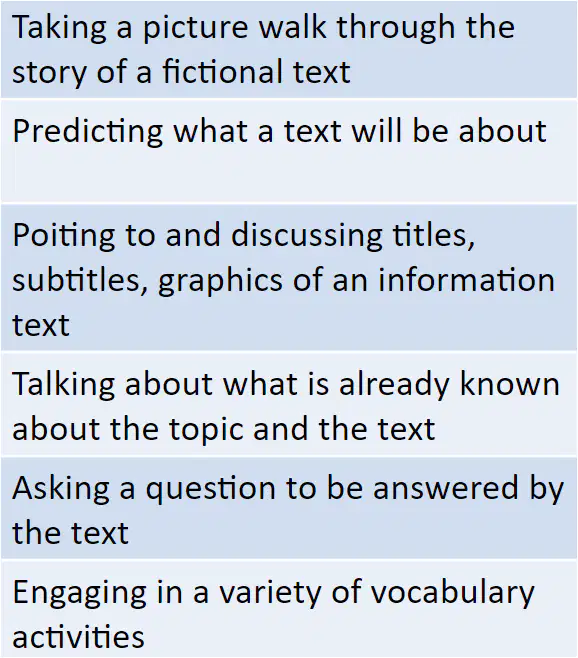
Which type of reading activities are these?
Pre-reading activities
During activities
post-reading

Which type of reading activities are these?
Pre-reading activities
During activities
post-reading
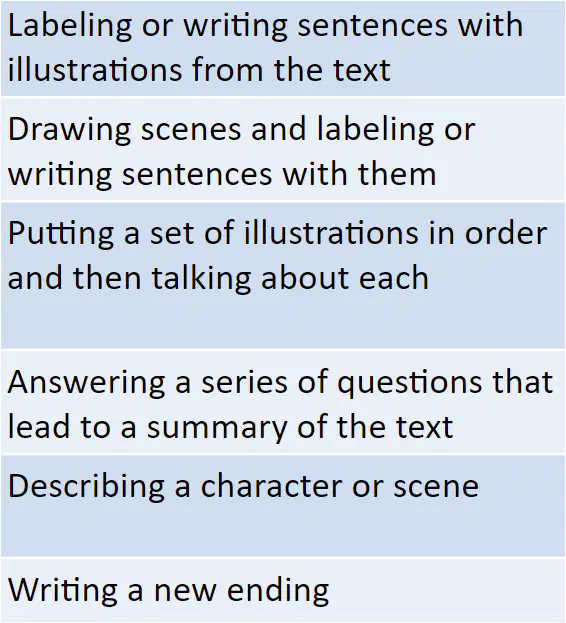
Which type of reading activities are these?
Pre-reading activities
During activities
post-reading

