
NEW
Font size
 Worksheets
Air Brake System Quiz
Total questions: 65
Worksheet time: 2hrs 10mins
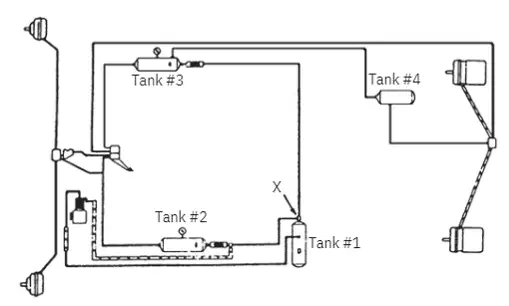
An air leak at point 'X' in the system shown above would cause which of these to leak down?
tank only
tank only
2 and 4 tanks only
the entire system

The slack adjuster shown above is being adjusted. Technician A says that travel 'X' should be as short as possible without dragging the brakes. Technician B says that angle 'Y' should be less than 90 degrees when the brakes are applied. Who is right?
Technician A only
Technician B only
Both A and B
Neither A or B
Which of the following cannot cause a drum on an air-braked vehicle to overheat?
an over-tightened brake adjuster at that wheel
under-adjusted brake(s) elsewhere on the vehicle
too-high governor cut-out pressure
driving downhill in too high a gear
All the brakes drag on a school bus with hydraulic brakes. Which of the following could be the cause?
air in the hydraulic system
too high a vacuum supply to the power brake booster
a leaking secondary cup in the master cylinder
no brake pedal free travel
Which of the following could cause a pulsating brake pedal on a school bus with hydraulic brakes?
zero brake pedal free travel
glazed linings
an out-of-round brake drum
a frozen wheel cylinder piston
In the 'AL' factor, the 'L' refers to the:
lining’s friction code
thickness of the lining
type of front-brake limiting valve
length of the slack adjuster
Technician A says that linings worn too thin on an air-braked school bus can cause the S-cam shaft to roll over. Technician B says this condition can cause excess brake pedal travel. Who is right?
Technician A only
Technician B only
Both A and B
Neither A or B
Spring brakes on an air-braked school bus must be able to hold the vehicle, facing uphill or downhill, on what percent grade?
10%
20%
30%
40%
The driver of a school bus with hydraulic brakes says the pedal reserve is too low. Technician A says the brakes could be out of adjustment. Technician B says one brake system may have failed. Who is right?
Technician A only
Technician B only
Both A and B
Neither A or B
The parking brakes fail to apply on a school bus with air brakes. Technician A says this could be caused by low air pressure in the spring brake chamber. Technician B says this could be caused by a ruptured spring brake diaphragm. Who is right?
Technician A only
Technician B only
Both A and B
Neither A or B
How much free movement should exist between a slack adjuster and its camshaft?
0.005-in. max
0.010-in. max
0.015-in. max
0.020-in. max
The warning light on a bus with an anti-lock brake system illuminates when the bus is started. When the bus is moving, the light stays on. Which of the following could be the cause?
Misadjusted wheel sensor
Bad air release solenoid
Blown fail-safe monitor fuse
Bad warning light relay
The driver of a school bus with air brakes says it has poor stopping ability. Any of these could be the cause EXCEPT:
The quick release valve exhaust port is plugged.
The air pressure is too low.
The service line is restricted.
The brakes are adjusted incorrectly.
Technician A says brake shoes should not be contaminated by any grease or oil. Technician B says a spot covering no more than 10% of the lining surface is permissible. Who is right?
Technician A only
Technician B only
Both A and B
Neither A or B
The driver of a school bus with air brakes says that the brakes are slow to release. Which of the following is the LEAST likely cause?
A weak return springs
A plugged exhaust port
A kinked air line
Worn brake linings
An air-braked school bus has lining wear tapered from inboard to outboard. There also is abrasion on the outer edges of the brake shoes. What could NOT be the cause?
Worn anchor pins
Worn outer S-cam bushings
Distorted anchor pin holes
Weak return springs
The driver of a school bus with hydraulic brakes says the brake pedal is extremely hard when stopping. Technician A says the problem could be in the power assist system. Technician B says the problem is most likely a weak or broken brake shoe return spring. Who is right?
Technician A only
Technician B only
Both A and B
Neither A or B
When exhausting the air pressure in an air brake equipped school bus, when should the low air warning buzzer sound?
around 20 psi
around 60 psi
around 40 psi
none of the above
On a school bus with hydraulic brakes, all of the following could cause a spongy brake pedal EXCEPT:
air in the system
excessively worn or cracked brake drums
broken pedal pivot bushing
restricted brake hose or line
With foot pressure applied, the brake pedal on a school bus with hydraulic power brakes moves down slightly when the engine is started. Technician A says that this condition can be caused by a leaking power brake booster diaphragm. Technician B says that the cause could be a faulty power brake booster check valve. Who is right?
Technician A only
Technician B only
Both A and B
Neither A or B
A technician finds that the service brakes on an air-braked school bus grab or pull to one side when stopping. Which of the following could be the cause?
glazed or contaminated lining
insufficient air pressure
overloaded vehicle
defective quick-release valve
All of the following are phases of hydraulic brake ABS control EXCEPT:
pressure maintain
pressure induction
pressure increase
pressure decrease
Technician A says that when adjusting a manual slack adjuster, if there is little or no pressure on the wrench once the shoes make contact with the drum, the adjustment mechanism is broken and the slack adjuster should be replaced. Technician B says if the adjustment mechanism is broken, the slack adjuster can be rebuilt. Who is right?
Technician A only
Technician B only
Both A and B
Neither A or B
Technician A says that DOT 3 brake fluid has a higher boiling point that DOT 4 brake fluid. Technician B says that DOT 5 brake fluid should not be used in a vehicle with ABS. Who is right?
Technician A only
Technician B only
Both A and B
Neither A or B
Which of the following is NOT the name for a type of driveline parking brake?
expanding disc
contracting shoe
expanding shoe
disc
Technician A says that some compressor governors are adjustable. Technician B says that some governors are mounted in the engine compartment instead of on the compressor. Who is right?
Technician A only
Technician B only
Both A and B
Neither A or B
The minimum suggested lining thickness for drum brakes is:
1/2-in.
1/4-in
3/4-in.
1/3-in.
On a bus with air brakes, the air tank pop off valve releases air prematurely. A technician has removed and checked the valve and it has checked out OK. What else could cause this problem?
governor adjustment
kinked air hose
defective drain valve
defective pressure limiting valve
When checking an application valve for internal leaks, an ultrasonic leak detector can be used at which port?
exhaust port
discharge port
release port
application port
Hydraulic brakes that drag or fail to release can be caused by which component in the master cylinder.
leaking primary cup
leaking secondary cup
failure of the residual pressure check valve
clogged compensating port
Technician A says that before a gear-driven air compressor is replaced, the gear must be timed with the engine prior to installation. Technician B says that when timing an air compressor gear, the piston in the engine’s No. 1 cylinder must be at Top Dead Center. Who is right?
Technician A only
Technician B only
Both A and B
Neither A or B
Technician A says the minimum thickness of solid disc brake rotors should be at least 0.779-in. Technician B says the minimum thickness of vented disc brake rotors should be at least 1.626-in. Who is right?
Technician A only
Technician B only
Both A and B
Neither A or B
The driver of an air-braked bus with ABS complains that on a panic stop in wet weather conditions, the right rear wheel locks up. What could be the cause?
a defective ABS/ECU
an air leak in the primary reservoir
a defective ABS wheel sensor
a defective diagnostic switch
Technician A says that all air compressors only have one cylinder. Technician B says that air compressors are available with up to four cylinders. Who is right?
Technician A only
Technician B only
Both A and B
Neither A or B
Proper voltage for an anti-lock brake system to function properly must be between:
8.5 to 13 volts
12.0 to 18 volts
24.0 to 27 volts
9.5 to 14 volts
All of the following can cause a problem in the Hydro-boost system EXCEPT:
loose power steering pump belt
leaking power steering hoses
low power steering pump pressure
leaking check valve
All of the following are procedures for removing air from a hydraulic system EXCEPT:
bench bleeding
power bleeding
manual bleeding
vacuum bleeding
Brake fluid leaking from a cracked hydraulic brake line causes the brake light on the dashboard to illuminate in response to the loss of hydraulic pressure. Which of the following valves in the hydraulic system switched on the light?
metering valve
pressure differential valve
proportioning valve
residual check valve
Technician A says that an integral ABS system is an add-on system. Technician B says that a non-integral ABS system is a high-pressure system. Who is right?
Technician A only
Technician B only
Both A and B
Neither A or B
The driver of a bus with hydraulic disc/drum brakes says the bus dives when the brakes are applied. Which of the following could be the cause?
defective metering valve
defective proportioning valve
defective safety valve
defective check valve
Technician A says that the low air pressure warning system must provide a signal that the driver can hear. Technician B says that the low air pressure warning system must provide a signal that the driver can see. Who is right?
Technician A only
Technician B only
Both A and B
Neither A or B
Wheel bearings have been removed from a vehicle. Technician A says that a bluish coloring on the bearings indicates normal wear and tear. Technician B says the wheel seals can be reused. Who is right?
Technician A only
Technician B only
Both A and B
Neither A or B
Technician A says the pressure protection valve protects against total air brake system failure by isolating the leaking reservoir from the rest of the air brake system. Technician B says the valve can be replaced without depleting the air brake system. Who is right?
Technician A only
Technician B only
Both A and B
Neither A or B
Technician A says air leaks in an air brake system can be checked using soapy water. Technician B says when servicing a spring brake chamber, the chamber must be caged. Who is right?
Technician A only
Technician B only
Both A and B
Neither A or B
The MOST likely cause for no air pressure in the secondary air reservoir tank is:
improperly adjusted air governor
blocked one-way check valve
weak pressure relief valve
restricted compressor main discharge line
Technician A says that a 3-in. soap bubble in three seconds leakage at the exhaust port of a foot valve is acceptable. Technician B says an application valve is the same as a foot valve. Who is right?
Technician A only
Technician B only
Both A and B
Neither A or B
Technician A says that brake adjustment is required after installing new brake shoes. Technician B says that disc brake pads are self-adjusting. Who is right?
Technician A only
Technician B only
Both A and B
Neither A or B
All new generation anti-lock systems on air braked vehicles _______________.
A. revert to conventional brake system operation when an ABS failure occurs
B. revert to non-ABS mode on one front and one rear wheel when an ABS failure occurs
C. revert to non-ABS mode on the front wheels when an ABS failure occurs
D. revert to ABS mode on the rear wheels when an ABS failure occurs
Technician A says that all disc brake calipers are mounted directly to the torque plate. Technician B says that calipers are mounted to the torque plate using slide pins. Who is right?
A. Technician A only
B. Technician B only
C. Both A and B
D. Neither A or B
What should be checked first when inspecting brakes for mechanical imbalance?
A. leaking valves
B. brake adjustment
C. master cylinder
D. spring brake
The dash mounted push-pull valve used in school buses is called a:
A. modulated valve
B. spring control valve
C. air control valve
D. singular integrated valve
A school bus is leaking hydraulic fluid from a brake line. Technician A says a short splice can be used to repair the line. Technician B says if the line has not drained the master cylinder, the system does not need to be bled. Who is right?
A. Technician A only
B. Technician B only
C. Both A and B
D. Neither A or B
Today’s hydraulically-braked school buses are equipped with:
A. singular split systems
B. constant split systems
C. diagonally split systems
D. none of the above
Technician A says the average wheel bearing movement should be less than 0.030-in. Technician B says wheel bearings must be checked with the brakes applied. Who is right?
A. Technician A only
B. Technician B only
C. Both A and B
D. Neither A or B
Technician A says that loose wheel bearings will not affect braking performance. Technician B says bearing preload adjustment must be performed on unitized wheel ends. Who is right?
A. Technician A only
B. Technician B only
C. Both A and B
D. Neither A or B
Technician A says slow air compressor build-up time can be caused by a plugged air compressor filter. Technician B says a plugged filter creates excessive pressure in the compressor cylinder during the intake stroke, thus causing oil to get past the compressor piston rings and into the air system. Who is right?
A. Technician A only
B. Technician B only
C. Both A and B
D. Neither A or B
A school bus with hydraulic brakes has been diagnosed with contaminated brake fluid. Of the following, what would be the proper procedure in the repair process?
A. Repair the system and manually bleed with fresh brake fluid.
B. Repair the system and flush with fresh brake fluid.
C. Repair the system and top-off with fresh brake fluid.
D. none of the above
Of the following, which is NOT a part of the internal workings of an air compressor?
combustion
cooling and lubricating systems
pistons
crankshaft
Which of the following could be used when bleeding a hydraulic anti-lock brake system?
multi-directional scan tool
semi-directional scan tool
bi-directional scan tool
sequential scan tool
Automatic slack adjusters come in which of the following variations?
adjustable and non-adjustable
stroke and clearance sensing
forward and rearward positioning
lateral and semi-integral
Technician A says the pressure differential switch activates a light on the dash warning the driver of a brake fluid pressure loss. Technician B says the combination valve activates a light on the dash warning the driver of a brake fluid pressure loss. Who is right?
Technician A only
Technician B only
Both A and B
Neither A or B
Technician A says a loose wheel bearing can cause an anti-lock brake system failure. Technician B says there are four pressure switches in the anti-lock brake accumulator. Who is right?
Technician A only
Technician B only
Both A and B
Neither A or B
Which of the following is NOT a component of S-type brakes?
brake spider
cam
anchor
brake band
Technician A says a vacuum brake booster on a vehicle with a diesel engine uses manifold vacuum to operate. Technician B says a vacuum brake booster operates using pressure differential. Who is right?
Technician A only
Technician B only
Both A and B
Neither A or B
Of the following, which is MOST likely to cause premature rear brake application (lock-up) on an empty school bus with hydraulic brakes?
misadjusted parking brake
defective proportioning valve
defective brake booster
defective pressure protection valve

