wayground logo

Free Printable Worksheets

NEW

Font size

S
M
L
XL
Worksheets

ENZYMES

Total questions: 20

Worksheet time: 15mins

Name
Class
Date
1.

Substrate attach to the enzymes at

a)

Binding site

b)

Ligation site

c)

Active site

2.

What is the name of the enzyme found in your saliva?

a)

protease

b)

carbohydrase

c)

lipase

d)

amylase

3.

Where do all enzymes work?

a)

small intestine

b)

large intestine

c)

stomach

d)

liver

4.

What is the function of amylase?

a)

to break down protein into fatty acids

b)

to break down carbohydrates into amino acids

c)

to break down starch into glucose

d)

to break down protein into glucose

5.
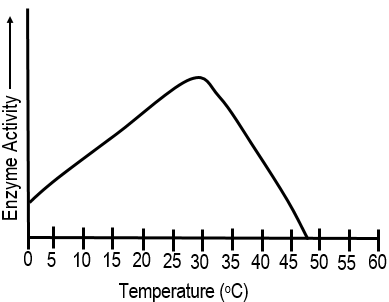
Based on the graph, what is the optimal temperature for this enzyme? 
a)
15oC
b)
40oC
c)
30oC
d)
35oC
6.

What is a substance called if it speeds up a chemical reaction?

a)

reusable

b)

catalyst

c)

specific

d)

fragile

7.
Which of these is NOT true?
a)
Enzymes can denature (change shape) when the temperature gets too high.
b)
Enzymes can only be used once in a chemical reaction. 
c)
Extreme pH can denature enzymes.
d)
Enzymes speed up chemical reactions. 
8.
What makes an enzyme substrate specific?
a)
Size
b)
Shape
c)
Name
d)
Location it is found in
9.
What is the name for the mechanism of enzyme activity?
a)
Lock and key
b)
jigsaw puzzle
c)
hammer and nail
d)
two hands pattern
10.
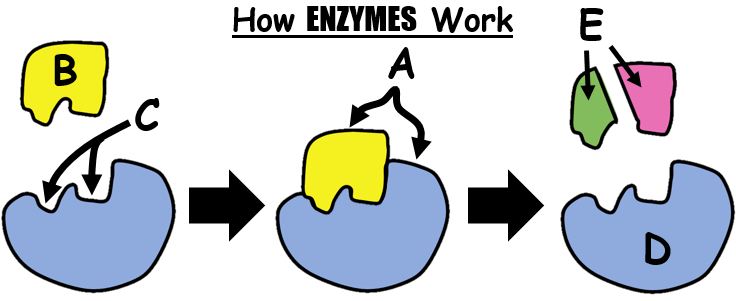
In the diagram, what is letter A? 
a)
product
b)
substrate
c)
enzyme-substrate complex
d)
active site
11.
What is another name for enzymes?
a)
chemical catalysts
b)
microorganisms
c)
biological catalysts
d)
inorganic catalysts
12.

Can a change in pH alter the active site of an enzyme

a)

yes

b)

no

13.
Where do substrates bind on an enzyme?
a)
voltage-gated channels
b)
surface receptor
c)
calcium channels
d)

None of the above

14.
What happens when enzymes are heated to a high temperature?
a)
The enzymes die.
b)
The shapes of the enzyme are altered denature
c)
The enzymes' amino acid sequence changes.
d)
The enzymes remain the same
15.
With what 3 letters do enzymes typically end?
a)
-ose
b)
-ase
c)
-ese
d)
-tic
16.
What is another name for enzymes?
a)
chemical catalysts
b)
microorganisms
c)
biological catalysts
d)
inorganic catalysts
17.

Can a change in pH alter the active site of an enzyme

a)

yes

b)

no

18.

The enzyme and substrates have

a)

adverse shapes

b)

complementary shapes

c)

contrary shapes

d)

similar shapes

19.

Enzymes are what macromolecule?

a)

Nucleic Acid

b)

Lipid

c)

Protein

d)

Carbohydrate

20.
Which of these is most likely an enzyme?  
a)
Sucrose
b)
Galactose
c)
Fructose
d)

Dehydrogenase