
 Worksheets
CSA #3 Earth Space
Total questions: 44
Worksheet time: 22mins
Which phase of the moon comes right after the new moon?
Waxing Crescent
First Quarter
Full Moon
Waning Crescent
How many days are in a typical lunar month?
29.5 days
30 days
28 days
31 days
5.10 Earth experiences different seasons throughout the year. Which of the following best explains the primary reason for this phenomenon?
Earth’s distance from the Sun changes significantly during its orbit, causing seasons.
The axial tilt of Earth as it orbits the Sun results in varying angles of sunlight, leading to seasons.
Seasonal changes are due to the varying amounts of solar radiation received at different latitudes.
The presence of clouds and atmospheric conditions primarily determine the seasonal changes.
What natural phenomenon is primarily responsible for the rise and fall of ocean tides?
Earth’s rotation
The Sun’s gravitational pull
Earth’s magnetic field
The Moon’s gravitational pull
What must be true for a lunar eclipse to occur?
The Earth must be directly between the Sun and the Moon.
The Moon must be directly between the Sun and the Earth.
The Sun must be directly between the Earth and the Moon.
The Earth must be at a right angle to the Sun and the Moon.
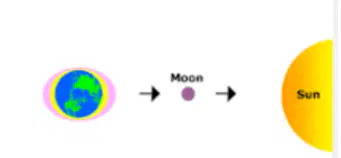
What type of tide occurs when the Sun, Earth, and Moon are aligned in a straight line?
Neap Tide
Spring Tide
High Tide
Low Tide
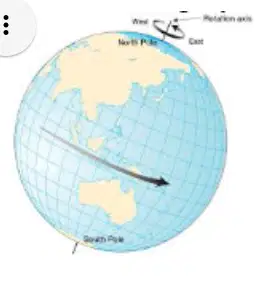
What is the term for Earth's movement that results in day and night?
Orbit
Period of Revolution
Period of Rotation
Season
Which natural cycle takes approximately 29.5 days to complete?
One Full Year
Day and Night
Lunar Phases
Seasons
Some constellations visible in the night sky change with the seasons. What is the primary reason for this change?
The constellations move around the Earth
The Earth spins on its axis
The Earth orbits around the Sun
The constellations are drifting away from the Earth
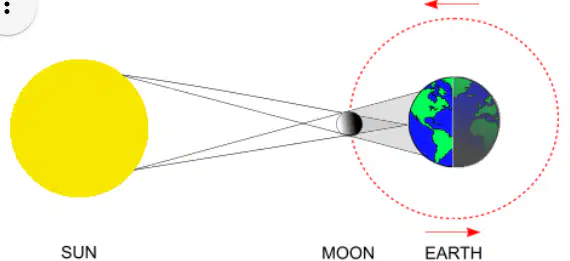
Why is a solar eclipse only possible during a new moon phase?
During a new moon, the Sun, Moon, and Earth are aligned, allowing the Moon to block the Sun.
During a new moon, the Sun, Moon, and Earth form a 90-degree angle, allowing the Moon to block the Sun.
During a new moon, the Sun, Moon, and Earth are aligned, allowing the Sun to block the Moon.
During a new moon, the Sun, Moon, and Earth form a 90-degree angle, allowing the Sun to block the Moon.
Which sequence correctly represents the phases of the moon starting from the New Moon?
New Moon -> Full Moon -> First Quarter -> Third Quarter
New Moon -> First Quarter -> Third Quarter -> Full Moon
New Moon -> First Quarter -> Full Moon -> Third Quarter
New Moon -> Third Quarter -> First Quarter -> Full Moon
When the Earth's shadow falls on the Moon, a(n) ________________ is occurring.
lunar eclipse
solar eclipse
equinox
solstice
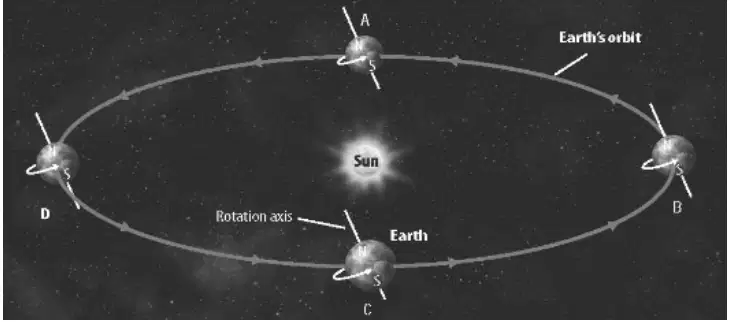
5.10 In the image below, what season is the Southern Hemisphere experiencing at point A?
Winter
Spring
Summer
Fall
Which of the following is NOT caused by the Moon's gravitational influence?
ocean tides
phases of the Moon
eclipses
seasonal changes
If Earth's axial tilt were significantly increased, what would be the most likely effect on the planet?
Seasons would become more extreme.
The length of a year would change.
The moon would move farther away.
Earth's rotation speed would increase.
When the north end of Earth's rotation axis is tilted toward the Sun, which of the following is correct?
The northern hemisphere experiences longer days.
The southern hemisphere experiences longer days.
The northern hemisphere experiences shorter days.
The southern hemisphere experiences shorter days.
Which characteristic is shared by all terrestrial planets?
They have rings.
They are primarily composed of gases.
They have a rocky surface.
They all have moons.
According to the Law of Universal Gravitation, how would the gravitational force change if the distance between the Moon and Earth increased and the Moon's mass decreased?
The gravitational force would decrease due to increased distance and decrease further due to smaller mass
The gravitational force would increase due to increased distance then decrease due to smaller mass
The gravitational force would decrease due to increased distance then increase due to smaller mass
The gravitational force would increase due to increased distance and increase due to smaller mass
The inner terrestrial planets are known for their solid, rocky surfaces and metallic cores. In contrast, the outer planets are often referred to as gas giants due to their thick, gaseous atmospheres. Despite these differences, what is one characteristic that all these planets share?
They all have rings.
They all orbit the Sun.
They all have active volcanoes.
They all have atmospheres.
What causes the Earth to orbit around the Sun?
The gravitational pull of the Moon
The gravitational forces of nearby planets
The combined gravitational forces of Earth, Venus, and Mars
The Sun’s gravitational attraction on Earth
Which characteristic is shared by all terrestrial planets?
They have similar magnetic fields.
They all have moons.
They have a rocky surface.
They are all the same distance from the Sun.
What are the small, rocky objects found primarily in the asteroid belt between Mars and Jupiter?
Comets
Planets
Meteors
Asteroids
Which of the following sequences correctly lists the planets in order of their distance from the Sun?
Mercury, Venus, Earth, Mars
Earth, Mars, Jupiter, Saturn
Venus, Earth, Mars, Jupiter
Mars, Jupiter, Saturn, Uranus
Hillary is learning about Kepler's laws of planetary motion. She discovers that planets move in elliptical orbits around the Sun. Which statement best describes the reason for this orbital motion?
The magnetic force of the Sun pulls the planets into their orbits.
The gravitational pull of the Sun keeps the planets in their orbits.
The planets' inertia keeps them moving in their orbits.
The interaction between the planets' forces maintains their orbits.
Why does Mercury have a more heavily cratered surface compared to Earth?
Mercury has a faster orbital speed than Earth.
Mercury has less geological activity than Earth.
Mercury has a stronger magnetic field than Earth.
Mercury is farther from the Sun than Earth.
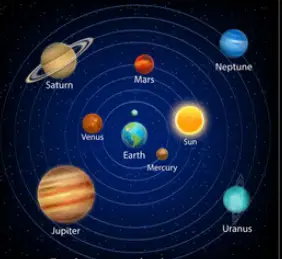
Which model of the solar system places the Earth at the center?
Heliocentric
Biocentric
Starcentric
Geocentric
Why does Saturn take 29.4 Earth years to complete one orbit around the Sun?
Saturn's large size causes it to move very slowly.
The great distance between Saturn and the Sun results in a longer orbital path.
Jupiter's gravitational pull slows down Saturn's orbit.
Saturn's slow rotation on its axis affects its orbital speed.
Which planetary model accurately predicts the positions of planets over long periods?
The planets' orbits are circles in a heliocentric model.
The planets' orbits are ellipses in a geocentric model.
The planets' orbits are ellipses in a heliocentric model.
The planets' orbits are circles in a geocentric model.
The Sun is located at the center of which of the following?
Our solar system
The universe
A star cluster
The Milky Way galaxy
What principle explains that every mass exerts an attractive force on every other mass?
Law of Universal Gravitation
Newton's Second Law
Newton's First Law of Motion
Centripetal Force
In which model is the Earth at the center of the universe, with the Sun, stars, and planets orbiting around it?
tetrahedral model
heliocentric model
concentric model
geocentric model
5.3 Copernicus, an early astronomer, developed a model of the solar system. Why are models important for scientists studying the solar system?
Models cannot accurately represent the solar system.
The solar system is too vast to study directly, and models help in its analysis.
The solar system is very small, and models make it easier to study.
Models are not useful for representing the solar system.
What is the significance of a Light Year?
The brightness of a star as seen from Earth.
The distance that light travels in one year.
The time it takes for light to travel from the Sun to the Moon.
The average distance between the Earth and the Moon.
An Astronomical Unit (AU) is the average distance between which two celestial bodies?
Earth and Mars
Sun and Venus
Sun and Earth
Earth and Saturn
What two factors determine the gravitational force between two objects?
mass and distance
volume and density
state of matter and volume
distance and density
Which of the following is a correct statement about the universe?
The universe contains millions of galaxies which contain millions of stars.
One galaxy contains billions of stars.
The solar system contains millions of stars.
The universe contains billions of stars which contain billions of galaxies.
What is the most appropriate unit of measurement for distances between planets in our solar system?
Kilometers
Light Years
Parsecs
Astronomical Units
5.4 Arrange these celestial bodies from largest to smallest.
Universe, galaxy, solar system, planets
Galaxy, universe, solar system, planets
Planets, galaxy, solar system, universe
Solar system, universe, galaxy, planets
5.3 What are the main components of galaxies?
Only Stars
Stars and Planets
Stars, Planets, and Moons
Stars, Dust, and Gas held together by gravity
Which of the following statements accurately describes the scale of celestial objects in our galaxy?
The Sun is the largest star in the Milky Way.
Jupiter is smaller than Earth.
The Milky Way contains billions of stars.
The distance between Earth and Mars is greater than the distance between Earth and the Sun.
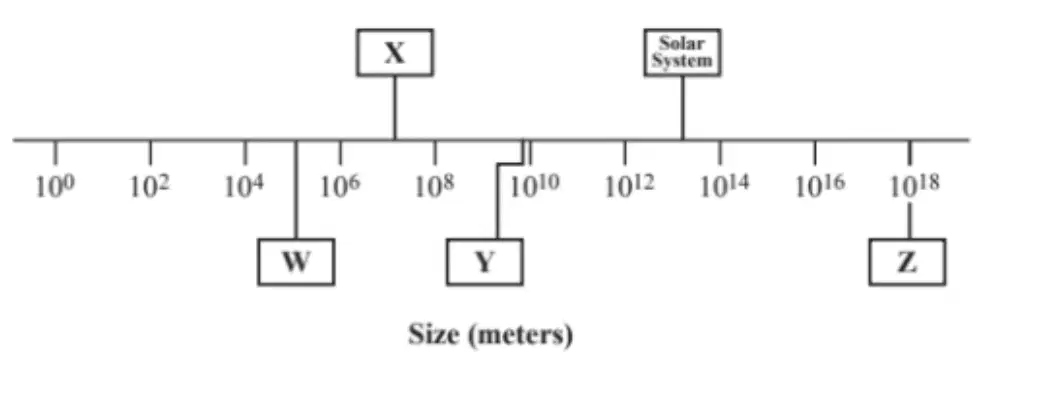
5.4 The points labeled on the number line below represent the approximate size of Mars, the Andromeda Galaxy, the Moon, and the Sun. The approximate size of the Solar System is also shown. Which point on the number line best represents Mars?
A
B
C
D
Why is it beneficial to place an optical telescope in space?
a. To avoid atmospheric distortion.
b. To get closer to the stars.
c. To reduce the gravitational pull on the telescope.
d. To avoid interference from Earth's magnetic field.
Which of the following space exploration technologies is primarily used for scientific research and not for transporting humans?
space shuttle
space station
space probe
rocket
Which type of space exploration technology is designed to traverse the surface of planets like Mars?
rover
shuttle
satellite
space probe

